Safety Helmet Market Size, Share & Industry Analysis, By Material (Polyethylene, Acrylonitrile Butadiene Styrene, Polycarbonate), By Product (Hard Hats, Bump Caps), By End-use, and Regional Forecast, 2026-2034
 Download Free Sample
Safety Helmet Market Size & Industry Overview
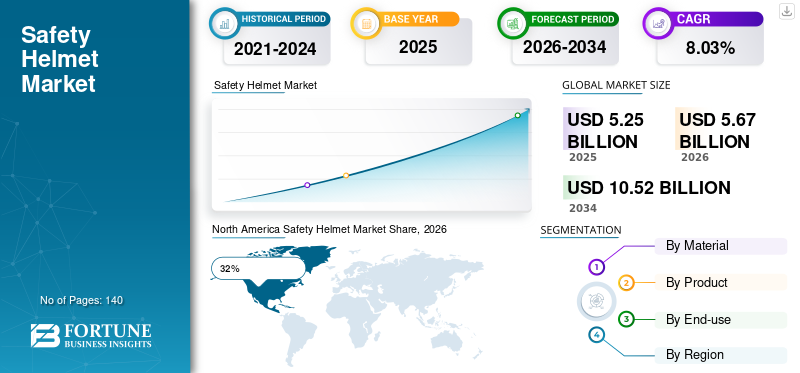
The global safety helmet market size was valued at USD 5.25 billion in 2025. The market is projected to grow from USD 5.67 billion in 2026 to USD 10.52 billion by 2034, exhibiting a CAGR of 8.03% during the forecast period.

The safety helmet market is experiencing strong demand across construction, mining, oil and gas, manufacturing, transportation, and infrastructure sectors due to growing workplace safety compliance requirements and industrial modernization. safety helmet market analysis indicates that industrial employers are prioritizing employee protection equipment to reduce workplace injuries and improve operational efficiency. Advanced helmet materials, lightweight designs, impact resistance technologies, and integrated communication systems are reshaping product development strategies. safety helmet market trends also show increasing adoption of smart helmets equipped with sensors, thermal imaging, and real-time monitoring features. Rapid industrialization, strict occupational safety standards, and rising awareness regarding head injury prevention continue to strengthen the global Safety Helmet Industry Report outlook.
The U.S. safety helmet market is witnessing consistent growth due to large-scale construction activities, energy sector expansion, and stringent worker safety regulations across industrial workplaces. safety helmet market research report findings highlight increasing demand from logistics warehouses, road infrastructure projects, chemical plants, and utility services. Employers in the United States are focusing on advanced protective equipment with enhanced comfort, ventilation, and long-duration U.S.bility for workers. The growing adoption of connected safety equipment and wearable technologies is also supporting product innovation. The U.S. accounts for nearly 28% of the North American safety helmet market share due to strong industrial safety investments and modernization of occupational safety infrastructure.
Download Free sample to learn more about this report.
Safety Helmet Market Key Takeaways
 Global Market Size & Forecast
- 2025 Market Size: USD 5.25 Billion
- 2026 Market Size: USD 5.67 Billion
- 2034 Forecast Market Size: USD 10.52 Billion
- CAGR: 8.03% from 2026-2034
 Market Share
- North America dominated with a regional market share of 32% in 2025.
- Polycarbonate safety helmets led by material with approximately 35% market share.
- Hard hats led by product with approximately 79% market share.
 Key Regional Highlights
North America
North America held the largest regional share at 32% of the global market.
Asia-Pacific
Asia-Pacific accounted for 30% of the global market, driven by industrialization and construction activity.
Europe
Europe represented 22% of the global market, supported by workplace safety regulations and industrial demand.
U.S
The U.S. remains a major market, supported by stringent workplace safety standards and construction activity.
Japan
Japan accounted for 11% of the Asia-Pacific market, supported by advanced industrial infrastructure and strong occupational safety practices.
Read More

safety helmet market Latest Trends
The safety helmet market is undergoing significant transformation due to technological integration and evolving workplace safety expectations. One major safety helmet market Trend is the increasing demand for smart safety helmets integrated with GPS tracking, impact detection, communication systems, and augmented reality capabilities. Industrial companies are deploying these advanced helmets to improve worker monitoring, emergency response, and site productivity. Manufacturers are also investing heavily in lightweight materials such as polycarbonate composites and advanced ABS structures to enhance durability while reducing user fatigue during extended industrial operations.
Download Free sample to learn more about this report.
Another important safety helmet market Insight involves the growing focus on sustainability and customization. Helmet manufacturers are developing eco-friendly production methods and recyclable materials to meet environmental compliance goals. Safety Helmet Industry Analysis also reveals rising demand for sector-specific helmet designs tailored for mining, construction, firefighting, electrical maintenance, and logistics operations. Ventilated helmets with anti-fog face shields and ergonomic suspension systems are becoming standard features in premium industrial protective equipment. E-commerce distribution channels, direct industrial procurement partnerships, and digital safety equipment platforms are further expanding global market accessibility and strengthening competitive positioning among manufacturers.
safety helmet market Dynamics
DRIVER
Increasing Industrial Safety Regulations and Infrastructure Development Projects.
The safety helmet market growth is being strongly driven by strict workplace safety standards implemented across industrial economies. Governments and labor organizations are introducing mandatory protective equipment regulations to minimize occupational injuries and fatalities in construction, mining, oil and gas, chemical manufacturing, and transportation industries. Rapid expansion of commercial infrastructure projects, smart cities, highways, metro rail systems, and industrial facilities is increasing the need for certified protective headgear. safety helmet market forecast studies indicate that industrial employers are allocating higher budgets toward employee safety programs to comply with international safety certifications and operational risk reduction targets.
The expansion of renewable energy projects, warehousing facilities, and manufacturing plants is also generating substantial demand for protective equipment. In addition, increasing awareness among workers regarding head injury prevention is encouraging adoption of premium-quality helmets with improved comfort and impact resistance. Technological innovations such as smart communication-enabled helmets and sensor-based monitoring systems are further contributing to safety helmet market opportunities across both developed and emerging economies.
RESTRAINT
Fluctuating Raw Material Prices and Counterfeit Product Penetration.
The safety helmet market faces significant restraints due to volatility in raw material costs, particularly for polymers, ABS compounds, polycarbonate materials, and industrial-grade plastics used in helmet manufacturing. Rising transportation expenses, energy costs, and supply chain disruptions are affecting production efficiency and pricing strategies for manufacturers. Smaller companies often struggle to maintain competitive pricing while meeting international quality certification requirements, limiting profitability and expansion potential.
Another major challenge within the Safety Helmet Industry Report is the increasing availability of low-cost counterfeit products in developing regions. Many unorganized manufacturers supply substandard helmets that fail to meet industrial safety regulations, creating pricing pressure for established companies. safety helmet market analysis further indicates that limited awareness regarding certified protective equipment in certain regions negatively affects adoption of premium products. Delayed replacement cycles among industrial users and cost-sensitive procurement practices in small-scale industries also reduce demand for technologically advanced safety helmets.
OPPORTUNITY
Growing Adoption of Smart Helmets and Connected Worker Technologies.
The integration of digital technologies presents substantial safety helmet market opportunities for manufacturers and industrial safety solution providers. Smart helmets equipped with IoT sensors, wireless communication systems, thermal monitoring, fatigue detection, and augmented reality displays are gaining traction in hazardous industrial environments. These advanced systems help employers improve worker productivity, site surveillance, emergency response coordination, and operational efficiency.
safety helmet market research report findings suggest strong future demand from sectors such as oil and gas, utilities, renewable energy, logistics, and defense operations where real-time worker monitoring is critical. Emerging economies are also investing heavily in industrial modernization and smart factory infrastructure, creating additional growth avenues for connected protective equipment. Manufacturers are collaborating with software developers and industrial automation companies to introduce integrated safety ecosystems. The increasing popularity of lightweight customizable helmets with ventilation systems, face protection modules, and communication accessories is expected to generate further expansion opportunities within the global safety helmet market Outlook.
CHALLENGE
Maintaining Compliance with Evolving Safety Certifications and Standards.
One of the major challenges within the safety helmet market is the continuous evolution of industrial safety standards across different countries and industries. Manufacturers must regularly upgrade product designs, testing procedures, and material technologies to comply with changing certification requirements. This process increases research and development expenses, operational complexity, and production timelines. Companies operating internationally often face difficulties managing multiple regional compliance frameworks and import regulations.
Another critical challenge involves balancing product durability, comfort, and affordability. Industrial workers increasingly demand lightweight helmets with enhanced ergonomic features, ventilation systems, and communication compatibility. However, integrating these features while maintaining impact resistance and cost competitiveness requires advanced engineering capabilities. safety helmet market insights also reveal that intense competition among regional and international manufacturers is creating pricing pressure and reducing margins. Supply chain uncertainties, labor shortages, and dependence on petroleum-based raw materials further complicate long-term operational planning for helmet manufacturers worldwide.
safety helmet market Segmentation
By Material
Polyethylene safety helmets hold approximately 34% of the global safety helmet market share due to their affordability, lightweight structure, and widespread use in construction and general industrial applications. These helmets are commonly utilized across infrastructure projects, logistics operations, utility maintenance, and municipal services where cost-effective head protection is required. Polyethylene helmets provide good impact resistance and electrical insulation properties, making them suitable for diverse industrial environments. safety helmet market trends indicate rising adoption of high-density polyethylene helmets with improved ventilation systems and adjustable suspension mechanisms. Manufacturers are introducing enhanced UV-resistant coatings and ergonomic designs to increase worker comfort during long-duration operations.
ABS safety helmets account for nearly 31% of the safety helmet market size due to their superior toughness, chemical resistance, and enhanced durability. These helmets are widely used in mining, heavy manufacturing, oil and gas operations, and transportation industries where workers are exposed to high-impact risks and hazardous environments. ABS material offers excellent balance between strength and flexibility, making it suitable for challenging industrial applications. safety helmet market analysis shows increasing demand for ABS helmets with integrated face shields, earmuffs, communication accessories, and anti-static properties.
Polycarbonate safety helmets represent around 35% of the global safety helmet market share and are rapidly gaining popularity due to their premium impact resistance, transparency options, and lightweight properties. These helmets are extensively used in high-risk industries such as petrochemicals, firefighting, defense, advanced manufacturing, and renewable energy operations. Polycarbonate materials provide excellent durability while maintaining user comfort during prolonged industrial tasks. Safety Helmet Industry Analysis highlights strong growth in demand for technologically advanced polycarbonate helmets integrated with communication systems, thermal imaging, augmented reality displays, and smart monitoring sensors.
To know how our report can help streamline your business, Speak to Analyst
By Product
Hard hats dominate the safety helmet market with nearly 79% market share due to extensive adoption across construction, mining, manufacturing, oil and gas, transportation, and infrastructure sectors. These helmets are designed to provide maximum protection against falling objects, electrical hazards, and workplace impacts. Governments and industrial employers continue to enforce mandatory hard hat regulations across hazardous work environments, supporting sustained demand growth. safety helmet market forecast studies indicate increasing preference for hard hats featuring lightweight structures, improved suspension systems, moisture-resistant liners, and integrated accessory compatibility.
Bump caps account for approximately 21% of the safety helmet market share and are primarily used in low-risk environments such as warehousing, logistics, automotive maintenance, food processing, and light manufacturing operations. These protective caps are designed to safeguard workers against minor head injuries caused by accidental bumps, scrapes, and contact with fixed objects. Their lightweight design and casual appearance improve user acceptance among workers who may not require heavy-duty industrial helmets. safety helmet market insights reveal growing adoption of bump caps in e-commerce fulfillment centers, retail warehouses, aviation maintenance facilities, and transportation hubs. Employers are increasingly implementing bump caps as part of workplace injury prevention programs to minimize compensation claims and improve occupational safety compliance.
By End-use
The construction industry represents one of the largest end-use segments in the safety helmet market due to the high risk of head injuries caused by falling objects, heavy machinery operations, and elevated work environments. Construction companies are increasingly investing in advanced protective equipment to comply with occupational safety regulations and improve workforce protection standards. safety helmet market analysis shows that urban infrastructure expansion, commercial real estate development, bridge construction, smart city projects, and transportation infrastructure investments are driving strong demand for industrial safety helmets across global construction sites. Modern construction safety helmets are designed with lightweight materials, improved ventilation systems, sweat-resistant liners, and impact-resistant shells to enhance worker comfort during long operational hours. Smart helmets integrated with communication devices, sensors, and GPS tracking are also gaining popularity in large-scale construction projects to improve worker monitoring and emergency response coordination. safety helmet market trends further indicate rising demand for customized hard hats featuring company branding, face protection accessories, and integrated lighting systems.
safety helmet market Regional Outlook
North America Safety Helmet Market Share, 2026 (%)
To get more information on the regional analysis of this market, Download Free sample
North America
North America holds approximately 32% of the global safety helmet market share due to strict occupational safety regulations, strong industrial infrastructure, and widespread adoption of advanced worker protection systems. The region benefits from high demand across construction, oil and gas, renewable energy, mining, utilities, and transportation industries. Industrial employers are investing heavily in premium safety equipment to reduce workplace accidents and improve operational efficiency. The increasing use of smart helmets integrated with communication systems and IoT technologies is further accelerating market expansion.
safety helmet market research report findings indicate that the United States and Canada are prioritizing modernization of industrial safety standards across public infrastructure and manufacturing projects. Demand for lightweight polycarbonate and ABS helmets is increasing among industrial contractors and utility operators. The region also has a strong presence of leading safety equipment manufacturers investing in advanced research and product innovation. Rising warehouse automation, logistics development, and renewable energy infrastructure projects continue to create strong demand for certified industrial protective headgear across North America.
Europe
Europe represents nearly 27% of the global safety helmet market size due to stringent workplace safety regulations and strong industrial compliance standards. Countries across the region emphasize worker welfare and industrial risk reduction, driving continuous investment in advanced protective equipment. Construction modernization, railway development, renewable energy installations, and manufacturing upgrades are major demand contributors. European industrial employers are increasingly adopting ergonomic helmets with integrated face protection, ventilation systems, and smart monitoring features.
safety helmet market Outlook for Europe also highlights rising demand for environmentally sustainable helmet manufacturing and recyclable protective materials. Regional manufacturers are focusing on lightweight designs, improved comfort, and customizable industrial solutions to strengthen competitive positioning. Growth in warehousing, automotive production, and offshore wind energy projects is further supporting market demand. Technological collaboration between industrial safety equipment companies and automation providers continues to drive innovation within the European Safety Helmet Industry Report landscape.
Germany safety helmet market
Germany accounts for nearly 29% of the European safety helmet market share due to its highly developed manufacturing, automotive, engineering, and industrial construction sectors. The country maintains strict occupational safety regulations that require certified protective equipment across industrial workplaces. German employers prioritize premium-quality safety helmets with advanced comfort features, thermal resistance, and integrated communication systems for high-risk industrial operations.
safety helmet market analysis in Germany indicates strong demand from automotive production facilities, logistics centers, railway infrastructure projects, and renewable energy installations. Industrial companies are increasingly investing in connected worker technologies and wearable safety systems to improve operational efficiency and employee protection. Demand for polycarbonate and ABS helmets is growing due to their durability and compatibility with smart industrial applications. Germany’s focus on industrial automation and worker safety modernization continues to support long-term expansion within the safety helmet market.
United Kingdom safety helmet market
The United Kingdom contributes approximately 22% of the European safety helmet market share due to ongoing infrastructure development, urban construction activities, and industrial safety compliance programs. The country has strong demand for protective headgear across construction, transportation, utilities, and offshore energy sectors. Employers are emphasizing advanced worker safety solutions to reduce workplace incidents and improve regulatory compliance performance.
safety helmet market trends in the United Kingdom highlight growing adoption of lightweight ventilated helmets designed for long-duration usage and improved worker comfort. Smart helmets integrated with communication systems and visibility-enhancing technologies are increasingly being used in construction megaprojects and energy operations. The expansion of logistics hubs, warehousing infrastructure, and transportation modernization initiatives is further contributing to demand growth. Industrial safety awareness campaigns and stricter workplace inspection procedures continue to strengthen the UK safety helmet market Outlook.
Asia-Pacific
Asia-Pacific dominates global industrial expansion and holds around 30% of the safety helmet market share due to rapid urbanization, infrastructure development, manufacturing growth, and increasing worker safety awareness. Countries across the region are investing heavily in highways, airports, railways, industrial parks, mining operations, and energy projects. The growing industrial workforce and stricter occupational safety regulations are significantly increasing demand for certified safety helmets.
safety helmet market opportunities in Asia-Pacific are supported by rising investments in manufacturing automation, smart factories, logistics infrastructure, and renewable energy development. Construction contractors and industrial employers are increasingly adopting durable polyethylene, ABS, and polycarbonate helmets to improve worker protection standards. Regional manufacturers are also expanding production capacity to meet large-scale industrial procurement requirements. Government initiatives promoting industrial safety compliance and workplace modernization are expected to drive long-term safety helmet market growth throughout Asia-Pacific.
Japan safety helmet market
Japan represents nearly 11% of the Asia-Pacific safety helmet market share due to its advanced manufacturing sector, strict industrial safety culture, and focus on technological innovation. The country has strong demand for high-performance safety helmets used in automotive manufacturing, electronics production, construction engineering, and disaster response operations. Japanese employers emphasize precision-engineered protective equipment with superior comfort, lightweight construction, and advanced durability.
safety helmet market insights indicate increasing adoption of smart helmets integrated with augmented reality, communication systems, and real-time worker monitoring technologies in Japan. Industrial automation and robotics expansion are creating new opportunities for technologically advanced protective equipment. Demand for polycarbonate helmets with anti-fog visors and thermal protection features is rising across industrial workplaces. Japan’s aging workforce is also encouraging development of ergonomic safety equipment designed to reduce fatigue and improve operational efficiency.
China safety helmet market
China accounts for approximately 8% of the Asia-Pacific safety helmet market share due to its massive construction industry, manufacturing dominance, and extensive infrastructure development projects. Large-scale industrial operations across mining, transportation, shipbuilding, logistics, and energy sectors continue to generate substantial demand for safety helmets. Government enforcement of workplace safety regulations and industrial modernization initiatives is further supporting market expansion.
safety helmet market forecast studies show strong growth in demand for affordable yet durable industrial protective equipment across China’s manufacturing and construction sectors. Domestic manufacturers are rapidly increasing production capabilities and introducing technologically enhanced helmet models with integrated communication and monitoring systems. Infrastructure megaprojects, renewable energy facilities, and urban development initiatives remain major demand drivers. China’s expanding export-oriented industrial sector continues to strengthen its position within the global Safety Helmet Industry Analysis landscape.
Rest of World
The Rest of World region holds nearly 11% of the global safety helmet market share, supported by expanding industrialization, mining activities, infrastructure development, and energy sector investments across Latin America, the Middle East, and Africa. Governments in these regions are increasingly implementing worker safety regulations and promoting occupational safety awareness programs to reduce industrial accident rates.
safety helmet market trends indicate rising demand for cost-effective protective headgear across oil and gas facilities, mining operations, transportation projects, and utility infrastructure developments. Construction activities associated with urban expansion and commercial real estate growth are also contributing to market demand. International manufacturers are expanding distribution partnerships and regional production capabilities to strengthen market presence. Growing foreign investments in industrial development and energy infrastructure are expected to create additional safety helmet market opportunities throughout emerging economies.
List of Top Safety Helmet Companies
- Delta Plus Group
- Bullard
- PIP
- 3M
- MSA Safety
- JSP Ltd.
- Polison Corporation
- Drägerwerk AG & Co. KGaA
- uvex group
- Centurion Safety Products Ltd
- Portwest UC
- Parkson Safety Industrial Corp
- MALLCOM INDIA LIMITED
- JI Safety
- Dursafety Inc.
Top Two Companies by Market Share
- 3M – 14% market share
- MSA Safety – 11% market share
Investment Analysis and Opportunities
The safety helmet market is attracting substantial investments due to rising workplace safety requirements and industrial modernization initiatives. Governments and private organizations are increasing funding for infrastructure development, smart manufacturing facilities, renewable energy projects, and transportation systems, all of which require advanced worker protection equipment. Investors are focusing on manufacturers developing smart helmets integrated with IoT sensors, augmented reality displays, communication systems, and environmental monitoring technologies.
safety helmet market opportunities are also expanding through mergers, acquisitions, and strategic partnerships among industrial safety equipment providers. Companies are investing in automated production facilities, sustainable materials, and lightweight helmet technologies to improve profitability and market competitiveness. Emerging economies present strong investment potential due to rapid industrialization and stricter labor safety regulations. Expansion of e-commerce industrial procurement channels and direct corporate safety contracts is enabling manufacturers to reach wider customer bases.
New Product Development
Innovation within the safety helmet market is accelerating as manufacturers focus on advanced protective technologies, ergonomic designs, and connected safety systems. New product development strategies are centered around lightweight materials, improved ventilation systems, anti-fog visors, modular accessories, and integrated communication solutions. Smart helmets equipped with GPS tracking, fatigue monitoring sensors, thermal imaging, and augmented reality displays are becoming increasingly popular in construction, mining, and oil and gas industries.
safety helmet market research report findings indicate growing demand for customizable helmets designed for specific industrial environments. Manufacturers are introducing helmets with enhanced electrical insulation, heat resistance, chemical protection, and impact absorption capabilities. Sustainable manufacturing methods and recyclable helmet materials are also emerging as important innovation areas due to environmental compliance goals. Companies are further investing in digital safety ecosystems that connect helmets with centralized workplace monitoring platforms.
Five Recent Developments (2023-2025)
- 3M introduced advanced smart industrial safety helmets with integrated communication and worker monitoring systems in 2024.
- MSA Safety expanded production capacity for lightweight polycarbonate safety helmets to support infrastructure and mining sector demand in 2023.
- Delta Plus Group launched sustainable safety helmet models manufactured using recyclable industrial materials in 2025.
- Bullard developed enhanced thermal-resistant helmets designed for firefighting and high-temperature industrial operations in 2024.
- JSP Ltd. introduced next-generation ventilated hard hats with improved ergonomic suspension systems for construction workers in 2025.
Report Coverage
The safety helmet market Report provides comprehensive analysis of industry trends, market dynamics, product innovations, regional developments, competitive landscape, and industrial safety regulations affecting global demand. The report evaluates key growth drivers including infrastructure expansion, industrial modernization, worker safety compliance, and adoption of connected protective equipment technologies. It also examines challenges related to raw material pricing, counterfeit products, and evolving certification standards.
Request for Customization to gain extensive market insights.
safety helmet market analysis within the report covers segmentation by type, application, material technology, and regional demand patterns. Detailed insights regarding polyethylene, ABS, and polycarbonate helmet categories are included alongside evaluation of hard hats and bump caps applications. The report further profiles major manufacturers, investment strategies, production developments, and new product launches shaping industry competition. Regional analysis covers North America, Europe, Asia-Pacific, and Rest of World markets with country-level insights for major industrial economies. safety helmet market forecast evaluations highlight future opportunities linked to smart industrial safety technologies, renewable energy infrastructure, and workplace automation trends.
Frequently Asked Questions
Fortune Business Insights says that the global market value stood at USD 5.25 billion in 2025 and is projected to reach USD 10.52 billion by 2034.
The market is expected to exhibit a CAGR of 8.03% during the forecast period of 2026-2034.
Hard hats were the leading product segment, accounting for nearly 79% of the market, driven by extensive adoption across construction, mining, manufacturing, oil and gas, transportation, and infrastructure.
Key players include 3M, MSA Safety, Delta Plus Group, Bullard, PIP, and JSP Ltd.
Major trends include rising adoption of smart helmets with GPS, impact detection, communication, and augmented reality and growing demand for lightweight, sustainable, and customizable helmets. North America leads with approximately 32% market share, supported by strict occupational safety regulations and strong industrial infrastructure.



- 2021-2034
- 2025
- 2021-2024
- 140
-

(Offer valid till 15th Sep 2026)
Get 30-60 hrs Free Customization
Expand Regional and Country Coverage, Segments Analysis, Company Profiles, Competitive Benchmarking, and End-user Insights.



















-
US +1 833 909 2966 ( Toll Free )
-
Get In Touch With Us