Sailboat Market Size, Share & Industry Analysis, By Type (Dinghies and Keelboats / Yacht-type Sailboats), By Hull (Monohull, Catamaran and Others), By Length (Less than 30 feet, 30-45 Feet, More than 45 feet, and Others), By Application (Private / Recreational, Charter, Racing, and Institutional / Training) and Regional Forecast, 2026-2034
 Download Free Sample
(Offer valid till 30th Sep 2026)

Sailboat Market Size & Overview
 Listen to Audio Version
The global sailboat market size was valued at USD 4.08 billion in 2025 and is projected to grow from USD 4.26 billion in 2026 to USD 5.98 billion by 2034, exhibiting a CAGR of 4.3% during the forecast period. Asia Pacific dominated the global sailboat market with a market share of 39.22% in 2025.
The sailboat market represents the global commercial environment associated with the manufacturing and sale of sail-powered vessels primarily used for recreational activities, sports, training, and tourism. Sailboats are distinct from other marine vessels due to their reliance on wind-based propulsion systems, which positions them as both environmentally responsible and experience-driven assets. Over time, sailing as a leisure activity has evolved from a niche pursuit into a structured lifestyle segment supported by marinas, charter services, and sailing institutions.
The sailboat industry benefits from strong emotional and experiential appeal, particularly among consumers seeking outdoor leisure and long-duration recreational engagement. Growth is closely tied to rising disposable income, especially in coastal economies, and an increasing number of high net worth individuals investing in premium leisure assets. The market also benefits from an increased interest in sustainable tourism and water-based sports, which supports steady demand for new sailboats.
Product innovation plays a central role in market expansion. Manufacturers are increasingly focusing on eco-friendly and technologically advanced designs, including lightweight hull materials, smart navigation systems, and improved onboard energy management. These technological advancements enhance safety, usability, and comfort, influencing evolving consumer preferences toward modern and customizable sailboats.
During the forecast period, market growth is expected to remain stable rather than explosive, reflecting the discretionary nature of sailboat purchases. However, infrastructure development and sailing awareness in emerging market regions are gradually broadening the addressable customer base. Applications such as private ownership, charter operations, racing, and institutional training collectively support long-term market sustainability. Despite cost-related constraints, the market continues to demonstrate resilience as a premium leisure segment rooted in lifestyle, sustainability, and performance.
Key players such as Group Beneteau, Fountaine Pajot and Hallbery-Rassy are focusing on design innovation, material advancements, and customization to attract both recreational and competitive sailing customers.
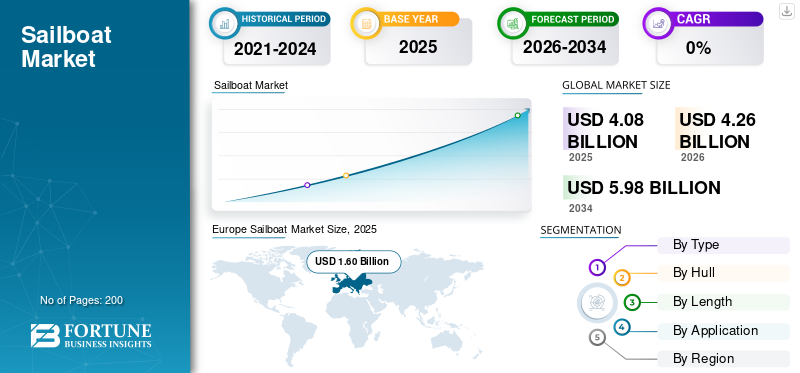
Download Free sample to learn more about this report.
SAILBOAT MARKET KEY TAKEAWAYS
 Market Size & Forecast
- 2025 Market Size: USD 4.08 Billion
- 2026 Market Size: USD 4.26 Billion
- 2034 Forecast Market Size: USD 5.98 Billion
- CAGR: 4.3% from 2026–2034
 Market Share
- Asia Pacific dominated the sailboat market with a 39.22% share in 2025.
- The keelboats / yacht-type sailboats segment held the largest share by type in 2025.
- The private / recreational segment accounted for the leading share by application in 2025.
 Key Regional Highlights
Europe
Europe represents the largest regional market, supported by a strong sailing culture, extensive marina infrastructure, and leading manufacturers.
North America
North America remains a mature market driven by private ownership, recreational boating, and technology upgrades.
Asia Pacific
Asia Pacific is expected to witness steady growth due to expanding coastal tourism, marina development, and rising affluent consumer populations.
U.S.
Strong recreational boating participation, sailing clubs, and demand for customized leisure vessels support market growth.
Japan
Growing interest in premium marine leisure activities and expanding marina infrastructure are contributing to sailboat market expansion.
Read More

SAILBOAT MARKET TRENDS
Integration of Advanced Sailing Technologies Enhancing User Experience Emerges as a Market Trends
Ongoing technological advancements, including smart navigation, automated sail handling, and digital monitoring systems, are reshaping the market. These innovations improve usability and safety, encouraging adoption among new sailors while supporting premiumization trends within the sailboat industry.
- For instance, modern cruising sailboats increasingly feature integrated digital navigation and sail control systems as standard equipment.
MARKET DYNAMICS
MARKET DRIVERS
Growing Participation in Recreational Sailing Fuels Market Expansion
The growing appeal of recreational activities, including sailing, is driving the sailboat market growth. Rising lifestyle spending, improved marina access, and increased awareness of experiential leisure are contributing to a growing demand, supporting steady growth in private ownership and sailing-related tourism during the forecast period.
- For instance, the European Boating Industry highlights the growing participation in recreational boating and sailing across coastal Europe, which supports demand for new leisure vessels.
MARKET RESTRAINTS
High Ownership and Operating Costs that Limit Sailboat Adoption Hinders the Market Growth
Despite its lifestyle appeal, high acquisition prices, maintenance expenses, insurance, and marina fees continue to hinder the growth of the sailboat market. These cost barriers restrict accessibility, particularly for younger consumers and first-time buyers, slowing penetration beyond premium customer segments.
- For instance, Industry associations, such as the National Marine Manufacturers Association (NMMA), have consistently highlighted rising marina and maintenance costs as a major challenge for the recreational boating industry.
MARKET OPPORTUNITIES
Sustainable and Hybrid Sailboats Create New Growth Opportunities
The demand for ecofriendly and technologically advanced sailboats presents a significant opportunity for manufacturers. Hybrid auxiliary engines, energy-efficient systems, and recyclable materials align with environmental regulations and evolving consumer preferences, helping brands attract environmentally conscious buyers and differentiate product offerings.
- For example, Several European sailboat builders have introduced hybrid-assisted sailing yachts to reduce emissions and improve onboard energy efficiency.
MARKET CHALLENGES
Limited Marina Infrastructure Restrains Market Expansion in Emerging Regions
Inadequate marina capacity and service infrastructure continue to be a significant challenge, particularly in emerging market regions. Limited docking availability and skilled maintenance networks restrict adoption, slow fleet expansion, and reduce accessibility for potential sailboat owners.
Download Free sample to learn more about this report.
Segmentation Analysis
By Type
Stability, Comfort, and Advanced Design Across Applications Drives Keelboats / Yacht-Type Sailboats Segment Growth
On the basis of type, the market is segmented into dinghies and keelboats / yacht-type sailboats.
Keelboats / yacht-type sailboat segment dominates the market due to its stability, cruising range, and adaptability across recreational, training, and charter applications. Their structural design supports safer handling and improved comfort, making them appealing to both new and experienced sailors. Continued technological advancements further enhance performance and onboard usability.
- For instance, World Sailing recognizes keelboats as the standard platform for cruising, instruction, and competitive sailing, supporting their widespread adoption across global sailing markets.
Keelboats segment is expected to grow at a CAGR of 4.7% over the forecast period.
By Hull
Monohull Segment Dominates Due to Traditional Design, Cost Efficiency, and Widespread Global Adoption
On the basis of vehicle type, the market is segmented into monohull, catamaran and others.
The monohull segment dominates due to its traditional sailing characteristics, cost efficiency, and broad availability across various vessel sizes. Their compatibility with existing marinas and sailing schools supports widespread adoption. Additionally, monohulls align with established training systems and remain central to the industry, reinforcing consistent demand across regions.
- For instance, the Royal Yachting Association highlights monohull sailboats as the most commonly used vessel type for training, cruising, and recreational sailing worldwide.
Catamaran segment is expected to grow at a CAGR of 7.2% over the forecast period.
By Length
To know how our report can help streamline your business, Speak to Analyst
On the basis of length, the market is segmented into less than 30 feet, 30-45 feet, more than 45 feet, and others.
The 30-45 feet segment dominates the market due to its optimal balance between sailing capability, onboard comfort, and manageable ownership costs. These sailboats appeal strongly to private owners and charter operators seeking high performance without excessive complexity. Their versatility aligns well with modern consumer preferences and supports a steady increase in demand across mature and developing sailing regions.
- For example, global charter operators such as Sunsail predominantly operate mid-sized monohull keelboats, reflecting operational efficiency and strong customer demand.
More than 45 feet segment is set to grow at a CAGR of 5.5% over the forecast period.
By Application
Rising Lifestyle Investments, Leisure Sailing Interest, and Customization Trends Drives Private/Recreational Segment Growth
On the basis of application, the market is segmented into private / recreational, charter, racing, and institutional / training.
The private / recreational segment dominates the market as individuals increasingly invest in lifestyle-oriented marine assets. This growth is supported by rising disposable income, expanding leisure time, and sustained increased interest in sailing as a leisure activity. Private ownership also benefits from customization trends and the long-term utilization of assets across multiple sailing seasons.
- For instance, according to NMMA (National Marine Manufacturers Association), recreational and private boat ownership accounts for the majority of new boat purchases, reflecting strong consumer participation in leisure boating activities.
Charter segment is expected to grow at the highest CAGR of 5.9% over the forecast period.
Sailboat Market Regional Outlook
By geography, the market is categorized into North America, Europe, Asia Pacific, and the rest of the world.
Europe
Europe Sailboat Market Size, 2025 (USD Billion)
To get more information on the regional analysis of this market, Download Free sample
Europe dominates with the largest sailboat market share due to its deep-rooted sailing culture, dense coastal geography, and concentration of leading manufacturers. The region benefits from a well-developed marina network, an active charter industry, and strong participation in recreational activities, making sailing a widely accessible leisure activity. Europe is home to several key players in the industry, which supports local production, innovation, and exports. Favorable tourism flows, a high share of experienced sailors, and steady fleet renewal further support this demand. Rising interest in premium cruising and high performance sailboats, along with growing adoption of eco-friendly and technologically advanced designs, continues to reinforce Europe’s leadership during the forecast period.
- For instance, France remains a global hub for sailboat manufacturing, hosting major builders such as Beneteau and Jeanneau, supported by extensive marina infrastructure and a strong recreational sailing culture.
North America
North America represents a mature but resilient market, driven primarily by private ownership and lifestyle-oriented boating. The region benefits from widespread access to both coastal and inland waters, well-established sailing clubs, and a strong culture of recreational activities. This growth is supported by rising disposable income and an increasing number of high net worth individuals investing in leisure assets. The U.S. remains the core contributor, where replacement demand, customization, and technology upgrades shape purchasing decisions. While the market is relatively saturated, continued technological advancements and evolving consumer preferences toward comfort and usability support steady expansion.
Asia Pacific
Asia Pacific is an emerging market for sailboats, characterized by gradual but consistent growth. Increasing coastal tourism, marina development, and a growing base of affluent consumers are expanding awareness of sailing as a premium leisure pursuit. Countries such as Australia and Japan anchor regional demand, while Southeast Asia and China contribute long-term upside. As the demand for experiential leisure increases, the adoption of modern sailboats also improves. However, infrastructure gaps and limited sailing culture in some markets continue to shape a measured growth trajectory.
Rest of the World
The rest of the world market is driven largely by tourism-focused regions, including parts of the Middle East, Latin America, and Africa. This growth is supported by charter operations and resort-based sailing rather than mass private ownership. Investment in marina infrastructure and coastal tourism gradually enhances market potential. While affordability constraints and limited local manufacturing hold the growth of the market in some areas, long-term opportunities exist as leisure marine ecosystems continue to develop.
COMPETITIVE LANDSCAPE
Key Industry Players
Established Global Brands Drive Competition in Sailboat Manufacturing
The competitive landscape of the sailboat market is characterized by a mix of established global manufacturers and specialized regional builders. Major key players include Groupe Beneteau, HanseYachts AG, Bavaria Yachtbau, Jeanneau, Fountaine Pajot, and Catalina Yachts. These companies operate across multiple sailboat categories, serving private owners, charter fleets, and sailing institutions.
Competition within the market is driven largely by design innovation, brand reputation, and distribution strength. Leading manufacturers invest heavily in research and development to enhance sailing performance, onboard comfort, and long-term durability. Product differentiation through modular interiors, digital sailing aids, and optimized hull forms enables companies to align their offerings with shifting consumer preferences.
Geographic expansion is another critical strategy. Many manufacturers strengthen dealer and service networks in high-potential regions to improve customer access and post-sale support. Partnerships with charter operators and sailing schools are also common, as these relationships provide volume demand and long-term brand exposure. Sustainability initiatives increasingly influence competitive positioning, with manufacturers adopting recyclable materials and low-emission auxiliary systems.
Pricing strategy and portfolio breadth further shape competition. While premium brands focus on craftsmanship and performance, mid-range players target affordability and usability, ensuring broad market coverage. Mergers, acquisitions, and production upgrades are used selectively to expand capabilities and control costs.
- For instance, in 2024, HanseYachts AG highlighted increased investment in sustainable production and digital sailing systems to strengthen its competitive position across European and international markets
LIST OF KEY SAILBOAT COMPANIES PROFILED
- Groupe Beneteau (France)
- HanseYachts AG (Germany)
- Bavaria Yachtbau (Germany)
- Grand Soleil Yachts (Italy)
- Fountaine Pajot (France)
- Catalina Yachts (U.S.)
- Hallberg-Rassy (Sweden)
- Nautor’s Swan (Finland)
- Dufour Yachts (France)
- X-Yachts (Denmark)
KEY INDUSTRY DEVELOPMENTS
- January 2025: Hallberg-Rassy featured its newly launched Hallberg-Rassy 370 in industry news, adding another mid-range cruising yacht built for comfort and offshore capability. The launch strengthened the brand’s portfolio across popular cruising categories.
- September 2024: X-Yachts expanded its performance sailboat lineup with models designed for both competitive and recreational sailing. This reinforced its dual-focus product strategy.
- September 2024: Hallberg-Rassy announced refinements to its bluewater cruising sailboats, integrating system upgrades and improved energy management solutions.
- June 2024: Fountaine Pajot confirmed capacity optimization initiatives at its production facilities to manage growing order volumes for sailing catamarans.
- April 2024: Lagoon Catamarans launched a new cruising catamaran optimized for long-term private ownership, with a focus on maximizing space utilization and onboard comfort. The product addressed the growing demand for leisure cruising vessels.
REPORT COVERAGE
The global sailboat market analysis provides an in-depth study of market size and forecast for all the market segments included in the report. It includes details on the market dynamics and trends expected to drive the market during the forecast period. It offers information on the technological advancements, new product launches, key industry developments, and details on partnerships, mergers, and acquisitions. The research report also encompasses detailed competitive landscape with information on the market share and profiles of key operating players.
Request for Customization to gain extensive market insights.
Report Scope & Segmentation
|
ATTRIBUTE |
DETAILS |
|
Study Period |
2021-2034 |
|
Base Year |
2025 |
|
Estimated Year |
2026 |
|
Forecast Period |
2026-2034 |
|
Historical Period |
2021-2024 |
|
Growth Rate |
CAGR of 4.3% from 2026-2034 |
|
Unit |
Value (USD Billion) |
|
Segmentation |
By Type, Hull, Length, Application and Region |
|
By Type |
· Dinghies · Keelboats / Yacht-type Sailboats |
|
By Hull |
· Monohull · Catamaran · Others |
|
By Length |
· Less than 30 feet · 30-45 feet · More than 45 feet · Others |
|
By Application |
· Private / Recreational · Charter · Racing · Institutional / Training |
|
By Geography |
· North America (By Type, Hull, Length, Application and Country) o U.S. o Canada o Mexico · Europe (By Type, Hull, Length, Application and Country) o France o Italy o Germany o Rest of Europe · Asia Pacific (By Type, Hull, Length, Application and Country) o Australia o New Zealand o Japan o China o Rest of Asia Pacific · Rest of the World (By Type, Hull, Length, Application and Country) |
Frequently Asked Questions
Fortune Business Insights says that the global market value stood at USD 4.08 billion in 2025 and is projected to reach USD 5.98 billion by 2034.
In 2025, the Europe market value stood at USD 1.60 Billion.
The market is expected to exhibit a CAGR of 4.3% during the forecast period of 2026-2034.
The 30-45 feet segment led the market by length.
Growing participation in recreational sailing is the key factor driving the market.
Beneteau, HanseYachts AG, Bavaria Yachtbau, and Hallberg are some of the prominent players in the market.
Europe dominated the market in 2025 with the largest share.



- 2021-2034
- 2025
- 2021-2024
- 200
-
(Offer valid till 30th Sep 2026)
Get 30-60 hrs Free Customization
Expand Regional and Country Coverage, Segments Analysis, Company Profiles, Competitive Benchmarking, and End-user Insights.




















Related Reports
-
US +1 833 909 2966 ( Toll Free )
-
Get In Touch With Us