Satellite Servicing Market Size, Share & Industry Analysis, By Orbit (Low Earth Orbit (LEO)), Medium Earth Orbit (MEO), Geostationary Orbit (GEO)), By Service (Robotic Servicing, Refueling, Assembly), By Type, By End Use, and Regional Forecast, 2026-2034
 Download Free Sample
Satellite Servicing Market Size & Overview
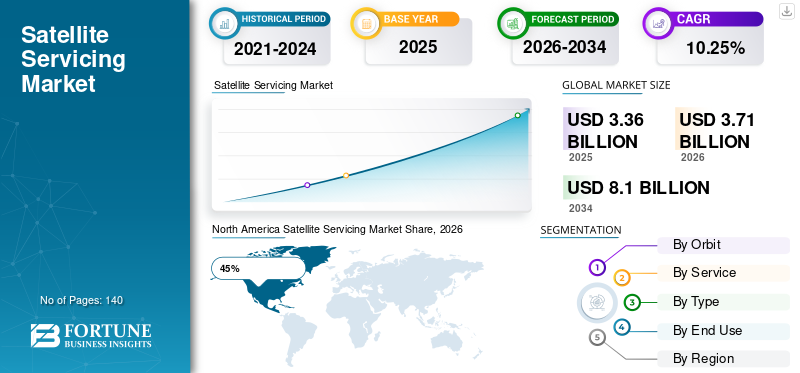
The global satellite servicing market size was valued at USD 3.36 billion in 2025. The market is projected to grow from USD 3.71 billion in 2026 to USD 8.1 billion by 2034, exhibiting a CAGR of 10.25% during the forecast period.

The satellite servicing market is gaining strategic importance across the global space industry due to the rising need for satellite life extension, orbital maintenance, debris mitigation, and in-space infrastructure support. Commercial satellite operators, defense agencies, and government space organizations are increasingly investing in on-orbit servicing capabilities to reduce replacement costs and maximize asset utilization. Satellite servicing missions now include inspection, repair, refueling, relocation, robotic maintenance, and assembly operations. Growing deployment of satellite constellations, expansion of Earth observation networks, and increasing orbital congestion are accelerating demand. The satellite servicing market report highlights strong adoption of autonomous rendezvous technologies, robotic arms, artificial intelligence navigation systems, and modular satellite architectures supporting long-term industry expansion.
The United States remains the largest contributor to the satellite servicing market, accounting for approximately 41% market share through extensive government funding, defense space programs, and commercial innovation. Major organizations continue to deploy servicing vehicles capable of extending the operational lifespan of geostationary satellites. The country maintains leadership in robotic servicing technologies, orbital logistics systems, and satellite life-extension missions. More than 8,000 active satellites are associated with U.S.-based operators and organizations, creating significant demand for inspection and maintenance solutions. Growing military requirements, increased investments in space sustainability initiatives, and expansion of private space enterprises are strengthening the U.S. Satellite Servicing Industry Analysis while supporting long-term operational efficiency across orbital assets.
Download Free sample to learn more about this report.
Satellite Servicing Market Key Takeaways
 Global Market Size & Forecast
- 2025 Market Size: USD 3.36 Billion
- 2026 Market Size: USD 3.71 Billion
- 2034 Forecast Market Size: USD 8.1 Billion
- CAGR: 10.25% from 2026-2034
 market share
- North America dominated with a revenue share of 45% in 2025.
- Low Earth Orbit held the largest share at approximately 48%.
- Robotic servicing accounted for approximately 38% of the market.
 Key Regional Highlights
North America
North America led the market with a 45% share, supported by strong commercial and government space activities.
Europe
Europe accounted for 24% of the market, supported by investments in satellite sustainability and servicing technologies.
Asia-Pacific
Asia-Pacific held a 22% share, driven by expanding satellite infrastructure and space programs.
U.S
The U.S. remains a key market, supported by commercial satellite operators, government initiatives, and advanced servicing technologies.
Japan
Japan is an important Asia-Pacific market, supported by growing investments in satellite operations and orbital servicing capabilities.
Read More

satellite servicing market Latest Trends
The satellite servicing market Trends indicate a major transition from experimental missions toward commercial deployment and recurring service contracts. Satellite operators are increasingly seeking cost-effective alternatives to satellite replacement, leading to higher adoption of refueling and mission-extension services. Autonomous docking systems are becoming a central focus, enabling servicing spacecraft to interact safely with satellites operating in complex orbital environments. The integration of artificial intelligence for navigation, fault detection, and mission planning is improving servicing precision.
Download Free sample to learn more about this report.
Another important trend involves the development of modular satellites designed specifically for future servicing compatibility. Manufacturers are introducing standardized docking interfaces that simplify repair and refueling operations. Space agencies are also prioritizing debris mitigation initiatives, encouraging investment in active debris removal and end-of-life satellite management. Growth in Low Earth Orbit mega-constellations is creating demand for fleet maintenance services, orbital relocation support, and inspection missions.
satellite servicing market Dynamics
DRIVER
Rising Demand for Satellite Life-Extension and Orbital Sustainability Solutions
The primary growth driver within the satellite servicing market is the increasing requirement to extend operational satellite lifespans while reducing replacement expenditures. Satellite operators face significant costs associated with manufacturing, launching, and commissioning new spacecraft. Servicing solutions allow operators to maximize the value of existing assets through refueling, maintenance, relocation, and performance optimization. Growing congestion in orbital environments has intensified the need for sustainability-focused operations. More than 10,000 active satellites currently operate across various orbital zones, creating strong demand for servicing infrastructure. Government agencies increasingly support orbital sustainability programs aimed at reducing debris accumulation. The Satellite Servicing Industry Report demonstrates that mission extension vehicles, robotic servicing systems, and autonomous inspection spacecraft are becoming critical components of modern space asset management strategies.
RESTRAINT
High Technological Complexity and Mission Risk
Despite strong growth potential, the satellite servicing market faces significant barriers related to technological complexity. Servicing missions require precise navigation, autonomous rendezvous capability, robotic manipulation systems, and highly reliable propulsion technologies. Any operational error may damage high-value satellites and create additional orbital debris. Development costs remain substantial due to extensive testing requirements and mission validation procedures. Insurance considerations also affect adoption because servicing operations involve complex risk profiles. Regulatory uncertainty surrounding orbital servicing activities presents additional challenges. International coordination is required when servicing satellites owned by different operators and nations. These factors can delay project approvals and increase deployment timelines. The satellite servicing market analysis indicates that technical certification requirements and mission assurance standards continue to represent important limitations affecting broader commercial adoption.
OPPORTUNITY
Expansion of Commercial Satellite Constellations and Space Infrastructure
The growing deployment of commercial satellite constellations creates substantial opportunities for the satellite servicing market growth. Thousands of satellites are being launched for broadband connectivity, Earth observation, navigation, and defense applications. Operators increasingly require cost-efficient fleet management capabilities to maintain network performance. Satellite servicing providers can offer inspection services, repositioning support, refueling operations, and anomaly resolution across large constellations. Future space stations, orbital manufacturing facilities, and lunar infrastructure projects may also require regular servicing support. The development of orbital logistics networks presents new revenue opportunities for servicing providers. Increasing investments in space commercialization encourage collaboration among launch companies, spacecraft manufacturers, and servicing specialists. These developments create strong foundations for sustained satellite servicing market opportunites across both government and commercial sectors.
CHALLENGE
Regulatory Fragmentation and Lack of Servicing Standards
One of the major challenges facing the satellite servicing market involves the absence of globally standardized servicing protocols. Satellite designs vary significantly regarding docking compatibility, refueling interfaces, and robotic access points. This diversity complicates servicing mission planning and increases operational costs. International regulations governing orbital activities continue to evolve, creating uncertainty for service providers. Licensing requirements differ across jurisdictions, affecting cross-border commercial operations. Data security concerns are particularly important for defense and government satellites. Operators often require strict cybersecurity measures before permitting servicing interactions. Additionally, liability considerations related to satellite damage or mission failure remain unresolved in many regulatory frameworks. The satellite servicing market forecast suggests that industry-wide standards for servicing interfaces and operational procedures will become increasingly necessary to support scalable commercial growth.
satellite servicing market Segmentation
By Orbit
Low Earth Orbit holds approximately 48% market share within the satellite servicing market due to rapid deployment of communication and Earth observation constellations. Thousands of satellites operate within LEO environments, creating substantial demand for inspection, maintenance, relocation, and debris management services. Servicing providers are developing autonomous systems capable of supporting high-volume constellation operations. LEO servicing missions often focus on fleet optimization, anomaly detection, and end-of-life management. Commercial broadband operators increasingly seek cost-efficient servicing options to improve network reliability.
Medium Earth Orbit accounts for approximately 21% market share and serves navigation, positioning, and specialized communication systems. MEO servicing activities focus heavily on maintaining critical infrastructure supporting global navigation services. Satellites operating within this orbit often represent high-value strategic assets with extended operational lifespans. Servicing requirements include orbital adjustments, health monitoring, inspection, and mission-extension support. Government agencies and navigation service providers are major customers within this segment. Increasing dependence on navigation systems for transportation, logistics, and defense applications strengthens demand for reliable servicing solutions.
Geostationary Orbit represents approximately 31% market share and remains the most mature segment for satellite servicing missions. GEO satellites typically involve significant investment and long operational lifespans, making life-extension services highly valuable. Refueling missions, robotic inspections, relocation support, and payload upgrades are common servicing activities within this orbital environment. Several successful mission-extension vehicles have already demonstrated commercial viability in GEO operations. Telecommunications providers, government agencies, and broadcasting organizations continue investing in GEO asset optimization.
To know how our report can help streamline your business, Speak to Analyst
By Service
Robotic servicing commands approximately 38% market share within service-based segmentation. Advanced robotic arms, autonomous docking systems, and machine vision technologies enable inspection, repair, and component replacement activities. Defense agencies and commercial operators increasingly rely on robotic systems to reduce operational risk and improve mission precision. Robotic servicing platforms support satellite diagnostics, hardware upgrades, and anomaly resolution. Continued advances in artificial intelligence are enhancing robotic autonomy and operational flexibility. The satellite servicing market growth within this segment is supported by rising investment in robotic mission architectures and orbital maintenance technologies.
Refueling services account for nearly 34% market share and represent one of the most commercially attractive satellite servicing applications. Satellite operators seek to extend mission durations by replenishing onboard propellant supplies rather than launching replacement spacecraft. Refueling operations support telecommunications satellites, defense platforms, and Earth observation systems. Standardized refueling interfaces are becoming an important area of industry development. Government-backed programs continue advancing orbital fuel transfer technologies. The satellite servicing market outlook indicates strong future demand as satellite operators prioritize asset longevity and operational cost optimization.
Assembly services hold approximately 28% market share and are emerging as a strategic segment within the Satellite Servicing Industry Report. Future space infrastructure projects, including large communications platforms, orbital manufacturing facilities, and exploration systems, may require in-space assembly capabilities. Robotic assembly solutions enable deployment of structures too large for conventional launch configurations. Space agencies and commercial organizations are investing heavily in modular architecture concepts supporting orbital construction activities. The increasing complexity of future space systems is expected to expand demand for assembly-focused servicing platforms.
By Type
Type-based application segmentation shows communication satellites controlling approximately 46% market share, followed by Earth observation satellites with 27%, navigation satellites with 17%, and scientific missions with 10%. Communication platforms require frequent operational support due to high utilization levels. Earth observation operators increasingly seek servicing solutions to protect data continuity. Navigation systems demand reliability-focused maintenance services, while scientific missions benefit from life-extension and repair capabilities. The satellite servicing market research report identifies communication satellites as the leading application category because of their large installed base and strategic commercial value.
By End Use
Commercial operators account for approximately 56% market share, government agencies represent 27%, and defense organizations contribute 17%. Commercial demand is driven by satellite fleet expansion, operational efficiency requirements, and sustainability objectives. Government agencies continue funding technology demonstrations and strategic servicing initiatives. Defense organizations increasingly invest in resilient space architectures supported by inspection and maintenance capabilities. The satellite servicing market share remains heavily influenced by commercial communications providers seeking long-term asset optimization and operational flexibility.
satellite servicing market Regional Outlook
North America Satellite Servicing Market Share, 2026 (%)
To get more information on the regional analysis of this market, Download Free sample
North America
North America commands approximately 45% market share within the satellite servicing market and remains the industry's primary innovation hub. The region benefits from extensive government funding, advanced aerospace infrastructure, and strong commercial participation. The United States leads development of mission extension vehicles, robotic servicing platforms, autonomous docking technologies, and orbital logistics systems. Defense agencies continue investing in resilient space architectures requiring maintenance and inspection capabilities. Commercial operators increasingly deploy servicing-compatible satellite platforms to support long-term operational strategies. Canada also contributes significantly through robotics expertise and advanced space engineering programs. Several North American companies are developing next-generation servicing spacecraft capable of refueling, relocation, and debris management operations.
Europe
Europe represents approximately 24% market share and continues expanding its role within the satellite servicing market through sustainability-focused initiatives and advanced engineering capabilities. European organizations actively support orbital debris removal, satellite life-extension technologies, and autonomous servicing research. Space agencies across the region are funding programs designed to improve long-term orbital sustainability and infrastructure resilience. Major aerospace manufacturers are collaborating with servicing startups to develop robotic maintenance systems and refueling solutions. European satellite operators increasingly recognize the value of extending spacecraft operational life through servicing interventions. Government funding mechanisms support technology demonstration missions and commercial ecosystem development. The region also maintains a strong focus on environmental responsibility in orbital operations, encouraging adoption of servicing solutions that reduce debris generation.
Germany satellite servicing market
Germany accounts for approximately 29% of the European satellite servicing market. The country benefits from advanced aerospace manufacturing capabilities, strong engineering expertise, and active participation in European space initiatives. German organizations are involved in robotic servicing research, autonomous navigation systems, and orbital sustainability projects. Government-supported programs encourage development of satellite maintenance technologies and debris mitigation solutions. Domestic aerospace firms continue investing in servicing-compatible spacecraft designs and mission support infrastructure. The satellite servicing market Insights indicate that Germany remains a critical contributor to European innovation through its technical leadership and long-term investment in advanced space systems.
United Kingdom satellite servicing market
The United Kingdom holds approximately 18% of the European satellite servicing market and continues expanding its presence through commercial innovation and government-supported space programs. British companies are actively developing orbital servicing technologies focused on refueling, inspection, and debris removal missions. National investments in space sustainability initiatives encourage research into autonomous servicing systems and orbital logistics networks. The country's growing satellite sector creates demand for maintenance and life-extension capabilities. Collaboration between private companies and public agencies supports technology commercialization. The satellite servicing market opportunites within the United Kingdom are strengthened by increasing participation in international servicing projects and sustainable space operations.
Asia-Pacific
Asia-Pacific accounts for approximately 22% market share within the satellite servicing market and is experiencing rapid expansion due to increasing satellite deployments and national space investments. Countries across the region are developing advanced satellite constellations supporting communication, navigation, Earth observation, and defense applications. These growing orbital assets create demand for servicing capabilities focused on operational continuity and asset protection. Regional governments continue increasing funding for autonomous spacecraft technologies, robotic systems, and orbital sustainability programs. Commercial space enterprises are also entering the servicing sector through partnerships with aerospace manufacturers and research organizations. The region benefits from expanding launch capabilities and growing participation in global space infrastructure projects.
Japan satellite servicing market
Japan represents approximately 31% of the Asia-Pacific satellite servicing market. The country has established a strong position through investment in robotics, autonomous spacecraft systems, and orbital debris mitigation technologies. Japanese organizations actively participate in life-extension, inspection, and servicing mission development. Commercial companies are expanding capabilities in autonomous rendezvous and docking technologies. Government support for sustainable orbital operations continues strengthening market growth. The satellite servicing market research report highlights Japan as a regional leader in precision robotics and advanced servicing architecture development.
China satellite servicing market
China accounts for approximately 22% of the Asia-Pacific satellite servicing market and continues investing heavily in satellite infrastructure, orbital logistics, and autonomous spacecraft capabilities. Expansion of communication networks, Earth observation systems, and navigation constellations drives demand for maintenance solutions. National space programs prioritize long-term operational sustainability and strategic space resilience. Chinese organizations are developing robotic servicing technologies and advanced maneuvering platforms. Increasing launch activity further strengthens demand for inspection and debris mitigation services. The satellite servicing market growth outlook remains strong due to ongoing government support and expanding orbital asset deployment.
Rest of World
The Rest of World region holds approximately 9% market share within the satellite servicing market. Emerging space nations across the Middle East, Latin America, and Africa are gradually expanding satellite infrastructure investments. Growing adoption of communication and Earth observation satellites creates future demand for maintenance, inspection, and life-extension services. Governments increasingly recognize the importance of protecting orbital assets and maximizing operational efficiency. Several countries are developing national space strategies that emphasize sustainability and long-term infrastructure management. International partnerships play a critical role in technology transfer and capability development. Commercial operators within these regions are beginning to evaluate servicing solutions as satellite deployment volumes increase. The satellite servicing market outlook suggests that adoption rates will strengthen as servicing technologies become more accessible and cost-efficient. Expansion of regional satellite programs is expected to generate new opportunities for global servicing providers.
List of Top Satellite Servicing Companies
- Northrop Grumman
- Maxar Technologies
- Astroscale
- Orbit Fab, Inc.
- Thales Alenia Space
- AIRBUS
- Lockheed Martin Corporation.
- ClearSpace
- Altius Space Machines
- Starfish Space
Top Two Companies with Highest market share
- Northrop Grumman – 21% market share
- Astroscale – 16% market share
Investment Analysis and Opportunities
Investment activity across the satellite servicing market continues increasing as governments, defense agencies, venture capital firms, and aerospace companies prioritize sustainable space operations. Funding is directed toward robotic servicing spacecraft, autonomous rendezvous systems, in-space refueling technologies, and orbital logistics platforms. Investors recognize growing demand for cost-effective alternatives to satellite replacement. The increasing number of operational satellites creates long-term opportunities for maintenance and life-extension services.
Commercial partnerships are becoming a major investment trend, enabling companies to combine servicing technologies with launch capabilities and satellite manufacturing expertise. Defense organizations continue supporting strategic servicing initiatives aimed at improving orbital resilience. Private investors are increasingly funding startups focused on debris removal, robotic maintenance, and in-space transportation services.
New Product Development
New product development within the satellite servicing market is focused on autonomous servicing vehicles, robotic maintenance systems, orbital fuel depots, and advanced inspection spacecraft. Companies are designing next-generation platforms capable of performing multiple servicing functions during a single mission. Artificial intelligence integration is improving navigation accuracy, docking performance, and anomaly detection capabilities.
Several manufacturers are developing modular servicing spacecraft equipped with interchangeable payloads. These systems enable operators to perform inspection, repair, relocation, and refueling activities using a common platform architecture. New robotic arm technologies offer enhanced dexterity for complex maintenance tasks. Advances in machine vision systems further improve autonomous operation reliability.
Five Recent Developments (2023-2025)
- Northrop Grumman continued advancement of its Mission Robotic Vehicle and Mission Extension technologies for geostationary satellite servicing.
- Astroscale U.S. announced participation in orbital refueling initiatives supporting future servicing operations for government space assets during 2025.
- United Kingdom space programs awarded servicing-related contracts involving Astroscale, ClearSpace, and Orbit Fab to advance orbital refueling technologies in 2024.
- DARPA confirmed progress toward deployment of the Robotic Servicing of Geosynchronous Satellites mission, targeting advanced robotic repair and upgrade operations.
- Multiple industry participants expanded investment in autonomous docking, orbital logistics, and servicing support systems for future satellite constellation maintenance missions.
Report Coverage of satellite servicing market
The satellite servicing market report provides comprehensive evaluation of industry developments across servicing technologies, orbital categories, applications, regional performance, competitive landscape, and investment activity. Coverage includes analysis of robotic servicing, refueling, assembly operations, inspection services, debris mitigation technologies, and orbital logistics solutions. The report examines market participation across commercial, government, and defense sectors while assessing demand drivers influencing adoption patterns.
Request for Customization to gain extensive market insights.
Detailed segmentation evaluates Low Earth Orbit, Medium Earth Orbit, and Geostationary Orbit servicing requirements. Application analysis covers service categories, satellite types, and end-use industries. Regional assessment examines North America, Europe, Asia-Pacific, and Rest of World market performance, highlighting technological capabilities and investment priorities. Competitive benchmarking evaluates major industry participants, product development strategies, and operational positioning. The report also reviews innovation trends including autonomous docking systems, artificial intelligence integration, robotic maintenance platforms, and orbital refueling infrastructure. Market
Frequently Asked Questions
Fortune Business Insights says that the global market value stood at USD 3.36 billion in 2025 and is projected to reach USD 8.1 billion by 2034.
The market is expected to exhibit a CAGR of 10.25% during the forecast period of 2026-2034.
Communication satellites were the leading type segment, accounting for approximately 46% market share, supported by their large installed base and strategic commercial value.
Key players include Northrop Grumman, Maxar Technologies, Astroscale, Orbit Fab, Inc., Thales Alenia Space, and AIRBUS.
Major trends include the shift toward commercial servicing and recurring contracts, alongside growing adoption of autonomous docking, AI-enabled navigation, and modular servicing-compatible satellites. North America leads with approximately 45% market share.



- 2021-2034
- 2025
- 2021-2024
- 140
-

(Offer valid till 15th Oct 2026)
Get 30-60 hrs Free Customization
Expand Regional and Country Coverage, Segments Analysis, Company Profiles, Competitive Benchmarking, and End-user Insights.




















-
US +1 833 909 2966 ( Toll Free )
-
Get In Touch With Us