Sauna Market Size, Share & Industry Analysis, By Product (Traditional Sauna, Infrared Sauna, Electric Sauna, Steam Saunas/Rooms), By Application (Residential, Commercial), and Regional Forecast, 2026-2034
 Download Free Sample
Sauna Market Overview
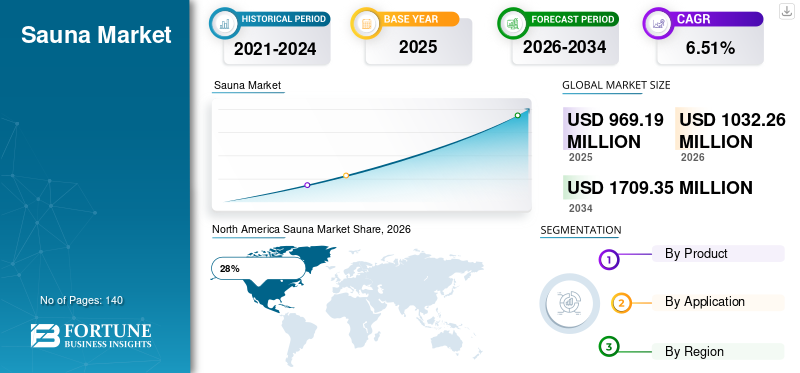
The global sauna market size was valued at USD 969.19 billion in 2025. The market is projected to grow from USD 1032.26 billion in 2026 to USD 1709.35 billion by 2034, exhibiting a CAGR of 6.51% during the forecast period. The market in Europe dominated with a revenue share of 37% in 2025.

The sauna market is experiencing strong momentum due to increasing consumer focus on wellness, relaxation, preventive healthcare, and luxury residential upgrades. Sauna installations are expanding across residential properties, hotels, wellness centers, fitness clubs, medical spas, and hospitality facilities. Growing awareness regarding heat therapy, muscle recovery, stress reduction, and cardiovascular wellness is supporting sustained demand for modern sauna solutions. Traditional sauna systems continue to maintain strong adoption across established markets, while infrared sauna technologies are attracting younger wellness-focused consumers. The sauna market Report indicates increasing integration of smart controls, energy-efficient heating systems, customized cabin designs, and premium wood materials, creating new growth opportunities across both developed and emerging economies.
The United States sauna market represents one of the most active regional sectors within the global industry. Consumer spending on home wellness infrastructure, luxury renovations, fitness recovery equipment, and backyard spa installations continues to accelerate market penetration. Commercial demand from health clubs, resorts, wellness retreats, rehabilitation centers, and premium hotels is expanding steadily. Infrared sauna installations have witnessed notable adoption among health-conscious consumers seeking compact and energy-efficient solutions. Smart sauna systems integrated with mobile controls and wellness tracking functions are becoming increasingly popular. The USA Sauna Industry Report highlights strong demand for customized residential installations, hybrid sauna rooms, and premium wellness environments across major metropolitan and suburban regions.
Download Free sample to learn more about this report.
Sauna Market Key Takeaways
 Global Market Size & Forecast
- 2025 Market Size: USD 969.19 Billion
- 2026 Market Size: USD 1032.26 Billion
- 2034 Forecast Market Size: USD 1709.35 Billion
- CAGR: 6.51% from 2026-2034
 Market Share
- Europe dominated with a revenue share of 37% in 2025.
- Traditional sauna systems held the largest share at approximately 43%.
- Residential applications accounted for approximately 59% of the market.
 Key Regional Highlights
Europe
Europe led the market with a 37% share, supported by strong cultural acceptance of sauna systems.
North America
North America accounted for 28% of the market, driven by growing home wellness adoption.
Asia-Pacific
Asia-Pacific held a 25% share, supported by expanding wellness and hospitality infrastructure.
U.S
Demand is supported by increasing adoption of home wellness solutions, fitness centers, spas, and premium sauna systems.
Japan
The market is supported by established wellness practices and continued demand for sauna and relaxation facilities.
Read More

sauna market Latest Trends
The sauna market Analysis demonstrates significant transformation driven by wellness-focused consumer behavior and technological innovation. One of the most prominent trends involves the growing popularity of smart sauna systems equipped with wireless connectivity, digital temperature controls, remote monitoring applications, and personalized wellness settings. Manufacturers are increasingly introducing app-enabled systems that allow users to manage temperature, humidity, lighting, and session duration through smartphones.
Download Free sample to learn more about this report.
Another major trend within the sauna market Research Report is the rapid expansion of infrared sauna adoption. Consumers are increasingly seeking lower-temperature heat therapy solutions that provide convenience and energy efficiency. Hybrid sauna designs combining traditional heating methods with infrared technology are also gaining traction across premium residential and commercial segments. Sustainability is becoming a defining factor in product development. Manufacturers are incorporating responsibly sourced timber, recyclable materials, low-energy heaters, and environmentally conscious manufacturing practices.
sauna market Dynamics
DRIVER
Rising Consumer Focus on Wellness and Preventive Healthcare
The primary growth driver within the sauna market is the increasing global emphasis on wellness, recovery, and preventive healthcare practices. Consumers are actively investing in products that support physical recovery, mental relaxation, detoxification, and overall well-being. Sauna usage is increasingly associated with stress management, muscle relaxation, improved circulation, and post-exercise recovery, making it attractive across multiple demographics. Fitness enthusiasts, athletes, wellness-conscious professionals, and aging populations are contributing to demand expansion. Commercial operators including gyms, rehabilitation centers, luxury spas, and hospitality providers continue expanding sauna facilities to meet consumer expectations. Growing awareness of heat therapy benefits through social media, wellness programs, and healthcare discussions has significantly strengthened adoption across developed and emerging markets.
RESTRAINT
High Installation and Maintenance Requirements
One of the major restraints affecting the sauna market Growth involves the substantial installation, maintenance, and operational requirements associated with premium sauna systems. Traditional sauna rooms require specialized construction materials, ventilation systems, insulation components, electrical infrastructure, and safety compliance measures. Commercial facilities often face additional expenditures related to regulatory approvals, maintenance staffing, energy consumption, and routine equipment replacement. Residential consumers may postpone purchasing decisions due to installation complexity and limited available space. Premium wood materials and imported heating components can further increase ownership costs. These factors create barriers to market penetration, particularly across price-sensitive regions and developing economies where discretionary spending on wellness infrastructure remains comparatively limited.
OPPORTUNITY
Expansion of Home Wellness and Luxury Residential Projects
The expansion of home wellness spaces presents substantial opportunities within the sauna market Forecast. Homeowners increasingly view wellness infrastructure as an essential component of modern living environments. Residential construction projects are incorporating dedicated wellness rooms, spa zones, recovery areas, and outdoor relaxation facilities. Luxury housing developments increasingly include sauna installations as standard premium amenities. Demand for compact, modular, and prefabricated sauna systems is creating new opportunities for manufacturers targeting urban consumers with limited space availability. Digital wellness trends, remote working lifestyles, and increased focus on personal health are encouraging long-term investment in home-based wellness solutions. Manufacturers capable of delivering customizable, energy-efficient, and technologically advanced residential products are positioned to benefit significantly from this market transition.
CHALLENGE
Regulatory Compliance and Energy Efficiency Demands
A significant challenge within the Sauna Industry Analysis involves maintaining compliance with evolving building regulations, electrical safety requirements, environmental standards, and energy efficiency mandates. Manufacturers must continuously adapt products to satisfy regional certification requirements while maintaining performance and user safety. Rising energy costs are increasing consumer scrutiny regarding operating expenses, encouraging demand for more efficient heating technologies. International expansion also presents challenges related to varying construction standards, installation practices, and consumer preferences. Companies must balance product innovation, material quality, sustainability goals, and affordability simultaneously. Competitive pressure from alternative wellness technologies such as recovery pods, hydrotherapy systems, and home fitness equipment further intensifies market challenges across multiple regions.
sauna market Segmentation
By Product
Traditional sauna market share of traditional sauna systems accounts for approximately 43% of the global sauna market. Traditional saunas remain the dominant product category due to strong cultural acceptance across Nordic and European countries. These systems utilize heated stones and controlled humidity levels to create authentic sauna experiences preferred by wellness enthusiasts and commercial operators. Hotels, resorts, luxury spas, and health clubs continue investing heavily in traditional sauna installations because of their established consumer recognition. Manufacturers are introducing advanced insulation materials, digital controls, and energy-efficient heating technologies while preserving traditional functionality.
Infrared sauna market share of infrared sauna systems represents approximately 24% of the sauna market. Infrared technology has gained considerable popularity due to lower operating temperatures, reduced energy consumption, and compact installation requirements. Consumers seeking convenient home wellness solutions increasingly prefer infrared units because they require less warm-up time and fit within smaller residential spaces. Fitness centers, rehabilitation clinics, and wellness facilities are adopting infrared systems to support recovery and relaxation services. Product innovation includes full-spectrum infrared emitters, carbon heating panels, ergonomic seating, and integrated wellness monitoring systems.
Electric sauna market share of electric sauna systems accounts for nearly 21% of the global Sauna Industry. Electric heaters provide operational convenience, temperature consistency, and simplified installation compared with wood-burning alternatives. Residential homeowners and commercial operators favor electric systems due to automation capabilities and reduced maintenance requirements. Manufacturers continue introducing smart heater technologies featuring mobile connectivity, programmable controls, and energy management functions. Demand remains particularly strong across urban environments where space constraints and environmental regulations limit the practicality of traditional fuel-based heating methods.
Steam Saunas/Room Market share of steam saunas and steam rooms represents approximately 12% of the sauna market. Steam-based wellness environments remain highly popular within luxury hospitality, healthcare, and spa applications. These facilities provide humid heat experiences that appeal to consumers seeking relaxation, respiratory comfort, and skin-care benefits. Hotels, wellness resorts, rehabilitation centers, and destination spas continue investing in premium steam room infrastructure to enhance guest experiences. Manufacturers are incorporating automated humidity controls, antimicrobial materials, advanced steam generators, and customized interior aesthetics.
To know how our report can help streamline your business, Speak to Analyst
By Application
Market share of residential applications accounts for approximately 59% of the global sauna market. Homeowners increasingly view sauna installations as long-term wellness investments that enhance property value and lifestyle quality. Residential demand is supported by growing awareness of stress management, muscle recovery, and home-based wellness practices. Compact indoor systems, outdoor barrel saunas, modular cabins, and infrared solutions are becoming increasingly common across residential properties. Smart connectivity features, customizable aesthetics, and energy-efficient operation are major purchasing considerations. High-income consumers, wellness enthusiasts, and remote workers continue driving adoption.
Market share of commercial applications represents approximately 41% of the Sauna Industry Report. Commercial demand originates from hotels, fitness centers, wellness clubs, spas, rehabilitation facilities, healthcare institutions, and luxury resorts. Businesses increasingly integrate sauna services to differentiate offerings, improve customer retention, and support premium wellness experiences. Wellness tourism growth has accelerated investment in commercial thermal therapy facilities across major travel destinations. Commercial operators prioritize durability, energy efficiency, regulatory compliance, and capacity optimization when selecting sauna systems.
sauna market Regional Outlook
North America Sauna Market Share, 2026 (%)
To get more information on the regional analysis of this market, Download Free sample
North America
North America holds approximately 28% share of the global sauna market. The region continues experiencing substantial demand growth fueled by consumer investment in wellness infrastructure, luxury home upgrades, and fitness recovery solutions. The United States remains the dominant regional contributor due to widespread adoption of home wellness products and increasing awareness regarding heat therapy benefits. Commercial demand from health clubs, luxury hotels, rehabilitation centers, and wellness resorts continues expanding steadily. Infrared sauna installations have become particularly popular throughout North America because consumers value energy efficiency, compact design, and convenience. Smart technology integration, mobile application controls, and personalized wellness settings are increasingly influencing purchasing decisions. Outdoor sauna cabins and backyard wellness environments have also gained popularity among residential consumers. Commercial operators continue modernizing facilities with premium sauna experiences to attract health-conscious customers. Increasing emphasis on preventive healthcare and recovery-focused lifestyles is supporting long-term market development throughout the region.
Europe
Europe commands approximately 37% market share and remains the largest regional contributor to the sauna market. Sauna culture has deep historical roots throughout Nordic countries and several continental European markets. Finland, Germany, Sweden, Austria, and Switzerland continue maintaining strong sauna penetration rates across both residential and commercial environments. Wellness traditions, established consumer familiarity, and extensive hospitality infrastructure contribute significantly to regional dominance. Commercial facilities including luxury spas, wellness resorts, and recreational centers continue investing in premium sauna technologies. Traditional sauna systems remain especially popular throughout Europe due to cultural preferences and long-standing usage habits. Manufacturers headquartered within the region continue driving innovation through smart controls, sustainable materials, and customized design solutions. Growing demand for eco-friendly heating systems and energy-efficient installations further supports product modernization. The European sauna market Analysis also reflects increasing demand for hybrid sauna technologies combining traditional experiences with infrared functionality.
Germany sauna market
Germany represents approximately 16% share of the European sauna market and around 6% of the global sauna market. The country possesses one of the strongest wellness and thermal bathing traditions in Europe. Commercial facilities including wellness resorts, fitness clubs, hotels, and spa complexes continue driving substantial demand for premium sauna infrastructure. German consumers demonstrate strong preference for authentic traditional sauna experiences while increasingly embracing smart control technologies and energy-efficient systems. Residential installations are expanding due to growing wellness awareness and luxury home improvement projects. Domestic demand for customized cabins, sustainable wood materials, and advanced heating technologies remains strong across both urban and suburban markets.
United Kingdom sauna market
The United Kingdom accounts for approximately 11% share of the European sauna market and nearly of global market activity. Consumer awareness regarding wellness, relaxation, and recovery practices continues supporting sauna adoption throughout residential and commercial sectors. Health clubs, boutique wellness centers, luxury hotels, and premium residential developments increasingly incorporate sauna facilities to meet evolving consumer expectations. Infrared sauna systems are particularly popular due to their space efficiency and lower operating requirements. Commercial investments in wellness-focused hospitality projects continue expanding market opportunities. Demand for digitally connected sauna systems and customized home wellness solutions is growing steadily across major metropolitan regions.
Asia-Pacific
Asia-Pacific accounts for approximately 25% share of the global sauna market and represents one of the fastest-expanding regional segments. Rising disposable income, urbanization, wellness awareness, and luxury hospitality development are creating favorable market conditions. Countries including Japan, China, South Korea, Australia, and Singapore continue investing heavily in wellness infrastructure and premium recreational facilities. Commercial growth is particularly strong within luxury hotels, destination spas, wellness resorts, and healthcare facilities. Consumers increasingly recognize the benefits of heat therapy, stress reduction, and recovery-oriented wellness practices. Infrared sauna systems demonstrate strong adoption because of their suitability for compact urban living spaces. Regional manufacturers are introducing technologically advanced products featuring smart controls, modern aesthetics, and energy-efficient operation. Government support for tourism and hospitality expansion further contributes to commercial demand. Increasing integration of wellness amenities into residential developments and mixed-use projects continues strengthening regional growth prospects across Asia-Pacific markets.
Japan sauna market
Japan contributes approximately 22% share of the Asia-Pacific sauna market and nearly 5% of global market activity. Sauna culture has gained remarkable popularity among younger consumers, wellness enthusiasts, and fitness-focused individuals. Public bathhouses, wellness facilities, hotels, and recreational centers continue expanding sauna offerings to accommodate growing demand. Premium experiences combining relaxation, recovery, and social engagement have become highly attractive among urban populations. Residential sauna adoption is also increasing as homeowners seek personalized wellness environments. Demand for compact, technologically advanced, and aesthetically refined installations remains particularly strong across major Japanese cities.
China sauna market
China accounts for approximately 31% share of the Asia-Pacific sauna market and around 8% of global market activity. Rapid urbanization, luxury real estate development, and expanding wellness awareness continue driving market growth. Commercial installations dominate demand, particularly across luxury hotels, spas, healthcare centers, and high-end residential developments. Increasing consumer interest in preventive wellness and premium lifestyle experiences supports expanding adoption. Domestic manufacturers are introducing competitively priced products alongside technologically advanced premium systems. Smart controls, modern designs, and customized configurations are becoming important purchasing factors. The Chinese sauna market Outlook remains favorable due to rising disposable income and continued investment in wellness infrastructure.
Rest of World
The Rest of World region represents approximately 10% share of the global sauna market. Adoption is expanding steadily across the Middle East, Latin America, and selected African markets as wellness culture becomes more mainstream. Luxury hospitality projects, tourism infrastructure, and premium residential developments are the primary drivers supporting regional expansion. High-end hotels, wellness resorts, and destination spas continue incorporating sauna facilities to enhance service offerings and attract international visitors. Middle Eastern markets are investing heavily in integrated wellness environments that combine sauna facilities with spas, hydrotherapy systems, and fitness centers. Latin American countries are witnessing increasing consumer awareness regarding wellness and recovery benefits, supporting gradual market penetration. Commercial operators remain the dominant buyers throughout most emerging regions due to higher installation costs and limited residential adoption. However, rising urbanization, expanding middle-class populations, and increasing exposure to international wellness trends continue creating opportunities for long-term market development across Rest of World markets.
List of Top Sauna Companies
- Harvia Group
- KLAFS GmbH
- SAUNATEC
- TyloHelo Group
- Sauna360 Inc. (Masco Corporation)
- HUUM
- Syracuse Sauna King
- Effegibi
- Nordic Sauna
- Saunacore
Top Two Companies with Highest Market Share
- Harvia Group – Approximately 5% global sauna market Share
- TyloHelo Group – Approximately 4% global sauna market Share
Investment Analysis and Opportunities
The sauna market presents substantial investment opportunities across manufacturing, technology development, wellness infrastructure, hospitality expansion, and residential construction segments. Investors are increasingly targeting companies specializing in energy-efficient heating systems, smart sauna technologies, premium cabin manufacturing, and modular wellness solutions. Growing consumer spending on health and wellness continues creating attractive long-term demand fundamentals. Luxury residential projects increasingly include wellness amenities as key differentiators, creating opportunities for suppliers of customized sauna systems. Commercial sectors including hotels, fitness chains, wellness resorts, and rehabilitation centers continue allocating capital toward premium thermal therapy facilities.
Strategic acquisitions remain active as larger manufacturers seek geographic expansion and broader product portfolios. Emerging markets provide additional opportunities due to increasing disposable income and growing wellness awareness. Infrared sauna technology, smart controls, connected wellness ecosystems, and sustainable manufacturing practices represent particularly attractive investment areas. Companies capable of balancing technological innovation, energy efficiency, and premium customer experiences are expected to strengthen competitive positioning. The sauna market Opportunities landscape also benefits from growing wellness tourism, personalized health solutions, and expanding demand for home-based recovery environments.
New Product Development
Product innovation remains a major competitive factor within the sauna market. Manufacturers are introducing next-generation systems that combine traditional thermal experiences with advanced digital technologies. Smart sauna platforms featuring mobile applications, voice control compatibility, automated temperature management, and personalized wellness programs are gaining commercial traction. Hybrid sauna systems integrating traditional and infrared heating technologies represent a significant area of product development. These solutions provide users with multiple therapy options within a single installation, enhancing convenience and value. Manufacturers are also investing in sustainable materials, energy-efficient heaters, and environmentally responsible production methods.
Chromotherapy lighting, aromatherapy integration, advanced ventilation systems, and ergonomic seating designs continue improving user experiences. Modular construction methods allow faster installation and greater customization flexibility for residential and commercial buyers. Outdoor sauna cabins designed for year-round operation are becoming increasingly sophisticated through improved insulation and weather-resistant materials. Commercial innovations include centralized management systems, occupancy monitoring, predictive maintenance capabilities, and enhanced safety features. The sauna market Trends indicate continued focus on wellness personalization, sustainability, operational efficiency, and digital connectivity as manufacturers compete to differentiate product offerings globally.
Five Recent Developments (2023-2025)
- Harvia expanded international operations through increased investment in North American distribution and manufacturing capabilities during 2023 and 2024.
- Several leading sauna manufacturers introduced app-controlled smart sauna systems featuring remote operation, personalized settings, and energy management functions during 2024.
- HUUM expanded its portfolio of connected electric heaters and digital control platforms targeting premium residential and commercial wellness installations in 2024.
- Multiple European manufacturers launched hybrid sauna solutions combining infrared and traditional heating technologies between 2023 and 2025.
- Commercial wellness operators across North America and Asia-Pacific increased investments in luxury sauna facilities integrated within fitness clubs, resorts, and recovery centers throughout 2025.
Report Coverage
The sauna market Report provides comprehensive evaluation of industry structure, market dynamics, competitive positioning, product innovation, regional performance, and investment trends across global markets. The report examines demand patterns influencing residential and commercial adoption while analyzing changing consumer preferences related to wellness, recovery, and preventive healthcare practices.
Request for Customization to gain extensive market insights.
Coverage includes detailed segmentation by product type, application, geographic region, technology adoption, and end-user behavior. Market analysis assesses traditional sauna systems, infrared technologies, electric heating solutions, and steam room installations. Regional evaluation examines demand patterns across North America, Europe, Asia-Pacific, and Rest of World markets while identifying emerging opportunities and competitive developments.
Frequently Asked Questions
Fortune Business Insights says that the global market value stood at USD 969.19 billion in 2025 and is projected to reach USD 1,709.35 billion by 2034.
The market is expected to exhibit a CAGR of 6.51% during the forecast period of 2026-2034.
Traditional saunas were the leading product segment, accounting for approximately 43% of the global market, supported by strong cultural acceptance, particularly across Nordic and European countries.
Key players include Harvia Group, KLAFS GmbH, SAUNATEC, TyloHelo Group, Sauna360 Inc. (Masco Corporation), and HUUM.
Major trends include growing adoption of smart, app-enabled sauna systems and increasing demand for infrared and hybrid saunas, alongside greater focus on energy efficiency and sustainable materials. Europe leads with approximately 37% market share, supported by deep-rooted sauna culture and strong hospitality infrastructure.



- 2021-2034
- 2025
- 2021-2024
- 140
-

(Offer valid till 30th Sep 2026)
Get 30-60 hrs Free Customization
Expand Regional and Country Coverage, Segments Analysis, Company Profiles, Competitive Benchmarking, and End-user Insights.













.webp)






-
US +1 833 909 2966 ( Toll Free )
-
Get In Touch With Us