Sawing and Cutting Tools Market Size, Share & Industry Analysis, By Tool Type (Corded and Cordless), By Product (Hack Saw, Band Saw, Jig Saw, Circular Saw, Table Saw, Shear, Nibbler, Cutter, and Others), By Application (Do-It-Yourself (DIY) and Industrial), and Regional Forecast, 2026–2034
 Download Free Sample
KEY MARKET INSIGHTS
 Listen to Audio Version
The global sawing and cutting tools market size was valued at USD 5.42 billion in 2025 and is projected to grow from USD 5.64 billion in 2026 to USD 7.85 billion by 2034, exhibiting a CAGR of 4.20% during the forecast period. The Asia Pacific dominated global market with a share of 51.43% in 2024.
The sawing and cutting tools market is characterized by an evolving landscape driven by the intense competition among competitors and the emergence of new and innovative tools. The market’s nature is mostly aligned with the overall health of the manufacturing processes, exhibiting a derived demand for sawing and cutting tools in complex industrial operations. The market’s key characteristics include different product offerings such as hack saw, band saw, jig saw, circular saw, table saw, shear, nibbler, cutter, and others.
Technological advancements play a pivotal role with advancements in the tool material, power source type, and Industry 4.0 technology, such as data analytics, IIoT, and robotics, is driving market potential in the long term. Furthermore, manufacturers are focusing on developing ergonomically compliant and energy efficient products for long-duration working. Manufacturers such as Milwaukee and Makita are incorporating lightweight tools into their product portfolio that offer more productive time and are easy to operate for long durations.
During the COVID-19 pandemic, the power tool market fell to negative levels owing to the immediate shutdown of factories, disruption in transportation, destabilization of the economy, related ecosystem, and other factors. The pandemic further extended these hindrances by highlighting the need for market resiliency and adaptability hampered by a disturbed trade balance. As the global economy recovers the sawing and cutting tools sector witnesses a poised growth driven by the infrastructure projects, the rebound of the automotive sectors, and the continuous pursuit of production excellency.
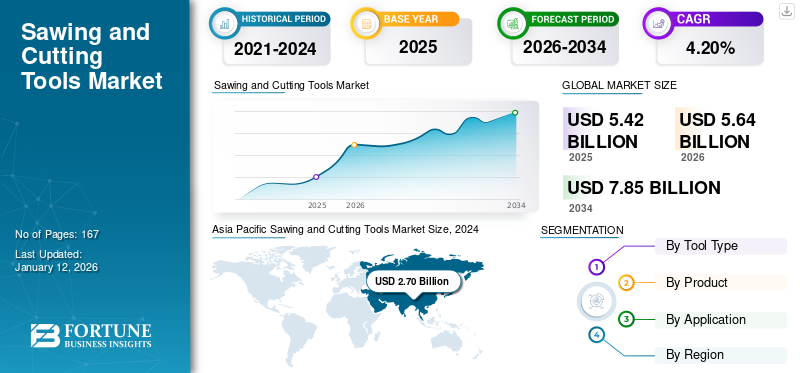
Download Free sample to learn more about this report.
Sawing and Cutting Tools Market Key Takeaways
 Global Market Size & Forecast
- 2025 Market Size: USD 5.42 billion
- 2026 Market Size: USD 5.64 billion
- 2034 Forecast Market Size: USD 7.85 billion
- CAGR: 4.20% from 2026–2034
 Market Share
- Asia Pacific dominated the sawing and cutting tools market with a 51.43% share in 2024.
- The cutting tools segment held the largest market share in 2024.
- The corded tools segment remained the dominant tool type in 2024.
 Key Regional Highlights
Asia Pacific
Asia Pacific led the market with a 51.43% share in 2024.
North America
North America remained a mature market with steady demand.
Europe
Europe is projected to witness steady market growth.
U.S
Growth is driven by the adoption of battery-powered tools.
Japan
R&D investments continue to support market growth.
Read More

IMPACT OF RECIPROCAL TARIFFS
Volatile Market Dynamics and Disturbed Trades are Restructuring Market
Due to the trade war, prominent tool manufacturers experience additional risks, such as decreased foreign demand, research and development investment, and thereby fueling the need for a resilient supply chain. Further, the impact of tariffs on power tools is a major reason for the market restructuring. Many manufacturers are focusing on identifying new markets and increasing their offerings in existing markets, supporting the merger and acquisition strategies of major manufacturers globally. The reciprocal tariffs' impact is very high in the short term, as it would delay order proceedings, and in the long term, it would create a price pressure on the end user, creating difficulties for the market.
- For instance, in April 2025, Stanley Black & Decker, a prominent power tools manufacturer, said that they were raising their prices and shifting their supply chain in response to the Trump administration’s tariffs. The prices will be raised in the second quarter of 2025 and further in the third quarter.
MARKET DYNAMICS
MARKET TRENDS
Focus on Integrating Automation and Redesigning of Products for Improvement
The market is experiencing a major shift to automated tools and technologies that use advanced AI and ML techniques to optimize various operations. Businesses are redesigning their products for enhanced use in industries such as automotive, aerospace, steel construction, and others. The advanced tools are designed to meet the strong usage requirement of these industries and equally compliant to the global standards that drive sawing and cutting tools market trends in long term.
- For instance, in May 2025, Cosen, a prominent band saw manufacturer, displayed four of their cutting-edge band saw solutions that are semi- and fully-automatic, designed for more enhanced accuracy, safety, and productivity.
Download Free sample to learn more about this report.
MARKET DRIVERS
Embracing Product’s Operation and Technological Upgrades Bolsters Market Growth
The market for sawing and cutting tools is witnessing rapid growth during the forecast years, owing to its extended battery life and the adoption of automation and smart solutions across various end-use verticals, such as shipbuilding, automotive, woodworking, aerospace, and others, is widening. These industries are implementing smart manufacturing, wherein the overall workflow process, including assembly, production, and other aspects are connected. End users embrace the latest upgrades and benefit from the product performance, boosting satisfaction and bolstering the sawing and cutting tools market growth during the forecast period.
- For instance, in April 2024, Milwaukee introduced the M12 1-¼"-2” copper tubing cutter, which delivers faster and cleaner cuts. The product delivers high performance and adjusts automatically to the diameter of different cut types K, L, and M.
MARKET RESTRAINTS
Volatility in User Prices and Supply Chain Volatility are Hindering Market Growth
The demand for power tools is growing with the emergence of an innovative, efficient, and easy-to-use range of tools. However, supply chain volatility and end-user product prices are a major factor that constrains market growth. Moreover, the cost of power tool ownership increases with increasing material costs, further limiting the power tools' sales growth.
MARKET OPPORTUNITIES
Commercialization of Tools and Supporting Incentives to Mitigate Risks and Opportunities
The market for commercial power tools is anticipated to flourish in the forecast period, owing to the rising number of contractors acting freelance across the residential and commercial sectors, delivering Tool as a Service (TaaS). These affordable services are easy to avail, reducing the need for tool expertise, and initial investment in acquiring a tool is further fueling sawing and cutting tools market size.
- For instance, in April 2025, NiTi Ayog, a government body of the Government of India, proposed a USD 1,423.17 million incentive plan to boost India’s hand and power tool sector. The plan aims to achieve a 10% market share in power tools and a 25% share in the hand tools sector.
Segmentation Analysis
By Tool Type
Recursive Corded Tools in Industrial Cutting Demand Drives Segmental Dominance
On the basis of tool type, the market is categorized into corded and cordless.
Among these, corded tools remain a dominant segment. They are anticipated to forecast the highest growth, owing to their recursive demand from commercial and industrial customers demanding high-power electric tools. Moreover, it has revolutionized the work culture of industries such as construction, automotive, and other industries, as they save time and costs for stakeholders.
Meanwhile, cordless tools are growing progressively, gaining the highest CAGR owing to their easy handling and ergonomics. According to The European Power Tool Association, the rechargeable battery industry holds a heavy investment in research & development activities.
By Product
Advancements in Cutting Tools for Nurturing Production Fuels Product Demand
On the basis of product, the market is categorized into hack saw, band saw, jig saw, circular saw, table saw, shear, nibbler, cutter, and others.
The cutting tools segment holds the largest market share in 2024 and is experiencing the highest growth due to the advancements in cutting tools, which benefit manufacturers with minimized downtime and better cutting. Band saws and circular saws are witnessing a progressive growth owing to the growing demand for saw profiles that can deliver high performance, lightweight, and without sacrificing time.
Hack saw, shear, jig saw, and nibbler are showcasing moderate growth due to the continuous innovation delivering consistent cutting process results.
By Application
Industrial Application Dominates with Increasing Commercial Investments
The application segment is further categorized into Do-It-Yourself (DIY) and industrial.
In the segment, the industrial sector is witnessing the highest growth owing to the growing investment of major manufacturers, such as Milwaukee Tools and Makita are mainly emphasizing manufacturing sawing and cutting tools that can deliver more precision cuts and longer tool life. Moreover, rising demand from the industrial fabrication and construction industries fuels the market growth.
The Do-it-Yourself (DIY) application is projected to have a remarkable impact on the market, owing to the growth and trend witnessed by DIY enthusiasts, mainly due to the increasing spending capability and the rising number of households across developed and developing countries.
Sawing and Cutting Tools Market Regional Outlook
The market is categorized by region into North America, Europe, Asia Pacific, the Middle East & Africa, and Latin America.
Asia Pacific
Asia Pacific Sawing and Cutting Tools Market Size, 2024 (USD Billion)
To get more information on the regional analysis of this market, Download Free sample
Asia Pacific has proven to be the dominant and exponentially growing region for the power tool sector. The demand for cutting and sawing tools is directly proportional to the increase in industrialization, infrastructure development, and urbanization. Further, the growing demand for high-speed cutting tools in industrial fabrication and complex metal cutting operations is driving the regional demand. China and India are leading the Asia Pacific region, while businesses supporting R&D in Japan, South Korea, and Taiwan are expanding sawing and cutting tools market share.
North America
North America remained a strong and mature market for cutting and sawing tools because of the presence of numerous power tool manufacturers and high-value customers with consistent demand for advanced cutting tools for various cutting and woodworking operations.
The U.S. cutting and sawing tools market is growing steadily, driven by the rapid adoption of battery-powered tool technology. These tools offer freedom of movement and enhanced operational efficiency in cutting and sawing operations.
Europe
The European region is projected to showcase potential growth owing to the stagnant demand for tools in metal cutting and forestry. Furthermore, a smaller customer base and domestic demand fulfillment by regional players support the market growth.
Middle East & Africa
The Middle East and Africa region witnessed a notable contraction during the pandemic that took almost two years to recover. The market is steadily growing as a preference for energy-efficient and compact tools rises during the forecast period.
Latin America
The Latin American market is estimated to witness the lowest growth throughout the forecast years. Less supportive policies and few investments in public infrastructure lessen the demand for cutting and sawing tools.
COMPETITIVE LANDSCAPE
Key Industry Players
Focus on Portfolio Expansion for Market Penetration is Driving Growth
Prominent players engaged in sawing and cutting tools operating through distribution channels or existing offices worldwide and are placing a growing emphasis on launching precision and efficient products in the existing market. Moreover, major tool manufacturers are focusing on the development of advanced precision cutting tools that can deliver precision over quantity with faster cutting speed and more cuts in a single charge to benefit industry players in the long term.
- For instance, in May 2024, Makita U.S.A. Inc. introduced its new innovation accessory category of diamond blades optimized for use with battery-powered cordless grinders and cutters. These blades feature ultra-thin kerfs that can deliver faster cuts per charge.
LIST OF KEY SAWING AND CUTTING TOOLS COMPANY PROFILED
- Atlas Copco AB (Sweden)
- Emerson Electric Co. (U.S.)
- Enerpac Tool Group (U.S.)
- Hilti Corporation (Liechtenstein)
- Ingersoll Rand (U.S.)
- Koki Holdings Co. Ltd. (Japan)
- Makita Corporation (Japan)
- Robert Bosch GmBH (Germany)
- Stanley Black & Decker Inc. (U.S.)
- DeWalt (U.S.)
KEY INDUSTRY DEVELOPMENTS
- February 2025: Makita Inc., a high-quality professional tool manufacturer, has introduced the XDefence tool management XGT communication adapter. It enables communication between XGT series batteries and tools, and PC tool management software, benefiting from better tool management and increased security.
- November 2024: Makita Inc. has introduced a 40V high-powered XGT battery that can deliver more power and run cooler. The batteries are designed to deliver high power under heavy load applications and are 35% more powerful, compact, and cooler than existing battery lines.
- October 2024: Makita Inc. released a new 40V max XGT 9-inch power cutter designed to deliver more power and less vibration than previous models. The tool is suitable for masons, general contractors, hardscape contractors, fire and rescue professionals, and many others.
- September 2024: Milwaukee Tool introduced next-generation deep cuts and band saws that deliver better user-cutting performance. The new band saws cut 4-inch black iron pipes 20% faster than old ones.
- June 2024: Milwaukee refined its chainsaw capabilities by utilizing a 20’’ dual battery chain saw that delivers 70 cc power and faster cutting with reduced stalls. The expansion of their professional chainsaw solution drives performance and productivity.
REPORT COVERAGE
The report provides a detailed analysis of the market and focuses on key aspects such as leading companies, product types, and product applications. It also offers insights into market trends and highlights key industry developments. In addition to the factors above, the report encompasses several factors that contributed to the market's growth in recent years.
Request for Customization to gain extensive market insights.
Report Scope & Segmentation
|
ATTRIBUTE |
DETAILS |
|
Study Period |
2021-2034 |
|
Base Year |
2025 |
|
Estimated Year |
2026 |
|
Forecast Period |
2026-2034 |
|
Historical Period |
2021-2024 |
|
Growth Rate |
CAGR of 4.20% from 2026-2034 |
|
Unit |
Value (USD Billion) |
|
Segmentation |
By Tool Type
|
|
By Product
|
|
|
By Application
|
|
|
By Region
|
Frequently Asked Questions
The market is projected to reach USD 7.85 billion by 2034.
In 2025, the market was valued at USD 5.42 billion.
The market is projected to grow at a CAGR of 4.20% during the forecast period.
The cutter product segment is expected to lead the market.
Embracing products operation and technological upgrades bolsters market growth.
Atlas Copco AB (Sweden), Emerson Electric Co. (U.S.), Enerpac Tool Group (U.S.), Hilti Corporation (Liechtenstein), Ingersoll Rand (U.S.), Koki Holdings Co. Ltd. (Japan), Makita Corporation (Japan), Robert Bosch GmBH (Germany), Stanley Black & Decker Inc. (U.S.), and Tectronic Industries Co. Ltd. (China) are the top players in the market.
Asia Pacific is expected to hold the highest market share.



- 2021-2034
- 2025
- 2021-2024
- 167
Get 30-60 hrs Free Customization
Expand Regional and Country Coverage, Segments Analysis, Company Profiles, Competitive Benchmarking, and End-user Insights.















-
US +1 833 909 2966 ( Toll Free )
-
Get In Touch With Us