 Download Free Sample



Get a Quote
Receive a tailored pricing based on your needs.
- Choose license type
- Multiple user options
- Custom scope & coverage
- Fast turnaround
"Designing Growth Strategies is in our DNA"
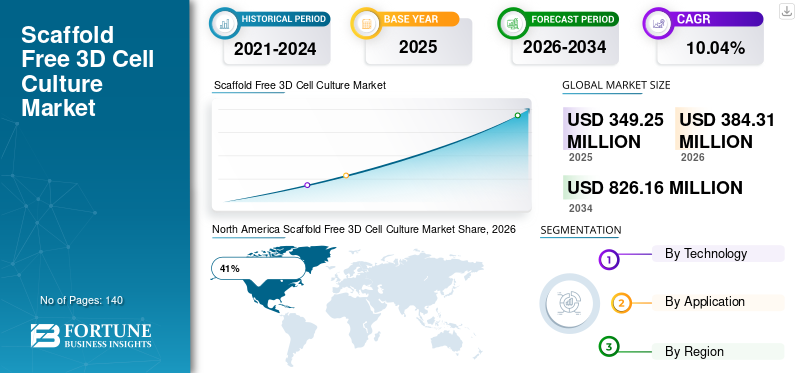
The scaffold free 3D cell culture market size was valued at USD 349.25 Million in 2025. The market is projected to grow from USD 384.31 Million in 2026 to USD 826.16 Million by 2034, exhibiting a CAGR of 10.04% during the forecast period.

The scaffold free 3D cell culture market has become an essential segment within life sciences research, biotechnology development, regenerative medicine, and pharmaceutical discovery. Scaffold-free technologies enable cells to self-assemble into spheroids and microtissues without requiring artificial support structures, resulting in biological models that closely mimic in vivo environments. The scaffold free 3D cell culture market is experiencing increased adoption due to growing demand for predictive drug screening, cancer biology research, tissue engineering applications, and stem cell investigations. Researchers increasingly prefer scaffold-free systems because they provide realistic cell-to-cell interactions, enhanced physiological relevance, and improved experimental outcomes. The scaffold free 3D cell culture market Report highlights strong demand from academic institutes, pharmaceutical companies, and biotechnology organizations seeking advanced cellular modeling technologies.
The United States represents the largest national market for scaffold-free 3D cell culture technologies. The country benefits from extensive biomedical research infrastructure, strong biotechnology ecosystems, and significant investments in drug discovery programs. Research organizations increasingly adopt scaffold-free spheroid technologies to improve translational research accuracy and reduce limitations associated with conventional two-dimensional cell cultures. The USA scaffold free 3D cell culture market analysis indicates growing implementation of advanced cell culture systems in oncology studies, stem cell development, immunotherapy research, and personalized medicine projects. Academic institutions and pharmaceutical laboratories continue expanding investments in automated culture platforms, high-content imaging systems, and predictive cellular models, supporting long-term market expansion across the United States.
Download Free sample to learn more about this report.
 Global Market Size & Forecast
 Market Share
 Key Regional Highlights
North America
North America led the market with a 41% share, supported by strong biotechnology and pharmaceutical research activity.
Europe
Europe accounted for 29% of the market, driven by growing adoption of advanced cell culture technologies.
Asia-Pacific
Asia-Pacific held a 23% share, supported by increasing investments in life sciences and regenerative medicine research.
U.S
The market is supported by strong pharmaceutical research, cancer studies, and adoption of advanced 3D cell culture technologies.
Japan
Demand is supported by growing investments in biotechnology, stem cell research, and advanced biomedical applications.
Read More

The scaffold free 3D cell culture market trends indicate increasing adoption of spheroid-based research models for drug toxicity testing and disease modeling. Pharmaceutical companies are utilizing scaffold-free systems to improve the predictive value of preclinical studies and reduce costly failures during clinical development. Researchers are increasingly integrating automation, robotics, and artificial intelligence into cell culture workflows to improve reproducibility and experimental efficiency.
Download Free sample to learn more about this report.
Another major trend shaping the scaffold free 3D cell culture market growth is the expansion of personalized medicine research. Scientists are creating patient-derived spheroids that replicate disease characteristics and treatment responses more accurately than traditional cell culture methods. The scaffold free 3D cell culture market insights also reveal growing interest in organoid development, regenerative medicine applications, and immuno-oncology studies. High-throughput screening platforms, advanced imaging technologies, and automated spheroid generation systems are becoming standard tools in modern laboratories. Furthermore, collaborations between biotechnology firms, academic research centers, and pharmaceutical companies continue accelerating innovation within scaffold-free cellular modeling technologies, strengthening the overall scaffold free 3D cell culture market outlook.
Rising Demand for Advanced Drug Discovery and Disease Modeling
The primary driver supporting scaffold free 3D cell culture market growth is the increasing demand for more predictive and physiologically relevant cellular models in pharmaceutical research. Traditional two-dimensional cultures often fail to replicate complex tissue structures and cellular interactions found in living organisms. Scaffold-free 3D systems address these limitations by enabling cells to self-organize into spheroids and multicellular structures that better represent human biology.
The scaffold free 3D cell culture market research report highlights growing use of these technologies in oncology research, toxicology studies, and drug screening programs. Pharmaceutical companies are investing heavily in advanced cell culture methods to improve candidate selection and reduce late-stage drug development failures. Researchers increasingly rely on scaffold-free models to investigate tumor progression, drug resistance mechanisms, and cellular signaling pathways. Growing interest in personalized medicine and patient-specific therapeutic development further supports market expansion. As regulatory agencies emphasize improved preclinical testing approaches, adoption of scaffold-free cellular systems continues increasing across research laboratories worldwide.
High Implementation Costs and Technical Complexity
One of the major restraints affecting the scaffold free 3D cell culture market is the relatively high cost associated with advanced culture systems, automated platforms, and specialized laboratory equipment. Many small research institutions and emerging biotechnology companies face budget constraints that limit widespread adoption.
The scaffold free 3D cell culture industry analysis indicates that researchers often require specialized training to establish reproducible spheroid cultures and optimize experimental conditions. Variability in spheroid formation, imaging challenges, and difficulties in standardizing protocols can create operational barriers. Furthermore, advanced imaging systems, high-content screening instruments, and automated liquid handling platforms represent significant investments. Limited availability of skilled personnel capable of managing complex three-dimensional cell culture experiments further restricts adoption in some regions. These challenges continue influencing purchasing decisions among cost-sensitive organizations and educational institutions.
Expansion of Regenerative Medicine and Personalized Therapies
A significant opportunity within the scaffold free 3D cell culture market opportunities landscape is the rapid expansion of regenerative medicine and personalized therapeutic development. Researchers increasingly utilize scaffold-free cell cultures to generate tissue-like structures that can support tissue repair, organ regeneration, and disease-specific modeling applications.
The scaffold free 3D cell culture market forecast suggests growing demand for patient-derived spheroids and organoid systems used in treatment response prediction and precision medicine programs. Biotechnology companies are investing in innovative cellular platforms capable of supporting stem cell differentiation and tissue engineering initiatives. As healthcare systems prioritize individualized treatment strategies, scaffold-free models are becoming valuable tools for evaluating therapeutic efficacy. Emerging markets are also increasing investments in biomedical research infrastructure, creating additional opportunities for technology providers. Advances in automation, imaging, and bioinformatics further enhance the commercial potential of scaffold-free cellular systems.
Standardization and Scalability Limitations
A major challenge facing the scaffold free 3D cell culture market is achieving consistent standardization across different research environments and experimental protocols. Variations in cell lines, culture conditions, media compositions, and spheroid generation methods can influence experimental outcomes and affect reproducibility.
The scaffold free 3D cell culture industry report emphasizes the need for scalable solutions capable of supporting large-scale pharmaceutical screening programs. Researchers frequently encounter difficulties when transitioning from laboratory-scale experiments to industrial applications. Imaging and analytical techniques must also evolve to accommodate increasingly complex three-dimensional structures. Regulatory validation and quality assurance requirements present additional challenges for commercial adoption. Manufacturers continue developing standardized platforms and automated systems to address these issues; however, achieving universal protocol harmonization remains an ongoing industry challenge.
Hanging Drop Microplates account for approximately 54% of the scaffold free 3D cell culture market share. This technology enables cells to aggregate naturally through gravity-induced spheroid formation, creating highly reproducible three-dimensional structures. Researchers prefer hanging drop systems because they provide excellent control over spheroid size and cellular composition. The technology is widely utilized in cancer biology studies, stem cell research, and drug screening applications.
The scaffold free 3D cell culture market analysis indicates that hanging drop microplates are particularly effective for generating uniform multicellular spheroids used in toxicity testing and therapeutic development. Pharmaceutical companies increasingly employ this technology to improve predictive modeling accuracy and evaluate treatment responses. Advances in automation and high-throughput compatibility continue supporting segment expansion. The ability to create physiologically relevant cellular structures without artificial scaffolds makes hanging drop systems a preferred choice among research institutions and biotechnology organizations.
Spheroid Microplates With Ultra-Low Attachment (ULA) Coating represent approximately 46% of the scaffold free 3D cell culture market size. These specialized microplates prevent cell adhesion to culture surfaces, encouraging spontaneous spheroid formation and multicellular aggregation. Researchers value ULA technology for its simplicity, scalability, and compatibility with automated laboratory workflows.
The scaffold free 3D cell culture market insights reveal increasing adoption of ULA-coated platforms in pharmaceutical screening programs and regenerative medicine research. These systems support large-scale spheroid production and facilitate integration with imaging and analytical technologies. Biotechnology companies are increasingly incorporating ULA microplates into high-throughput drug discovery workflows because of their operational efficiency and reproducibility. Growing investments in precision medicine and disease modeling continue strengthening demand for this technology segment.
To know how our report can help streamline your business, Speak to Analyst
Cancer Research accounts for approximately 62% of the scaffold free 3D cell culture market share. Oncology researchers increasingly utilize scaffold-free spheroids to replicate tumor microenvironments and investigate disease progression. These models provide realistic representations of cellular interactions, nutrient gradients, and drug penetration characteristics that are difficult to achieve using traditional two-dimensional cultures.
The scaffold free 3D cell culture market research report highlights widespread adoption of spheroid technologies in chemotherapy evaluation, immunotherapy development, and biomarker discovery. Pharmaceutical companies rely on three-dimensional tumor models to identify promising therapeutic candidates and optimize treatment strategies. Scaffold-free cancer models improve translational relevance and support personalized medicine initiatives by enabling patient-derived tumor investigations. The continued global focus on cancer treatment innovation remains a major growth driver for this application segment.
Stem Cell Research & Tissue Engineering contribute approximately 38% of the scaffold free 3D cell culture market growth. Researchers increasingly use scaffold-free culture technologies to investigate stem cell differentiation, tissue regeneration, and developmental biology processes. These systems provide physiologically relevant environments that support natural cellular organization and functional tissue formation.
The scaffold free 3D cell culture market outlook indicates growing demand for scaffold-free approaches in regenerative medicine programs. Scientists utilize spheroid cultures to develop tissue models for transplantation research, wound healing studies, and organ regeneration initiatives. Biotechnology organizations are investing in advanced cellular engineering platforms capable of generating complex tissue-like structures for therapeutic applications. Increasing interest in personalized regenerative therapies and cell-based treatments continues driving adoption across academic, clinical, and commercial research environments.
North America Scaffold Free 3D Cell Culture Market Share, 2025 (%)
To get more information on the regional analysis of this market, Download Free sample
North America holds approximately 41% of the scaffold free 3D cell culture market share. The region benefits from strong pharmaceutical research capabilities, advanced biotechnology infrastructure, and extensive government support for biomedical innovation. Research institutions actively adopt scaffold-free systems for oncology studies, drug development programs, and regenerative medicine investigations. The presence of major biotechnology companies and academic research centers strengthens regional demand. Increased focus on precision medicine, immunotherapy development, and translational research continues expanding the application scope of scaffold-free cell culture technologies. Automated laboratory workflows, high-content imaging platforms, and advanced analytical systems are widely implemented throughout North American research organizations, reinforcing the region's leadership position within the global scaffold free 3D cell culture market.
Europe accounts for approximately 29% of the scaffold free 3D cell culture market share. The region benefits from strong academic research networks, pharmaceutical manufacturing capabilities, and collaborative biomedical innovation initiatives. Research organizations increasingly utilize scaffold-free systems to support cancer biology studies, stem cell development, and tissue engineering projects. European laboratories emphasize alternative testing methods that reduce dependence on animal models while improving experimental accuracy. Government-funded scientific programs and biotechnology investments continue encouraging technology adoption. Germany, the United Kingdom, France, and the Netherlands remain key contributors to regional market development. Increasing demand for advanced disease modeling technologies and personalized medicine research continues strengthening the European scaffold free 3D cell culture market outlook.
Germany represents approximately 27% of the European scaffold free 3D cell culture market. The country maintains a strong position due to its advanced biotechnology sector, pharmaceutical manufacturing capabilities, and extensive academic research infrastructure. Research institutions across Germany increasingly utilize scaffold-free 3D cell culture systems to improve disease modeling accuracy and support innovative therapeutic development. Cancer research, regenerative medicine, and stem cell studies remain major application areas driving demand for spheroid generation technologies and advanced culture platforms.
The Germany scaffold free 3D cell culture market analysis highlights growing adoption of automated laboratory systems capable of producing highly reproducible spheroid models for drug screening applications. Biotechnology companies are investing in advanced cell culture technologies to enhance predictive testing and accelerate research timelines. Universities and biomedical research centers continue expanding collaborations with pharmaceutical organizations to develop next-generation cellular models. Increasing emphasis on reducing animal testing and improving translational research outcomes further strengthens market demand. The country’s strong focus on scientific innovation and laboratory modernization supports continuous adoption of scaffold-free cellular systems.
The United Kingdom accounts for approximately 22% of the European scaffold free 3D cell culture market. Strong investments in life sciences research, biomedical innovation, and pharmaceutical development support market growth throughout the country. Academic institutions and biotechnology firms increasingly utilize scaffold-free cell culture technologies for oncology studies, regenerative medicine projects, and personalized therapy research.
The United Kingdom scaffold free 3D cell culture market research report indicates rising demand for patient-derived spheroids and organoid-based models that improve understanding of disease mechanisms and therapeutic responses. Research hospitals and biotechnology companies continue integrating advanced cellular modeling platforms into preclinical research workflows. Government-supported scientific initiatives and collaborations between academic and commercial organizations contribute to technology adoption. The increasing use of artificial intelligence, automated imaging systems, and high-throughput screening technologies further enhances market opportunities. Growing emphasis on precision medicine and translational research continues strengthening the role of scaffold-free cellular systems within the United Kingdom.
Asia-Pacific holds approximately 23% of the scaffold free 3D cell culture market share. The region is experiencing rapid growth due to increasing investments in biotechnology infrastructure, pharmaceutical research, and regenerative medicine programs. Countries such as China, Japan, India, South Korea, and Australia are expanding research capabilities and strengthening biomedical innovation ecosystems. Academic institutions and biotechnology organizations are increasingly adopting scaffold-free technologies to improve disease modeling and accelerate drug discovery processes.
The scaffold free 3D cell culture industry analysis indicates growing awareness of advanced cellular research methods across Asia-Pacific. Pharmaceutical companies are investing in high-throughput screening platforms and predictive testing technologies to enhance research efficiency. Government initiatives supporting biotechnology development and healthcare innovation continue creating favorable market conditions. The expansion of personalized medicine, stem cell research, and cancer biology studies further contributes to increasing demand for scaffold-free 3D cell culture solutions throughout the region.
Japan represents approximately 20% of the Asia-Pacific scaffold free 3D cell culture market. The country is recognized for its strong biomedical research capabilities, advanced healthcare technologies, and significant investments in regenerative medicine. Research institutions increasingly utilize scaffold-free culture systems to support stem cell differentiation studies, tissue engineering applications, and disease-specific modeling projects.
The Japan scaffold free 3D cell culture market outlook highlights growing demand for advanced spheroid technologies used in drug discovery and personalized therapy development. Biotechnology companies continue investing in innovative culture platforms capable of supporting high-precision cellular research. Universities and research organizations are actively exploring scaffold-free approaches for organoid development and translational medicine initiatives. The country's focus on scientific excellence, automation, and precision research continues supporting market expansion and technology adoption.
China accounts for approximately 36% of the Asia-Pacific scaffold free 3D cell culture market. Rapid expansion of biotechnology parks, pharmaceutical manufacturing facilities, and biomedical research institutions has significantly increased demand for advanced cell culture technologies. The country continues investing heavily in life sciences research and laboratory modernization programs.
The China scaffold free 3D cell culture market insights indicate strong adoption of scaffold-free systems in oncology research, drug screening, and regenerative medicine applications. Domestic biotechnology companies are expanding research capabilities while international firms strengthen partnerships within the country. Government initiatives supporting healthcare innovation and scientific advancement continue encouraging technology implementation. Growing interest in precision medicine and advanced therapeutic development further accelerates demand for scaffold-free cellular platforms across China.
The Rest of World region accounts for approximately 7% of the scaffold free 3D cell culture market share. Countries in Latin America, the Middle East, and Africa are gradually increasing investments in biotechnology research and healthcare infrastructure. Academic institutions and research laboratories are adopting scaffold-free culture systems to support biomedical innovation and disease research activities.
The scaffold free 3D cell culture market forecast suggests growing opportunities in emerging economies where laboratory modernization initiatives are expanding. International collaborations, scientific training programs, and technology transfer efforts are improving access to advanced cellular research tools. Increasing awareness of predictive testing methods and regenerative medicine applications continues supporting gradual market growth throughout these regions.
The scaffold free 3D cell culture market opportunities continue expanding as biotechnology companies, pharmaceutical manufacturers, and venture capital firms increase investments in advanced cellular research technologies. Funding activities are particularly strong in oncology research, regenerative medicine, and personalized therapy development. Organizations are seeking innovative solutions capable of improving drug screening accuracy and accelerating therapeutic discovery programs.
The scaffold free 3D cell culture market Report indicates significant investment opportunities in automated spheroid generation platforms, high-content imaging technologies, and artificial intelligence-assisted analytical systems. Emerging markets are increasing expenditures on biotechnology infrastructure and laboratory modernization, creating favorable conditions for equipment suppliers. Research institutions continue expanding collaborations with commercial organizations to develop next-generation cellular models. Growing adoption of organoid technologies and tissue engineering platforms presents additional opportunities for long-term market expansion and technological innovation.
Innovation remains a major focus within the scaffold free 3D cell culture market. Manufacturers are developing advanced spheroid culture platforms that improve reproducibility, scalability, and automation. New systems increasingly incorporate artificial intelligence, robotics, and integrated imaging technologies to streamline laboratory workflows and improve experimental consistency.
The scaffold free 3D cell culture market trends indicate strong interest in automated microplate systems capable of generating uniform spheroids for high-throughput screening applications. Companies are introducing enhanced ultra-low attachment technologies, advanced culture media formulations, and cloud-connected analytical platforms. Product development efforts also focus on supporting organoid generation, stem cell differentiation, and personalized medicine research. These innovations continue improving the efficiency and predictive value of scaffold-free cellular models across pharmaceutical and biotechnology applications.
The scaffold free 3D cell culture market research report provides comprehensive analysis of market dynamics, technological developments, competitive positioning, and emerging growth opportunities. The report evaluates adoption patterns across pharmaceutical companies, biotechnology firms, academic institutions, and research laboratories. Detailed assessments of scaffold-free technologies, application segments, and end-user categories are included to support strategic decision-making.
Request for Customization to gain extensive market insights.
The scaffold free 3D cell culture industry report also examines regional developments across North America, Europe, Asia-Pacific, and Rest of World markets. Analysis covers technology advancements, investment activities, product innovation trends, and competitive strategies adopted by leading manufacturers. The report further explores market drivers, restraints, opportunities, and challenges influencing industry development. Comprehensive insights regarding scaffold free 3D cell culture market size, scaffold free 3D cell culture market share, scaffold free 3D cell culture market growth, scaffold free 3D cell culture market forecast, and scaffold free 3D cell culture market outlook support business planning and investment evaluation activities.
Fortune Business Insights says that the global market value stood at USD 349.25 million in 2025 and is projected to reach USD 826.16 million by 2034.
The market is expected to exhibit a CAGR of 10.04% during the forecast period of 2026-2034.
Cancer Research was the leading application segment, accounting for approximately 62% of the market, driven by increasing use of scaffold-free spheroids for tumor modeling, drug testing, and disease research.
Key players include Thermo Fisher Scientific Inc., Merck KGaA, Corning Incorporated, Lonza Group AG, Greiner Bio-One International GmbH, and InSphero AG.
Major trends include increasing adoption of spheroid-based models for drug toxicity testing and disease modeling and greater integration of automation, robotics, and AI into cell-culture workflows. North America leads with approximately 41% market share.


(Offer valid till 31st Oct 2026)
Get 30-60 hrs Free Customization
Expand Regional and Country Coverage, Segments Analysis, Company Profiles, Competitive Benchmarking, and End-user Insights.













.webp)






Get In Touch With Us
US +1 833 909 2966 ( Toll Free )
Receive a tailored pricing based on your needs.
Discuss your questions with our industry experts.
Have questions? Get quick answers before you purchase.

