 Download Free Sample



Get a Quote
Receive a tailored pricing based on your needs.
- Choose license type
- Multiple user options
- Custom scope & coverage
- Fast turnaround
"Electrifying your pathway to success through in-depth market research"
 Listen to Audio Version
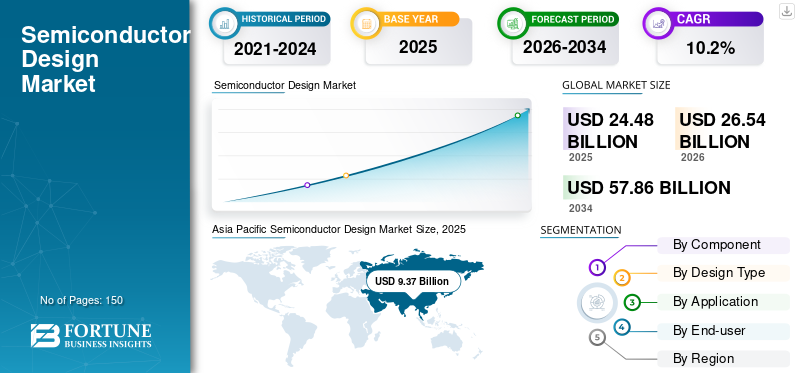
The global semiconductor design market size was valued at USD 24.48 billion in 2025. The market is projected to grow from USD 26.54 billion in 2026 to USD 57.86 billion by 2034, exhibiting a CAGR of 10.2% during the forecast period. Asia Pacific dominated the semiconductor design market with a market share of 38.27% in 2025.
The market includes the solutions and services used to design, verify, simulate, and optimize semiconductor devices before physical manufacturing. The market covers design activities across IC design, SoC design, FPGA design, analog and mixed-signal design, PCB design, embedded system design, memory design, and RF/microwave IC design. The solutions serve fabless semiconductor companies, integrated device manufacturers, foundries, OEMs, design service providers, and research institutes that require advanced design capabilities for chip and electronic system development. The market growth is driven by the rising demand for complex chips across consumer electronics, automotive, data centers, telecommunications, industrial electronics, healthcare, and aerospace & defense applications.
Synopsys, Inc., Cadence Design Systems, Inc., Siemens AG, and Arm Limited are the top players in the market.
Download Free sample to learn more about this report.
 Global Market Size & Forecast
 Market Share
 Key Regional Highlights
Asia Pacific
Asia Pacific holds the largest share in the market due to its strong semiconductor ecosystem across China, Taiwan, South Korea, Japan, India, and ASEAN.
North America
North America holds the second-largest share in the market due to its advanced semiconductor ecosystem across the U.S., Canada, and Mexico.
Europe
Europe holds a significant share in the market due to its established semiconductor ecosystem across Germany, the U.K., France, Italy, the Nordics, and Benelux.
U.S.
The U.S. market reached a value of around USD 6.73 billion in 2025, accounting for roughly 27.5% of global sales.
Japan
The Japanese market was valued at around USD 1.56 billion in 2025, accounting for roughly 6.4% of global revenues.
Read More

Growing Adoption of AI-enabled EDA Tools in Semiconductor Design
Design teams are increasingly using intelligent automation to manage verification, simulation, layout optimization, and performance tuning as chip architectures become more complex. This shift is helping semiconductor companies reduce manual engineering effort, improve design accuracy, and shorten development timelines across IC, SoC, FPGA, and AI processor development. It is becoming more important as advanced nodes, heterogeneous integration, and power-efficient chip requirements create higher design complexity. AI-enabled EDA tools are also supporting faster decision-making during chip development by identifying design issues earlier and improving engineering productivity. This trend is expected to strengthen the demand for advanced solutions and services.
Download Free sample to learn more about this report.
Rising Demand for Advanced Chips across AI, Data Center, Automotive, and Connected Device Applications to Propel Industry Expansion
The semiconductor design market growth is being driven by the rising need for advanced, high-performance, and power-efficient chips across multiple end-use industries. AI workloads, cloud data centers, software-defined vehicles, 5G infrastructure, consumer electronics, and industrial automation are spurring the demand for complex ICs, SoCs, FPGAs, and custom processors. This is pushing fabless companies, IDMs, OEMs, and design service providers to invest in advanced design solutions and engineering services. The growing use of smaller process nodes, heterogeneous architectures, and application-specific chip designs is further increasing design intensity and expanding the demand for semiconductor designing tools, IP, verification, and optimization services globally.
Shortage of Skilled Design Engineers May Hamper Industry Expansion
The market faces restraint from the limited availability of skilled semiconductor design engineers, particularly in areas such as IC design, SoC architecture, verification, physical design, analog and mixed-signal design, and embedded system development. Modern chip design requires deep expertise across hardware description languages, EDA tools, IP integration, advanced nodes, and system-level validation. The shortage of experienced talent can increase project costs, delay tape-outs, and reduce the ability of companies to scale complex chip programs. This challenge is more visible as AI chips, automotive semiconductors, and data center processors require highly specialized design capabilities.
Expansion of Chiplet-based and Heterogeneous Semiconductor Design to Open Doors to New Growth Avenues
The increasing shift toward chiplet-based architectures is creating strong opportunities for design solutions and service providers in the semiconductor sector. Chiplets allow companies to combine multiple specialized dies into a single package, improving design flexibility, performance, scalability, and cost efficiency compared to large monolithic chips. This approach is gaining traction across AI processors, high-performance computing, automotive electronics, data centers, and advanced networking applications. As chiplet adoption expands, the demand is expected to rise for advanced EDA tools, IP integration platforms, interconnect design, thermal analysis, package verification, and system-level co-design services, creating new revenue opportunities across the semiconductor design ecosystem.
Solutions Segment Dominated the Market due to Core Role in Chip Design Workflows
Based on component, the market is divided into solutions and services.
In 2025, the solutions segment held the largest share in the market as EDA software, simulation platforms, verification tools, layout tools, and IP design platforms form the core requirement for chip development. These solutions are essential across IC, SoC, FPGA, analog and mixed-signal, PCB, and embedded system design workflows, making them the primary spending area for fabless companies, IDMs, foundries, and OEMs.
The services segment is expected to grow at the highest CAGR of 12.3% over the analysis period. The segment is expanding as chip complexity is increasing and companies require external support for design engineering, verification, physical design, IP integration, prototyping, and validation. The shortage of skilled semiconductor design engineers and the rising demand for customized chips are further encouraging companies to outsource specialized design services.
IC Design Segment Led the Market as the Foundation of Semiconductor Product Development
Based on design type, the market is distributed into IC design, SoC design, FPGA design, analog & mixed-signal design, PCB design, embedded system design, and others.
In 2025, the IC design segment held the maximum market share of 28.3% as integrated circuits remain the foundation of nearly all semiconductor products used in consumer electronics, automotive systems, industrial devices, telecommunications equipment, and data center hardware. The segment has a broad application base and continuous demand for logic, memory, analog, power management, and mixed-signal ICs, supporting its leading position in the market.
The SoC design segment is expected to record the maximum CAGR of 12.9% over the forecast period as industries increasingly require compact, high-performance, and power-efficient chips that integrate processors, memory, connectivity, AI accelerators, sensors, and security functions on a single chip. Growth in smartphones, electric vehicles, edge AI devices, IoT products, and data center accelerators is accelerating the demand for advanced SoC design capabilities.
Consumer Electronics Segment Dominated the Market through High-volume Semiconductor Adoption
Based on application, the market is subdivided into consumer electronics, automotive, data centers, telecommunications, industrial electronics, healthcare, aerospace & defense, and others.
In 2025, the consumer electronics segment held a dominant semiconductor design market share of 25.2% due to the high-volume demand for semiconductors used in smartphones, laptops, tablets, wearables, gaming devices, smart TVs, home appliances, and connected devices. Frequent product refresh cycles, miniaturization, energy efficiency requirements, and demand for advanced features continue to drive strong design activity in this application segment.
The data centers segment is projected to grow at the highest CAGR of 14.0% over the analysis period as AI workloads, cloud computing, high-performance computing, and large-scale data processing increase the need for advanced GPUs, CPUs, ASICs, networking chips, memory controllers, and accelerator chips. Rising investment in AI infrastructure is pushing companies to design customized, high-bandwidth, and power-efficient semiconductor architectures for data center environments.
To know how our report can help streamline your business, Speak to Analyst
Fabless Semiconductor Companies Segment Led the Market due to Design-centric Business Model and Custom Chip Demand
Based on end-user, the market is segmented into fabless semiconductor companies, integrated device manufacturers, foundries, OEMs, and others.
In 2025, the fabless semiconductor companies segment accounted for the largest share of 34.9% as their business model is centered on chip design, architecture development, verification, and commercialization while outsourcing fabrication to foundries. The segment is also expected to grow at the maximum CAGR of 11.8% during the analysis period as the demand for custom AI chips, automotive semiconductors, edge processors, connectivity ICs, and application-specific chips continues to expand across global markets. Fabless firms rely heavily on EDA solutions, semiconductor IP, design services, and verification platforms, which directly support their strong contribution to the market.
The integrated device manufacturers segment held the second-largest share in 2025 and is anticipated to expand at a CAGR of 8.3% over the analysis period. The segment is expanding as they manage both design and manufacturing capabilities, particularly for memory, analog, power, microcontroller, and specialty semiconductor products, where in-house design remains strategically important.
By geography, the market is categorized into North America, South America, Asia Pacific, Europe, and the Middle East & Africa.
Asia Pacific Semiconductor Design Market Size, 2025 (USD Billion)
To get more information on the regional analysis of this market, Download Free sample
Asia Pacific holds the largest share in the market due to its strong semiconductor ecosystem across China, Taiwan, South Korea, Japan, India, and ASEAN. The region has a high concentration of fabless companies, electronics OEMs, foundries, OSAT providers, and semiconductor manufacturing clusters, creating strong demand for design solutions and services. Government-backed semiconductor programs, rising electronics production, and growing demand from consumer electronics, automotive electronics, telecommunications, and AI hardware further strengthen the region’s leadership.
To know how our report can help streamline your business, Speak to Analyst
The Japanese market was valued at around USD 1.56 billion in 2025, accounting for roughly 6.4% of global revenues.
The China market is projected to be one of the largest markets globally, with 2025 revenues of around USD 3.41 billion, roughly 13.9% of global sales.
The India market was valued at around USD 0.89 billion in 2025, accounting for roughly 3.6% of global revenues.
North America holds the second-largest share in the market due to its advanced semiconductor ecosystem across the U.S., Canada, and Mexico. The region has a strong presence of fabless companies, EDA vendors, cloud providers, AI chip developers, and advanced computing firms, creating high demand for design solutions and services. Strong R&D investment, advanced IP development, and rising demand from AI, data centers, automotive electronics, aerospace and defense, and custom chips continue to support the region’s market position.
The U.S. market reached a value of around USD 6.73 billion in 2025, accounting for roughly 27.5% of global sales.
Europe holds a significant share in the market due to its established semiconductor ecosystem across Germany, the U.K., France, Italy, the Nordics, and Benelux. The region has strong demand from automotive electronics, industrial semiconductors, power electronics, embedded systems, telecom infrastructure, and aerospace and defense, creating steady demand for design solutions and services. Policy support for semiconductor sovereignty, rising automotive electrification, and growing investment in Industry 4.0 and connected infrastructure further support the region’s market position.
The U.K. market was valued at approximately USD 0.75 billion in 2025, accounting for roughly 3.1% of global revenues.
The Germany market reached approximately USD 1.39 million in 2025, equivalent to around 5.7% of global sales.
The Middle East & Africa market is expected to grow at the highest CAGR over the analysis period due to increasing investments in digital infrastructure, AI, data centers, smart cities, telecom networks, and technology localization programs. The region is witnessing rising participation from GCC countries, Israel, Turkey, and South Africa in semiconductor-related innovation, electronics design, and advanced technology ecosystems. Government-backed digital transformation programs, rising cloud infrastructure investment, and growing demand from AI, telecom, and smart mobility applications are expected to support faster market growth.
The GCC market reached approximately USD 0.42 billion in 2025, accounting for roughly 1.7% of global revenues.
The South America market is expected to grow at an average rate due to its moderate semiconductor ecosystem across Brazil, Argentina, and other regional markets. The region depicts a rising demand from consumer electronics, automotive electronics, telecom equipment, industrial automation, and IT infrastructure, creating steady demand for design solutions and services. However, limited semiconductor fabrication capacity, fewer large fabless companies, and comparatively lower R&D investment are expected to restrict market growth.
The Brazil market was valued at around USD 0.53 billion in 2025, accounting for roughly 2.2% of global revenues.
Leading Players Launch New Solutions to Strengthen their Market Standing
Key players in the semiconductor design market are strengthening their positions by launching advanced design solutions, improving automation, and addressing the rising complexity of chip development. Companies are focusing on AI-enabled EDA platforms, semiconductor IP integration, verification, simulation, physical design optimization, high bandwidth memory designs, and energy efficient chip architectures to enhance their offerings. Portfolio expansion, partnerships, acquisitions, and ecosystem development further help designers and manufacturers, chip manufacturers, and technology providers strengthen their role across the global supply chain.
The global semiconductor design market report provides a comprehensive assessment of market size and forecasts across all covered segments. It analyzes key market dynamics, emerging trends, technological advancements, and capital expenditures that are expected to influence market growth during the forecast period. The report further highlights major industry developments, including partnerships, mergers, acquisitions, and strategic initiatives adopted by key players. It also includes a detailed competitive landscape, market share analysis, and profiles of leading companies operating in the market.
Request for Customization to gain extensive market insights.
| ATTRIBUTE | DETAILS |
| Study Period | 2021-2034 |
| Base Year | 2025 |
| Estimated Year | 2026 |
| Forecast Period | 2026-2034 |
| Historical Period | 2021-2024 |
| Growth Rate | CAGR of 10.2% from 2026-2034 |
| Unit | Value (USD Billion) |
| Segmentation | By Component, By Design Type, By Application, By End-user, and By Region |
| By Component |
|
| By Design Type |
|
| By Application |
|
| By End-user |
|
| By Region |
|
Fortune Business Insights says that the global market value stood at USD 24.48 billion in 2025 and is projected to reach USD 57.86 billion by 2034.
In 2025, the Asia Pacific market value stood at USD 9.37 billion.
The market is expected to grow at a CAGR of 10.2% over the forecast period.
By end-user, the fabless semiconductor companies segment led the market in 2025.
The market is driven by the rising demand for advanced chips, growing AI and data center workloads, increasing automotive electronics adoption, and the need for faster, power-efficient semiconductor designs.
Synopsys, Inc., Cadence Design Systems, Inc., and Siemens AG are the top players in the market.
Asia Pacific holds the largest market share.
Key factors that favor the product adoption include increasing chip complexity, AI and data center demand, automotive electronics growth, and the need for faster, power-efficient designs.

Get 30-60 hrs Free Customization
Expand Regional and Country Coverage, Segments Analysis, Company Profiles, Competitive Benchmarking, and End-user Insights.




















Related Reports
Get In Touch With Us
US +1 833 909 2966 ( Toll Free )
Receive a tailored pricing based on your needs.
Discuss your questions with our industry experts.
Have questions? Get quick answers before you purchase.

