Beverage Packaging Market Size, Share & Industry Analysis, By Material (Plastic, Glass, Metal, and Others), By Product Type (Cans, Bottles & Jars, Pouches, Cartons, and Others), By Application (Alcoholic and Non - Alcoholic), and Regional Forecast, 2026-2034
 Download Free Sample
(Offer valid till 31st Oct 2026)

KEY MARKET INSIGHTS
 Listen to Audio Version
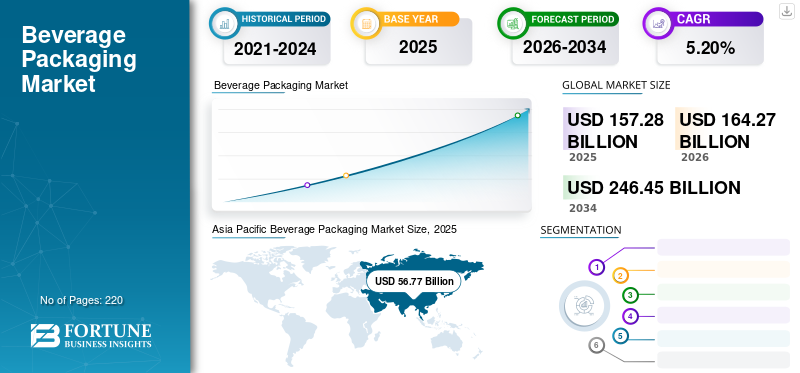
The global beverage packaging market size was valued at USD 157.28 billion in 2025 and is projected to grow from USD 164.27 billion in 2026 to USD 246.45 billion by 2034, exhibiting a CAGR of 5.20% during the forecast period. Asia Pacific dominated the beverage packaging market with a market share of 36.09% in 2025. Moreover, the beverage packaging market in the U.S. is projected to grow significantly, reaching an estimated value of USD 39.43 billion by 2032, driven by the increasing demand for carbonated drinks, energy drinks, and soft drinks among the younger generation.
Packaging is generally done to protect the product from damage and attract customers by enhancing its visuals through the utilization of advanced decorative techniques, which also helps the product stand out among competitors. Beverage packaging plays a crucial role in protecting liquids as they are prone to leakages and contamination. Packaging companies provide a wide range of products, such as cans, bottles, jars, pouches, and cartons, to increase the shelf life and sales of beverages. The high strength, lightness, and protection from the external environment offered by the packaging solutions may accelerate the beverage packaging market growth.
Due to stringent government regulations, labor shortages, and high prices of raw materials during the COVID-19 pandemic, production was hampered, resulting in the contraction of demand for beverage packaging products. Moreover, the rise in the number of online food & beverage outlets in the ever-growing e-commerce industry is anticipated to propel the beverage packaging market share in the post-pandemic era.
Download Free sample to learn more about this report.
Beverage Packaging Market Key Takeaways
 Global Market Size & Forecast
- 2025 Market Size: USD 157.28 Billion
- 2026 Market Size: USD 164.27 Billion
- 2034 Forecast Market Size: USD 246.45 Billion
- CAGR: 5.20% from 2026–2034
 Market Share
- Asia Pacific dominated the beverage packaging market with a 36.09% share in 2025.
- The plastic segment is projected to account for 38.42% of the market in 2026.
- The non-alcoholic beverages segment is expected to hold a 52.71% market share in 2026.
 Key Regional Highlights
Asia Pacific
Asia Pacific accounted for USD 56.77 billion, representing 36.09% of the global market in 2025.
Europe
Europe reached USD 45.76 billion, holding 29.09% of the global market in 2025.
North America
North America was valued at USD 36.91 billion, accounting for 23.47% of the global market in 2025.
U.S.
The U.S. beverage packaging market is projected to reach USD 31.69 billion by 2026.
Japan
The Japan beverage packaging market is projected to reach USD 10.05 billion by 2026.
Read More

Beverage Packaging Market Trends
Surge in Usage of Sustainable Materials to Emerge as a Key Trend
The growing environmental concerns among manufacturers and consumers have surged the demand for sustainable packaging. The use of recyclable materials and invention of bioplastic will become a significant trend in the market. Governments and organizations in several emerging and developed nations have increased their focus on using sustainable materials and recycling & reusing packaging products to save the environment from the hazardous effects of non-recyclable plastic and other packaging materials. For instance, the EU Waste Framework Directive set a target for 50% of waste to be recycled by 2020. The regulation placed a legal obligation on companies over a particular size, make, or use of packaging to make sure that a particular percentage of the packaging released in the market is recycled and recovered. The U.K. parliament set targets for plastic and paper recycling provided by the EU Waste Directive, and the targets for 2020 were 69.5% and 51%, respectively.
Moreover, manufacturers are also taking initiatives by launching sustainable products. For instance, in June 2023, Coca-Cola India launched a new bottle made from 100% rPET (recycled PET) with the support of packaging giant ALPLA. It is the first time when that a 100% rPET bottle has been used in India for food or drinks. Such initiatives will also motivate other small players and even players from other emerging nations to use sustainable packaging.
Download Free sample to learn more about this report.
Beverage Packaging Market Growth Factors
Rising Consumption of Non-Alcoholic Drinks to Contribute to Market Growth
The growing demand for non-alcoholic drinks, such as bottled water, milk, soft drinks, energy drinks, and carbonated drinks is driving the market’s growth. The change in people’s preferences and increase in the consumption of healthy drinks after the COVID-19 outbreak has accelerated the demand for non-alcoholic beverages. These beverages have high health benefits, such as improving digestion, providing instant energy, and enhancing heart health. Owing to this, people are more inclined toward these beverages, thereby increasing the demand for their packaging. Moreover, the rising inclination toward the consumption of ready-to-drink and packed beverages has enhanced the growth of this market. Furthermore, the launch of flavored milk and juices, along with carbonated drinks having attractive packaging, has increased the consumption of these products among children and the elderly population. In addition, the surging e-commerce industry is enhancing the demand for non-alcoholic beverages, such as soft drinks, juices, and packaged milk.
Furthermore, the surging demand for non-alcoholic beer, de-alcoholized wine and alcohol-free liqueurs among younger generations due to fear of overconsumption and health issues is helping in the lucrative growth of this market.
Significant Benefits Offered by Beverage Packaging to Drive Market Growth
This market is experiencing significant growth as it safeguards the product from contamination and harmful rays, and increases product shelf life. Packaging provides an isolated environment during storage and transportation, and prevents the product from coming in contact with micro-organisms. Moreover, the decorative designs attract a large customer base and provide as much information to the consumer, helping the market grow. Beverages are prone to leakages, and tough packaging materials, such as metal cans and plastic bottles keep liquids safe. In addition, rising use of tetra packs to pack drinks is anticipated to aid the market growth as they are sustainable and increase the shelf life of liquids.
RESTRAINING FACTORS
Strict Rules Against Use of Non-Recyclable Materials to Restrict Market Growth
Governments of developed and emerging nations have imposed stringent rules and regulations to ban single-use plastic and curb the usage of non-recyclable plastic. Plastic and glass are widely used in beverage packaging as they protect the liquids from leakage and contamination. But they are not easy to recycle and can thus hamper the growth of this market. Moreover, the lack of manufacturing units and machinery in developing nations for recycling this material will impede the growth of this industry. For instance, according to the World Economic Forum, the total bottle recycling rate for 2020 was 27.2%, down from 28.7% in 2019, and 2.5 million plastic bottles are thrown away in the U.S. every hour, increasing landfill waste.
Manufacturers are shifting from plastic and glass to metal and paper as the latter are sustainable. However, it is expected to increase the manufacturing cost and price of the end product, thereby affecting the consumers’ buying behavior.
Beverage Packaging Market Segmentation Analysis
By Material Analysis
Plastic to Dominate Market Due to Its Various Properties
Based on material, the market is segmented into plastic, glass, metal, and others.
Plastic materials hold the largest market share and is expected to account for 38.42% of the market in 2026. Plastic materials have several benefits, such as high strength and stability, and are leak-proof. These materials can survive extreme temperatures, which protects beverages during transportation. Moreover, the surging use of bioplastic and other plastic types, which are easy to recycle, is expected to drive the growth of this segment.
By Product Type Analysis
Bottles & Jars to Gain Traction Among End-Users to Pack Large Volumes of Drinks
Based on product type, the market is segmented into cans, bottles & jars, pouches, cartons, and others.
In 2026, the bottles & jars segment is projected to lead the market with a 44.82% share. These products are widely used in the packaging of beverages as they provide better safety to liquids, are easy to handle, and can be used to pack large amounts of liquids. In addition, glass bottles maintain the freshness of beverages and enhance the appearance of the packaging. Furthermore, the transparency of glass bottles attracts customers and will contribute to the growth of this segment.
By Application Analysis
To know how our report can help streamline your business, Speak to Analyst
Non-Alcoholic Beverages to Dominate Market Due To Their Widespread Benefits
Based on application, the market is segmented into alcoholic and non-alcoholic.
Non–alcoholic beverages are the leading application of the global beverage packaging industry. A large amount of packaging material is used to pack fruit juices, soft drinks, carbonated drinks, milk, smoothies, purees, and various other liquids. The rising demand for energy drinks and changing lifestyles are contributing to the growth of this segment. After the pandemic, people are more concerned for their health and inclined toward products that help them increase the nutrition of their diet. This has led to rise in the consumption of non-alcoholic beverages. The non-alcoholic segment is anticipated to hold a dominant market share of 52.71% in 2026.
REGIONAL INSIGHTS
Asia Pacific Beverage Packaging Market Size, 2025 (USD Billion)
To get more information on the regional analysis of this market, Download Free sample
The market is analyzed across North America, Europe, Asia Pacific, Latin America, the Middle East, and Africa.
Asia Pacific
The Asia Pacific market was valued at USD 56.77 billion in 2025, capturing 36.09% of global revenue, and is estimated to reach USD 59.77 billion in 2026. Rapid changes in consumer lifestyles and a shifting preference toward non-alcoholic drinks are expected to enhance market growth in this region. Emerging economies such as China and India, along with their increasing populations, are boosting product consumption, thereby propelling market growth across the Asia Pacific region. The Japan market is projected to reach USD 10.05 billion by 2026, the China market is projected to reach USD 12.3 billion by 2026, and the India market is projected to reach USD 11.76 billion by 2026.
Europe
Europe accounted for USD 45.76 billion in 2025, representing 29.09% of the global market share, and is projected to reach USD 47.82 billion in 2026. Europe is the second-largest dominating region in the beverage packaging industry. High alcohol consumption in the region, influenced by climatic conditions, along with the presence of major market players, is expected to drive regional market growth. The UK market is projected to reach USD 6.45 billion by 2026, while the Germany market is projected to reach USD 8.63 billion by 2026.
North America
North America contributed 23.47% to the global market in 2025, with a valuation of USD 36.91 billion, and is projected to reach USD 38.35 billion in 2026. North America is projected to record a moderate growth rate due to increasing demand for carbonated drinks, energy drinks, and soft drinks, particularly among the younger generation. The US market is projected to reach USD 31.69 billion by 2026.
Latin America
In 2025, the Latin America market stood at USD 11.41 billion, representing 7.25% of global demand, and is projected to grow to USD 11.76 billion in 2026. Latin America is expected to witness steady growth, supported by the increasing number of online food and beverage outlets and rising disposable income levels.
Middle East & Africa
The market in Middle East & Africa reached USD 6.43 billion in 2025, representing 4.09% of total market revenue, and is projected to reach USD 6.57 billion in 2026. The Middle East & Africa market is anticipated to experience moderate growth due to rapid urbanization and the growing influence of Western trends on the younger population.
List of Key Companies in Beverage Packaging Market
Key Market Participants to Witness Significant Growth Opportunities
The global market is highly fragmented and competitive. In terms of market share, a few major players are dominating the market by offering innovative packaging solutions. These major players in the market are constantly focusing on expanding their customer base across the regions and innovating their existing products.
Major players in the market include Amcor Plc, Glasswork International, Ball Corporation, Crown Holdings, and others. Numerous other players operating in the industry are focused on delivering advanced packaging solutions.
List of Key Companies Profiled:
- Amcor plc (Australia)
- Glassworks International (U.K.)
- Crown Holdings (U.S.)
- Mondi Group (U.K.)
- Graham Packaging Company (U.S.)
- Sonoco Products Company (U.S.)
- Refresco Group (Netherlands)
- Ball Corporation (U.S.)
- Berry Global Inc. (U.S.)
- Tetra Pak Group (Switzerland)
KEY INDUSTRY DEVELOPMENTS:
- March 2023 - Hinojosa Packaging Group, one of the leading brands in sustainable packaging, launched a new range of primary packaging for the prepared foods & beverages market. This packaging is said to be 100% recyclable and mainly designed for hot and cold beverages.
- September 2022 - Vetropack launched the Echovai bottle, made from tempered lightweight glass weighing 30% less than the standard returnable bottles. It is more resistant to abrasion and reduces the logistical effort.
- August 2021 - AstraPouch announced the launch of its flexible beer packaging solution. The packaging is of dark amber color to protect the beer from the UVA/UVB lights and has a smaller head space to preserve the carbonation and quality of the product.
- June 2021 - Volnaa launched mineral water in aluminum cans. The vision behind launching these cans was to reduce plastic pollution by using 100% recyclable aluminum cans with relock technology for lids.
- May 2020 - Gualapack, one of the leading producers of flexible packaging, launched recyclable mono-material pouches in collaboration with Jufico. These pouches were available in two versions, one was for hot-filled and pasteurized shelf-stable products, and another was for cold-filling/dairy applications. These pouches offered protection against oxygen and water vapor.
REPORT COVERAGE
The market research report provides a detailed analysis of the market and focuses on key aspects, such as leading companies, competitive landscape, product/service types, porters five forces analysis, and leading applications of the product. Besides, the report offers insights into the latest market trends and highlights key industry developments. In addition to the above factors, the report encompasses several factors that contributed to the market's growth in recent years.
REPORT SCOPE AND SEGMENTATION
|
ATTRIBUTE |
DETAILS |
|
Study Period |
2021-2034 |
|
Base Year |
2025 |
|
Estimated Year |
2026 |
|
Forecast Period |
2026-2034 |
|
Historical Period |
2021-2024 |
|
Unit |
Value (USD Billion) |
|
Segmentation |
By Material
|
|
By Product Type
|
|
|
By Application
|
|
|
By Region
|
Frequently Asked Questions
The Fortune Business Insights study shows that the global market was USD 157.28 billion in 2025.
The global market is projected to record a CAGR of 5.20% during the forecast period.
The market size of Asia Pacific stood at USD 56.77 billion in 2025.
Based on material, the plastic segment will dominate the global market share due to the significant features offered by the material.
The global market size is expected to reach USD 246.45 billion by 2034.
The key market drivers, such as rising consumption of non-alcoholic drinks and benefits offered by beverage packaging are contributing to the growth of this market.
The top players in the market are Amcor Plc, Glasswork International, Ball Corporation, and Crown Holdings, among others.



- 2021-2034
- 2025
- 2021-2024
- 220
-
(Offer valid till 31st Oct 2026)
Get 30-60 hrs Free Customization
Expand Regional and Country Coverage, Segments Analysis, Company Profiles, Competitive Benchmarking, and End-user Insights.







Related Reports
-
US +1 833 909 2966 ( Toll Free )
-
Get In Touch With Us