 Download Free Sample



Get a Quote
Receive a tailored pricing based on your needs.
- Choose license type
- Multiple user options
- Custom scope & coverage
- Fast turnaround
"Designing Growth Strategies is in our DNA"
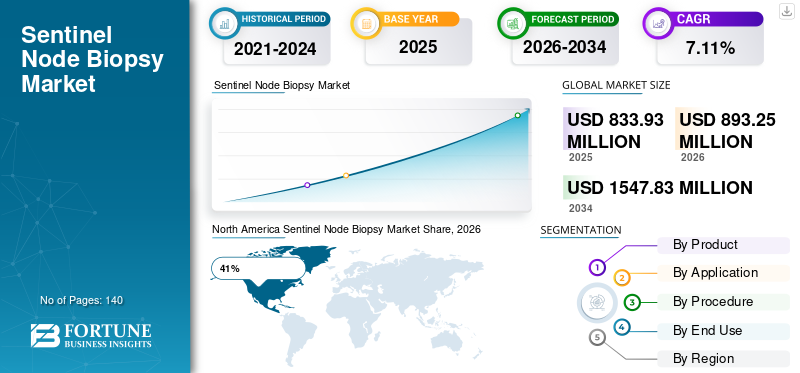
The global sentinel node biopsy market size was valued at USD 833.93 million in 2025. The market is projected to grow from USD 893.25 million in 2026 to USD 1547.83 million by 2034, exhibiting a CAGR of 7.11% during the forecast period.

The sentinel node biopsy market is expanding steadily due to increasing cancer diagnosis rates, rising adoption of minimally invasive surgical procedures, and growing awareness regarding early-stage cancer detection. Sentinel node biopsy procedures are widely utilized in oncology to determine cancer spread while minimizing unnecessary lymph node removal. Healthcare providers are increasingly adopting advanced imaging systems, diagnostic kits, and surgical instruments to improve procedural precision and patient outcomes. The sentinel node biopsy market report highlights strong demand for targeted diagnostic approaches in breast cancer and melanoma management. Technological advancements in radioactive tracers, fluorescence imaging, and hybrid diagnostic systems continue to strengthen market growth across global healthcare institutions.
The USA sentinel node biopsy market remains a leading regional contributor due to advanced oncology infrastructure, high cancer screening rates, and strong adoption of minimally invasive surgical technologies. Hospitals and specialty cancer centers in the United States are increasingly implementing image-guided biopsy procedures to improve diagnostic accuracy and reduce post-surgical complications. Rising prevalence of breast cancer and melanoma continues to drive demand for sentinel lymph node mapping technologies. Healthcare providers are emphasizing personalized oncology treatment pathways supported by advanced imaging agents and surgical navigation systems. The sentinel node biopsy industry analysis also reflects growing investment in cancer diagnostics research and precision oncology solutions throughout the United States healthcare market.
Download Free sample to learn more about this report.
 Global Market Size & Forecast
 Market Share
 Key Regional Highlights
North America
North America led the market with a 41% share, supported by advanced oncology infrastructure and adoption of minimally invasive procedures.
Europe
Europe accounted for 29% of the market, driven by growing demand for precision cancer staging technologies.
Asia-Pacific
Asia-Pacific held a 22% share, supported by rising cancer prevalence and expanding healthcare infrastructure.
U.S
The market is supported by advanced oncology facilities, increasing breast cancer procedures, and adoption of image-guided biopsy technologies.
Japan
Demand is supported by growing adoption of minimally invasive oncology procedures and advanced diagnostic technologies.
Read More

The sentinel node biopsy market trends are evolving rapidly with increasing adoption of fluorescence-guided imaging technologies and minimally invasive oncology procedures. Healthcare providers are focusing on advanced imaging agents that improve lymph node visualization and enhance surgical precision during cancer staging procedures. Hybrid imaging systems integrating radioactive tracers with fluorescence detection technologies are becoming increasingly popular across oncology centers and specialized surgical facilities.
Download Free sample to learn more about this report.
Another important trend in the sentinel node biopsy market research report is the growing integration of artificial intelligence and digital imaging solutions into cancer diagnostics. Surgeons are increasingly utilizing image-guided navigation systems to improve biopsy accuracy and reduce procedural complications. Rising preference for outpatient cancer surgeries and shorter recovery periods is also supporting the adoption of minimally invasive biopsy techniques. Pharmaceutical and medical device manufacturers are investing in innovative tracer agents and portable imaging systems designed for enhanced clinical performance. The sentinel node biopsy market outlook further highlights increasing collaboration between oncology research institutions and medical technology companies focused on improving cancer staging efficiency and patient-centered surgical outcomes.
Increasing Prevalence of Breast Cancer and Melanoma
The growing prevalence of breast cancer and melanoma is a major driver accelerating the sentinel node biopsy market growth globally. Rising cancer awareness campaigns and expanding screening programs are improving early-stage cancer detection, increasing the need for accurate lymph node assessment procedures. Sentinel node biopsy has become a preferred technique because it reduces unnecessary lymph node dissection and minimizes post-operative complications such as lymphedema.
Healthcare providers are increasingly adopting advanced sentinel lymph node mapping technologies to improve surgical precision and patient recovery outcomes. Hospitals and oncology centers are investing in innovative imaging systems and biopsy instruments to strengthen cancer staging capabilities. The sentinel node biopsy market analysis indicates that growing demand for minimally invasive oncology procedures is significantly supporting adoption across developed and emerging healthcare markets. Government healthcare agencies and cancer research organizations are also emphasizing early diagnosis and precision oncology strategies, creating strong opportunities for medical device manufacturers and diagnostic technology providers within the global oncology sector.
High Procedural and Imaging Technology Costs
One of the major restraints affecting the sentinel node biopsy market size is the high cost associated with advanced imaging systems, radioactive tracers, and specialized surgical equipment. Many healthcare facilities, particularly in developing regions, face financial limitations when adopting technologically advanced biopsy solutions. The need for nuclear medicine infrastructure and trained oncology professionals further increases operational costs for hospitals and specialty cancer centers.
Complex regulatory approval procedures for imaging agents and diagnostic kits also create commercialization barriers for manufacturers. Smaller healthcare facilities may experience challenges related to reimbursement coverage and equipment procurement, limiting broader market penetration. The Sentinel Node Biopsy Industry Report also highlights concerns regarding radiation safety protocols and infrastructure requirements associated with certain lymph node mapping technologies. Additionally, limited awareness regarding sentinel node biopsy procedures in underdeveloped healthcare markets can delay adoption rates. These financial and operational constraints continue to influence overall growth within the global sentinel node biopsy industry landscape.
Expansion of Image-Guided and Personalized Oncology Procedures
The increasing expansion of image-guided oncology procedures presents substantial opportunities within the sentinel node biopsy market opportunities landscape. Healthcare providers are rapidly adopting fluorescence imaging systems and advanced diagnostic tracers designed to improve lymph node detection accuracy and surgical outcomes. Personalized cancer treatment approaches are also encouraging the use of targeted diagnostic technologies that support precise disease staging and treatment planning.
Medical technology companies are investing heavily in portable imaging systems, artificial intelligence-enabled diagnostics, and hybrid tracer agents that enhance clinical efficiency. The sentinel node biopsy market forecast further indicates rising opportunities in emerging healthcare markets where cancer screening programs and oncology infrastructure are improving significantly. Academic research institutions and oncology centers are increasingly collaborating on clinical studies aimed at improving biopsy precision and reducing surgical complications. The growing popularity of outpatient oncology procedures and minimally invasive cancer surgeries is expected to create long-term expansion opportunities for imaging agents, diagnostic kits, and surgical navigation technologies globally.
Shortage of Specialized Oncology Professionals
The sentinel node biopsy market challenges are increasing due to the shortage of trained oncology surgeons, nuclear medicine specialists, and diagnostic imaging professionals required for advanced biopsy procedures. Sentinel node biopsy procedures involve complex imaging interpretation and precise surgical techniques, making specialized expertise essential for accurate clinical outcomes. Many developing healthcare systems continue to face workforce limitations that restrict adoption of advanced cancer staging technologies.
Healthcare institutions are also challenged by the need for continuous training and certification programs related to evolving imaging systems and diagnostic tracers. The rapid pace of technological innovation often requires hospitals to upgrade infrastructure and clinical workflows, increasing operational complexity. The sentinel node biopsy market research report further highlights challenges associated with maintaining radiation safety standards and integrating multidisciplinary oncology care teams. Reimbursement inconsistencies and regulatory variations across healthcare systems can also create financial uncertainty for hospitals and medical technology providers. These workforce and operational challenges continue to influence the competitive landscape of the sentinel node biopsy industry.
Surgical instruments account for nearly 46% of the global sentinel node biopsy market share due to the increasing demand for precision-based oncology procedures. This segment includes biopsy needles, forceps, probes, surgical navigation systems, and minimally invasive surgical tools designed to improve lymph node identification and removal accuracy. Hospitals and specialty oncology centers are increasingly investing in advanced surgical technologies to enhance procedural safety and reduce patient recovery times. The sentinel node biopsy market report indicates growing adoption of robotic-assisted surgical instruments and image-guided biopsy systems across modern healthcare facilities. Surgeons are prioritizing minimally invasive tools that reduce tissue damage and improve diagnostic efficiency during breast cancer and melanoma procedures.
To know how our report can help streamline your business, Speak to Analyst
Imaging agents represent approximately 34% of the sentinel node biopsy market size and play a critical role in accurate lymph node mapping and cancer staging procedures. Radioactive tracers, blue dyes, and fluorescence imaging agents are widely utilized to identify sentinel lymph nodes before surgical removal. Healthcare providers are increasingly adopting hybrid imaging agents that improve visualization accuracy and reduce procedural complexity during oncology surgeries. The sentinel node biopsy market analysis highlights growing demand for safer and more efficient imaging compounds that minimize radiation exposure while enhancing surgical precision. Pharmaceutical and biotechnology companies are investing in next-generation tracer development focused on improved sensitivity and faster detection capabilities. Hospitals and cancer treatment centers are integrating fluorescence-guided imaging systems to optimize real-time surgical navigation.
Diagnostic Kits: Diagnostic kits account for nearly 20% of the sentinel node biopsy market outlook and are becoming increasingly important in streamlining cancer staging procedures. These kits are designed to support efficient preparation, identification, and processing of sentinel lymph node samples during oncology surgeries. Healthcare providers are emphasizing standardized diagnostic workflows to improve pathology accuracy and clinical decision-making. The sentinel node biopsy market research report indicates rising demand for integrated diagnostic solutions that combine imaging support, pathology analysis, and surgical guidance technologies. Diagnostic kit manufacturers are focusing on user-friendly designs and enhanced compatibility with modern oncology imaging systems. Hospitals and pathology laboratories are increasingly implementing advanced diagnostic protocols to improve cancer detection accuracy and reduce procedural turnaround times.
Breast cancer represents the largest application segment in the sentinel node biopsy market growth, accounting for approximately 68% of global demand. Sentinel node biopsy procedures are widely used in breast cancer staging to determine whether cancer cells have spread to nearby lymph nodes. The procedure significantly reduces the need for complete axillary lymph node dissection, minimizing surgical complications and improving patient recovery outcomes. The sentinel node biopsy market industry analysis indicates rising adoption of minimally invasive breast cancer diagnostic procedures across hospitals, ambulatory surgical centers, and oncology clinics. Healthcare providers are increasingly integrating fluorescence-guided imaging systems and advanced tracer agents into breast cancer surgeries to improve diagnostic accuracy and surgical efficiency. Rising awareness regarding early breast cancer detection and expanding cancer screening programs are further supporting market growth. Medical technology companies are also investing in specialized biopsy tools and imaging systems tailored specifically for breast oncology applications.
The procedure segment in the sentinel node biopsy market is experiencing strong growth due to increasing preference for minimally invasive cancer staging techniques and improved diagnostic precision. Sentinel lymph node biopsy procedures are widely utilized in breast cancer and melanoma management because they reduce the need for extensive lymph node removal and minimize post-operative complications. Hospitals and oncology centers are increasingly adopting image-guided biopsy procedures supported by fluorescence imaging systems, radioactive tracers, and hybrid navigation technologies. The segment accounts for nearly 64% of the sentinel node biopsy market share due to growing awareness regarding early cancer diagnosis and patient-centered surgical approaches. Healthcare providers are emphasizing procedures that improve recovery times, reduce surgical trauma, and enhance pathology accuracy. The sentinel node biopsy market report also highlights increasing integration of robotic-assisted biopsy systems and artificial intelligence-based imaging tools to improve procedural efficiency and clinical outcomes across modern oncology treatment facilities.
Hospitals and clinics dominate the sentinel node biopsy market growth landscape with approximately 71% market share due to high patient inflow, advanced oncology infrastructure, and increasing adoption of minimally invasive cancer diagnostic procedures. Large hospitals and specialized oncology clinics are continuously investing in fluorescence-guided imaging systems, surgical navigation technologies, and advanced biopsy instruments to improve cancer staging accuracy. Rising prevalence of breast cancer and melanoma is significantly increasing demand for sentinel node biopsy procedures within hospital-based oncology departments. The sentinel node biopsy market analysis further indicates strong collaboration between healthcare providers and medical device manufacturers focused on enhancing surgical precision and patient outcomes.
The others segment accounts for nearly 29% of the sentinel node biopsy market size and includes ambulatory surgical centers, specialty diagnostic laboratories, and academic research institutions. These healthcare settings are increasingly adopting sentinel node biopsy technologies due to rising demand for outpatient oncology procedures and cost-effective diagnostic solutions. Ambulatory surgical centers are emphasizing minimally invasive biopsy procedures that allow faster patient discharge and reduced healthcare expenses. Research institutions are also contributing to segment growth through ongoing clinical studies focused on advanced imaging agents and precision oncology diagnostics. The sentinel node biopsy market outlook highlights increasing investment in portable imaging systems and compact biopsy technologies that support broader adoption across non-hospital healthcare environments.
North America Sentinel Node Biopsy Market Share, 2026 (%)
To get more information on the regional analysis of this market, Download Free sample
North America holds nearly 41% of the global sentinel node biopsy market share due to advanced oncology infrastructure, high cancer screening rates, and strong adoption of minimally invasive surgical technologies. The region benefits from significant investment in cancer diagnostics research, advanced imaging systems, and precision oncology programs. Hospitals and specialty cancer centers across the United States and Canada are rapidly integrating fluorescence-guided biopsy technologies and robotic-assisted surgical systems.
The sentinel node biopsy market analysis for North America also highlights strong collaboration between medical device manufacturers, cancer research institutions, and healthcare providers focused on improving cancer staging procedures. Rising prevalence of breast cancer and melanoma continues to support demand for sentinel lymph node mapping technologies. Favorable reimbursement policies and increasing adoption of outpatient oncology procedures further strengthen regional market growth. Continuous technological innovation and healthcare modernization are expected to maintain North America’s leadership position within the global sentinel node biopsy industry.
Europe accounts for approximately 29% of the global sentinel node biopsy market size due to growing healthcare investments and expanding adoption of precision oncology procedures. Healthcare providers across the region are emphasizing early-stage cancer detection and minimally invasive surgical approaches to improve patient outcomes. Hospitals and oncology centers are increasingly utilizing advanced imaging agents and surgical navigation systems for breast cancer and melanoma staging.
The sentinel node biopsy market research report highlights increasing collaboration between European oncology institutions and medical technology companies focused on developing innovative biopsy solutions. Countries within Western Europe are strengthening cancer screening programs and investing in advanced diagnostic infrastructure. Rising awareness regarding patient-centered oncology care and minimally invasive surgical procedures continues to drive regional market demand. Strong regulatory standards and ongoing technological advancements are also contributing to market expansion throughout Europe.
Germany contributes nearly 25% of the European sentinel node biopsy market outlook due to its advanced healthcare infrastructure and strong focus on oncology innovation. The country has a well-established network of specialized cancer treatment centers that actively utilize image-guided biopsy procedures and fluorescence imaging technologies. German hospitals are increasingly investing in robotic-assisted oncology surgeries and advanced lymph node mapping systems.
The sentinel node biopsy market Insights for Germany also reflect rising adoption of personalized cancer treatment approaches and precision diagnostic technologies. Medical device manufacturers are collaborating with research institutions to develop innovative imaging agents and minimally invasive surgical tools. Government healthcare initiatives supporting cancer screening and oncology modernization are further strengthening market demand. Increasing focus on improving surgical accuracy and reducing post-operative complications continues to support the growth of sentinel node biopsy technologies across Germany.
The United Kingdom represents approximately 4% of the European sentinel node biopsy market forecast due to expanding cancer screening programs and increasing adoption of minimally invasive oncology procedures. Healthcare providers across the country are emphasizing advanced diagnostic technologies that improve cancer staging accuracy and support personalized treatment planning. Hospitals and oncology clinics are increasingly implementing fluorescence-guided imaging systems and targeted biopsy techniques.
The Sentinel Node Biopsy Industry Report indicates growing investment in oncology infrastructure modernization and digital imaging integration throughout the United Kingdom healthcare system. Public healthcare institutions are collaborating with medical technology providers to improve patient access to advanced biopsy procedures. Rising prevalence of breast cancer and increasing awareness regarding early diagnosis continue to strengthen market demand. The country’s focus on healthcare innovation and patient-centered oncology treatment is expected to support continued market development.
Asia-Pacific accounts for nearly 22% of the global sentinel node biopsy market growth and is emerging as a rapidly expanding region due to improving healthcare infrastructure and increasing cancer awareness. Governments across the region are investing heavily in oncology care modernization and advanced diagnostic technologies. Countries such as China, Japan, South Korea, and India are strengthening cancer screening initiatives and expanding access to minimally invasive oncology procedures.
The sentinel node biopsy market trends in Asia-Pacific also reflect increasing adoption of fluorescence imaging systems, diagnostic kits, and surgical navigation technologies. Rising healthcare expenditure, growing middle-class populations, and increasing prevalence of breast cancer and melanoma are supporting market demand. Hospitals and specialty oncology centers are increasingly collaborating with international medical technology providers to improve diagnostic capabilities and surgical precision. Expanding healthcare accessibility and rising investment in cancer research are expected to accelerate regional market growth further.
Japan contributes approximately 18% of the Asia-Pacific sentinel node biopsy market share due to its technologically advanced healthcare system and strong focus on precision oncology. Hospitals and specialized cancer centers in Japan are rapidly adopting image-guided surgical technologies and advanced fluorescence imaging systems to improve cancer staging procedures. The country’s aging population and increasing cancer incidence rates continue to drive demand for minimally invasive biopsy techniques.
The sentinel node biopsy market analysis for Japan highlights rising investment in oncology research, digital healthcare integration, and personalized cancer diagnostics. Medical technology companies are developing innovative imaging agents and robotic-assisted biopsy systems tailored to the needs of modern oncology care. Government healthcare initiatives supporting cancer prevention and early diagnosis are also contributing to market expansion. Continuous technological innovation and strong healthcare infrastructure continue to strengthen Japan’s position within the Asia-Pacific sentinel node biopsy market.
China accounts for nearly 38% of the Asia-Pacific sentinel node biopsy market size due to rapid healthcare modernization and expanding oncology treatment infrastructure. Public healthcare reforms and increasing investment in cancer diagnostics are improving access to advanced biopsy procedures across urban healthcare systems. Hospitals and specialty cancer centers are increasingly adopting fluorescence-guided imaging systems and minimally invasive surgical technologies.
The sentinel node biopsy market forecast for China also reflects growing collaboration between domestic healthcare providers and international medical device manufacturers focused on improving oncology diagnostics capabilities. Rising cancer awareness and expanding breast cancer screening programs are significantly increasing demand for sentinel node biopsy procedures. Government support for healthcare digitalization and oncology infrastructure development is further strengthening market growth. Increasing healthcare expenditure and broader adoption of precision oncology technologies are expected to continue supporting market expansion throughout China.
The Rest of World region represents approximately 8% of the global sentinel node biopsy market share and includes Latin America, the Middle East, and Africa. Healthcare systems across these regions are gradually improving access to cancer diagnostics and minimally invasive oncology procedures. Governments and private healthcare providers are investing in oncology infrastructure development and modern surgical technologies to improve cancer care accessibility.
The sentinel node biopsy market opportunities within emerging economies are supported by increasing healthcare awareness, growing cancer incidence rates, and expanding healthcare modernization initiatives. Middle Eastern healthcare institutions are increasingly adopting advanced imaging systems and surgical navigation technologies for cancer staging procedures. Latin America is also witnessing gradual improvement in oncology screening programs and specialized cancer treatment centers. Despite ongoing infrastructure and reimbursement challenges, improving healthcare investments continue to support gradual market development across these regions.
The sentinel node biopsy market Investment analysis highlights increasing investment in precision oncology technologies, advanced imaging systems, and minimally invasive surgical solutions. Medical device manufacturers and biotechnology companies are allocating substantial resources toward the development of fluorescence imaging agents, robotic-assisted surgical tools, and artificial intelligence-driven diagnostic systems. Hospitals and cancer treatment centers are also investing heavily in oncology infrastructure modernization to improve surgical precision and patient outcomes.
The sentinel node biopsy market opportunities are expanding due to growing cancer screening programs and rising demand for personalized oncology treatment strategies. Emerging healthcare markets are attracting investment as governments strengthen cancer care infrastructure and diagnostic capabilities. Venture capital firms and healthcare investors are increasingly focusing on companies involved in innovative imaging technologies and precision diagnostics. Strategic partnerships between medical device manufacturers, oncology research institutions, and healthcare providers are accelerating product innovation and commercialization activities.
The sentinel node biopsy market trends are increasingly influenced by new product development focused on advanced imaging technologies and minimally invasive surgical systems. Medical device companies are developing fluorescence-guided imaging platforms that improve real-time lymph node detection and surgical precision during oncology procedures. Hybrid imaging agents combining radioactive tracers with near-infrared fluorescence technologies are also gaining significant attention due to improved diagnostic efficiency.
The sentinel node biopsy market research report further highlights innovation in portable imaging systems, robotic-assisted biopsy devices, and artificial intelligence-based surgical navigation platforms. Manufacturers are emphasizing compact system designs, improved imaging sensitivity, and enhanced compatibility with modern oncology workflows. Hospitals and cancer centers are increasingly adopting integrated diagnostic solutions that support precision oncology and personalized treatment planning. Continuous advancement in imaging agents, biopsy instrumentation, and digital surgical technologies is expected to strengthen future market competitiveness and clinical adoption globally.
The sentinel node biopsy market report provides comprehensive coverage of oncology diagnostic technologies, imaging systems, surgical instruments, and biopsy-related healthcare trends across global markets. The report analyzes market segmentation by product type, application, healthcare setting, and regional oncology infrastructure. It also evaluates technological advancements in fluorescence imaging, radioactive tracers, robotic-assisted surgery, and artificial intelligence-driven diagnostic platforms.
Request for Customization to gain extensive market insights.
The sentinel node biopsy market industry analysis further examines cancer prevalence trends, healthcare investment patterns, reimbursement developments, and competitive strategies adopted by leading medical technology companies. Detailed assessment of breast cancer and melanoma applications, minimally invasive surgical procedures, and image-guided oncology technologies is included. Regional analysis covering North America, Europe, Asia-Pacific, and Rest of World markets provides insights into healthcare modernization, oncology infrastructure development, and precision medicine adoption. The report also highlights emerging opportunities related to personalized cancer treatment, digital healthcare integration, and advanced diagnostic innovation.
Fortune Business Insights says that the global market value stood at USD 833.93 million in 2025 and is projected to reach USD 1,547.83 million by 2034.
The market is expected to exhibit a CAGR of 7.11% during the forecast period of 2026-2034.
Surgical instruments were the leading product segment, accounting for nearly 46% of the market, driven by increasing demand for precision-based and minimally invasive oncology procedures.
Key players include Hologic, Inc., Devicor Medical Products, Inc., KUBTEC, SurgicEye GmbH, Varay Laborix, and Stryker.
Major trends include increasing adoption of fluorescence-guided and hybrid imaging technologies and growing integration of AI and digital imaging solutions into cancer diagnostics. North America leads with approximately 41% market share.


(Offer valid till 31st Oct 2026)
Get 30-60 hrs Free Customization
Expand Regional and Country Coverage, Segments Analysis, Company Profiles, Competitive Benchmarking, and End-user Insights.













.webp)






Get In Touch With Us
US +1 833 909 2966 ( Toll Free )
Receive a tailored pricing based on your needs.
Discuss your questions with our industry experts.
Have questions? Get quick answers before you purchase.

