Silicon Photomultiplier Market Size, Share & Industry Analysis, By Offering (Near Ultraviolet Silicon Photomultiplier, RGB Silicon Photomultiplier), By Application, By End-use, By Region, and Regional Forecast, 2026-2034
 Download Free Sample
Silicon Photomultiplier Market Size & Overview
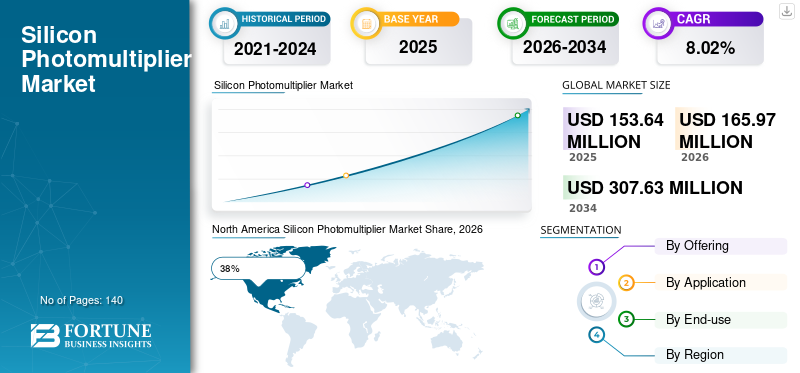
The silicon photomultiplier market size was valued at USD 153.64 Million in 2025. The market is projected to grow from USD 165.96 Million in 2026 to USD 307.63 Million by 2034, exhibiting a CAGR of 8.02% during the forecast period.

The silicon photomultiplier market is witnessing significant expansion due to the growing adoption of high-sensitivity photodetection technologies across medical imaging, automotive sensing, industrial automation, and scientific research. Silicon photomultipliers (SiPMs) are increasingly replacing conventional photomultiplier tubes because of their compact size, low operating voltage, superior photon detection efficiency, and compatibility with semiconductor manufacturing processes. The silicon photomultiplier market report highlights increasing demand from positron emission tomography systems, radiation detection equipment, LiDAR platforms, and advanced security systems. Continuous technological improvements in noise reduction, timing resolution, and sensor integration are strengthening market penetration. The silicon photomultiplier market analysis indicates growing investments in photonics research and next-generation sensing solutions across developed and emerging economies.
The United States remains one of the most influential contributors to the silicon photomultiplier market due to extensive investments in healthcare imaging infrastructure, defense technologies, aerospace programs, and autonomous vehicle development. American manufacturers and research institutions continue to deploy advanced photon detection systems in medical diagnostics, nuclear monitoring, and scientific laboratories. The increasing adoption of LiDAR-enabled mobility systems and industrial robotics is creating additional demand for silicon photomultiplier solutions. The silicon photomultiplier industry report identifies strong collaboration between semiconductor manufacturers, research organizations, and healthcare equipment providers as a major factor supporting technology commercialization. Expansion of domestic semiconductor production and photonics innovation initiatives is further strengthening the U.S. market landscape.
Download Free sample to learn more about this report.
Silicon Photomultiplier Market Key Takeaways
 Global Market size & forecast
- 2025 Market size: USD 153.64 Million
- 2026 Market size: USD 156.96 Million
- 2034 forecast Market size: USD 307.63 Million
- CAGR: 8.02% from 2026-2034
 Market share
- North America dominated with a revenue share of 38% in 2025.
- RGB silicon photomultipliers held the largest offering share at approximately 58%.
- Medical imaging and biophotonics accounted for approximately 41% of the market.
 Key Regional Highlights
North America
North America led the market with a 38% share, supported by advanced healthcare and scientific research infrastructure.
Europe
Europe accounted for 28% of the market, driven by growing adoption of advanced photon detection technologies.
Asia-Pacific
Asia-Pacific held a 26% share, supported by expanding medical imaging and semiconductor capabilities.
U.S
The market is supported by increasing adoption of SiPM-based medical imaging, diagnostics, and research technologies.
Japan
Demand is supported by advanced healthcare infrastructure and growing use of silicon photomultipliers in imaging and scientific applications.
Read More

silicon photomultiplier market Latest Trends
The silicon photomultiplier market trends indicate a rapid shift toward digital silicon photomultiplier architectures capable of delivering enhanced timing precision and improved signal processing capabilities. Manufacturers are focusing on miniaturized sensor arrays that support compact medical imaging devices, portable radiation detectors, and next-generation scientific instruments. Integration with artificial intelligence-enabled imaging systems is emerging as a key trend across healthcare and industrial sectors.
Download Free sample to learn more about this report.
Another notable trend in the silicon photomultiplier market research report is the growing deployment of SiPM technology in automotive LiDAR and advanced driver-assistance systems. Autonomous mobility platforms increasingly require high-speed and highly sensitive optical detection systems capable of operating in diverse environmental conditions. Additionally, photonics companies are investing in near-ultraviolet and RGB silicon photomultipliers to address specialized requirements in life sciences, spectroscopy, fluorescence detection, and environmental monitoring applications. Growing demand for energy-efficient sensing components continues to shape product development strategies throughout the industry.
silicon photomultiplier market Dynamics
DRIVER
Rising Demand for Advanced Medical Imaging Systems
The primary growth driver in the silicon photomultiplier market is the increasing deployment of advanced medical imaging equipment worldwide. Hospitals, diagnostic centers, and research institutions are continuously upgrading imaging infrastructure to improve disease detection accuracy and patient outcomes. Silicon photomultipliers offer superior photon detection efficiency, lower power consumption, and enhanced timing resolution compared with conventional technologies, making them highly suitable for positron emission tomography and hybrid imaging systems.
Growing prevalence of cancer, neurological disorders, and cardiovascular diseases has intensified the need for precise diagnostic solutions. Healthcare providers are increasingly investing in next-generation PET scanners equipped with silicon photomultiplier technology to achieve higher image quality and reduced scan durations. The silicon photomultiplier market Growth is also supported by government healthcare modernization initiatives and increasing investments in precision medicine. As imaging requirements become more sophisticated, manufacturers are introducing specialized SiPM solutions designed to meet the performance expectations of advanced healthcare environments.
RESTRAINT
High Manufacturing Complexity and Production Costs
A significant restraint affecting the silicon photomultiplier market is the complexity associated with sensor fabrication and packaging processes. Silicon photomultipliers require highly controlled semiconductor manufacturing environments, precise wafer processing, and stringent quality assurance measures. These requirements contribute to elevated production costs and create barriers for new market entrants.
The development of high-performance SiPM devices involves substantial research expenditure and specialized engineering expertise. Additionally, maintaining consistent performance characteristics such as photon detection efficiency, dark count rate, and thermal stability remains technically demanding. Smaller organizations often face challenges in scaling production while maintaining competitive pricing structures. The silicon photomultiplier market Outlook indicates that cost sensitivity among end users, particularly in price-conscious industrial and research applications, may slow adoption rates in certain regions. Manufacturers continue to invest in process optimization and production automation to address these cost-related constraints.
OPPORTUNITY
Expansion of Lidar and Autonomous Sensing Technologies
The rapid expansion of LiDAR-enabled systems represents one of the most attractive opportunities within the silicon photomultiplier market. Autonomous vehicles, intelligent transportation infrastructure, industrial robotics, and unmanned aerial systems increasingly depend on precise optical sensing technologies for navigation and object detection. Silicon photomultipliers provide high sensitivity and fast response times that enhance LiDAR system performance under challenging environmental conditions.
The silicon photomultiplier market opportunities are also expanding through smart city projects, environmental monitoring systems, and industrial automation platforms. As governments and private organizations invest in intelligent infrastructure, demand for reliable photon detection solutions continues to rise. Manufacturers are introducing automotive-grade SiPM products designed specifically for high-volume deployment in mobility applications. This transition from specialized scientific markets toward large-scale commercial applications is expected to generate substantial long-term growth potential for industry participants.
CHALLENGE
Performance Optimization under Varying Environmental Conditions
One of the most significant challenges facing the silicon photomultiplier market is maintaining consistent sensor performance across diverse operating environments. Factors such as temperature fluctuations, optical noise, background radiation, and humidity can influence device behavior and impact measurement accuracy. End users increasingly demand reliable operation in automotive, aerospace, industrial, and defense applications where environmental conditions can vary substantially.
Manufacturers must continuously improve sensor architecture, thermal management techniques, and signal processing algorithms to overcome these challenges. The silicon photomultiplier industry analysis highlights the importance of balancing performance enhancement with cost efficiency. In highly regulated sectors such as healthcare and defense, extensive validation and certification procedures further increase development timelines. Companies capable of delivering robust, environmentally resilient SiPM solutions are expected to strengthen their competitive positioning within the global market.
silicon photomultiplier market Segmentation
By Offering
Near ultraviolet silicon photomultipliers account for approximately 42% of the silicon photomultiplier market share. These devices are specifically engineered to detect photons in ultraviolet wavelength ranges and are widely used in life sciences, spectroscopy, particle physics experiments, and fluorescence imaging applications. Growing demand for highly sensitive detection technologies in biomedical research laboratories is supporting segment expansion.
The silicon photomultiplier market Insights indicate increasing deployment of near ultraviolet devices in radiation monitoring systems and advanced scientific instrumentation. research organizations and academic institutions rely on these sensors to achieve accurate photon counting and precise signal measurement. Improvements in ultraviolet sensitivity, reduced noise levels, and enhanced spectral response continue to expand application opportunities. Manufacturers are also developing compact ultraviolet detection modules suitable for portable and field-based analytical equipment.
RGB silicon photomultipliers represent nearly 58% of the silicon photomultiplier market size. These devices are designed to detect multiple wavelength bands and are increasingly utilized in medical imaging systems, industrial inspection platforms, LiDAR solutions, and machine vision applications. Their versatility enables deployment across a wide range of commercial and scientific environments.
The silicon photomultiplier market forecast highlights strong demand for RGB solutions in healthcare imaging technologies where accurate color and photon detection capabilities are essential. Industrial automation systems also benefit from RGB SiPMs due to improved object recognition and quality inspection performance. Advances in semiconductor fabrication are enabling higher pixel densities and improved spectral discrimination capabilities. As imaging and sensing requirements become increasingly sophisticated, RGB silicon photomultipliers are expected to maintain a dominant position within the market.
To know how our report can help streamline your business, Speak to Analyst
By Application
Medical imaging and biophotonics account for approximately 41% of the silicon photomultiplier market share. This segment remains the largest application area due to widespread adoption of SiPM technology in positron emission tomography scanners, hybrid imaging systems, and biomedical research instruments. Healthcare organizations continue to prioritize imaging accuracy and diagnostic efficiency, driving demand for advanced photon detection solutions.
The silicon photomultiplier market research report identifies increasing utilization of SiPM-enabled imaging systems for oncology, cardiology, and neurology diagnostics. Enhanced image resolution and improved timing performance contribute to superior clinical outcomes. research laboratories also employ these sensors in fluorescence imaging and molecular diagnostics applications. Continued healthcare infrastructure development is expected to support long-term segment growth.
By End-use
Healthcare and medical institutions account for approximately 37% market share in the silicon photomultiplier market. This end-user segment represents the largest adoption base due to the extensive use of silicon photomultipliers in positron emission tomography (PET), PET/CT systems, molecular imaging platforms, and advanced diagnostic equipment. Hospitals and diagnostic centers increasingly prefer SiPM-based imaging technologies because they provide superior photon detection efficiency, enhanced image resolution, and faster signal processing capabilities compared to traditional photodetection systems.
The growing demand for early disease detection, precision medicine, and advanced oncology diagnostics continues to drive adoption within healthcare facilities. research hospitals and academic medical centers are also utilizing silicon photomultipliers in clinical trials and biomedical research projects. As healthcare providers invest in next-generation imaging infrastructure and patient-centered diagnostic technologies, this end-user segment is expected to maintain a dominant position in the silicon photomultiplier market.
silicon photomultiplier market Regional Outlook
North America Silicon Photomultiplier Market Share, 2026 (%)
To get more information on the regional analysis of this market, Download Free sample
North America
North America holds approximately 38% of the global silicon photomultiplier market share. The region benefits from advanced healthcare infrastructure, extensive scientific research activities, and strong investments in semiconductor innovation. The United States remains the dominant contributor due to increasing adoption of SiPM technology in medical imaging, aerospace systems, defense applications, and autonomous mobility platforms.
Regional manufacturers continue to invest in product innovation and photonics research. Collaboration among universities, healthcare providers, and semiconductor companies supports commercialization of next-generation sensing solutions. The silicon photomultiplier market Outlook for North America remains favorable due to ongoing modernization of diagnostic imaging systems and increasing deployment of advanced optical detection technologies across industrial sectors.
Europe
Europe accounts for approximately 28% of the silicon photomultiplier market share. The region is characterized by strong photonics expertise, advanced manufacturing capabilities, and significant investments in scientific research infrastructure. European countries continue to promote innovation in healthcare technologies, automotive systems, and environmental monitoring applications.
The silicon photomultiplier industry report highlights growing demand for SiPM-enabled solutions across medical imaging centers, industrial automation facilities, and research laboratories. Regional organizations are actively involved in photon science initiatives and next-generation semiconductor development projects. Expansion of sustainable mobility programs and intelligent transportation systems is also contributing to market growth throughout Europe.
Germany silicon photomultiplier market
Germany represents approximately 31% of the European silicon photomultiplier market. The country serves as a major center for industrial automation, automotive engineering, and photonics innovation. German manufacturers increasingly integrate silicon photomultipliers into LiDAR systems, machine vision platforms, and advanced industrial sensing equipment. Strong research collaboration between universities and technology companies supports continuous product innovation.
Healthcare modernization initiatives are also contributing to demand for high-performance imaging systems equipped with silicon photomultiplier technology. Germany’s emphasis on precision engineering and Industry 4.0 implementation has accelerated adoption of advanced optical sensing solutions. Scientific institutions involved in particle physics and radiation detection research continue to generate significant opportunities for SiPM suppliers. The country's robust semiconductor ecosystem further enhances its strategic position within the European market.
United Kingdom silicon photomultiplier market
The United Kingdom contributes approximately 22% of the European silicon photomultiplier market. Demand is driven by medical research, defense modernization programs, and increasing investments in photonics technologies. British healthcare institutions are expanding the use of advanced imaging systems to support precision diagnostics and clinical research initiatives.
The country's scientific research sector remains an important source of demand for silicon photomultipliers used in spectroscopy, radiation detection, and high-energy physics experiments. Growing interest in autonomous mobility, environmental monitoring, and smart infrastructure projects is also creating new application opportunities. Collaboration between universities, healthcare providers, and technology developers continues to strengthen the United Kingdom's position within the global silicon photomultiplier market.
Asia-Pacific
Asia-Pacific accounts for approximately 26% of the global silicon photomultiplier market share. Rapid industrialization, expanding healthcare infrastructure, and increasing investments in semiconductor manufacturing are driving regional growth. Countries across the region are adopting advanced sensing technologies to support smart manufacturing, healthcare modernization, and transportation innovation.
The silicon photomultiplier market Growth in Asia-Pacific is supported by strong electronics manufacturing ecosystems and increasing research activities in photonics and semiconductor technologies. Rising demand for medical imaging equipment and industrial automation systems continues to create opportunities for regional suppliers. Government support for domestic semiconductor production further enhances market prospects.
Japan silicon photomultiplier market
Japan represents approximately 29% of the Asia-Pacific silicon photomultiplier market. The country maintains a strong leadership position in photonics, semiconductor technology, and scientific instrumentation. Japanese manufacturers are recognized globally for producing high-performance silicon photomultiplier solutions used in medical imaging, particle physics research, and industrial sensing applications.
Growing demand for precision healthcare technologies and advanced diagnostic equipment continues to support market development. Japan's emphasis on innovation and quality engineering has encouraged widespread adoption of SiPM-enabled systems across multiple industries. research institutions and technology companies remain actively engaged in developing next-generation photon detection technologies, strengthening the nation's competitive advantage in the global market.
China silicon photomultiplier market
China accounts for approximately 43% of the Asia-Pacific silicon photomultiplier market. Rapid expansion of healthcare infrastructure, semiconductor manufacturing capacity, and industrial automation projects has significantly increased demand for advanced sensing technologies. Chinese organizations are investing heavily in photonics research and domestic semiconductor production capabilities.
The country's growing focus on intelligent transportation systems, autonomous mobility platforms, and scientific research initiatives is creating substantial opportunities for silicon photomultiplier manufacturers. Hospitals and diagnostic centers continue to adopt advanced imaging technologies to improve healthcare service quality. Strong government support for technological self-sufficiency and innovation further accelerates market expansion across China.
Rest of World
The Rest of World region holds approximately 8% of the global silicon photomultiplier market share. Emerging economies in Latin America, the Middle East, and Africa are gradually increasing adoption of advanced imaging and sensing technologies. Healthcare infrastructure development and industrial modernization projects represent major growth drivers throughout these regions.
The silicon photomultiplier market opportunities within these markets are supported by increasing investments in scientific research, radiation monitoring, and security systems. Demand for compact and energy-efficient photon detection solutions continues to rise as industries modernize operations. Expansion of healthcare services and technology-driven infrastructure initiatives is expected to support future market development.
List of Top Silicon Photomultiplier Companies
- AdvanSiD
- Berkeley Nucleonics Corporation
- Broadcom Inc.
- Cremat Inc
- Dynasil Corporation
- Excelitas Technologies Corp.
- First Sensor AG (TE Connectivity)
- Hamamatsu Photonics K.K.
- John Caunt Scientific Ltd.
- PicoQuant
Top Two Companies by Market share
- Hamamatsu Photonics K.K. – 24%
- Broadcom Inc. – 18%
Investment analysis and opportunities
Investment activity within the silicon photomultiplier market continues to increase as organizations recognize the strategic importance of advanced photon detection technologies. Venture capital firms, semiconductor manufacturers, and photonics specialists are funding research programs focused on sensor miniaturization, digital architectures, and enhanced photon detection efficiency. Investments in semiconductor fabrication facilities are also supporting capacity expansion and supply chain resilience.
The silicon photomultiplier market opportunities are particularly strong in medical imaging, LiDAR systems, industrial automation, and environmental monitoring applications. Emerging demand for autonomous mobility solutions is encouraging long-term investment in high-performance optical sensing platforms. Strategic partnerships between healthcare technology providers, automotive manufacturers, and semiconductor companies are accelerating commercialization efforts. Investors increasingly view photonics technologies as critical enablers of next-generation digital infrastructure and intelligent sensing ecosystems.
New Product Development
Product innovation remains a central focus within the silicon photomultiplier market. Manufacturers are introducing digital SiPM platforms featuring improved timing resolution, reduced dark count rates, and enhanced signal processing capabilities. Advances in semiconductor design are enabling higher pixel densities while maintaining compact form factors suitable for portable and embedded applications.
Recent developments include automotive-grade silicon photomultipliers optimized for LiDAR systems, near-ultraviolet devices for life science applications, and high-speed sensors for scientific instrumentation. Companies are also integrating advanced packaging technologies to improve thermal stability and operational reliability. The silicon photomultiplier market trends indicate increasing emphasis on application-specific solutions capable of addressing the unique requirements of healthcare, defense, industrial automation, and environmental monitoring sectors.
Five Recent Developments (2023–2025)
- Hamamatsu Photonics expanded production capabilities for advanced silicon photomultiplier devices targeting medical imaging and scientific research applications.
- Broadcom introduced enhanced SiPM solutions designed for high-performance industrial sensing and machine vision environments.
- Excelitas Technologies expanded its photon detection portfolio with improved low-noise silicon photomultiplier technologies.
- ON Semiconductor strengthened LiDAR-focused sensing capabilities through continued integration of advanced SiPM technologies.
- Multiple manufacturers launched compact digital silicon photomultiplier platforms optimized for next-generation PET scanners and autonomous sensing systems.
report Coverage of silicon photomultiplier market
The silicon photomultiplier market report provides comprehensive analysis of industry developments, competitive positioning, technological advancements, and emerging application opportunities. Coverage includes detailed assessment of product categories, application segments, regional performance, and key strategic initiatives undertaken by market participants. The report evaluates demand patterns across healthcare, automotive, industrial, scientific, and defense sectors.
Request for Customization to gain extensive market insights.
The silicon photomultiplier market research report also examines innovation trends, supply chain developments, investment activity, and evolving customer requirements. Detailed segmentation analysis provides insights into near ultraviolet and RGB silicon photomultiplier technologies, while regional evaluation highlights opportunities across North America, Europe, Asia-Pacific, and emerging markets. The report supports business decision-making by offering actionable silicon photomultiplier market Insights, competitive benchmarking, and future industry outlook assessments.
Frequently Asked Questions
Fortune Business Insights says that the global market value stood at USD 153.64 million in 2025 and is projected to reach USD 307.63 million by 2034.
The market is expected to exhibit a CAGR of 8.02% during the forecast period of 2026-2034.
RGB silicon photomultipliers were the leading offering segment, accounting for nearly 58% of the market, owing to their versatility across medical imaging, industrial inspection, LiDAR, and machine vision applications.
Key players include Hamamatsu Photonics K.K., Broadcom Inc., Excelitas Technologies Corp., First Sensor AG (TE Connectivity), AdvanSiD, and PicoQuant.
Major trends include the shift toward digital SiPM architectures and miniaturized sensor arrays, along with growing deployment in automotive LiDAR and AI-enabled imaging systems. North America leads with approximately 38% market share, supported by advanced healthcare, research, and semiconductor innovation.



- 2021-2034
- 2025
- 2021-2024
- 140
-

(Offer valid till 15th Oct 2026)
Get 30-60 hrs Free Customization
Expand Regional and Country Coverage, Segments Analysis, Company Profiles, Competitive Benchmarking, and End-user Insights.




















-
US +1 833 909 2966 ( Toll Free )
-
Get In Touch With Us