Sinus Dilation Devices Market Size, Share & Industry Analysis, By Device Type (Balloon Sinus Dilation Devices, Sinus Access Devices, and Sinus Stents & Implants), By Patient Type (Adult and Pediatric), By End-user (Hospitals & ASCs, ENT Specialty Clinics, and Others), and Regional Forecast, 2026-2034
 Download Free Sample
Sinus Dilation Devices Market Size and Future Outlook
 Listen to Audio Version
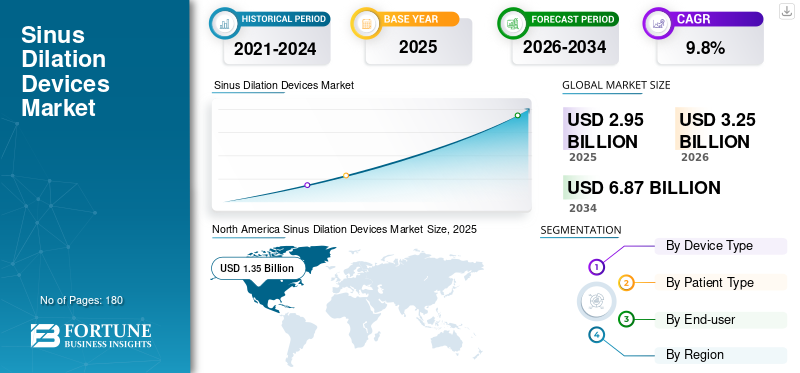
The global sinus dilation devices market size was valued at USD 2.95 billion in 2025 and is projected to grow from USD 3.25 billion in 2026 to USD 6.87 billion by 2034, exhibiting a CAGR of 9.8% during the forecast period. North America dominated the sinus dilation devices market with a market share of 45.76% in 2025.
Sinus dilation devices are medical instruments used to treat sinusitis, a condition in which the sinus cavities become inflamed or blocked. These devices help open the sinus passages and improve drainage, allowing patients to breathe normally and reducing symptoms such as congestion, facial pain, and headaches. Market growth is driven by technological advancements and new product launches by companies, influenced by the rising prevalence of chronic rhinosinusitis and the increasing adoption of minimally invasive ENT procedures.
Furthermore, Medtronic, Stryker, and Smith+Nephew held the major market share in 2025, driven by continuous product development and strong distribution networks.
Download Free sample to learn more about this report.
Sinus Dilation Devices Market Key Takeaways
 Market Size & Forecast
- 2025 Market Size: USD 2.95 Billion
- 2026 Market Size: USD 3.25 Billion
- 2034 Forecast Market Size: USD 6.87 Billion
- CAGR: 9.80% from 2026–2034
 Market Share
- North America dominated the sinus dilation devices market with a 45.76% share in 2025.
- The Adult segment is projected to lead the market with a 91.1% share in 2026.
- The Hospitals & ASCs segment is expected to dominate the market with a 62.2% share in 2026.
 Key Regional Highlights
Asia Pacific
Asia Pacific is expected to reach USD 0.71 billion by 2026.
North America
North America held the leading position with a market value of USD 1.35 billion in 2025.
Europe
Europe is projected to reach USD 0.78 billion by 2026.
U.S.
The market is projected to reach USD 1.39 billion by 2026.
Japan
The market is projected to generate USD 0.11 billion by 2026.
Read More

SINUS DILATION DEVICES MARKET TRENDS
Technological Advancements in Balloon Dilation Systems to Emerge as a Key Market Trend
Currently, prominent market players are developing devices with improved balloon catheter designs, integrated lighting systems, and image-guided navigation to enhance procedural accuracy, which is demonstrated by several studies. These innovations have enabled surgeons to better visualize sinus anatomy and safely perform dilation procedures, thereby encouraging physicians to adopt newer sinus dilation solutions.
- For instance, in March 2023, a Proof-of-Concept study published by Sage Journals tested VR navigation for maxillary sinus balloon sinuplasty (BSD), achieving 77.0% accuracy in dilating the natural ostium across 16 procedures in 8 cadavers.
MARKET DYNAMICS
MARKET DRIVERS
Download Free sample to learn more about this report.
Rising Prevalence of Chronic Sinusitis to Fuel the Market Expansion
In recent years, there has been an increasing prevalence of chronic rhinosinusitis, which often requires medical or surgical intervention. Procedures such as the balloon sinuplasty provide a minimally invasive solution that improves sinus drainage without removing tissue or bone. Also, awareness among patients and ENT specialists about these procedures is further increasing adoption of related devices, which is expected to drive the global sinus dilation devices market growth.
- For instance, according to data published by MDPI in June 2025, CRS affects a significant share of the population, with prevalence rates estimated at 5%-12%.
MARKET RESTRAINTS
High Cost of Advanced ENT Devices to Restrict Market Growth
Balloon dilation systems, navigation technologies, and specialized ENT surgical tools require significant investment from hospitals and clinics. Healthcare facilities in low- and middle-income countries lack the resources to adopt these advanced systems. Moreover, the higher cost of procedures is also expected to slow the adoption of sinus dilation devices, hindering market growth over the forecast period.
- For instance, according to the data from Pristyncare in March 2026, the average cost of balloon sinuplasty typically ranges from USD 380.3 to USD 652.0.
MARKET OPPORTUNITIES
Growth of Outpatient and Office-Based Sinus Procedures to Offer Lucrative Growth Opportunities
In recent years, there has been a shift toward outpatient and office-based ENT procedures, encouraging ENT specialists to adopt portable, easy-to-use sinus dilation systems. Additionally, healthcare systems are promoting minimally invasive procedures to reduce surgical burden and improve patient outcomes, which is further expected to surge the demand for efficient and compact sinus dilation devices.
MARKET CHALLENGES
Limited Awareness in Emerging Markets to Challenge Market Expansion
In emerging and underdeveloped economies, awareness of sinus dilation procedures has been limited. Several healthcare professionals and patients still rely on traditional sinus surgery methods due to a lack of knowledge about minimally invasive alternatives such as balloon sinuplasty. Also, a shortage of trained ENT specialists is expected to further limit the adoption of these procedures and related devices, challenging market expansion.
- For instance, in March 2026, Yashoda Hospitals mentioned that limited access to advanced diagnostic tools, a shortage of trained ENT specialists, and a lack of comprehensive treatment facilities often result in delayed diagnosis and suboptimal management of ENT conditions in India.
Segmentation Analysis
By Device Type
Widespread Usage in Minimally Invasive Approach to Boost the Balloon Sinus Dilation Devices Segment's Growth
Based on device type, the market is segmented into balloon sinus dilation devices, sinus access devices, and sinus stents & implants.
To know how our report can help streamline your business, Speak to Analyst
The balloon sinus dilation devices segment accounted for the largest global sinus dilation devices market share in 2025. The segment's growth is attributed to the widespread use of these devices, which offer a minimally invasive approach to treating chronic sinusitis. These devices also offer faster recovery and less postoperative pain, which is driving their adoption further.
Additionally, the sinus stents & implants segment is projected to grow at a CAGR of 10.3% during the forecast period.
By Patient Type
Rising Number of Chronic Sinusitis in Adults Globally Fuels the Segment's Growth
By patient type, the market is bifurcated into adult and pediatric.
The adult segment accounted for the largest market share in 2025. Chronic sinusitis is more commonly diagnosed in adults due to lifestyle factors and respiratory infections. As a result, the growing adult population, especially the elderly, globally is driving demand for sinus dilation devices, contributing to the segment's growth. Moreover, the segment is estimated to hold a 91.1% share in 2026.
- For instance, according to data from the World Health Organization (WHO) in October 2025, the world's population aged 60 and older is expected to double by 2050.
Additionally, the pediatric segment is anticipated to grow at a CAGR of 10.7% over the forecast period.
By End-user
Facilities Equipped with Advanced Infrastructure to Drive the Hospitals & ASCs Segment Growth
Based on end user, the market is segmented into hospitals & ASCs, ENT specialty clinics, and others.
In 2025, hospitals & ASCs dominated the market as end users. These facilities are equipped with advanced ENT surgical infrastructure and skilled specialists capable of performing sinus dilation procedures, which is leading to higher procedure volume, supporting the adoption of related devices, and boosting the segment's growth. Furthermore, the segment is set to hold a 62.2% share in 2026.
In addition, the ENT specialty clinics segment is projected to grow at a 10.1% CAGR over the forecast period.
Sinus Dilation Devices Market Regional Outlook
Based on region, the market is classified into North America, Europe, Asia Pacific, Latin America, and the Middle East & Africa.
North America
North America Sinus Dilation Devices Market Size, 2025 (USD Billion)
To get more information on the regional analysis of this market, Download Free sample
North America accounted for the largest share of revenues in 2024, valued at USD 1.22 billion, and held USD 1.35 billion in 2025. The growth is attributed to well-established healthcare infrastructure and strong adoption of minimally invasive ENT procedures such as balloon sinuplasty, which is driving the demand for sinus dilation devices.
- For instance, according to the data from the American Hospital Association (AHA), there are approximately 6,100 total hospitals in the U.S. as of 2026.
U.S Sinus Dilation Devices Market
In 2026, the U.S. is projected to reach USD 1.39 billion, accounting for approximately 42.7% of the global market.
Europe
Europe is projected to record a 9.7% growth rate during the projection period, the second-highest globally, to reach USD 0.78 billion by 2026. Regulatory approvals for advanced ENT devices and rising healthcare expenditure are supporting the adoption of sinus dilation devices, which are expected to drive regional growth.
U.K Sinus Dilation Devices Market
The U.K. market is expected to reach USD 0.13 billion by 2026, accounting for roughly 4.0% of global revenues.
Germany Sinus Dilation Devices Market
Germany's market is projected to reach USD 0.18 billion by 2026, accounting for approximately 5.7% of global revenue.
Asia Pacific
By 2026, the Asia Pacific's market is expected to reach USD 0.71 billion, ranking third globally. The region’s growth is attributed to the large patient pool of sinus disorders, which is influencing manufacturers to support cost-effective sinus dilation devices.
Japan Sinus Dilation Devices Market
Japan is projected to generate USD 0.11 billion in revenue by 2026, accounting for approximately 3.5% of the global market.
China Sinus Dilation Devices Market
China's market is expected to reach nearly USD 0.33 billion by 2026, accounting for 10.3% of global revenues.
India Sinus Dilation Devices Market
India's market is projected to reach USD 0.08 billion by 2026, accounting for around 2.4% of global market revenue.
Latin America and Middle East & Africa
Both Latin America and the Middle East & Africa are expected to showcase moderate growth, with the Latin America market predicted to reach USD 0.17 billion by 2026. The growth of these regions is expected to be driven by growing awareness about sinus treatments, which is influencing hospitals to adopt advanced ENT surgical technologies.
GCC Sinus Dilation Devices Market
By 2026, the GCC market is expected to reach USD 0.06 billion, accounting for 1.8% of total market revenues.
COMPETITIVE LANDSCAPE
Key Industry Players
Product Innovation and Strategic Partnerships Between Industry Players Fuels Market Progression
In 2025, Medtronic, Stryker, and Smith+Nephew held the majority of the global sinus dilation devices market share. This share is attributed to key initiatives by these companies, including product innovation, portfolio expansion, and strategic partnerships.
Moreover, other prominent players are expanding into emerging markets, improving physician training programs, and strengthening their distribution network, which is expected to help them increase market share.
LIST OF KEY SINUS DILATION DEVICES COMPANIES PROFILED
- Medtronic (Ireland)
- Stryker (U.S.)
- Smith+Nephew (U.K.)
- Integra LifeSciences Corporation (U.S.)
- Olympus Corporation (Japan)
- Fiagon GmbH (Germany)
- Dalent Medical (Israel)
- Meril Life Sciences (India)
- Medasil Surgical (U.K.)
- InnAccel Technologies Pvt Ltd. (India)
KEY INDUSTRY DEVELOPMENTS
- December 2025: Airiver Medical received FDA IDE approval to launch a pivotal clinical trial of its ESSpand Sinus Drug Coated Balloon (DCB) for chronic rhinosinusitis (CRS) patients, enrolling up to 300 participants nationwide.
- March 2024: Olympus Corporation announced the launch of its CELERIS single-use sinus debrider system and Celon Elite with Celon ProBreath for treating nasal turbinate hypertrophy.
- May 2022: Medtronic completed its acquisition of Intersect ENT, Inc., securing PROPEL and SINUVA sinus implant technologies, IP, and the Menlo Park facility while integrating staff.
- August 2021: Medtronic announced a definitive agreement to acquire Intersect ENT to bolster its ENT portfolio with PROPEL and SINUVA sinus implants.
- July 2021: Intersect ENT, Inc. announced U.S. nationwide commercial availability of the VenSure Balloon Sinus Dilation System and Cube 4D Navigation System with VirtuEye photo registration.
- February 2021: Intersect ENT, Inc. announced the U.S. launch of its new Straight Delivery System (SDS) packaged with the PROPEL Mini sinus implant, following FDA PMA approval.
REPORT COVERAGE
The report delivers a comprehensive analysis across all market segments, drivers, trends, opportunities, restraints, and challenges shaping the market landscape. It provides key insights into technological innovations, the prevalence of chronic rhinosinusitis (CRS), major industry developments, market share analysis, and in-depth company profiles.
Request for Customization to gain extensive market insights.
Report Scope & Segmentation
| ATTRIBUTE | DETAILS |
| Study Period | 2021-2034 |
| Base Year | 2025 |
| Estimated Year | 2026 |
| Forecast Period | 2026-2034 |
| Historical Period | 2021-2024 |
| Growth Rate | CAGR of 9.8% from 2026-2034 |
| Unit | Value (USD Billion) |
| Segmentation | By Device Type, Patient Type, End-user, and Region |
| By Device Type |
|
| By Patient Type |
|
| By End-user |
|
| By Region |
|
Frequently Asked Questions
Fortune Business Insights says that the global market value stood at USD 2.95 billion in 2025 and is projected to reach USD 6.87 billion by 2034.
In 2025, the market value stood at USD 1.35 billion.
The market is expected to grow at a CAGR of 9.8% over the forecast period.
The balloon sinus dilation devices segment led the market by device type.
The key factor driving the market is the rising prevalence of chronic sinusitis.
Medtronic, Stryker, and Smith+Nephew are among the prominent players in the market.
North America dominated the market in 2025.



- 2021-2034
- 2025
- 2021-2024
- 180
Get 30-60 hrs Free Customization
Expand Regional and Country Coverage, Segments Analysis, Company Profiles, Competitive Benchmarking, and End-user Insights.













.webp)






Related Reports
-
US +1 833 909 2966 ( Toll Free )
-
Get In Touch With Us