 Download Free Sample



Get a Quote
Receive a tailored pricing based on your needs.
- Choose license type
- Multiple user options
- Custom scope & coverage
- Fast turnaround
"Designing Growth Strategies is in our DNA"
 Listen to Audio Version
The global sitagliptin market size was valued at USD 3.67 billion in 2025. The market is projected to grow from USD 3.90 billion in 2026 to USD 5.83 billion by 2034, exhibiting a CAGR of 5.14% during the forecast period. Asia Pacific dominated the sitagliptin market with a market share of 34.6% in 2025.
The global market is growing steadily due to the rising burden of type 2 diabetes and the continued demand for anti-diabetic medicines for long-term use. Sitagliptin is a DPP-4 inhibitor used to improve glycemic control in adults with type 2 diabetes, either as a standalone therapy or in combination with metformin. The market is supported by established branded products such as Januvia, Janumet, and Janumet XR, while patent expiries and generic launches are widening access in price-sensitive markets. At the same time, new formulations and distribution partnerships are helping companies improve patient reach, adherence, and product availability across developed and emerging regions.
Furthermore, Merck & Co., Inc., Zydus Lifesciences Ltd., and Teva Pharmaceutical Industries Ltd. held the majority of the market share due to their broad portfolios.
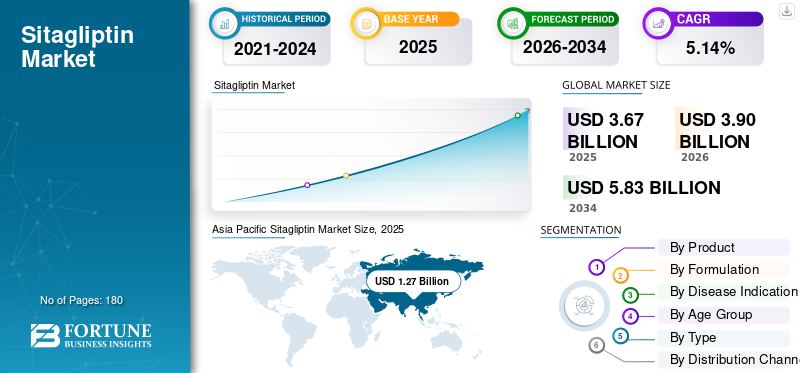
Download Free sample to learn more about this report.
 Global Market Size & Forecast
 Market Share
 Key Regional Highlights
Asia Pacific
Asia Pacific generated USD 1.18 billion in 2024 and is projected to reach USD 1.41 billion in 2026, maintaining its leading position.
North America
North America generated USD 1.27 billion in 2025, maintaining its second-largest regional position.
Europe
Europe is projected to reach USD 0.73 billion by 2026, growing at a 1.81% rate.
U.S.
U.S. market is projected to reach USD 1.18 billion by 2026.
Japan
Japan market is projected to reach USD 0.19 billion by 2026.
Read More

Growing Shift Toward Generic Sitagliptin to Improve Diabetes Treatment Affordability
A prominent trend witnessed in the market is the wider availability of generic drugs, as branded DPP-4 inhibitor products face patent expiry and loss of exclusivity in key markets. This shift is important as type 2 diabetes requires long-term treatment, and lower-cost generic versions can improve patient access, especially in price-sensitive healthcare systems. As more companies launch sitagliptin and sitagliptin-metformin products, competition is expected to increase, which may reduce treatment costs and expand prescription volumes. At the same time, branded players are focusing on distribution partnerships and portfolio access strategies to protect market presence in high-volume diabetes markets.
Download Free sample to learn more about this report.
Rising Prevalence of Type 2 Diabetes to Drive Demand for Sitagliptin-Based Therapies
The global market is expected to grow as the number of adults living with type 2 diabetes continues to rise across both developed and emerging economies. This growing patient pool increases the need for long-term glucose-lowering therapies, especially oral medicines that are easy to prescribe and convenient for daily use. As sitagliptin is used to improve glycemic control in adults with type 2 diabetes, the rising diagnosis and treatment rate directly supports demand for both branded and generic sitagliptin-based products. In addition, the long-term nature of diabetes management creates recurring prescription demand, supporting market growth over the forecast period.
|
Rank |
Market Driver |
Expected Impact on Market Growth |
Estimated Gross Market Growth Contribution (USD Billion) |
Impact: 2026-2028 |
Impact: 2029-2031 |
Impact: 2032-2034 |
|
1 |
Rising Prevalence of Type 2 Diabetes to Drive Demand for Sitagliptin-Based Therapies |
High |
0.72 |
High |
High |
High |
|
2 |
Growing demand for convenient oral anti-diabetic therapies |
High |
0.55 |
High |
High |
Medium |
|
3 |
Expansion of generic sitagliptin improving affordability and access |
Medium-High |
0.48 |
Medium |
High |
High |
|
4 |
Increasing use of fixed-dose combination products such as sitagliptin-metformin |
Medium |
0.38 |
Medium |
High |
Medium |
|
5 |
Wider availability through retail pharmacies and online pharmacy channels |
Medium |
0.32 |
Medium |
Medium |
Medium |
|
6 |
Others |
Low |
0.25 |
Low |
Low |
Low |
|
Total Gross Growth Contribution |
2.70 |
Increasing Generic Competition and Shift Toward Newer Diabetes Drug Classes to Limit Market Value Growth
A factor restraining the global sitagliptin market growth is increasing pressure, as the product class moves from a branded, high-value market toward a more price-competitive generic market. Patent expiry of key sitagliptin brands such as Januvia and Janumet has encouraged generic entry in several markets, which improves affordability but reduces average selling prices and limits revenue growth for branded manufacturers. As a result, sitagliptin may continue to retain prescription demand among suitable type 2 diabetes patients. Still, its overall market value growth is expected to remain restrained by price erosion and stronger competition from newer treatment options.
Expansion of Combination Sitagliptin Products in Emerging Markets to Create Growth Opportunities
The global market is expected to gain growth opportunities from the fixed-dose combination products, especially in emerging markets with a large diabetes patient base. Combination products such as sitagliptin with metformin create growth opportunities as they simplify treatment, reduce pill burden, and support better adherence among adults needing multi-drug glycemic control. As branded products face patent expiry, generic manufacturers and distribution partners can expand sitagliptin availability across retail, hospital, and pharmacy networks, creating volume-led growth despite price competition.
Balancing Price Erosion and Volume Growth Amid Generic Sitagliptin Expansion
The global market is expected to face a key challenge in maintaining value growth as generic products expand across major markets. Generic entry can increase patient access and prescription volumes, but it also reduces average selling prices, which can weaken overall revenue growth for branded sitagliptin products. This creates a difficult balance for manufacturers, as higher unit demand may not fully offset the decline in product pricing after loss of exclusivity. In addition, companies operating in this market must manage competition from multiple generic suppliers while also responding to stronger treatment preference for newer diabetes drug classes. As a result, the market may continue to grow in volume, but revenue growth is likely to remain under pressure during the forecast period.
Strong Brand Recognition and Early Market Entry Supported Januvia’s Dominance
Based on the product, the market is segmented into Januvia, Janumet, and others.
Januvia dominated the product segment in 2025 as it was one of the earliest and most established sitagliptin brands used for type 2 diabetes management. Its long presence in the market helped build strong physician familiarity, patient trust, and wide prescription acceptance. Also, it offers flexibility for physicians to prescribe it alone or with other anti-diabetic medicines depending on the patient's needs. This helped the product maintain a strong position, especially among patients who require DPP-4 inhibitor therapy but may not need a fixed-dose combination. Strategic collaboration with other operating entities in the market to expand access further drives the segmental growth.
The others segment is projected to grow at a CAGR of 14.83% during the global sitagliptin market forecast period.
To know how our report can help streamline your business, Speak to Analyst
High Prescribing Convenience and Broad Availability Supported Immediate-Release Tablets Segment Dominance
By formulation, the market is segmented into immediate-release tablets, extended-release tablets, and others.
Immediate-release tablets dominated the formulation segment in 2025. The segment dominated as they are the most commonly used and widely available sitagliptin dosage forms. These tablets are convenient for daily diabetes management and are easier for physicians to prescribe across a broad adult patient population. Their simpler formulation also supports wider manufacturing by branded and generic companies, which improves availability across hospital, retail, and pharmacy channels. As a result, immediate-release tablets remained the preferred formulation due to ease of use, established prescribing habits, and broader product availability.
The others segment is anticipated to grow at a CAGR of 11.50% over the forecast period.
Rising Type 2 Diabetes Treatment Needs Strengthened Diabetes Segment Dominance
By disease indication, the market is segmented into diabetes and others.
The diabetes segment held the largest share in the market based on disease indication. Sitagliptin is primarily indicated for improving glycemic control in patients with type 2 diabetes. The segment benefits from the large and continuously treated patient base, as diabetes requires long-term therapy and regular medication use. Since sitagliptin helps manage blood glucose and is often used when patients need additional control beyond lifestyle changes or metformin, its demand remains closely linked to diabetes treatment volumes. This direct therapeutic relevance made diabetes the leading indication in the market.
The others segment is anticipated to grow at a CAGR of 10.02% over the forecast period.
Adult Type 2 Diabetes Patient Pool Supported Adult Segment Dominance
By age group, the market is segmented into pediatric and adults.
The adult segment dominated the sitagliptin market share based on age group. Sitagliptin-based therapies are mainly used for type 2 diabetes, which is more common in the adult population. Most approved sitagliptin products are positioned for adult patients, and prescribing is largely concentrated among adults requiring long-term glycemic control. The need for convenient oral medicines, low treatment complexity, and continuous disease management further supports higher sitagliptin use among adults compared to pediatric patients. Therefore, the adult segment held the dominant share due to both disease prevalence and product indication alignment.
The pediatric segment is anticipated to grow at a CAGR of 9.60% over the forecast period.
Established Innovator Products and Physician Trust Supported Branded Segment Dominance
By type, the market is segmented into branded and generic.
Branded products dominated the type segment due to strong market presence of established sitagliptin brands such as Januvia and Janumet. These products benefited from earlier market entry, clinical familiarity, strong distribution networks, and high physician confidence built over years of use. In many countries, branded sitagliptin products also maintained a strong position before full-scale generic substitution increased. As a result, branded products accounted for a larger value share, even though generic competition is gradually increasing in several markets.
The generic segment is anticipated to grow at a CAGR of 14.38% over the forecast period.
Chronic Prescription Refills and Easy Patient Access Supported Drug Stores and Retail Pharmacies Segment Dominance
On the basis of the distribution channel, the market is segmented into drug stores & retail pharmacies, hospital pharmacies, online pharmacies, and others.
In 2025, drug stores and retail pharmacies dominated the distribution channel segment as sitagliptin is mainly used for long-term outpatient diabetes management. Patients with type 2 diabetes require regular prescription refills, making retail pharmacies the most convenient and frequently used purchase channels. Retail pharmacy networks also support better availability of branded, generic, and combination sitagliptin products, especially in urban and semi-urban markets. This regular refill pattern and easy accessibility helped drug stores and retail pharmacies capture the leading share in the market.
In addition, the online pharmacies segment is projected to grow at a CAGR of 10.62% over the forecast period.
By region, the market is categorized into Europe, North America, Asia Pacific, Latin America, and the Middle East & Africa.
Asia Pacific Sitagliptin Market Size, 2025 (USD Billion)
To get more information on the regional analysis of this market, Download Free sample
Asia Pacific dominated the market in 2024 with a valuation of USD 1.18 billion and maintained its dominant position in 2025. Further, the region is estimated to reach USD 1.41 billion in 2026. Asia Pacific is growing rapidly due to its large diabetes patient pool, especially in countries such as India, China, and Japan. Rising diagnosis rates and increasing access to affordable generics are expanding treatment volumes.
The Japanese market in 2026 is estimated at around USD 0.19 billion, accounting for approximately 4.81% of the global market.
China's market is projected to be among the largest worldwide, with 2026 revenues estimated at around USD 0.46 billion, accounting for approximately 11.91% of global sales.
The Indian market size is estimated at around USD 0.32 billion in 2026, accounting for roughly 8.31% of global revenue.
North America held the second-largest share in 2024 at USD 1.25 billion and maintained its leading position in 2025 at USD 1.27 billion. The market is growing in North America due to the high prevalence of type 2 diabetes, robust healthcare infrastructure, and strong use of prescription-based oral anti-diabetic therapies. Wide availability of branded and generic sitagliptin products supports continuous patient access. Strong retail pharmacy networks and insurance coverage further support long-term prescription refills.
Given North America's substantial contribution and the U.S. dominance in the region, the U.S. market is estimated at around USD 1.18 billion in 2026, accounting for roughly 30.33% of the global market.
Europe is projected to grow at 1.81% over the coming years, the third-highest among all regions, and reach a valuation of USD 0.73 billion by 2026. Europe is witnessing growth due to the rising aging population and increasing diabetes management needs. The region has strong clinical adoption of oral diabetes therapies, including DPP-4 inhibitors, for suitable patient groups. Generic availability is also improving affordability and supporting wider use across public healthcare systems.
The U.K. market size is estimated at USD 0.12 billion in 2026, accounting for roughly 3.05% of the global market.
Germany's market is projected to reach approximately USD 0.15 billion in 2026, equivalent to around 3.86% of the global market.
The Latin America region is expected to witness growth in this market during the forecast period and is estimated to reach a valuation of USD 0.26 billion by 2026. The market is growing in Latin America due to increasing diabetes prevalence and improving access to chronic disease medicines.
Further, retail pharmacy expansion and broader availability of generic oral anti-diabetic drugs are supporting patient access. In the Middle East & Africa, the GCC is set to reach USD 0.09 billion in 2026.
The South African market is projected to reach approximately USD 0.04 billion by 2026, accounting for roughly 0.91% of global revenue.
Regulatory Approval and New Product Developments among Key Companies to Strengthen Market Growth
The global sitagliptin market is moderately consolidated, with Merck & Co., Inc maintaining a leading position due to the strong brand presence of Januvia, Janumet, and Janumet XR. However, the market is gradually becoming more competitive as patent expiries are opening opportunities for generic manufacturers to launch lower-cost sitagliptin and sitagliptin-metformin products. Key companies are strengthening their presence through product approvals, launches, distribution partnerships, and expanded generic portfolios. These companies are focusing on improving affordability, increasing pharmacy access, and expanding the availability of both single-agent and fixed-dose combination sitagliptin therapies.
Among these players, Zydus Lifesciences, Apotex, Teva, Lupin, Glenmark, and Azurity Pharmaceuticals are actively involved in recent product development and commercialization activities. At the same time, generic manufacturers are expected to gain share during the forecast period as healthcare systems and patients increasingly prefer affordable oral diabetes therapies. This shift is likely to make the market more volume-driven, with competition centered on pricing, formulation convenience, product availability, and distribution strength.
The global sitagliptin market report provides a detailed assessment of all market segments, highlighting key drivers, trends, opportunities, restraints, and challenges shaping industry growth. It also covers the rising burden of type 2 diabetes, increasing use of oral anti-diabetic therapies, patent expiry impact, generic competition, and changing treatment preferences across major regions. The report also provides global market analysis on branded and generic product performance, formulation trends, distribution channel dynamics, and demand patterns across adult and pediatric patient groups. It includes regional market analysis, competitive landscape, recent company developments, product launches, strategic partnerships, and comprehensive profiles of leading companies operating in the market.
Request for Customization to gain extensive market insights.
| ATTRIBUTE | DETAILS |
| Study Period | 2021-2034 |
| Base Year | 2025 |
| Estimated Year | 2026 |
| Forecast Period | 2026-2034 |
| Historical Period | 2021-2024 |
| Growth Rate | CAGR of 5.14% from 2026 to 2034 |
| Unit | Value (USD Billion) |
| Segmentation | By Product, Formulation, Disease Indication, Age Group, Type, Distribution Channel, and Region |
| By Product |
|
| By Formulation |
|
| By Disease Indication |
|
| By Age Group |
|
| By Type |
|
| By Distribution Channel |
|
| By Region |
|
Fortune Business Insights says that the global market value stood at USD 3.67 billion in 2025 and is projected to reach USD 5.83 billion by 2034.
In 2025, the market value stood at USD 1.27 billion.
The market is expected to grow at a CAGR of 5.14% over the forecast period.
The Januvia segment led the market by product.
The key driver of the market is the rising prevalence of type 2 diabetes, which drives global market demand.
Merck & Co., Inc., Zydus Lifesciences Ltd., and Teva Pharmaceutical Industries Ltd. are among the prominent players in the market.
North America dominated the market in 2025.

Get 30-60 hrs Free Customization
Expand Regional and Country Coverage, Segments Analysis, Company Profiles, Competitive Benchmarking, and End-user Insights.








.webp)




Get In Touch With Us
US +1 833 909 2966 ( Toll Free )
Receive a tailored pricing based on your needs.
Discuss your questions with our industry experts.
Have questions? Get quick answers before you purchase.

