Sleeping Bruxism Treatment Market Size, Share & Industry Analysis, By Product Type (Mouth Guards, Splints, and Others), By Patient Type (Adults, and Pediatric), By End-user (Hospitals, Dental Clinics, Homecare, and Others), and Regional Forecast, 2026-2034
 Download Free Sample
KEY MARKET INSIGHTS
 Listen to Audio Version
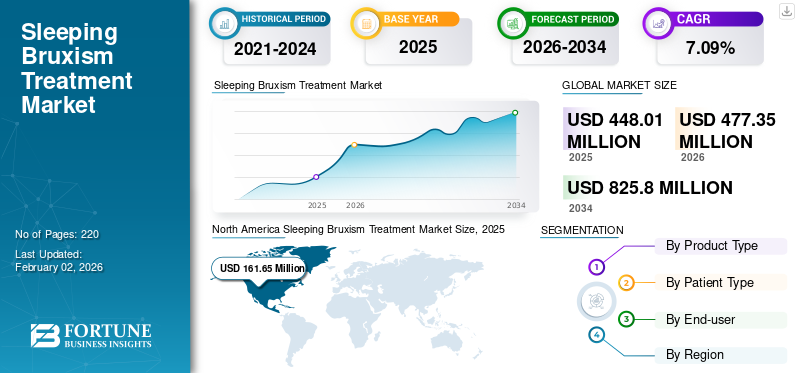
The global sleeping bruxism treatment market size was valued at USD 448.01 million in 2025. The market is projected to grow from USD 477.35 million in 2026 to USD 825.8 million by 2034, exhibiting a CAGR of 7.09% during the forecast period. North America dominated the sleeping bruxism treatment market with a market share of 36.08% in 2025.
Sleep bruxism is a condition in which a person involuntarily clenches or grinds their teeth during sleep, often without being aware of it. This sleep-related movement disorder may lead to jaw pain, headaches, or worn teeth, and is often linked to stress or sleep problems, further requiring treatment. The global market growth is significantly driven by increasing cases of anxiety, stress, sleep disorders, and other related conditions including obstructive sleep apnea, which are increasing the risk of sleeping bruxism. Other factors driving the treatment rate for such conditions include increasing public awareness, improved diagnostic technologies, and rising demand for non-invasive and personalized products such as mouth guards and splints. Moreover, access to such products is expanding through hospitals, clinics, and online pharmacies.
Furthermore, the market is dominated by major players such as Procter & Gamble (Plackers), Smile Brilliant, and others. The growth of these companies is supported by their broader product portfolio and involvement in strategic initiatives to expand market presence.
Download Free sample to learn more about this report.
Sleeping Bruxism Treatment Market Key Takeaways
 Market Size & Forecast
- 2025 Market Size: USD 448.01 Million
- 2026 Market Size: USD 477.35 Million
- 2034 Forecast Market Size: USD 825.8 Million
- CAGR: 7.09% from 2026–2034
 Market Share
- North America dominated the sleeping bruxism treatment market with a 36.08% share in 2025.
- The mouth guards segment is projected to lead with a 51.79% market share in 2026.
- The adult segment is expected to account for 76.15% of the global market in 2026.
 Key Regional Highlights
North America
North America accounted for USD 161.65 million and 36.08% of the global sleeping bruxism treatment market in 2025.
Europe
Europe generated USD 133.98 million, representing 29.90% of the global market in 2025.
Asia Pacific
Asia Pacific contributed USD 122.96 million and 27.45% of the global market in 2025.
U.S.
The U.S. sleeping bruxism treatment market is projected to reach USD 159.5 million in 2026, supported by high diagnosis rates and strong dental infrastructure.
Japan
Japan is expected to witness steady market growth, supported by increasing awareness of sleep-related dental disorders and expanding access to treatment.
Read More

MARKET DYNAMICS
MARKET DRIVERS
Increasing Prevalence of Sleeping Bruxism to Propel the Market Growth
In recent years, there has been a significant rise in the prevalence of sleeping bruxism across the globe. This high prevalence rate of developing symptoms including jaw pain and tooth wear among millions of people, boosting demand for diagnosis and management solutions. The prevalence is also expected to increase due to growing number of cases of sleep apnea and other related conditions.
- For instance, according to the Journal of Clinical Sleep Medicine in March 2023, a study conducted at Chulalongkorn University, Bangkok, Thailand, reported that around half (49.7%) of adults with obstructive sleep apnea (OSA) have sleep bruxism (SB). Males with lower body mass index, and those with more light sleep (N1 stage) are more likely to have SB.
Moreover, as awareness grows and more people seek support for sleep-related tooth grinding, the demand for sleeping bruxism treatments, such as OTC and custom mouth guards and splints, is expected to increase rapidly, thereby driving the market growth.
MARKET RESTRAINTS
Limited Adoption of Treatment Among Patients to Restrict Market Expansion
Globally, there is a limited actual treatment rate among sleeping bruxism patients despite the relatively high prevalence. Several individuals with sleep bruxism do not seek or receive a diagnosis and proper management due to limited awareness, underreporting of symptoms, and limited effective, as well as universally accepted, treatment options.
This gap between prevalence and treatment rate is hindering the usage of devices such as mouth guards and splints, which is anticipated to hamper the market growth during the forecast period.
- For instance, according to the data published by the Odovtos International Journal of Dental Sciences in April 2020, a study by the Department of Pediatric Dentistry, Osmangazi University, Turkey, mentioned that the proportion of parents seeking treatment for their children for bruxism was only 3.8%.
MARKET OPPORTUNITIES
Smart Mouth Guards with Biofeedback Features to Create Lucrative Growth Opportunities
Smart mouth guards protect teeth from grinding, along with monitoring of jaw activity, muscle tension, and provide real-time feedback to users. This biofeedback trains individuals to reduce bruxism episodes through behavioral adjustments, offering both protection and preventive therapy. Moreover, the growing demand for connected and user-friendly solutions is rising, which is creating a significant opportunity for key players to develop and expand the availability of smart mouth guards in the global market.
- For instance, according to the data published by the Cleveland Clinic in October 2023, Prevent Biometrics’ Intelligent Mouthguard technology captures every head impact, then transmits the data wirelessly via Bluetooth to an iPhone, providing precise measurements of both linear and angular accelerations and speeds.
SLEEPING BRUXISM TREATMENT MARKET TRENDS
Advances in Custom-Fit and 3D Printing Technologies to Emerge as a Key Market Trend
Advances in custom-fit and 3D printing technologies are transforming the bruxism treatment by enabling highly personalized mouth guards that offer superior comfort and protection. 3D printing has allowed for precise fabrication based on digital scans of an individual’s oral structure, significantly improving device fitting and reducing production time. These manufacturing innovations are enabling rapid prototyping and customization at a lower cost compared to traditional methods.
Additionally, new biocompatible materials designed for 3D printing are enhancing the durability of mouth guards. As a result, key players are combining 3D printing with sensor integration to create smart mouth guards that protect as well as monitor jaw activity, delivering personalized feedback. Furthermore, the ability to custom-fitted devices based on a patient’s mouth anatomy is boosting its demand, especially among athletes and patients with sleep bruxism.
MARKET CHALLENGES
Alternative Treatment Options to Hamper Market Growth
Currently, several patients prefer non-device-based solutions such as behavioral therapies, Botox injections, and muscle relaxants, which are less invasive. These alternatives can reduce demand for device-based treatments like mouth guards and splints, limiting market penetration. Moreover, the stringent regulatory scenario for new devices is expected to delay their market entry and slow down their adoption.
Such a diversity of treatment preferences and the availability of multiple therapeutic options are creating challenges for key players to focus solely on device-based solutions, potentially hampering sleeping bruxism treatment market growth.
- For instance, according to the article published by the National Center for Biotechnology Information (NCBI) in July 2023, Botulinum toxin injection is an effective treatment option, particularly for patients who do not respond well to conventional therapies or have poor compliance with those treatments.
Download Free sample to learn more about this report.
Segmentation Analysis
By Product Type
Mouth Guards Segment to Lead the Market Due to their Ease of Access
On the basis of the segmentation of product type, the market is classified into mouth guards, splints, and others.
The mouth guards segment accounted for the dominant global sleeping bruxism treatment market share 51.79% in 2026. The growth is attributed to its affordability and OTC availability, as well as its custom-fitted design, which is increasing the ease of access and increasing its demand among patients. As a result, the key players are launching new products, thereby increasing product availability.
- For instance, in November 2023, Quip launched custom-fit "Quip Night Guards" to expand professional-grade solutions into the homes of consumers everywhere.
To know how our report can help streamline your business, Speak to Analyst
By Patient Type
Adult Segment to Dominate Due to Higher Necessity for the Treatment
By patient type, the market is categorized into adults and pediatrics.
The adult segment captured the largest share of the market in 2025. In 2026, the segment is anticipated to dominate with a 76.15% share. Bruxism in adults is associated with TMD (temporomandibular disorders), headaches, cracked teeth, etc., making treatment more clinically necessary. This is expected to increase usage of bruxism devices among adults, thereby boosting the segment’s growth in the coming years.
The pediatric segment is expected to grow at a CAGR of 6.4% over the forecast period.
By End-user
Active Involvement in Genome-based Research Activities by Pharmaceutical & Biotechnology Companies Propelled Segment Growth
Based on end-user, the market is segmented into hospitals, dental clinics, homecare, and others.
In 2025, the global market was dominated by dental clinics in terms of end-user. Most custom-fitted devices are prescribed and fitted at dental clinics. Additionally, in developed countries, patients prefer dentist-prescribed splints rather than buying OTC guards. Moreover, the treatment rate among children for bruxism treatments is increasing in dental settings, which is expected to contribute to the segment’s growth. Furthermore, the segment is set to hold 41.59% share in 2026.
- For instance, according to the data published by the Odovtos International Journal of Dental Sciences in April 2020, a study by the Department of Pediatric Dentistry, Osmangazi University, Turkey reported that the majority of the parents (37.7%) seek bruxism treatment for their children from dentists.
In addition, the homecare segment is projected to grow at a CAGR of 6.8% during the forecast period.
Sleeping Bruxism Treatment Market Regional Outlook
By geography, the market is categorized into North America, Europe, Asia Pacific, Latin America, and Middle East & Africa.
North America
North America Sleeping Bruxism Treatment Market Size, 2025 (USD Million) To get more information on the regional analysis of this market, Download Free sample
In 2025, North America represented USD 161.65 million, accounting for 36.08% of the worldwide market, and is projected to grow to USD 172.47 million in 2026. The region has high adult prevalence rates of sleep bruxism, leading to greater device demand. Moreover, the countries in the region, such as the U.S. and Canada, have a high density of dentists per capita, which is accelerating both diagnosis and device prescribing, which is expected to drive the region’s market growth. In 2026, the U.S. market is estimated to reach USD 159.5 million.
- For instance, according to the data from the American Dental Association, in 2024, the U.S. had 202,485 professionally active dentists, which equals 59.5 dentists for every 100,000 people.
Europe and Asia Pacific
The Europe market generated USD 133.98 million in 2025, representing 29.90% of the global market landscape, and is expected to reach USD 142.88 million in 2026.Asia Pacific contributed 27.45% to the global market in 2025, with a valuation of USD 122.96 million, and is projected to reach USD 131.38 million in 2026. During the forecast period, the Europe region is projected to record the growth rate of 6.9%, which is the second highest amongst all the regions, and reach the valuation of USD 158.6 million in 2025. This is primarily due to the routinely screening for bruxism during checkups, leading to higher treatment rates with mouth guards and splints. Backed by these factors, countries including U.K. anticipates to record the valuation of USD 20.8 million, Germany to record USD 29.75 million, and France to record USD 21.5 million in 2026. After Europe, the market in Asia Pacific is estimated to reach USD 155.8 million in 2025 and secure the position of the third-largest region in the market. In the region, India and China are both estimated to reach USD 18.75 million and 43.07 million, respectively in 2026.
Latin America and Middle East & Africa
The market in Latin America reached USD 13.56 million in 2025, representing 3.03% of total market revenue, and is projected to reach USD 13.92 million in 2026. The Middle East & Africa market was valued at USD 15.86 million in 2025, capturing 3.54% of global revenue, and is estimated to reach USD 16.7 million in 2026. Over the forecast period, Latin America and Middle East & Africa regions would witness a moderate growth in the market. Latin America market in 2025 is set to record USD 40.9 million as its valuation. The growth is attributed to growing awareness of bruxism treatment and key players entering in the region with advanced products. In the Middle East & Africa, GCC is set to attain the value of USD 21.4 million in 2025.
COMPETITIVE LANDSCAPE
Key Industry Players
Wide Range of Product Offerings and Growing Adoption of Customized Devices Strengthened the Leading Position of Key Players
The global sleeping bruxism treatment market is moderately consolidated, with key players such as SomnoMed, Procter & Gamble, Dentsply Sirona, and Smile Brilliant.
These companies are focusing on producing customized mouth guards and splints, innovative materials, and digital fabrication technologies. Additionally, their focus on strategic partnerships with dental service providers and expansion into online channels is supporting their market positions.
Moreover, other notable companies, including Ivoclar Vivadent, Henry Schein, and Quip, are emphasizing strategies such as direct-to-consumer custom-fit guard offerings, 3D printing integration, and others to increase their reach among both clinicians and consumers.
LIST OF KEY SLEEP BRUXISM TREATMENT COMPANIES PROFILED
- Prestige Consumer Healthcare Inc. (U.S.)
- Procter & Gamble (Ireland)
- Smile Brilliant (U.S.)
- Dentsply Sirona (U.S.)
- Ivoclar Vivadent (Liechtenstein)
- SomnoMed (Australia)
- Henry Schein, Inc. (U.S.)
- Sunstar Group (Switzerland)
- ResMed (U.S.)
KEY INDUSTRY DEVELOPMENTS
- October 2024: Slow Wave Inc.’s BROSA, a bruxism device, received FDA clearance for the treatment of sleep bruxism.
- January 2024: The University at Buffalo’s dental school partnered with UB Athletics to provide custom mouth guards for the football team’s upcoming season.
- December 2023: Aesyra SA raised USD 3.0 million in seed financing in late 2023 to advance its AesyBite line of oral appliances for sleep bruxism.
- September 2021: Aesyra SA developed a smart oral appliance, AesyBite, that reduces bruxism by relaxing muscles during sleep.
- November 2020: Dentsply Sirona signed an exclusive agreement with Panthera Dental to offer a validated, fully digital workflow for custom sleep / oral appliance devices (including bruxism/splint workflows.
REPORT COVERAGE
Request for Customization to gain extensive market insights.
Report Scope & Segmentation
|
ATTRIBUTE |
DETAILS |
|
Study Period |
2021-2034 |
|
Base Year |
2025 |
|
Estimated Year |
2026 |
|
Forecast Period |
2026-2034 |
|
Historical Period |
2021-2024 |
|
Growth Rate |
CAGR of 7.09% from 2026-2034 |
|
Unit |
Value (USD Million) |
|
Segmentation |
By Product Type, Patient Type, End-user, and Region |
|
By Product Type |
|
|
By Patient Type |
|
|
By End-user |
|
|
By Region |
North America (By Product Type, Patient Type, End-user, and Country)
Europe (By Product Type, Patient Type, End-user, and Country/Sub-region)
Asia Pacific (By Product Type, Patient Type, End-user, and Country/Sub-region)
Latin America (By Product Type, Patient Type, End-user, and Country/Sub-region) Brazil (By Product Type) Mexico (By Product Type) Rest of Latin America (By Product Type) Middle East & Africa (By Product Type, Patient Type, End-user, and Country/Sub-region)
|
Frequently Asked Questions
The global sleeping bruxism treatment market size was valued at USD 448.01 million in 2025. The market is projected to grow from USD 477.35 million in 2026 to USD 825.8 million by 2034.
In 2025, the market value in North America stood at USD 161.65 million.
The market is expected to exhibit a CAGR of 7.09% during the forecast period.
The mouth guards segment led the market by product type.
The key factors driving the market are the increasing prevalence of chronic diseases, innovation of smart guards, and collaboration and partnerships.
SomnoMed, Procter & Gamble, Dentsply Sirona, and Smile Brilliant are some of the prominent players in the market.
North America dominated the market in 2025.
Innovation of smart devices, increasing product supply, and new launches are favoring the product adoption globally.



- 2021-2034
- 2025
- 2021-2024
- 220
Get 30-60 hrs Free Customization
Expand Regional and Country Coverage, Segments Analysis, Company Profiles, Competitive Benchmarking, and End-user Insights.













.webp)






Related Reports
-
US +1 833 909 2966 ( Toll Free )
-
Get In Touch With Us