Sludge Treatment and Handling Equipment Market Size, Share & Industry Analysis By Equipment Type (Sludge Treatment Equipment {Thickening Equipment, Conditioning Equipment, Stabilization Equipment, Dewatering Equipment, and Drying & Thermal Treatment Equipment} and Sludge Handling Equipment {Pumping & Conveying Systems, Storage & loading Equipment, Odor & Air Control Equipment, and Others}), By End Use Industry (Food & Beverage, Pulp & Paper, Chemical and Petrochemical, Textile, Power Generation, Pharmaceuticals, and Others) and Regional Forecast, 2026-2034
 Download Free Sample
KEY MARKET INSIGHTS
 Listen to Audio Version
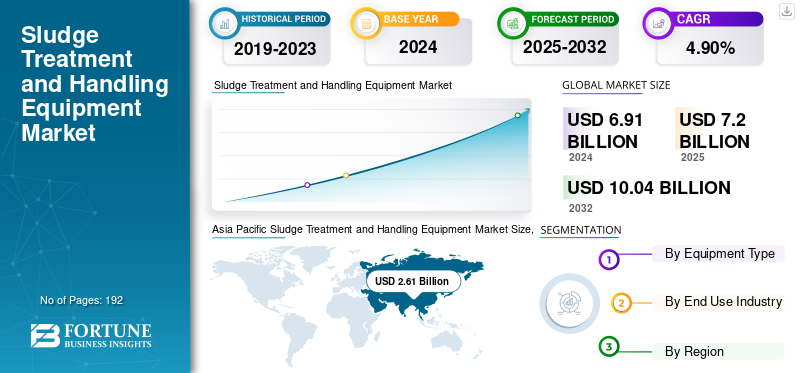
The global sludge treatment and handling equipment market size was valued at USD 7.2 billion in 2025. The market is projected to grow from USD 7.52 billion in 2026 to USD 11.19 billion by 2034, exhibiting a CAGR of 5.1% during the forecast period. Asia Pacific dominated the sludge treatment and handling equipment market with a market share of 38% in 2025.
The sludge treatment and handling equipment refers to systems and machines that are used for treating, dewatering, disposing, and thickening of sludge that is generated from wastewater treatment processes. This include belt filter presses, centrifuges, thickeners, and dryers that help in reducing sludge volume and overall environmental impact.
The market is driven by stringent environmental regulations, growing need for efficient waste water management in different industries and municipalities and ongoing urbanization. Furthermore, the growing integration of sustainable technologies and resource recovery methods such as biogas generation also augments the demand for these equipment.
Few key players operating in the market include, Andritz AG, Veolia Water Technologies, HUBER SE, Alfa Laval, VA Tech Wabag, SPIRAC, TAKRAF and others. These companies are focusing on strategic partnerships, technological innovations, and mergers to expand their global presence.
Download Free sample to learn more about this report.
Sludge Treatment and Handling Equipment Market Key Takeaways
 Global Market Size & Forecast
- 2025 Market Size: USD 7.2 billion
- 2026 Market Size: USD 7.52 billion
- 2034 Forecast Market Size: USD 11.19 billion
- CAGR: 5.1% from 2026–2034
 Market Share
- Asia Pacific dominated the sludge treatment and handling equipment market with a 38.00% share in 2025.
- Sludge treatment equipment is expected to account for 66.89% of the market in 2026.
- The chemical and petrochemical segment is projected to hold 26.06% of the market in 2026.
 Key Regional Highlights
Asia Pacific
Asia Pacific led the market at USD 2.73 billion in 2025 and is projected to reach USD 2.86 billion in 2026.
North America
North America accounted for USD 2.13 billion in 2025 and is expected to reach USD 2.25 billion in 2026.
Europe
Europe generated USD 1.54 billion in 2025 and is projected to grow to USD 1.58 billion in 2026.
U.S
The market is expected to reach USD 1.54 billion by 2026.
Japan
Japan is expected to witness steady growth, supported by advanced wastewater treatment adoption.
Read More

MARKET DYNAMICS
Market Drivers
Rising Industrialization and Stringent Environmental Regulations Drives the Market Development
Increase in industrialization is a prominent driver for sludge treatment and handling equipment market growth. This is further supported by the growing wastewater generation across different industries that fuels the demand for effective sludge management systems.
- For instance, according to niti.gov, the estimated wastewater generation is approximately 39,604 Million Litres per Day (MLD) in the rural regions, while in the urban centres, the wastewater generation has been estimated as 72,368 MLD.
Additionally, governments across different regions and major economies are implementing stricter wastewater discharge standards. This is enabling municipalities and industries to adopt modern sludge treatment equipment.
Market Restraints
High Operational and Maintenance Costs Hampers the Market Growth
Despite the increase in demand for sludge treatment and handling equipment, the market tends to face different challenges. These include the higher cost of installation, operation and maintenance of sludge treatment systems. Various small municipalities and industries are struggling to adopt these systems due to limited budget, thus limiting the overall market expansion.
Market Opportunities
Technological Advancements and Resource Recovery Offers Lucrative Growth Opportunities
Technological innovations in dewatering, automation and thermal drying systems tend to create new opportunity for market growth and avenues for manufacturers. This is further supported by the growing emphasis of companies on resource recovery including conversion of sludge into bio-fertilizers or renewable energy. This offers a lucrative opportunity for market development.
Additionally, the advancements in smart control systems and digital monitoring are also improving the operational effectiveness and decreasing the maintenance costs. This also attracts new investments in modern sludge management solutions.
SLUDGE TREATMENT AND HANDLING EQUIPMENT MARKET TRENDS
Shift Toward Sustainable and Energy-Efficient Solutions Has Emerged as a Prominent Market Trend
The market is rapidly shifting toward a sustained and energy efficient systems owing to the global push for environmental protection and effective cost optimization. Various manufacturers are increasingly developing innovative systems that aid in reducing energy consumption and carbon emissions, while increasing the resource recovery. Technologies aligning with sludge-to-energy conversion, nutrient recovery, and biogas generation are increasingly gaining a higher attention.
Download Free sample to learn more about this report.
Additionally, adoption of new technologies such as IoT based monitoring, automation, and smart control systems improve the process efficiency and reducing operational costs. This aligns with the principle of circular economy that encourages industries to adopt a greener solution.
SEGMENTATION ANALYSIS
By Equipment Type
Increasing demand for Reducing Environmental Impact Boosts Sludge Treatment Equipment Segment Growth
Based on equipment type, the market is segmented into sludge treatment equipment and sludge handling equipment. The sludge treatment equipment segment is further divided into thickening equipment, conditioning equipment, stabilization equipment, dewatering equipment, and drying & thermal treatment equipment. Similarly, the sludge handling equipment segment is segmented into pumping & conveying systems, storage & loading equipment, odor & air control equipment and others.
In 2024, sludge treatment equipment segment held the largest sludge treatment and handling equipment market share and with a revenue share of USD 4.64 billion. This segmental growth is attributed to its crucial role in reducing the environmental impact. This equipment also aids in ensuring a compliance with wastewater disposal regulations. The sludge treatment equipment segment is expected to lead the market, contributing 66.89% globally in 2026.
Additionally, sludge handling equipment segment held the highest CAGR of 5.4% in 2024. This is due to the increase in municipal and industrial waste generation. This is coupled with growing focus on sustainable waste management practices, and implementation of stricter environmental policies.
By End Use Industry
To know how our report can help streamline your business, Speak to Analyst
Increased Generation of Wastewater Drives the Chemical and Petrochemical Segment Growth
The market is divided into food & beverage, pulp & paper, chemical and petrochemical, textile, power generation, pharmaceuticals, others, based on end use industry.
Among these, chemical and petrochemical segment dominated the market with a revenue share of USD 1.75 Billion in 2024. The segment also held a highest CAGR of 6.3% in 2024. The chemical and petrochemical segment is expected to account for 26.06% of the market in 2026. This segmental growth is due to increased generation of wastewater and the demand for advanced treatment solutions. Additionally, the huge volume of hazardous and complex wastewater that is generated in production processes, growing integration of advanced sludge treatment technologies, and growing regulatory pressures for wastewater management also augments the segment growth.
SLUDGE TREATMENT AND HANDLING EQUIPMENT MARKET REGIONAL OUTLOOK
Geographically the market is segmented into North America, Europe, Asia Pacific, South America and Middle East & Africa.
North America
Asia Pacific Sludge Treatment and Handling Equipment Market Size, 2025 (USD Billion) To get more information on the regional analysis of this market, Download Free sample
North America maintained a strong presence in the global market, reaching USD 2.13 Billion in 2025, accounting for 29.90% share, and is expected to reach USD 2.25 Billion in 2026. This growth is due to a significant modernization of wastewater treatment infrastructure and growing integration of energy efficient/automated sludge management systems. Moreover, a stringent regulatory standard across developed economies including the U.S. also contributes the overall regional market growth. The U.S. leads the North American market with an expected revenue share of USD 1.54 billion in 2026.
Europe
In 2025, Europe generated USD 1.54 Billion, contributing 21.10% to global market revenue, and is projected to grow to USD 1.58 Billion in 2026. This regional market growth is due to strict environmental regulations, strong government support, and advanced wastewater management infrastructure. U.K., Germany, and Italy are some of the major contributors to the market growth with an expected revenue share of USD 0.3 billion, USD 0.4 billion and USD 0.2 billion respectively by 2026.
Asia Pacific
The Asia Pacific market accounted for USD 2.73 Billion in 2025, representing 38.00% of the global industry, and is expected to reach USD 2.86 Billion in 2026. This growth is due to growing urban expansion, rapid industrialization, and surge in investments in wastewater treatment infrastructure. India and China are the major contributors for the market growth with an expected revenue share of USD 0.38 and USD 1.16 billion by 2026.
South America and Middle East & Africa
In 2025, Middle East & Africa represented USD 0.39 Billion, accounting for 5.40% of the worldwide market, and is projected to grow to USD 0.41 Billion in 2026. This growth is driven by increasing investments by government in modern wastewater infrastructure, with industries looking for sustainable and efficient solutions to manage the growing sludge volumes and environment issues. GCC countries are predicted to have a market share of USD 0.18 billion by 2025.
Latin America
Latin America contributed 5.70% to the global market in 2025, with a valuation of USD .41 Billion, and is projected to reach USD .43 Billion in 2026.
COMPETITIVE LANDSCAPE
Key Industry Players
Key Players Are Focusing on Collaborations to Sustain in Market Competition
The sludge treatment and handling equipment industry comprises of various players operating such as Andritz AG, Veolia Water Technologies, HUBER SE, Alfa Laval, VA Tech Wabag, SPIRAC, TAKRAF and others. These firms are executing different key strategies including mergers and collaborations, innovating new technologies and others to sustain their market positions.
LIST OF KEY SLUDGE TREATMENT AND HANDLING EQUIPMENT COMPANIES PROFILED:
- Andritz AG (Austria)
- Veolia Water Technologies (France)
- HUBER SE (Germany)
- Alfa Laval (Sweden)
- VA Tech Wabag (India)
- SPIRAC (Georgia)
- TAKRAF (Germany)
- Parkson Corporation (U.S.)
- Phoenix Process Equipment (U.S.)
- Xylem Inc. (U.S.)
- Kurita Water Industries (Japan)
KEY INDUSTRY DEVELOPMENTS
- In April 2025, JWC launches rotary screen for enhanced municipal wastewater treatment. The new Drumscreen Monster Channel Rotary Screen (CRS) from Sulzer’s JWC is a screening solution designed to boost the efficiency and performance of municipal wastewater treatment facilities.
- In April 2025, Edmonds launched new technology at a wastewater treatment facility that eradicates “forever chemicals,” otherwise known as PFAS. The city will start the new system on a 6-month trial run to collect data and train Public Works staff.
- In June 2024, Huber Technology unveils new center flow perforated band screen. This new CenterMax Hybrid is a center flow perforated band screen offering high throughput capacity and maximum separation efficiency with plastic perforated screen elements to prevent hair pinning and fouling.
- In January 2022, Rotork has introduced its IQ3 SET actuator, part of its Lifetime Management service and maintenance programme, which offers backwards compatibility with legacy actuators on sites that have non-integral starters, known as SyncroSET.
- In October 2021, Smarter washing solutions specialist, MWS Equipment announced the launch of a latest equipment to its product portfolio. The Hydropure thickener range is designed to maximize water recovery whilst minimizing the use of tailing dams.
REPORT COVERAGE
The global report provides a detailed analysis of the market and focuses on key aspects such as prominent companies, deployment modes, types, and end users of the product. Besides this, it offers insights into the sludge treatment and handling equipment market trends and highlights key industry developments and market share analysis for key companies. In addition to the aforementioned factors, the report encompasses several factors that have contributed to the growth of the market over recent years.
Request for Customization to gain extensive market insights.
Report Scope & Segmentation
|
ATTRIBUTE |
DETAILS |
|
Study Period |
2021-2034 |
|
Base Year |
2025 |
|
Estimated Year |
2026 |
|
Forecast Period |
2026-2034 |
|
Growth Rate |
CAGR of 5.1% from 2026-2034 |
|
Historical Period |
2021-2024 |
|
Unit |
Value (USD billion) |
|
Segmentation |
By Equipment Type, End Use Industry and Region |
|
By Equipment Type |
|
|
By End-Use Industry |
|
|
By Region |
|
Frequently Asked Questions
Fortune Business Insights says that the global market stood at USD 7.52 billion in 2026 and is projected to reach USD 11.19 billion by 2034.
The market is expected to exhibit steady growth at a CAGR of 5.1% during the forecast period.
Rising industrialization and stringent environmental regulations drives the market growth.
Andritz AG, Veolia Water Technologies, HUBER SE, Alfa Laval, VA Tech Wabag, SPIRAC, TAKRAF and others are some of the top players in the market.
The Asia Pacific region held the largest market share.
Asia Pacific was valued at USD 2.73 billion in 2025.


- 2021-2034
- 2025
- 2021-2024
- 192
Get 30-60 hrs Free Customization
Expand Regional and Country Coverage, Segments Analysis, Company Profiles, Competitive Benchmarking, and End-user Insights.






-
US +1 833 909 2966 ( Toll Free )
-
Get In Touch With Us