Small-Scale LNG Market Size, Share & Industry Analysis, By Mode of Supply (Truck to Load (TTL), Ship to Ship (STS), Truck to Ship (TTS), Pipeline to Truck (PTT), and Pipeline to Ship (PTS)), By Type (Liquefaction Terminal, Regasification Terminal, and LNG Transportation and Storage Infrastructure), By End-Use Industry (Industrial, Power Generation, Transportation, Marine and Shipping, Commercial and Residential, and Others), and Regional Forecast, 2026-2034
 Download Free Sample
Small Scale LNG Market Overview
 Listen to Audio Version
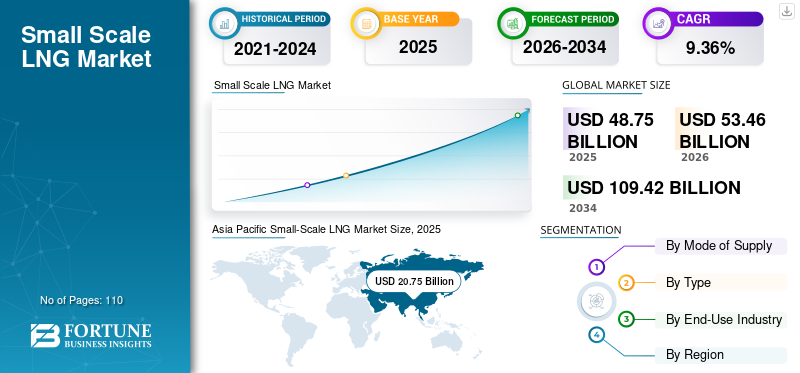
The small scale lng market size was valued at USD 78.61 billion in 2025 and is projected to grow from USD 90.02 billion in 2026 to USD 266.13 billion by 2034, exhibiting a CAGR of 14.51% during the forecast period. Asia Pacific dominated the small-scale LNG market with a market share of 42.56% in 2025.
Small-scale LNG (SSLNG) refers to the production, transportation, storage, distribution, and regasification of liquefied natural gas through relatively lower-capacity infrastructure compared to conventional large-scale LNG export and import terminals. SSLNG systems are typically designed to serve localized or distributed energy demand where pipeline gas infrastructure is unavailable, uneconomical, or insufficient. The market generally includes small and modular liquefaction plants, LNG trucking, ISO container transport, satellite LNG stations, bunkering facilities, and small-scale regasification terminals. Thus, the market is growing due to a combination of environmental regulations, fuel cost advantages, energy access needs, and expansion of cleaner transportation and industrial energy solutions. The industry is benefiting from the expansion of LNG bunkering infrastructure, remote power generation projects, and industrial fuel switching from diesel, coal, and heavy fuel oil to LNG.
The industry is experiencing tremendous expansion due to the growing worldwide demand for cleaner, more adaptable, and affordable energy options. LNG is becoming increasingly popular in transportation and industry as it has a lower carbon footprint, less sulfur, and higher fuel efficiency than diesel, coal, and heavy fuel oil. The market acceptance is being further accelerated by the expansion of virtual pipeline networks, LNG trucking, and marine bunkering infrastructure, especially in areas without traditional natural gas pipeline connections. Furthermore, governments in North America, Europe, and the Asia Pacific are funding LNG infrastructure and promoting cleaner fuel options to improve energy security and advance decarbonization efforts.
Shell plc, Wärtsilä Corporation, and Linde plc are key players in the market due to their strong capabilities across LNG infrastructure, technology development, distribution networks, and end-use applications. Shell plc has a significant presence in LNG bunkering, LNG supply, and global LNG logistics, supported by its extensive natural gas portfolio and investments in marine LNG fueling infrastructure. The company actively supplies LNG for transportation, industrial, and marine applications, making it one of the leading integrated players in the SSLNG ecosystem. Wärtsilä Corporation is a major player due to its expertise in LNG-powered marine engines, regasification systems, and SSLNG terminal technologies.
Download Free sample to learn more about this report.
Small Scale LNG Market Key Takeaways
 Global Market Size & Forecast
- 2025 Market Size: USD 78.61 billion
- 2026 Market Size: USD 90.02 billion
- 2034 Forecast Market Size: USD 266.13 billion
- CAGR: 14.51% (2026–2034)
 Market Share
- Asia Pacific dominated the market with a 42.56% share in 2025.
- The truck-to-load (TTL) segment accounted for the largest market share of 37.23% in 2025.
- The liquefaction terminal segment dominated the market, accounting for 67.88% of the global market in 2025.
 Key Regional Highlights
Asia Pacific
Asia Pacific generated USD 20.75 billion in 2025 and is projected to reach USD 22.95 billion in 2026.
North America
North America generated USD 9.32 billion in 2025, representing a significant regional market.
Europe
Europe accounted for USD 13.18 billion in 2025 and is projected to reach USD 14.54 billion in 2026.
U.S.
U.S. market reached USD 7.19 billion in 2025.
Japan
Japan market is projected to witness steady growth during the forecast period.
Read More

SMALL-SCALE LNG MARKET TRENDS
Soaring Energy Demand in Remote and Off-grid Locations to Drive the Market Growth
The primary factor driving the expansion of the market is the rising energy demand in remote and off-grid areas, where many islands, rural communities, mining operations, industrial sites, and distant commercial facilities lack access to traditional natural gas pipelines or reliable power grids. In these areas, heavy fuel oil and diesel have historically been the main energy sources, but these fuels are associated with high transportation costs, volatile prices, and increased carbon emissions. By allowing natural gas to be transported through cryogenic trucks, ISO containers, and virtual pipeline networks to locations where pipeline connections are not possible, small-scale LNG offers a versatile and affordable option. Furthermore, SSLNG systems help reduce operational costs and environmental impacts by enabling reliable power generation, industrial heating, and fuel supply for remote operations.
In February 2026, Wärtsilä, a technology company based in Finland, secured a contract to provide LNG cargo-handling and fuel-gas systems for two specialized LNG bunkering ships under construction in China. This agreement solidifies the company's position in the expanding market. The 20,000 cubic meter ships are being constructed at Zhejiang XinLe Shipbuilding for a Hong Kong-based owner. The equipment is planned for delivery in the second half of 2026 and the ships are anticipated for delivery in the second half of 2027. The entire LNG system package, including engineering, cargo handling systems, and integrated monitoring and control solutions for cargo operations, will be provided by Wärtsilä's Gas Solutions division. The initiative emphasizes the growing worldwide investment in marine LNG logistics and small-scale LNG infrastructure to promote the use of cleaner fuels and decentralized energy distribution.
MARKET DYNAMICS
MARKET DRIVERS
Download Free sample to learn more about this report.
Increasing Adoption of LNG in Heavy-Duty Transportation to Drive Market Growth
Due to its cost efficiency, reduced emissions profile, and appropriateness for long-haul operations, the expanding use of LNG in heavy-duty transportation is a significant factor driving small-scale LNG market growth. To lower fuel costs and comply with more stringent environmental standards, rail locomotives, mining vehicles, heavy-duty vehicles, and commercial freight fleets are increasingly switching to LNG as a diesel alternative. Vehicles running on LNG emit less carbon dioxide, sulfur oxide, nitrogen oxide, and particulate matter than traditional diesel-powered engines, making them appealing to fleet operators who prioritize operational efficiency and sustainability. The growth of LNG fueling stations, cryogenic transportation infrastructure, and virtual pipeline networks is boosting the transportation industry's acceptance of LNG. Furthermore, many governments are encouraging the use of cleaner transportation fuels by setting emission reduction targets and offering incentives for the adoption of natural gas vehicles. The demand for compact LNG distribution and refueling infrastructure is also increasing worldwide due to the growth of cross-border logistics, long-distance freight transit, and industrial transportation.
In June 2025, Linde plc signed a new long-term agreement with Blue Point Number One, a joint venture between CF Industries, JERA, and Mitsui & Co., under which Linde will provide industrial gases to Blue Point's 1.4 million metric ton low-carbon ammonia facility in Ascension Parish, Louisiana. The deal emphasizes Linde's growing significance in promoting cleaner fuel technologies, industrial gas solutions, and low-carbon energy infrastructure. Through modular LNG production systems, cryogenic storage technologies, and LNG distribution infrastructure intended for decentralized and remote energy applications, Linde is actively engaged in the market in addition to its industrial gas business. The company's capacity for small-scale LNG also helps promote the use of LNG in heavy-duty transportation, where it is increasingly common as a cleaner alternative to diesel in long-haul trucking and industrial logistics fleets. Growing investments in low-carbon fuels, LNG fueling infrastructure, and distributed LNG supply networks are driving the demand for small-scale LNG solutions across the transportation, industrial, and off-grid energy sectors.
MARKET RESTRAINTS
High Transportation and Cryogenic Storage Costs to Restrain Market Growth
High transportation and cryogenic storage costs are major factors restraining the growth of the market, as LNG must be maintained at extremely low temperatures, approximately -162°C, throughout storage and transportation. This requires specialized cryogenic tanks, insulated containers, LNG carrier trucks, and advanced handling infrastructure, all of which involve significant capital and operational expenses. In small-scale LNG supply chains, transportation costs can be particularly high when serving remote, off-grid locations due to long delivery distances, lower transportation volumes, and limited infrastructure. In addition, maintaining cryogenic conditions during LNG loading, unloading, and storage increases energy consumption and equipment maintenance requirements.
MARKET OPPORTUNITIES
Rising Adoption of Bio-LNG and Renewable Gas Integration to Drive Market Growth
The growing adoption of bio-LNG and renewable gas integration is a significant driver of the market, as industries and governments increasingly focus on reducing carbon emissions and transitioning to cleaner energy systems. Bio-LNG, produced from renewable sources such as agricultural waste, municipal solid waste, sewage sludge, and organic biomass, offers a low-carbon alternative to conventional LNG while utilizing existing LNG infrastructure and distribution networks. Small-scale LNG systems are particularly well-suited for bio-LNG integration as modular liquefaction plants, virtual pipelines, and localized distribution networks enable flexible deployment near renewable gas production sites. In addition, bio-LNG can be used across heavy-duty transportation, marine bunkering, industrial fuel supply, and off-grid power generation applications without major modifications to existing LNG engines and infrastructure.
In April 2026, Gasum inaugurated a new bio-LNG filling station in Joensuu, Finland, as part of its bio-LNG infrastructure expansion. In addition to providing compressed biogas for lighter vehicles, the station also supports heavy-duty transportation. As the nation's easternmost bio-LNG refueling facility, it greatly increases the availability of renewable LNG throughout Eastern Finland. The opening of the Joensuu station brings Gasum's total number of bio-LNG refueling facilities for heavy-duty vehicles in Finland to 23, underscoring the rising investment in renewable LNG fueling infrastructure and the expanding use of bio-LNG in commercial transportation. These changes are fueling the demand for compact LNG infrastructure, cryogenic storage facilities, and global LNG distribution networks.
MARKET CHALLENGES
Limited Pipeline Connectivity in Remote Regions to Hamper Market Growth
Due to difficulties with fuel transportation, infrastructure integration, and end-user accessibility, the expansion of the market is anticipated to be limited by restricted pipeline connectivity in distant, underserved areas. Effective logistics networks are essential to the operation of small-scale LNG systems as they deliver LNG from liquefaction terminals to off-grid customers, marine refueling stations, power plants, and industrial facilities. LNG providers frequently rely on road tankers, rail, or sea transport in areas with insufficient pipeline infrastructure, which can raise transportation expenses and complicate operations. In addition, the lack of well-developed gas distribution networks limits the ability to guarantee a reliable, uninterrupted fuel supply, especially in hilly or geographically remote regions.
Segmentation Analysis
By Mode of Supply
Truck to Load (TTL) Segment Led the Market due to its Cost-Effective and Flexible LNG Distribution Capabilities
Based on the mode of supply, the market is classified into truck to load (TTL), ship to ship (STS), truck to ship (TTS), pipeline to truck (PTT), and pipeline to ship (PTS).
The truck to load (TTL) segment dominated the small-scale LNG market share, accounting for 37.23%, in 2025 due to its flexibility, cost-effectiveness, and suitability for supplying LNG to remote and off-grid locations. Truck-to-load distribution enables LNG to be transported directly from liquefaction facilities or storage terminals to end users without requiring extensive pipeline infrastructure, making it an efficient solution for regions with limited natural gas connectivity. The segment is widely adopted across industrial facilities, power generation plants, mining sites, marine bunkering stations, and heavy-duty transportation applications where reliable fuel delivery is essential. Additionally, truck-based LNG transportation requires lower initial infrastructure investment than pipelines and enables suppliers to serve multiple customers through scalable, mobile distribution networks.
In April 2026, to further solidify India's position in the expanding market for natural gas infrastructure and small-scale LNG, Petronet LNG added 5 MTPA of capacity at its Dahej terminal, increasing the terminal's overall capacity from 17.5 MTPA to 22.5 MTPA as of March 31. The Dahej plant is still India's largest LNG import facility, despite several setbacks in its initial timetable, and is now building a third pier to improve its LNG handling capacity. The growth is anticipated to meet the increased demand for LNG in transportation, industrial uses, LNG-to-power initiatives, and decentralized energy distribution networks. Furthermore, the larger terminal capacity is anticipated to enhance truck-to-load (TTL) LNG operations, which are essential to the small-scale LNG supply chain by enabling the delivery of LNG via cryogenic tanker trucks to distant industrial facilities, LNG fueling stations, off-grid sites, and heavy-duty transportation networks.
The truck to ship (TTS) segment is the fastest-growing segment and is projected to grow at a CAGR of 10.34% during the forecast period. The segment is expanding as it provides a flexible, cost-effective, and rapidly deployable solution for LNG bunkering operations, particularly at ports where permanent LNG fueling infrastructure is still under development. In the TTS model, LNG is transported through cryogenic tanker trucks directly to ships for refueling, eliminating the immediate need for large-scale pipeline or terminal investments. This method has gained significant adoption with an increase in the number of LNG-powered vessels operating under stricter maritime emission regulations established by the International Maritime Organization (IMO).
By Type
Liquefaction Terminal Segment Led the Market due to Vital Role in Natural Gas Storage, Transportation, and Distribution
By type, the market is categorized into liquefaction terminal, regasification terminal, and LNG transportation and storage infrastructure.
The liquefaction terminal segment dominated the market, accounting for 67.88% share, in 2025. Liquefaction facilities form the foundation of the entire LNG supply chain by converting natural gas into a liquefied form for efficient storage, transportation, and distribution, propelling the dominance of the segment. Small-scale liquefaction terminals enable LNG delivery to remote, off-grid locations where conventional pipeline infrastructure is unavailable or uneconomical.
In March 2026, New Fortress Energy continued expanding its small-scale LNG infrastructure by building modular liquefaction and LNG terminal facilities to facilitate LNG logistics and distributed energy delivery. The company has been investing in integrated LNG supply networks and small-scale liquefaction facilities to support remote energy applications, marine bunkering, industrial clients, and electricity production. To improve access to LNG in areas without pipeline connections, TotalEnergies and ENN Energy have also increased their investments in satellite LNG distribution systems and modular liquefaction plants.
The regasification terminal segment is anticipated to grow at a CAGR of 10.10% over the analysis period. The segment is expanding with the growing need for decentralized natural gas delivery in distant, off-grid areas where pipeline infrastructure is limited or nonexistent. Tiny regasification facilities convert LNG back into natural gas for use in industry, electricity production, business establishments, and municipal gas distribution systems. The increasing adoption of LNG-to-power projects is driving investments in small, modular regasification infrastructure, the expansion of satellite LNG facilities, and the growing industrial fuel conversion from coal and diesel to cleaner natural gas.
By End-Use Industry
To know how our report can help streamline your business, Speak to Analyst
Industrial Segment Dominated the Market due to Significant LNG Adoption as a Cleaner and Cost-effective Fuel
By end-use industry, the market is categorized into industrial, power generation, transportation, marine and shipping, commercial and residential, and others.
The industrial segment captured the largest market share, accounting for 35.85%, in 2025 given that industries are increasingly adopting LNG as a cleaner, more cost-effective alternative to diesel, coal, and heavy fuel oil for manufacturing and processing operations. Small-scale LNG is widely used across industries such as mining, metals, chemicals, cement, food processing, and remote manufacturing facilities where access to pipeline natural gas is limited.
In June 2024, to bolster and broaden its liquefied natural gas (LNG) business across Asia, Shell Eastern Trading, a division of the U.K.-based energy giant Shell, began the process of acquiring Pavilion Energy, based in Singapore, from Carne Investments, an indirect wholly owned subsidiary of Temasek. The purchase is expected to enhance Shell's capacity for LNG supply, trading, bunkering, and distribution, thereby helping the expansion of the market. The transaction is especially important for the industrial sector, where the growing demand for cleaner fuel alternatives is driving the greater use of LNG in manufacturing plants, industrial parks, mining operations, and isolated industrial centers.
The marine and shipping segment is poised to grow at a CAGR of 10.95% over the analysis period. The segment growth is driven by the increasing adoption of LNG as a cleaner marine fuel to comply with stringent emissions regulations imposed by the International Maritime Organization (IMO). LNG-powered vessels emit lower levels of sulfur oxides, nitrogen oxides, particulate matter, and carbon dioxide than conventional marine fuels such as heavy fuel oil and diesel, making LNG an attractive solution for decarbonizing the shipping industry. The rapid expansion of LNG bunkering infrastructure, including truck-to-ship, ship-to-ship, and port-based LNG fueling systems, is further supporting market growth. In addition, increasing investments in LNG-fueled cargo ships, ferries, cruise vessels, and offshore support vessels are driving demand for SSLNG supply and distribution networks.
SMALL-SCALE LNG MARKET REGIONAL OUTLOOK
By geography, the market is categorized into Europe, North America, Asia Pacific, Latin America, and the Middle East & Africa.
Asia Pacific
Asia Pacific Small-Scale LNG Market Size, 2025 (USD Billion)
To get more information on the regional analysis of this market, Download Free sample
Asia Pacific is the dominating region in the market. The regional market size was valued at USD 20.75 billion in 2025 and is expected to reach USD 22.95 billion in 2026. This market is growing rapidly due to rising energy demand, expanding industrialization, and the escalating adoption of cleaner fuel alternatives across major economies such as China, India, Japan, and Southeast Asian countries. Governments across the region are promoting LNG as a transition fuel to reduce dependence on coal and diesel while supporting decarbonization and air quality improvement initiatives. The rapid expansion of LNG trucking networks, satellite LNG stations, LNG bunkering infrastructure, and LNG-to-power projects is further accelerating market growth. In addition, many remote and island regions across Southeast Asia lack pipeline gas infrastructure, making SSLNG an efficient solution for decentralized power generation and industrial fuel supply.
China Small-Scale LNG Market
In 2025, the China market reached USD 8.36 billion. The nation has built one of the largest LNG trucking and virtual pipeline networks in the world, enabling LNG delivery to businesses and industrial consumers who are not near pipeline infrastructure. Additionally, the increasing demand for transportation fuels with reduced emissions, tighter air pollution restrictions, and coal-to-gas conversion initiatives in China are driving the expansion of LNG use in logistics fleets, manufacturing facilities, and municipal energy systems. The expansion of the market in China is being aided by the quick rollout of LNG fueling stations, cryogenic tanker fleets, and modular LNG infrastructure as well as by growing investment in domestic liquefaction capabilities.
In April 2026, in collaboration with Shaanxi Yanchang Petroleum & Natural Gas Co. Ltd, Beijing Petrochemical Engineering Co., Ltd placed an order with GTT for the design of a 10,000 m3 onshore LNG tank to be constructed at the Yangjiawan LNG liquefaction facility in Yan'an, Shaanxi Province, China. GTT's membrane technology will be used for the first time in conjunction with an onshore LNG liquefaction facility. Due to the limited land available, this arrangement represents a significant advancement for LNG infrastructure, which requires the highest possible energy efficiency.
India Small-Scale LNG Market
The India market reached a value of around USD 3.01 billion in 2025, accounting for roughly 14.50% of the global market. The India market is expanding as the nation's growing emphasis on extending natural gas access beyond conventional pipeline-connected areas and integrating LNG into its broader energy diversification plan. In contrast to many developed markets, where the development of SSLNG is primarily fueled by marine bunkering or well-established LNG logistics systems, the India market is being influenced by the fast expansion of city gas distribution (CGD) networks, the increasing industrial energy demand from semi-urban manufacturing clusters, and the necessity of providing underserved areas with cleaner fuel. Through LNG trucking and virtual pipeline systems, SSLNG is becoming increasingly popular for connecting industries outside the existing gas grid.
North America
North America was valued at roughly USD 8.46 billion in 2024 and touched USD 9.32 billion by 2025. The market in North America is expanding due to the region's robust natural gas production base, growing shale gas availability, and rising use of LNG for distributed energy and industrial resilience applications. North America, in contrast to many other areas where development, is largely hampered by limited access to energy or reliance on imports and has a robust midstream infrastructure network and plentiful domestic natural gas reserves that enable affordable LNG production and local distribution.
U.S. Small-Scale LNG Market
The U.S. market stood at around USD 7.19 billion in 2025. The U.S. market is growing due to the country’s expanding emphasis on flexible domestic gas monetization, decentralized energy infrastructure, and cleaner fuel deployment across commercial transportation and industrial sectors. The U.S. has a strong advantage in low-cost shale gas production, allowing LNG suppliers to develop localized liquefaction and distribution systems that can economically serve inland and remote demand centers. SSLNG is increasingly being adopted for heavy-duty trucking fleets, rail transport, mining operations, marine fueling, and backup power applications where operators are seeking alternatives to diesel with lower emissions and more stable fuel pricing.
Europe
The Europe market was valued at USD 13.18 billion in 2025 and is expected to reach USD 14.54 billion by 2026. The market is expanding due to the region's emphasis on energy diversification, decarbonization, and decreasing reliance on traditional pipeline gas supplies. European nations are investing more in satellite LNG stations, decentralized gas distribution networks, LNG import facilities, and LNG bunkering infrastructure amid heightened concerns about energy security and tighter environmental regulations. As a more environmentally friendly alternative to coal, diesel, and heavy fuel oil, SSLNG is gaining popularity across a range of industries, including industrial plants, maritime transportation, heavy-duty trucks, and remote power generation.
U.K. Small-Scale LNG Market
The U.K. market stood at around USD 1.51 billion in 2025, representing roughly 11.45% of the global market. The growing demand for cleaner, more adaptable energy options in the transport, maritime, industrial, and decentralized power generation sectors is driving the expansion of the market in the U.K. In accordance with environmental and maritime regulations, the nation is expanding its LNG logistics and bunkering infrastructure to facilitate the shift to lower-emission fuels. SSLNG is increasingly used in industrial facilities, port operations, and heavy-duty trucking fleets seeking alternatives to fuel oil and diesel.
Germany Small-Scale LNG Market
The Germany market stood at around USD 2.20 billion in 2025, accounting for roughly 16.70% of the global market. The comparatively small LNG market in Germany is expanding as a result of the country's quick transition to a flexible gas infrastructure that supports transportation decarbonization and industry continuity as well as the restructuring of its energy supply system. Germany has increased investments in LNG import infrastructure, mobile regasification units, and decentralized LNG distribution networks in response to significant changes in the European energy supply environment to enhance supply security for industrial and manufacturing activities. In contrast to many other markets that prioritize remote energy access, Germany's growth is heavily reliant on supporting its export-oriented industrial economy, which includes sectors such as chemicals, automotive production, steel, and logistics that require reliable, lower-emission fuel sources.
Latin America & Middle East Africa
Latin America and the Middle East & Africa markets stood at USD 3.02 billion and USD 2.48 billion, respectively, in 2025. The Latin America market is expanding as the demand for a reliable, flexible energy source is depicting a rise in remote industrial operations, mining operations, and areas with poor pipeline infrastructure. Due to their reliance on expensive diesel-based power generation and uneven gas delivery networks, many Latin American nations are facing challenges, creating a strong need for distributed LNG solutions. As it offers a cleaner, more cost-effective alternative to traditional liquid fuels, SSLNG is becoming increasingly popular for mining, industrial fuel applications, heavy-duty transportation, and LNG-to-power projects.
The market in the Middle East and Africa is expanding due to the growing demand for decentralized energy solutions, increased industrial diversification, and the expansion of LNG-to-power infrastructure in developing, energy-intensive nations. The region's numerous nations are experiencing difficulties with limited pipeline connectivity, erratic power availability, and rising energy consumption in the mining, commercial, and industrial sectors, all of which offer significant opportunities for SSLNG. To enhance access to cleaner, more adaptable energy sources, governments and energy firms are making increasing investments in virtual pipeline systems, LNG import terminals, floating regasification units, and truck-loading facilities.
GCC Small-Scale LNG Market
The GCC market stood at around USD 1.11 billion in 2025, representing roughly 44.85% of the global market. The GCC industry is expanding as the region's emphasis on maximizing indigenous natural gas use, promoting industrial diversification, and building cleaner fuel infrastructure outside the framework of conventional large-scale hydrocarbon exports grows. In contrast to many other locations, where the industry growth is largely driven by energy access constraints, GCC nations are using SSLNG to increase fuel flexibility for logistics activities, industrial parks, desalination plants, and new transportation applications.
COMPETITIVE LANDSCAPE
Key Industry Players
Industry Players to Concentrate on Strategic Partnerships to Improve their Market Position
Companies operating in the small-scale LNG market are actively engaged in developing and expanding LNG infrastructure, cryogenic transportation systems, LNG bunkering services, and decentralized energy supply networks to support the growing global demand for cleaner fuels. These companies are investing in modular liquefaction plants, satellite LNG stations, truck-to-load facilities, LNG fueling stations, and small-scale regasification terminals to improve LNG accessibility in industrial, transportation, marine, and remote off-grid applications. Many players are also focusing on LNG bunkering solutions for marine vessels, LNG-powered heavy-duty transportation, and virtual pipeline systems that deliver LNG via cryogenic tanker trucks and ISO containers to regions without natural gas pipeline connectivity.
For instance, in February 2025, TotalEnergies and the Gujarat State Petroleum Corporation Limited (GSPC), a state-owned oil and gas business, reached an agreement on a long-term Sale and Purchase Agreement (SPA) that will be in effect for ten years, beginning in 2026. Under this arrangement, TotalEnergies will provide GSPC with 6 shipments of liquefied natural gas (LNG) per year, totaling 400,000 tons.
The majority of the LNG supplied to terminals on India's west coast from TotalEnergies' worldwide portfolio will be used by GSPC's industrial clients. Additionally, it will supply Indian families with CNG for their homes, businesses, and service stations that serve vehicles that run on it, such as autorickshaws.
LIST OF KEY SMALL-SCALE LNG COMPANIES PROFILED
- Shell plc (U.K.)
- TotalEnergies SE (France)
- Engie SA (France)
- Linde plc (U.K.)
- Chart Industries, Inc. (U.S.)
- Wartsila Corporation (Finland)
- Air Products and Chemicals, Inc. (U.S.)
- Excelerate Energy, Inc. (U.S.)
- ENN Energy Holdings Limited (China)
- Gasum Oy (Finland)
KEY INDUSTRY DEVELOPMENTS
- May 2026: Wärtsilä Gas Solutions, a division of the technology company Wärtsilä, would provide cargo handling and fuel gas delivery systems for four new LNG bunkering ships being built at the Nantong CIMC Sinopacific Offshore & Engineering shipyard in China for GSX Energy. Wärtsilä booked two ships in the first three months of 2026 and then for two more ships in the second three months of the year. The project emphasizes the increasing investment in marine LNG infrastructure and the rising importance of the small-scale LNG sector in promoting sustainable maritime fuel alternatives. LNG bunkering vessels are an essential part of smaller-scale LNG distribution networks, allowing for a versatile LNG supply for LNG-powered ships and contributing to the worldwide switch to marine fuels with lower emissions.
- April 2026: Shell plc, a major international energy company, significantly increased its natural gas supplies to India following disruptions caused by the West Asia conflict, leveraging its global liquefied natural gas (LNG) portfolio to address supply shortages and meet rising demand. Industry sources indicated that Shell emerged as a key supplier in recent bulk LNG tenders issued by Indian fertilizer companies, securing 4 trillion British thermal units (TBtus) out of the 6 TBtus tendered. The government’s priority largely drove the move to maintain feedstock availability for urea production amid constrained LNG supplies from the Gulf region. The disruption was primarily linked to QatarEnergy, India’s largest LNG supplier, which declared force majeure due to escalating geopolitical tensions, affecting nearly 11.2 million tonnes of India’s annual LNG imports of approximately 27 million tonnes.
- August 2025:S.-based Excelerate Energy announced the acquisition of Methane Alison Victoria from Greece's GasLog Partners with the intention of transforming the 2007-built, steam-powered liquefied natural gas (LNG) carrier into a floating storage and regasification unit (FSRU). Following the completion of the conversion, the ship, which would be known as the Excelerate Shenandoah FSRU, would be used as part of an LNG supply agreement in the Atlantic Basin. This trend highlights the increase in investments in flexible LNG infrastructure and the growing significance of floating regasification systems in the market. Through scalable LNG supply solutions, FSRUs are increasingly being utilized to improve energy access in areas without permanent LNG import terminals, support marine fuel, power generation, and industrial applications, and enhance decentralized LNG distribution. Shipping databases subsequently verified the transfer and renaming of the 145,000-m³ ship under Excelerate Energy. At the same time, GasLog Partners announced the sale of the vessel to an unknown buyer in its Q2 2025 earnings presentation.
- June 2025: China's biggest independent natural gas business, ENN Natural Gas Co., Ltd., announced its completion of the Phase I of a mini-LNG development project in Indonesia and began offering post-construction management and maintenance services through its subsidiary, Xindi Energy Engineering Technology Co., Ltd. The evolution emphasizes ENN Energy's expanding participation in the small-scale LNG industry, notably in decentralized LNG infrastructure and distributed energy supply systems in developing countries. As they allow for localized LNG production, storage, and transportation for industrial plants, isolated communities, and off-grid energy applications where traditional pipeline infrastructure is sparse, mini-LNG projects are a crucial component of the small-scale LNG business.
- February 2022: Sucros Oy, a Finnish sugar firm, unveiled plans to switch its sugar beet factory in Säkylä from coal and heavy fuel oil to LNG and liquefied biogas (LBG), underscoring the growing industrial adoption of small-scale LNG. Gasum would provide the fuel, which is expected to reduce emissions from the facility's current three boilers significantly. Gasum already collaborates with Sucros's subsidiary, Suomen Sokeri, by using wastewater sludge and biosludge as feedstock for its biogas facilities, where the biogas produced is further used to generate industrial heat and electricity as well as fuel for road and marine transportation.
REPORT COVERAGE
The global small-scale LNG market analysis provides an in-depth study of the market size and forecast across all market segments included in the report. It contains details on the market dynamics and trends expected to drive the market over the forecast period. It offers information on technological advancements, new product launches, key industry developments, and partnerships, mergers, and acquisitions. The market research report also includes a detailed competitive landscape, providing market share and profiles of key players.
Request for Customization to gain extensive market insights.
Report Scope & Segmentation
| ATTRIBUTE | DETAILS |
| Study Period | 2021-2034 |
| Base Year | 2025 |
| Estimated Year | 2026 |
| Forecast Period | 2026-2034 |
| Historical Period | 2021-2024 |
| Growth Rate | CAGR of 9.36% from 2026-2034 |
| Unit | Value (USD Billion) |
| Segmentation | By Mode of Supply, By Type, By End-Use Industry, and Region |
| By Mode of Supply |
|
| By Type |
|
| By End-Use Industry |
|
| By Region |
|
Frequently Asked Questions
Fortune Business Insights says that the global market value stood at USD 78.61 billion in 2025 and is projected to reach USD 266.13 billion by 2034.
The market is expected to exhibit a CAGR of 14.51% during the forecast period (2026-2034).
By end-use industry, the industrial segment led the market in 2025.
The increasing adoption of LNG in heavy-duty transportation is a key factor driving market growth.
Linde plc, Engie SA, and Chart Industries, Inc. are the top players in the market.
Asia Pacific dominates the market in terms of share.
The surging adoption of bio-LNG and renewable gas integration is a significant factor driving market growth.



- 2021-2034
- 2025
- 2021-2024
- 110
Get 30-60 hrs Free Customization
Expand Regional and Country Coverage, Segments Analysis, Company Profiles, Competitive Benchmarking, and End-user Insights.


















-
US +1 833 909 2966 ( Toll Free )
-
Get In Touch With Us