Virtual Pipeline Market Size, Share & Industry Analysis, By Fuel Type (CNG, LNG, and Others), By Application (Transportation and Industrial & Commercial), and Regional Forecasts, 2026-2034
 Download Free Sample
KEY MARKET INSIGHTS
 Listen to Audio Version
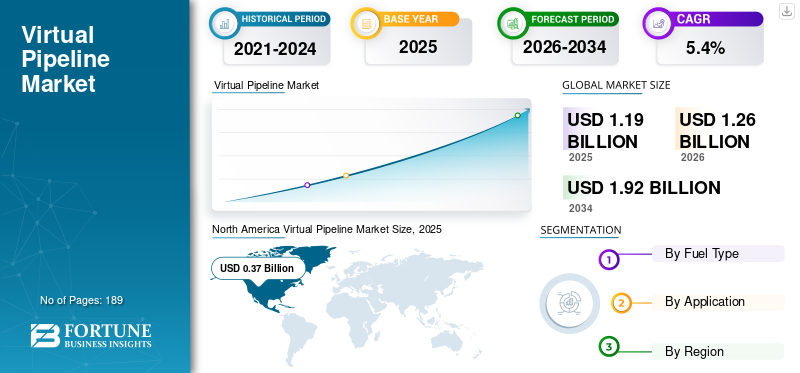
The global virtual pipeline market size was estimated at USD 1.19 billion in 2025 and is projected to reach USD 1.26 billion in 2026 to USD 1.92 billion by 2034, growing at a CAGR of 5.40% from 2026 to 2034. North America dominated the virtual pipeline market with a market share of 31.00% in 2025. The global COVID-19 pandemic has been unprecedented and staggering, with virtual pipeline experiencing lower-than-anticipated demand across all regions compared to pre-pandemic levels. Based on our analysis, the global virtual pipeline market exhibited a decline of -3.1% in 2020 as compared to 2019. Virtual Pipeline Market in the U.S. is projected to grow significantly, reaching an estimated value of USD 428.50 million by 2032.
A virtual pipeline is a replacement for a physical pipeline in which gas would be transported through a traditional gas pipeline to the delivery point as LNG by sea, road, rail or an amalgamation of one or more of such modes of transport. The LNG is crammed into a cryogenic vessel for transporting it from its source, such as an import terminal, dispensation center or liquefaction provision, to the point of delivery where it will be used. At the point of delivery, a regasification station, a multi-purpose facility that includes LNG storage, vaporization, and pressure regulator, along with control systems delivers the natural gas as exactly as it would have come from the traditional pipeline.
Download Free sample to learn more about this report.
Virtual Pipeline Market Key Takeaways
 Global Market Size & Forecast
- 2025 Market Size: USD 1.19 billion
- 2026 Market Size: USD 1.26 billion
- 2034 Forecast Market Size: USD 1.92 billion
- CAGR: 5.40% from 2026–2034
 Market Share
- North America dominated the virtual pipeline market with a 31.00% share in 2025.
- The CNG segment is projected to account for 66.7% of the market in 2026.
- The transportation segment is expected to dominate the market during the forecast period.
 Key Regional Highlights
North America
Led the market in 2025, supported by its established natural gas infrastructure and strong industry presence.
Asia Pacific
Is witnessing strong growth, driven by rapid industrialization and expanding gas-based infrastructure.
Europe
Is growing steadily, supported by increasing CNG and LNG adoption and decarbonization initiatives.
U.S
The market is projected to reach USD 428.50 million by 2032.
Japan
The market is supported by rising adoption of cleaner fuels and expanding gas infrastructure.
Read More

VIRTUAL PIPELINE MARKET TRENDS
Download Free sample to learn more about this report.
Increasing Demand to Enhance Gas Pipeline to Spur Market Opportunities
The population explosion in urban areas due to the migration of people has caused a surge in energy demand from various sectors. The increased urbanization and industrialization have intensified the demand for electricity, gas, and other energy sources. As renewable energy is still in the initial stages of its life cycle in many parts of the world, most power is derived from conventional resources like gas. Pipelines are required to transport these fuels long distances, as pipelines offer the most cost-effective transport option. Due to high energy demand, the increasing offshore exploration activities have led to a surge in pipeline infrastructure development. This has furthered the need for pipeline transport solutions and services to various remote locations.
Increasing urbanization and expanding industry have resulted in natural gas being used in various sectors, such as power generation, chemical, manufacturing, and residential and commercial, which has fueled the demand for the infrastructure of gas pipelines. Also, the government subsidies provided to increase the use of natural gas and deliver natural gas to every part of the country have allured more users.
Natural gas facilities in remote regions face few transportation challenges due to lack of pipeline infrastructure. Using a virtual based pipeline has acted as one of the most reliable options in terms of cost compared to investing in or developing new pipeline infrastructure at remote locations. This new technology also allows the increasing number of vehicular natural gas service stations, with a relatively smaller investment, emphasizing that this technology is also employed in other products and service sectors. This way, the users of vehicles provided with GNV have more flexibility to drive through the countryside of the country, with natural gas available even in places where there are no conventional pipelines.
DRIVING FACTORS
Shifting Trend toward Cleaner Energy Resources and Rising Demand for Natural Gas to Propel Market Growth
The world is facing severe threats of global warming resulting in a shifting trend toward cleaner energy resources, which increased the demand for natural gas. Due to topography or geopolitical events that may drive the market growth, physical pipelines are not always feasible. The virtual type pipeline offers flexibility over the transportation of natural gas. It does not require massive installation of a physical pipeline, resulting in many cost savings of pipeline installation, anticipating the growth of the market.
Over time, the demand for gas has been increasing across all regions. However, natural gas supply through conventional pipelines has not kept pace with this need. Therefore, a Compressed Natural Gas (CNG) system that can meet the needs of cities for power generation, automotive, industry, and industrial use is the need of the hour.
A virtual based pipeline is a system that enables the transportation of natural gas in the form of compressed or liquefied gas using modules integrated with mobile platforms transported by trucks, ferries, boats, and rail platforms. Subsequently, this pipeline makes it possible to meet the demand in regions without gas pipeline distribution network infrastructure, which helps in the market development.
Increasing Operations at Remote Locations to Drive Market Growth
The use of a virtual based pipeline must not be seen as a permanent and definitive alternative but as a quick way to bring natural gas to places where the traditional pipeline is not technically or economically feasible.
In places without natural gas, the industry is limited to processing or developing products and services using energy sources and does not keep up with new technologies that may be more economical, having lower emissions, higher quality, and more reliable.
The industry/commercial operator can use natural gas in the local market of any region, which is a cleaner energy source compared to the oil by-products, by developing more competitive goods and services for internal and external competitors, thus stimulating their penetration into new markets.
The virtual pipeline is a passport to new frontiers, consolidating natural gas consumption and preparing the region for the future use of conventional gas supply, as this pipeline creates the flexibility for a more suitable industrial location and the possibility of better use of geographic resources at a better cost-benefit ratio. In this case, the virtual based pipeline system can be transferred to a newly developed region. This is fueling the growth of the market.
RESTRAINING FACTORS
Rising Adoption of Renewable Energy Sources and Volatility in Gas Prices to Hinder Market Growth
The increasing demand for clean energy has led to the tremendous development of solar, wind, and other forms of energy worldwide. In particular, the European continent is expanding its renewable energy capacities. This has led to a decline in investments in the crude oil industry and infrastructure development. This is expected to hamper the virtual pipeline market growth. According to the International Monetary Fund (IMF), large companies have scaled back their investments in oil infrastructure. Due to rapid depletion of oil reserves, a decline in oil reserve replacement and investment has been observed since 2014. In parallel, the volatility of natural gas prices is also hampering the mainstream adoption of natural gas worldwide, which is also likely to hamper the market in forecast period.
Subsequently, natural gas is extremely flammable and requires precautionary measures while handling and transportation, which is expected to hinder market growth. The variation in normal temperature may change the natural gas properties that require special attention and insulation, which is expected to increase overall maintenance costs. Thus, it may hamper the market growth.
SEGMENTATION ANALYSIS
By Fuel Type Analysis
To know how our report can help streamline your business, Speak to Analyst
CNG to Hold Dominant Share Due to Crucial Role in Delivering Fuel with Low Cost
Based on fuel type, the market is segmented into CNG, LNG, and others. CNG is set to dominate the market, as transport of CNG through virtual based pipelines is the best alternative to costly underground pipelines for transporting natural gas to remote locations for distances up to 250 miles. In addition, high oil prices are increasing the demand for natural gas. CNG deliveries via virtual based pipelines are the best alternative to transport natural gas to remote locations. Based on this factor, the CNG segment is projecteed to dominate the markt with a share of 66.7% in 2026.
Other fuel types, such as hydrogen and renewable natural gas, are transported through virtual based pipelines. Like conventional natural gas, RNG can be used as a transportation fuel in the form of Compressed Natural Gas (CNG) or Liquefied Natural Gas (LNG), which is likely to see significant demand in the years to come.
By Application Analysis
Transportation Segment to Dominate the Market Due to Increasing Natural Gas Consumption
Based on application, the market is segmented into transportation and industrial & commercial. The transportation segment consists of natural gas distributors such as CNG & LNG stations. With the growing need for clean energy, the demand for natural gas will likely experience significant growth in the coming years. Based on this factor, the transportation application will likely dominate the virtual pipeline market share during the forecast timeframe.
Moreover, the transportation of natural gas is done across industrial and commercial applications, such as the mining industry, infrastructure maintenance, food & beverages, and others, which also operate at remote locations.
REGIONAL ANALYSIS
North America Virtual Pipeline Market Size, 2025 (USD Billion)
To get more information on the regional analysis of this market, Download Free sample
North America to Dominate the Market Owing to the Presence of Major Operating Players
Geographically, the market is analyzed across North America, Europe, Asia Pacific, Latin America, and the Middle East & Africa, reflecting varied adoption patterns influenced by infrastructure maturity, regulatory frameworks, and energy transition priorities.
North America
North America dominated the global market in 2025, with a market size of USD 3.37 billion, supported by the strong operational footprint of companies such as CERTARUS Ltd, Xpress Natural Gas, CNG Services, and Edge Energy across the U.S., Canada, and Mexico. The region benefits from a well-established natural gas ecosystem, supportive federal and state-level policies promoting lower-carbon fuels, and increasing efforts to supply gas to off-grid industrial and commercial consumers. The U.S. Virtual Pipeline Market is projected to grow significantly, reaching an estimated value of USD 428.50 million by 2032, driven by rising shale gas production, cost advantages over liquid fuels, and growing demand for temporary and peak-shaving gas supply solutions. Regulatory oversight from energy and environmental agencies further ensures compliance with safety and emissions standards, reinforcing investor confidence and long-term infrastructure expansion.
Asia Pacific
Asia Pacific holds a substantial share of the market, supported by rapid urbanization and industrialization across emerging economies. Expanding manufacturing bases, power generation needs, and limited access to conventional pipeline infrastructure in remote and island geographies are accelerating reliance on virtual pipeline networks. Governments across the region are promoting cleaner fuel adoption to curb air pollution, thereby strengthening demand for compressed and liquefied natural gas distribution. Policy initiatives encouraging gas-based economies, coupled with infrastructure gaps in tier-II and tier-III cities, are creating sustained demand for modular and flexible gas transportation systems.
Europe
Europe follows with steady growth momentum, primarily driven by increasing adoption of CNG and LNG as cleaner alternatives in the transportation sector in the U.K., Germany, and Poland. The region’s stringent carbon reduction targets and emissions regulations under broader climate transition frameworks are encouraging decentralized gas supply models where conventional pipelines are economically unviable. Virtual pipelines are increasingly utilized to support industrial decarbonization, backup energy supply, and cross-border fuel logistics. Strong regulatory alignment with energy efficiency and sustainability goals continues to shape investment flows and technology integration across member states.
Latin America
Latin America is witnessing progressive development, supported by the expansion strategies of North American service providers and rising energy demand in underserved regions. While pipeline infrastructure remains unevenly distributed, governments are gradually implementing reforms to attract private investments in gas distribution networks. Virtual pipelines serve as a cost-effective alternative for supplying industrial clusters, mining operations, and power plants located far from transmission grids. Economic recovery initiatives and efforts to diversify energy matrices are expected to further strengthen regional adoption.
Middle East & Africa
The Middle East & Africa region is experiencing increasing demand amid large-scale infrastructural development and industrial expansion. Several countries are investing in energy diversification strategies to support economic growth and reduce reliance on oil-based fuels. In areas where conventional pipeline connectivity is limited, virtual pipeline solutions offer logistical flexibility and faster deployment timelines. Regulatory reforms aimed at liberalizing gas markets and encouraging foreign direct investment are gradually enhancing market accessibility. As transportation and industrial sectors expand, demand for reliable and scalable gas delivery systems is expected to rise steadily across the region.
KEY INDUSTRY PLAYERS
Key Participants are Concentrating on Enhancing their Business Capacities Through Collaboration and New Investment Strategies
Most market participants invest in research and development activities, which will likely help the market generate better returns. The market players are likely to collaborate with major players in the market. They have positive in-store traits for market operation and growth until 2029. The considerable increase in market funding and investment puts the production and manufacturing units in a better position for mass-produced products that will help the market to expand and improve at the global level.
List of Key Companies Profiled:
- Kinder Morgan (U.S.)
- Stabilis Solutions, Inc. (U.S.)
- Hexagon Agility (U.S.)
- Fiba Technologies (U.S.)
- Petronas (Malaysia)
- CNG Services (U.K.)
- Gas Malaysia (Malaysia)
- Galileo Technologies (Argentina)
- NG Advantage (Vermont)
- Marline Gas Services (U.S.)
- Snam (Italy)
- Certarus Ltd (Canada)
KEY INDUSTRY DEVELOPMENTS:
- August 2022 - Kinder Morgan acquired North American Natural Resources, Inc. and its affiliated companies, North American Biofuels LLC and North American-Central LLC, for USD 135 million. The acquisition, in the amalgamate purchase amount along with related contract costs, includes seven quantities of landfill gas to power plants located in Michigan & Kentucky. Through this acquisition, Kinder Morgan makes the Final Investment Decision (FID) to convert 4 of the 7 gas to power plants to renewable natural gas plants at a capital expenditure of approximately USD 175 million.
- June 2022 - AVR assessed the possibilities of locally managing its hazardous gas and cleaning residues by partnering with HaloSep AB, a Swedish company. The HaloSep process is a patented solution that turns hazardous waste into harmless and useful fractions. By selecting HaloSep’s solution, AVR will be embellished into a circular by recovery of material resources along with a reduction of the plant’s environmental footprint.
- December 2021 - Tennessee Gas Pipeline (TGP), a subsidiary of Kinder Morgan, Inc., has filed a proposal with the Federal Energy Regulatory Commission (FERC) for implementing a responsibly sourced natural gas (RSG) supply assembling regathering service at selected locations across the Tennessee Gas Pipeline system. The proposed service is planned to sanction the suppliers as well as customers on TGP to buy and sell RSG supplies at abstract trading facilities, thereby serving end-users, utilities, power plants, and LNG facilities connected to the TGP system.
- October 2021 - Gas Malaysia and Malakoff Corporation Berhad formed Malakoff – Gas Malaysia Cogen O&M Sdn Bhd. The alliance is a strategic partnership between two utility companies within the MMC Group of Companies that brings together the expertise and resources of both parties to commence the cogeneration plant’s Operations & Maintenance (O&M) services in Malaysia.
- September 2020 - Petronas has rolled out the Virtual Pipeline System (VPS) solution through the Regasification Terminal (RGT) in Pengerang, Johor. In part, of the company's customer driven offerings, propels the extension of clean energy usage in Peninsular Malaysia. The VPS solution was evolved by Petronas Gas and New Energy's business segment and is being retailed by PETRONAS Dagangan Berhad to deliver Liquefied Natural Gas (LNG) majorly to off-grid customers using trucks equipped with cryogenic tanks.
- June 2019 - Galileo Global Technologies set forth the beginning of operations, Edge Gathering virtual pipelines 2 LLC (Edge), a U.S. based company. Edge Gathering Virtual Pipelines 2 LLC will commission the Liquefied Natural Gas (LNG) virtual pipelines to associate the shale producing gas fields with the consumers without laying down conventional pipelines.
REPORT COVERAGE
The research report presents a comprehensive industry assessment by offering valuable insights, facts, industry-related information, and historical data. Several methodologies and approaches are adopted to make meaningful assumptions and views to formulate the report.
Request for Customization to gain extensive market insights.
REPORT SCOPE & SEGMENTATION
|
ATTRIBUTE |
DETAILS |
|
Study Period |
2021-2034 |
|
Base Year |
2025 |
|
Estimated Year |
2026 |
|
Forecast Period |
2021-2034 |
|
Historical Period |
2021-2024 |
|
Unit |
Value (USD Billion) |
|
Segmentation |
By Fuel Type, Application, and Region |
|
Segmentation |
By Fuel Type
|
|
By Application
|
|
|
By Region
|
Frequently Asked Questions
Fortune Business Insights study shows that the global market was USD 1.19 billion in 2025.
The global market is projected to grow at a CAGR of 5.4% in the forecast period.
The market size of North America stood at USD 0.37 billion in 2025.
Based on fuel type, CNG holds the dominating share in the global market.
The global market size is expected to reach USD 1.92 billion by 2034.
The key market drivers are the adoption of clean energy and the growing waste management application.
The top players in the market are Veolia, AVR, China Everbright Limited, Attero, and Viridor.



- 2021-2034
- 2025
- 2021-2024
- 189
Get 30-60 hrs Free Customization
Expand Regional and Country Coverage, Segments Analysis, Company Profiles, Competitive Benchmarking, and End-user Insights.



















Related Reports
-
US +1 833 909 2966 ( Toll Free )
-
Get In Touch With Us