Smart Mirror Market Size, Share & Industry Analysis, By Display Type (LED, LCD, OLED), By Component (Hardware, Software, and Services), By Mounting Type (Wall-Mounted, Floor-Standing, and Embedded/Built-In), By End User (Household/Individual Consumers, Retailers & Brands, Fitness Centers & Studios, and Others), and Regional Forecast, 2026-2034
 Download Free Sample
(Offer valid till 30th Sep 2026)

KEY MARKET INSIGHTS
 Listen to Audio Version
The global smart mirror market size reached USD 2.95 billion in 2025. It is projected to grow from USD 3.38 billion in 2026 to USD 10.37 billion by 2034, exhibiting a CAGR of 15.03% over the forecast period. North America dominated the global market with a market share of 37.28% in 2025.
The global smart mirror industry is expanding at a steady pace. This expansion is driven by increasing use of advanced mirrors in residential bathrooms, fitness and wellness spaces, retail environments, and hospitality applications. This technology combines displays, sensors, connectivity, and AI-enabled software to offer personalized user experiences. The rising penetration of smart homes, bathroom refurbishments, the rapid deployment of AR-enabled fitting rooms in retail, and an increasing demand for interactive fitness solutions in both residential and commercial spaces impel the market growth. For instance, the global smart home user base comprises more than 400 million households globally, thereby leading demand for connected bathroom and wellness devices. Simultaneously, retailers are increasingly investing in in-store digital technologies to engage customers and lower return rates. Moreover, the growth of urban housing construction in the Asia Pacific and the ongoing refurbishment of premium hotels in North America, Europe, and the Middle East are additional factors supporting the market expansion.
Key players in the market include Kohler, Lululemon (Mirror), FXGear Inc., Japan Display Inc., and Magna International. These brands in the market are continuously focusing on product launches, innovation and the integration of AI, IoT, and smart home devices ecosystems in applications across residential, fitness, retail, and hospitality sectors. Industry participants are engaging and spending on premium positioning, strategic partnerships, and expanding into high-value commercial and connected living environments. At the same time, they are progressively adopting software, digital services, and recurring revenue models to strengthen their market presence in the long run.
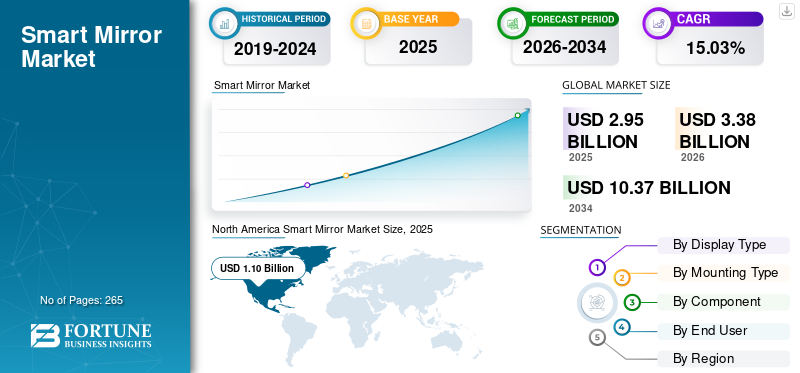
Download Free sample to learn more about this report.
Smart Mirror Market Key Takeaways
 Market Size & Forecast
- 2025 Market Size: USD 2.95 billion
- 2026 Market Size: USD 3.38 billion
- 2034 Forecast Market Size: USD 10.37 billion
- CAGR: 15.03% from 2026–2034
 Market Share
- North America dominated the smart mirror market with a 37.28% share in 2025.
- The OLED display type segment is projected to grow at the fastest CAGR of 17.90% during forecast period.
- The retailers & brands segment is expected to witness the highest CAGR of 16.85% growth during the forecast period.
 Key Regional Highlights
North America
North America held 37.28% share in 2025, valued at USD 1.10 billion.
Asia Pacific
Asia Pacific market projected to reach USD 0.84 billion in 2026.
Europe
Europe market projected to reach USD 0.91 billion in 2026.
U.S.
The market in the U.S. was valued at USD 0.96 billion in 2025.
Japan
The market in Japan is projected to reach USD 0.13 billion by 2026.
Read More

SMART MIRROR MARKET TRENDS
Integration of AI and AR for Interactive and Personalized Experiences to be a New Market Trend
A major trend influencing consumer-purchasing decisions is the integration of AI (artificial intelligence) and AR (augmented reality) to offer highly interactive and personalized user experiences. Technological advancements in mirrors integrated with posture tracking, facial recognition, virtual try-on, and real-time fitness feedback capabilities, qualifying them for use across retail, beauty, and fitness and wellness industry verticals. This trend is driving higher user engagement, resulting in increased software value, and prompting adoption in commercial settings, including retail stores and fitness studios.
Download Free sample to learn more about this report.
MARKET DYNAMICS
Market Drivers
Rising Penetration of Smart Homes and Connected Living Technologies to Drive Market Growth
One of the primary aspects leading the smart mirror market growth is the rapidly expanding smart homes, driven by AI, IoT, growing need for energy efficiency, and increasing consumer demand for convenience, personalization, and security. Cutting-edge mirrors fit in perfectly with voice assistants, lighting systems, and IoT platforms, making them an integral part of smart and advanced bathrooms and wellness spaces. For instance, smart home penetration in developed markets such as the U.S. has exceeded 65% of households, thus laying strong foundation for complementary products such as advanced mirrors.
Growing Deployment in Retail, Fitness, Automotive, and Hospitality Applications to Propel Market Growth
Demand for smart mirrors is escalating across different industries, such as retail, fitness, and hospitality, where the use of interactive displays improves customer engagement and is more efficient from an operational standpoint. Retailers are implementing AR, enabling products to allow virtual try on and lower product return rates. At the same time, gyms and studios are getting technologically advanced mirrors for training and digital coaching. Additionally, advanced mirrors have contributed to the growth of the automotive industry by strengthening driver assist functionalities through integrated cameras and sensors that provide real time visibility of blind spots and surrounding traffic. When combined with Advanced Driver Assistance Systems (ADAS), smart mirrors deliver instant safety alerts and contextual information directly within the driver’s line of sight. This integration enhances driving safety, supports regulatory requirements, and accelerates the adoption of intelligent and connected vehicle technologies. Furthermore, with over 22 million hotel rooms globally, the continuous renovation and investment in the guest experience is driving the increasing use of advanced mirrors in hotels and resorts, thus supporting the growth of commercial demand for these devices.
Market Restraints
Complex Integration and High Initial Setup to Hamper Market Growth
Higher upfront costs and installation complications, particularly for advanced models equipped with AI, AR, and advanced display technologies, are the major constraints hampering the adoption of the product. In residential and commercial projects, such intelligent mirrors often require custom electrical fittings, system integration, and network connectivity within existing smart home or building management platforms, extending the total ownership costs. This cost sensitivity among price-conscious consumers in emerging markets restricts mass adoption and hinders penetration beyond high-income and premium commercial segments.
Market Opportunities
Expansion into Emerging Markets and Mass-Market Smart Bathroom Solutions to Create Lucrative Market Opportunities
The rising adoption of smart and technologically advanced mirrors across emerging economies and mass markets presents a considerable growth opportunity for key players in the market. The expanding middle-class population and their income levels, rapid urbanization, rising penetration of smart cities and smart homes, coupled with growing residential construction in regions such as Asia Pacific, South America, and parts of the Middle East, are propelling demand for modern home upgrades. In addition, as manufacturers start producing locally while optimizing production costs, and innovating in the modular smart product space, the penetration of advanced mirrors is projected to accelerate beyond premium segments into mainstream households.
Market Challenges
Restricted Market Penetration Owing to Specialized Usage Requirements to Pose a Challenge
The global market faces a major challenge of data theft and cybersecurity concerns, since these mirrors increasingly gather and store sensitive user data such as health metrics, images, and usage patterns. Ensuring compliance with evolving data protection regulations, secured data storage, and protecting user trust adds complexity and cost for manufacturers. These concerns certainly slow down the adoption, especially in healthcare, retail, and residential environments where data security expectations are high.
SEGMENTATION ANALYSIS
By Display Type
Availability of Wide Range and Budget-Friendly Options Supplemented Growth of LED Segment
Based on display type, the market is segmented into LED, LCD, and OLED.
The LED display type led market growth in 2025, which is largely attributed to its cost-effectivness, wide availability in sizes and shapes, and versatility across commercial and residential applications. These mirrors are largely embraced in hotels, bathrooms, and healthcare centers owing to their long lifespan, energy efficiency, and ease of integration with lighting and voice-integrated systems. Compared to LCD and OLED, LED options provide value for money ratio, making them the most preferred choice for large-scale deployments and refurbishment projects, thereby maintaining their leading position in the market.
The OLED display type segment is projected to grow at the fastest CAGR of 17.90% from 2026-2034.
To know how our report can help streamline your business, Speak to Analyst
By Component
Hardware Component Mandatory for Every Installation Led to its Dominance in Market
Based on component, the market is segmented into software, hardware, and services.
The hardware segment led the overall segment’s growth in 2025. The segment drives higher value share since displays, sensors, mirror glass, and embedded electronics contribute to the largest chunk of the product cost and are mandatory for every installation. In addition, widespread deployment of LED-based smart bathroom mirrors across residential and hospitality applications drives high shipment volumes, reinforcing hardware’s leading market share.
The software segment is projected to grow at the highest CAGRof 16.87% over the assessment period.
By End User
Large Number of Residential Installations Contributed Major Share to Household/Individual Consumers
Based on end user, the market is segmented into household/individual consumers, retailers & brands, fitness centers & studios, and others.
The household/individual consumers segment accounted for the majority global smart mirror market share. The segment’s domination is driven by sheer number of residential installations that significantly surpasses commercial deployments. Smart mirrors, especially LED-based bathroom mirrors, are increasingly embraced by homeowners during new housing projects, bathroom renovation activities, and smart home upgrades. Despite of their lower average selling price as compared to commercial setups, the high unit volumes across millions of homes translate into the largest cumulative revenue contribution.
The retailers & brands segment is expected to witness the highest CAGR of 16.85% growth during the forecast period.
By Mounting Type
Ease of Installations and Broad Applicability Boosted Wall-Mounted Segment Growth
Based on mounting type, the market is segmented into wall-mounted, floor-standing, and embedded/built-in.
The wall-mounted segment accounted for the largest market share in 2025. The largest share of the segment is primarily attributed to its ease of installations, broad applicability across residential and commercial settings, and retrofit compatibility. These mirrors are profoundly used in residences, healthcare facilities, hotels & wellness clubs, and other commercial spaces, where they can be installed without major structural modifications. Their space efficiency and lower installation cost, combined with strong demand for smart bathroom upgrades and hotel room renovations, are driving higher adoption volumes compared to built-in/embedded and floor-standing units, contributing to segment’s growth.
The embedded/built-in segment is anticipated to expand at the highest CAGR of 16.97% over the assessment period from 2025-2032.
Smart Mirror Market Regional Outlook
Regionally, the market is divided into North America, South America, Europe, Asia Pacific, and the Middle East & Africa.
NORTH AMERICA
North America Smart Mirror Market Size, 2025 (USD Billion)
To get more information on the regional analysis of this market, Download Free sample
The North America market held the dominant share in 2025, valued at USD 1.10 billion, and also took the leading share in 2026 with USD 1.26 billion. Growth of the region is driven by its early adoption of smart home technologies, high penetration of connected lifestyle products, and strong consumer purchasing power. A well-established base of residential smart bathroom installations and significant deployment of products across retail stores, fitness clubs, and hospitality properties further contributes to the region’s growth.
U.S. Smart Mirror Market
The U.S. market was valued at USD 0.96 billion and is projected to record a CAGR of 14.45% during the forecast period.
EUROPE
During the forecast period, the Europe region is projected to record a growth rate of 13.70% and touch a valuation of USD 0.91 billion in 2026. The European market benefits from strong home upgrade and renovation culture, particularly in countries including Germany, France, the U.K., and the Nordics, where homeowners are constantly seeking energy-efficient upgrades. Moreover, rigid energy-efficiency regulations mandated by governing bodies and strong demand from hotels & resorts, wellness centers, and spas supplement market growth.
U.K. Smart Mirror Market
The U.K. market was valued at USD 0.09 billion in 2025 and is estimated to grow at a CAGR of 15.04% over the forecast years.
Germany Smart Mirror Market
The Germany market was valued at 0.14 billion in 2025 and is projected to grow at a CAGR of 14.26% over the forecast period.
ASIA PACIFIC
The Asia Pacific region is estimated to reach USD 0.84 billion in 2026 and secure the position of the third-largest region in the market. Asia Pacific market growth is attributed to rapid urbanization, growing consumer-spending power, large-scale residential construction, and increasingly rising technology-savvy product consumption. Growing penetration of smart home ecosystems, growing disposable income levels, and increasing deployment of smart mirrors in fitness centers, hospitality projects, and retail outlets are driving the regional expansion.
China Smart Mirror Market
The China market was valued at USD 0.24 billion in 2025 and is projected to flourish at the CAGR of 17.47% during the forecast period.
India Smart Mirror Market
The Indian market was valued at USD 0.22 billion in 2025 and is anticipated to grow at a CAGR of 16.23% respectively in the coming years.
SOUTH AMERICA and MIDDLE EAST & AFRICA
Over the forecast period, South America and the Middle East and Africa regions are projected to witness significant growth. The South America market in 2025 is set to record USD 0.23 billion as its valuation. Gradual adoption of smart home technologies, increasing urban residential construction, and ongoing modernization of retail and hospitality infrastructure in major metropolitan areas is likely to drive South America market growth.
UAE Smart Mirror Market
UAE attained the value of USD 0.03 billion and grew at the CAGR of 15.91% in 2025.
Competitive Landscape
Key Industry Players
Key Players Focus on Premium Design Innovation and Integration of AI and ML to Expand Market Share
The global industry landscape is moderately fragmented and innovation-driven, with competition featuring a mix of well-established electronics manufacturers, niche technology specialists, and bathroom fixture brands. Industry participants mainly emphasize upon product differentiation, premium design innovation, and integration of IoT and AI capabilities, while their growth strategies mainly involve expanding application areas beyond residential uses such as into fitness, retail, and hospitality, reinforcing ecosystem partnerships, and increasingly leveraging software platforms and recurring digital services to enhance customer retention and long-term revenue.
LIST OF KEY SMART MIRROR COMPANIES PROFILED IN REPORT
- Kohler Co. (U.S.)
- FXGear Inc. (France)
- Japan Display Inc. (Japan)
- Magna International (Canada)
- Lululemon Athletica (Mirror / lululemon Studio) (Canada)
- Electric Mirror, Inc. (U.S.)
- Séura (U.S.)
- Gentex Corporation (U.S.)
- Pro Display (Japan Display Inc. ecosystem) (Japan)
- Ad Notam AG (Switzerland)
Key Industry Developments
- January 2025: At CES 2025, Withings unveiled the Omnia smart mirror concept, equipped with sensors and AI to measure metrics such as weight, heart health, and metabolic data, plus real-time health feedback via a built-in voice assistant. Although still a concept, Omnia demonstrates a forward-looking integration of telehealth, biometric analysis, and connected device ecosystems, indicating how smart mirrors could evolve into health monitoring hubs rather than mere information displays.
- September 2023: Lululemon announced the discontinuation of sales of its Mirror smart fitness hardware and entered into a strategic partnership with Peloton to integrate fitness content offerings. As reported by Retail Dive, lululemon decided to pivot away from proprietary hardware due to slower-than-expected growth and operational challenges, while continuing to support existing Mirror users. Through this partnership, lululemon aligned its fitness ambitions with Peloton’s established digital platform, allowing the company to focus on its core apparel business and content-led fitness strategy, rather than capital-intensive hardware manufacturing.
- March 2023: Kohler Co. expanded the regional distribution of its smart mirror offerings, including the Verdera and Verdera Voice smart mirrors, across North America, Europe, and Asia Pacific. The company strengthened its presence through Kohler Experience Centers, authorized kitchen and bath dealers, hospitality partnerships, and digital sales channels, enabling wider adoption in residential, hospitality, and large-scale renovation projects while reinforcing its connected smart bathroom ecosystem strategy.
REPORT COVERAGE
The smart mirror market report provides a detailed analysis of the market and focuses on key aspects such as the competitive landscape, services, and leading display types. It also offers global market industry trends and insights and highlights key industry developments. In addition to the aforementioned factors, the report on the global market outlook includes several factors that have contributed to the market's growth in recent years. The report’s free sample pages gives the brief regarding the report coverage.
Request for Customization to gain extensive market insights.
Report Scope & Segmentation
|
ATTRIBUTE |
DETAILS |
|
Study Period |
2021-2034 |
|
Base Year |
2025 |
|
Estimated Year |
2026 |
|
Forecast Period |
2026-2034 |
|
Historical Period |
2021-2024 |
|
Growth Rate |
CAGR of 15.03% from 2026 to 2034 |
|
Unit |
Value (USD Billion) |
|
Segmentation |
By Display Type · LED · OLED |
|
By Mounting Type · Wall-Mounted · Floor-Standing · Embedded / Built-In |
|
|
By Component · Hardware · Software · Services |
|
|
By End User · Households/ Individual Consumers · Retailers & Brands · Fitness Centers & Studios · Others |
|
|
By Region
|
Frequently Asked Questions
According to Fortune Business Insights, the global market size was USD 3.38 billion in 2026 and is anticipated to reach USD 10.37 billion by 2034.
In 2025, the global market stood at USD 2.95 billion.
The market will be growing at a CAGR of 15.03% and exhibit a significant growth rate during the forecast period.
By display type, the LED segment dominated the market.
Increasing use of smart mirrors in residential bathrooms, fitness and wellness spaces, retail environments, and hospitality applications drives global smart mirror market growth.
Kohler, Lululemon (Mirror), FXGear Inc., Japan Display Inc., and Magna International are among the few significant players in the global market.
North America held the highest market share in 2025.
Expanding middle-class population and their income levels, rapid urbanization, rising penetration of smart cities and smart homes, coupled with growing residential construction is likely to drive the product adoption among end-users.



- 2021-2034
- 2025
- 2021-2024
- 265
-
(Offer valid till 30th Sep 2026)
Get 30-60 hrs Free Customization
Expand Regional and Country Coverage, Segments Analysis, Company Profiles, Competitive Benchmarking, and End-user Insights.



















Related Reports
-
US +1 833 909 2966 ( Toll Free )
-
Get In Touch With Us