Smart Refinery Market Size, Share & Industry Analysis, By Solution (Advanced Process Control (APC), Real-Time Optimization (RTO) & Planning Software, Asset Performance Management (APM), Digital Twin & Simulation, Industrial Data Platforms & Historians, Cybersecurity & Industrial Networks, and Others), By Deployment Type (On-Premise, Cloud-Based, and Hybrid Deployment), By Application (Process Optimization & Yield Improvement, Energy Efficiency & Emissions Reduction, Maintenance & Reliability Management, Supply Chain & Refinery Planning, and Others), and Regional Forecast, 2026-2034
 Download Free Sample
Smart Refinery Market Size and Future Outlook
 Listen to Audio Version
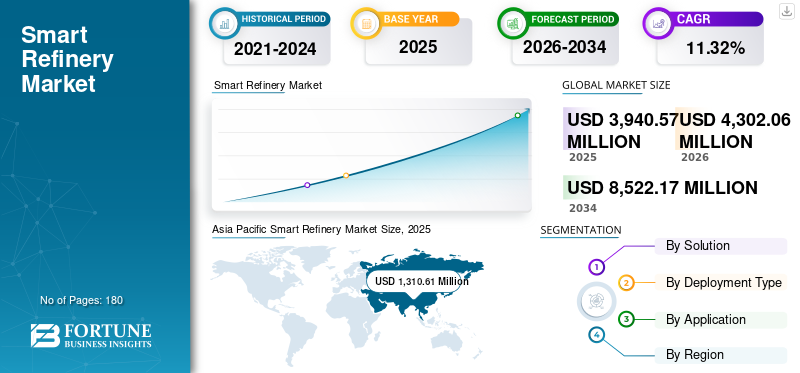
The global smart refinery market size was valued at USD 3,940.57 million in 2025 and is expected to reach USD 4,302.06 million by 2026. The market is projected to reach USD 8,522.17 million by 2034, with a CAGR of 8.92% over 2026-2034. Asia Pacific dominated the smart refinery market with a market share of 33.25% in 2025.
Asia Pacific is expected to dominate the market driven by the need for operational efficiency, stricter fuel standards (e.g., Euro VI, China VI), and increasing capacity in China and India. While regional demand is high for refined products, current geopolitical disruptions from the U.S.-Iran war are causing severe supply shocks and shifting reliance for crude sourcing.
A smart refinery is a modernized, digitally connected, and data-driven petroleum manufacturing facility that leverages Industry 4.0 technologies such as Artificial Intelligence (AI), the Industrial Internet of Things (IIoT), digital twins, and advanced automation to enhance operational efficiency, maximize profitability, improve safety, and reduce environmental impact.
- In October 2025, BPCL signed MoUs with Oil India Limited, Numaligarh Refinery Limited, and FACT to expand refining and petrochemical capacity, improve logistics for product evacuation, and advance green‑energy initiatives including organic manure and waste‑to‑energy projects as part of India’s energy‑transition push.
Emerson holds a prominent position in the market by providing advanced automation technologies, software, and services that enable oil and gas companies to improve operational efficiency, safety, and profitability. The market is competitive, with several industrial automation and technology companies such as Honeywell, Schneider Electric, Siemens and others providing similar solutions for digital transformation and operational efficiency.
Download Free sample to learn more about this report.
Smart Refinery Market Key Takeways
 Global Market Size & Forecast
- 2025 Market Size: USD 3,940.57 million
- 2026 Market Size: USD 4,302.06 million
- 2034 Forecast Market Size: USD 8,522.17 million
- CAGR: 8.92% from 2026–2034
 Market Share
- Asia Pacific dominated the smart refinery market with a 33.25% share in 2025.
- The Advanced Process Control (APC) segment accounted for the largest market share of 17.92% in 2025.
- The Hybrid deployment segment led the market with a 41.42% share in 2025.
 Key Regional Highlights
Asia Pacific
Asia Pacific Led the global market with USD 1,310.61 million in 2025 and is projected to reach USD 1,465.36 million in 2026, driven by rapid refinery modernization and digital transformation.
Europe
Europe Valued at USD 767.22 million in 2025, supported by increasing adoption of digital technologies to meet stricter emissions regulations and evolving fuel demand.
North America
North America Reached USD 925.09 million in 2025, driven by strong investments in digitalization, operational efficiency, safety, and sustainability across downstream oil and gas operations.
U.S.
U.S. The market generated USD 780.96 million in 2025, representing approximately 19.82% of the global smart refinery market.
Japan
Japan The market reached USD 129.67 million in 2025, accounting for approximately 3.29% of global smart refinery revenues.
Read More

SMART REFINERY MARKET TRENDS
Shift toward Autonomous and AI-Driven Refineries to Boost Market Growth
Refineries are rapidly transitioning from traditional automation to AI-driven autonomous operations, integrating advanced process control, machine learning, and digital twins. Companies are deploying real-time optimization systems that continuously adjust operations based on feedstock variability, energy costs, and demand patterns. The rise of digital control rooms and remote operations is reducing human intervention while improving efficiency and safety.
- In March 2025, Accenture expanded its AI Refinery platform by launching an AI agent builder and new industry‑specific agent solutions to accelerate agentic‑AI adoption. The enhancements let business users quickly build, customize, and scale AI‑agent networks across enterprises.
Additionally, integration of enterprise IT with operational technology (OT) is enabling data-driven decision-making across the value chain. This trend is particularly strong in Asia and the Middle East, where new refineries are being designed as “smart from inception,” accelerating the adoption of next-generation digital solutions.
MARKET DYNAMICS
MARKET DRIVERS
Download Free sample to learn more about this report.
Need for Operational Efficiency and Margin Optimization to Boost Market Growth
Refining is a low-margin, high-volume business, making efficiency improvements critical. Smart refinery solutions enable real-time optimization of yields, energy usage, and throughput, directly impacting profitability. Technologies such as APC, RTO, and predictive analytics help refiners maximize output from each barrel of crude while minimizing downtime and energy consumption. Increasing crude price volatility further pushes refiners to adopt advanced analytics for better planning and scheduling.
- In November 2025, Honeywell and TotalEnergies launched an AI‑powered pilot at TotalEnergies’ Port Arthur refinery, using Honeywell’s Experion Operations Assistant to enhance operator decision‑making, improve safety, reduce downtime, and accelerate the shift toward industrial autonomy in refinery operations.
Moreover, digital solutions can deliver measurable ROI within short payback periods, making them attractive investments. As global refining margins remain under pressure, digital transformation is becoming a strategic necessity rather than an optional upgrade.
MARKET RESTRAINTS
High Initial Investment and Integration Complexity Restrains Market Growth
Despite strong benefits, adoption of smart refinery technologies is often constrained by high upfront capital costs and complex integration with legacy systems. Many refineries operate on decades-old infrastructure, making it challenging to deploy modern digital solutions without significant retrofitting. Integration across multiple systems (DCS, ERP, MES, historians) requires specialized expertise and long implementation timelines. Additionally, smaller and state-owned refineries, especially in developing regions, may face budget limitations and slower decision-making processes. The perceived risk of operational disruption during system upgrades further delays adoption, particularly in facilities where downtime can lead to substantial financial losses and impede the smart refinery market growth.
MARKET OPPORTUNITIES
Decarbonization and Energy Transition Integration is Expected to Create Lucrative Opportunities
The global push toward net-zero emissions is creating strong opportunities for smart refinery solutions. Digital technologies are increasingly being used to optimize energy consumption, reduce emissions, and enable carbon tracking and reporting. Refineries are integrating smart systems to support co-processing of biofuels, hydrogen blending, and carbon capture initiatives. Advanced analytics and digital twins help simulate and implement low-carbon strategies without disrupting operations. Governments and regulatory bodies are also incentivizing digital investments that enhance energy efficiency. As refineries evolve into integrated energy hubs, the demand for smart refinery solutions will expand beyond traditional optimization to include sustainability-driven applications.
MARKET CHALLENGES
Cybersecurity Risks and Workforce Skill Gaps Create Challenges for Market Growth
As refineries become more connected and data-driven, they are increasingly exposed to cybersecurity threats targeting critical infrastructure. Protecting operational technology networks while enabling remote access and cloud integration is a major challenge. Additionally, the transition to smart refineries requires a highly skilled workforce capable of managing advanced analytics, AI systems, and digital platforms. However, many refineries face a shortage of digital talent and must invest heavily in training and change management. Resistance to organizational change and reliance on traditional operational practices can further slow adoption. Balancing digital transformation with operational security and workforce readiness remains a key hurdle.
Segmentation Analysis
By Solution
Integration & Services is Dominant Due to Rising Demand High Demand for Customized Implementation
Based on solution, the market is classified into Advanced Process Control (APC), real-time optimization (RTO) & planning software, asset performance management (APM), digital twin & simulation, industrial data platforms & historians, cybersecurity & industrial networks, and integration & services.
In 2025, the advanced process control (APC) segment dominated, capturing the largest share of 17.92% due to its critical role in seamlessly incorporating advanced technologies such as AI, IoT, and automation into existing refinery operations. This leadership stems from high demand for customized implementation, maintenance, and optimization services that minimize downtime and boost efficiency.
The digital twin & simulation is the fastest-growing segment with a CAGR 11.74% over 2026-2034, propelled by its ability to create virtual replicas for real-time predictive modeling, scenario testing, and performance enhancements, driving rapid adoption amid digital transformation trends.
By Deployment Type
Hybrid Deployment Leads as Cloud Capabilities Help in Lowering Risk and Efficient Data Processing
Based on deployment type, the market is classified into on-premise, cloud-based, and hybrid deployment.
In 2025, the hybrid deployment segment dominated the smart refinery market share with 41.42% by blending on-premises infrastructure with cloud capabilities for optimal flexibility, security, and scalability. This approach appeals to refineries balancing legacy systems with modern needs, reducing risks while enabling efficient data processing and real-time analytics.
The cloud-based deployment has emerged as the fastest-growing segment with a CAGR of 11.60% for the projected timeframe. The segment’s growth is fueled by its cost-effectiveness, rapid scalability, and seamless access to advanced AI/ML tools, accelerating digital adoption in the energy sector.
To know how our report can help streamline your business, Speak to Analyst
By Application
Energy Efficiency & Emissions Reduction Leads Due to Infrastructure Supporting Efficiency in Large Scale Refinery Projects
Based on application, the market is classified into process optimization & yield improvement, energy efficiency & emissions reduction, maintenance & reliability management, supply chain & refinery planning, safety & risk management, and remote operations & workforce optimization.
In 2025, the process optimization & yield improvement segment dominated with a market share of 27.25%, by leveraging AI-driven analytics, real time monitoring, and automation to maximize throughput, refine crude yields, and cut operational costs. This focus addresses core profitability challenges in refining.
Meanwhile, energy efficiency & emissions reduction has surged as the fastest-growing segment with a CAGR 10.72%, driven by stringent global regulations, ESG pressures, and technologies such as predictive maintenance and carbon capture integration, enabling sustainable operations amid the energy transition.
Smart Refinery Market Regional Outlook
By geography, the Market is categorized into North America, Europe, Asia Pacific, Latin America, and the Middle East & Africa.
Asia Pacific
Asia Pacific Smart Refinery Market Size, 2025 (USD Million)
To get more information on the regional analysis of this market, Download Free sample
Asia Pacific held the largest share in 2025 at USD 1,310.61 million, and in 2026 will hit USD 1,465.36 million. The market is marked by strong expansion, supported by rising downstream demand, ongoing refinery upgrades, and aggressive digital‑technology adoption. Refiners across the region are integrating advanced automation, data analytics, and predictive‑maintenance solutions to enhance efficiency, reliability, and sustainability while aligning with evolving environmental and energy‑transition goals.
China Smart Refinery Market
In 2025, China gained USD 518.73 million, accounting for roughly 13.16% of the global revenues. China’s market is defined by rapid digitalization across major state‑owned and independent complexes, driven by the need for higher efficiency, safety, and environmental compliance. Refiners are increasingly adopting 5G‑connected platforms, AI‑driven process optimization, and smart‑plant concepts to enhance operational resilience and reduce emissions while aligning with national energy‑transition and industrial‑upgrade policies.
India Smart Refinery Market
India's market revenues were at USD 258.29 million in 2025, representing approximately 6.55% of the global market.
Japan Smart Refinery Market
The Japanese market in 2025 secured USD 129.67 million, accounting for approximately 3.29% of global revenues.
Europe
Europe was valued at USD 767.22 million in 2025. Europe’s market is characterized by deep digital‑technology integration as refiners modernize to meet tightening emissions rules and shifting fuels demand. Operators are widely adopting AI‑driven analytics, IoT platforms, and predictable maintenance automated systems to boost efficiency, safety, and compliance while aligning with regional decarbonization and energy‑transition goals.
Germany Smart Refinery Market
Germany accounted for USD 151.90 million and is projected to reach USD 165.59 million in 2026, representing approximately 3.85% of the global revenues.
North America
North America was valued at USD 925.09 million in 2025. The regional market is characterized by rapid digital transformation across downstream oil and gas operations, driven by the need for higher efficiency, safety, and sustainability. Refiners are increasingly adopting advanced automation, AI‑driven analytics, and cloud‑connected platforms to optimize processes and adapt to evolving regulatory and market demands.
U.S. Smart Refinery Market
With North America's strong contribution and dominance of the U.S. in the region, the U.S. market acquired USD 780.96 million in 2025, accounting for roughly 19.82% of the global market.
Latin America
Latin America is expected to witness moderate growth during the forecast period and its 2026 estimated market revenue is USD 283.64 million as refiners adopt digital tools to improve efficiency, safety, and environmental performance amid rising downstream demand and modernization pressures.
Brazil Smart Refinery Market
Brazil's market gained approximately USD 121.07 million in 2025, accounting for a minor share of the global market.
Middle East & Africa
The Middle East & Africa accounted for a market share of 16.60% in 2025 with a revenue of USD 654.01 million and is expected to witness significant growth. The market is evolving as refiners integrate digital technologies to improve efficiency, safety, and emissions performance while expanding downstream capacity. Growing investment in automation, data analytics, and connected‑plant solutions supports modernization aligned with regional energy‑transition and value‑addition goals.
GCC Smart Refinery Market
The GCC market’s valuation was at USD 476.13 million in 2025, accounting for around 12.08% of the global market.
COMPETITIVE LANDSCAPE
Key Industry Players
Market Player are Focused on Technological Advancements to Gain Market Share
The global market is consolidated, featuring a mix of major global players and numerous regional players. Few top names include Honeywell International Inc., Aspen Technology, Inc., AVEVA Group plc, Emerson Electric Co., and Schneider Electric SE, among others. For instance, in December 2025, Honeywell partnered with Dangote Petroleum Refinery to boost high‑octane fuel production and enhance operational efficiency through its Performance+ connected services and Honeywell Forge analytics, while also strengthening local workforce capabilities via advanced training and digital‑twin‑based simulators.
LIST OF KEY SMART REFINERY COMPANIES PROFILED
- Honeywell International Inc. (U.S.)
- Aspen Technology, Inc. (U.S.)
- AVEVA Group plc (U.K.)
- Emerson Electric Co. (U.S.)
- Schneider Electric SE (France)
- Siemens AG (Germany)
- Yokogawa Electric Corporation (Japan)
- ABB Ltd. (Switzerland)
- Rockwell Automation, Inc. (U.S.)
- General Electric (GE Digital) (U.S.)
KEY INDUSTRY DEVELOPMENTS
- December 2025: Oil Green Energy, a subsidiary of Oil India Limited, has signed a MoU with Numaligarh Refinery to jointly develop, procure, and supply renewable energy, supporting group captive power needs and scaling up OGEL’s green‑energy portfolio in line with India’s energy‑transition goals.
- December 2025: ADNOC Refining and AIQ have signed a strategic collaboration to deploy AI‑enabled corrosion and safety monitoring systems across ADNOC’s downstream operations, using SMARTi and digital‑twin‑based tools to enhance safety, efficiency, and sustainability.
- November 2025: Honeywell and TotalEnergies are piloting an AI‑assisted control‑room solution at TotalEnergies’ Port Arthur refinery to advance industrial autonomy. The project uses Honeywell’s Experion Operations Assistant to provide real‑time predictive insights, helping operators prevent disruptions, improve safety, and reduce emissions.
- February 2025: HPCL‑Mittal Energy (HMEL) has signed MoUs with Emerson and AVEVA to accelerate digital transformation in its refinery and petrochemical operations. The collaborations will implement AI, advanced analytics, and real‑time optimization to enhance process efficiency, safety, sustainability, and energy‑value‑chain performance at HMEL’s integrated complex.
- January 2025: Accenture launched AI Refinery for Industry, a platform offering 12 ready‑made industry‑specific AI agent solutions to help companies rapidly build and deploy networks of AI agents. It aims to reinvent business processes, enhance workforce productivity, and accelerate agentic‑AI adoption across sectors.
REPORT COVERAGE
The global smart refinery market analysis provides an in-depth study of the market size & forecast by all the segments included in the report. It contains details on the market dynamics and industry trends expected to drive the market in the forecast period. It offers information on technological advancements, new product launches, key industry developments, and partnerships, mergers & acquisitions. The report also encompasses a detailed competitive landscape, including market share and profiles of key players.
Request for Customization to gain extensive market insights.
Report Scope & Market Segmentation
| ATTRIBUTE | DETAILS |
| Study Period | 2021-2034 |
| Base Year | 2025 |
| Estimated Year | 2026 |
| Forecast Period | 2026-2034 |
| Historical Period | 2021-2024 |
| Growth Rate | CAGR of 11.32% from 2026-2034 |
| Unit | Value (USD Million) |
| Segmentation | By Solution, Deployment Type, Application, and Region |
| By Solution |
|
| By Deployment Type |
|
| By Application |
|
| By Geography |
|
Frequently Asked Questions
Fortune Business Insights says that the global market value stood at USD 3,940.57 million in 2025 and is projected to reach USD 8,522.17 million by 2034.
In 2025, Asia Pacific market value stood at USD 1,310.61 million.
The market is expected to exhibit a CAGR of 8.92% during the forecast period of 2026-2034.
The process optimization & yield improvement sub-segment led on the basis of application.
Need for operational efficiency and margin optimization to boost market growth.
Honeywell International Inc., Aspen Technology, Inc., AVEVA Group plc, Emerson Electric Co., and Schneider Electric SE are some of the prominent players.
Asia Pacific dominated the market in 2025 by holding the largest share.



- 2021-2034
- 2025
- 2021-2024
- 180
Get 30-60 hrs Free Customization
Expand Regional and Country Coverage, Segments Analysis, Company Profiles, Competitive Benchmarking, and End-user Insights.



















Related Reports
-
US +1 833 909 2966 ( Toll Free )
-
Get In Touch With Us