Soft Tissue Repair Market Size, Share & Industry Analysis, By Product Type (Fixation Devices {Open Fixation Devices and Laparoscopic Fixation Devices}, Meshes & Grafts {Synthetic Mesh, Biologic Mesh, Allografts, Xenografts, and Others}, Biologics & Regenerative Products, and Others), By Application (Hernia Repair, Orthopedic Repair, Wound and Skin Repair, Dural Repair, Dental Repair, and Others), By End User (Hospitals & Specialty Clinics, Research & Academic Institutes, and Others), and Regional Forecast, 2026-2034
 Download Free Sample
KEY MARKET INSIGHTS
 Listen to Audio Version
The global soft tissue repair market size was valued at USD 17.21 billion in 2025 and is projected to grow from USD 18.15 billion in 2026 to USD 28.4 billion by 2034, exhibiting a CAGR of 5.76% during the forecast period. North America dominated the soft tissue repair market with a market share of 48.62% in 2025.
Soft tissue repair includes instruments and consumables utilized to reconstruct and support damaged tendons, muscles, or fascia. These devices, comprising meshes and matrix, fixation devices, and biologic grafts, are widely adopted in surgeries such as hernia repair, rotary cuff injuries, and reconstructive surgeries. In addition, these products offer benefits such as lower recurrence levels, rapid recovery rates, and superior treatment outcomes. The market growth is prominently attributed to the rising prevalence of hernia, rising demand for soft tissue repair, and musculoskeletal injuries, along with an aging population.
The market is highly competitive, with major players such as Becton Dickinson and Company, Medtronic, Johnson & Johnson, and Smith & Nephew holding a considerable share of the global soft tissue repair market. Strong product offerings, strong distribution networks, and continuous investment in innovation have enabled these companies to maintain their dominance in the global market.
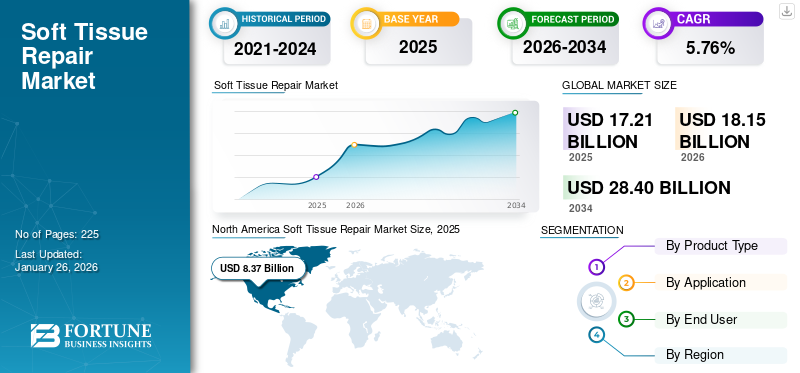
Download Free sample to learn more about this report.
Soft Tissue Repair Market KEY TAKEAWAYS
 Market Size & Forecast
- 2025 Market Size: USD 17.21 Billion
- 2026 Market Size: USD 18.15 Billion
- 2034 Forecast Market Size: USD 28.4 Billion
- CAGR: 5.76% from 2026–2034
 Market Share
- North America dominated the soft tissue repair market with a 48.62% share in 2025.
- The meshes & grafts segment is expected to account for 45.92% of the market in 2026.
- The hernia repair segment is expected to account for 36.81% of the market in 2026.
 Key Regional Highlights
North America
North America generated USD 8.37 billion in 2025, driven by sports injuries, obesity prevalence, and medical technology advancements.
Europe
Europe generated USD 3.30 billion in 2025 and is projected to reach USD 3.46 billion in 2026.
Asia Pacific
Asia Pacific generated USD 4.29 billion in 2025 and is projected to reach USD 4.59 billion in 2026.
U.S.
The soft tissue repair market is estimated to reach USD 8.25 billion in 2025.
Japan
Healthcare spending, advanced surgical procedures, and orthopedic treatment demand support market growth.
Read More

MARKET DYNAMICS
MARKET DRIVERS
Rising Incidence of Hernia and Other Soft Tissue Injuries to Drive Market Growth
The increasing incidence of hernia and other soft tissue damage is one of the prominent drivers of the soft tissue repair market. In addition, the adoption of unhealthy lifestyles, obesity, sporting activities, and aging populations is projected to boost the incidence of soft tissue disorders. These disorders severely disrupt daily activities, cause pain, and often prompt surgery for permanent relief.
- For instance, according to the American College of Surgeons (ACS), more than 1 million hernia repairs are performed annually in the U.S., making it one of the most common operations in general practice.
- Moreover, according to data published by the World Health Organization in 2022 indicates that 1 in 8 people in the world is obese.
Furthermore, soft tissue repair products such as meshes, fixation devices, and biologics provide effective solutions to recover normal functions along with the prevention of recurrence of injury. Growing awareness and enhanced accessibility to advanced repair products are also likely to propel market growth during the forecast period.
MARKET RESTRAINTS
High Surgical and Product Costs to Hinder Market Expansion
Higher costs associated with surgical procedures and high-end soft tissue repair products are estimated to hamper the global soft tissue repair market growth by 2032. Super-premium biologic meshes and fixation systems are considerably more expensive than generic materials, limiting their adoption among cost-conscious patient pools. Additionally, limited reimbursement practices in most emerging economies further incur costs among patient pools and may necessitate individuals opting for low-end substitutes or abstaining from treatment.
- For instance, the cost of hernia surgery in the U.S. lies between USD 4,500 to USD 11,000, depending on the quality of the mesh or matrix used during hernia surgery. For example, the Phasix ST Hydrogel Coating Mesh is priced from around USD 799 to USD 6,400 depending on the required size.
MARKET OPPORTUNITIES
Technological Innovations in Meshes and Fixation Devices to Provide New Opportunities
Market players are focusing on continuous advancements in meshes, grafts, and fixation devices. Certain features of these products, such as enhanced biocompatibility, low infection risk, and quick tissue incorporation, are achievable with next-generation meshes. In addition, next-generation fixation devices at the laparoscopic level are making it possible to perform less invasive surgeries, less postoperative pain, and quicker patient turnaround. These kinds of innovations induce surgeons to employ advanced products more frequently, leading to improved patient results and low recurrence rates.
- For instance, in April 2025, BD received FDA approval for its Phasix ST Umbilical hernia patch. The product is fully absorbable and specifically designed for umbilical hernias.
SOFT TISSUE REPAIR MARKET TRENDS
Shift Toward Biologic Materials is a Key Market Trend
One of the emerging trends of the soft tissue repair market is the growing popularity of utilizing biologic grafts and meshes over synthetic products. Biologic tissues, derived from animal or human sources, tend to promote better healing with fewer risks of rejection or long-term failures. Moreover, surgeons are increasingly looking at utilizing biologics in high-complexity repairs, such as recurrent repairs of hernias or procedures involving patients with compromised immune systems. Continued clinical studies, greater regulatory clearance, and increasing acceptance among healthcare providers continue to support this trend.
- For instance, in April 2024, TELA Bio announced the launch of OviTex IHR, a biological mesh designed for hernia repair procedures.
MARKET CHALLENGES
Risk of Post-Operative Complications and Patient Reluctance are Projected to Offer Substantial Challenges
Despite advancements, complications such as infection, erosion of the mesh, chronic pain, or recurrence of hernia are still significant issues in the market. Moreover, fear of complications or the need for re-surgery often causes patients to delay treatment. Additionally, with low socioeconomic status, the patients often opt for traditional treatment modalities or pain control medication rather than opting for costly procedures. These factors restrict the full growth potential of the market.
- For instance, according to a survey published on NCBI in January 2024, an estimated 17% of the population who underwent hernia repair surgery experienced post-surgical complications.
Download Free sample to learn more about this report.
Segmentation Analysis
By Product Type
Widespread Use of Meshes & Grafts in Hernia Surgery Encouraged Segment Growth
On the basis of product type, the market is divided into fixation devices, meshes & grafts, biologics & regenerative products, and others.
To know how our report can help streamline your business, Speak to Analyst
The meshes & grafts segment is expected to hold the highest share of the soft tissue repair market, accounting for 45.92% in 2026. Dominance of this segment is attributed to its widespread adoption in hernia repair operations. Meshes offer significant advantages such as minimum recurrence rates, supplementary tissue support, and improved patient results. In addition, the availability of both synthetic and biologic mesh variants provides surgeons with wide options to serve specific clinical needs and boost segment growth.
- For instance, in April 2024, Xtant Medical announced the launch of its two new amniotic allografts called as SimpliMax and SimpliGraft. Through this strategic move, the company re-entered into wound care market.
By Application
Rising Incidence of Hernia Repair Surgeries Boosted Segment Growth
In terms of application, the market is categorized into hernia repair, orthopedic repair, wound and skin repair, dural repair, dental repair, and others.
The hernia repair segment is expected to capture the largest share of the market, accounting for 36.81% in 2026. In 2025, the segment is anticipated to dominate with a 37.1% share. Its dominance is due to the increasing cases of hernia all over the world, along with high volumes of procedures performed annually. Hernia repair continues to be one of the most performed general operations which is expected to have a positive impact on the adoption of advanced meshes and fixation systems.
- For instance, according to data published on NCBI in August 2019, an estimated 100,000 hernia repair procedures are conducted in the U.K. per year.
The orthopedic repair segment is expected to grow at a CAGR of 6.5% over the forecast period.
By End User
Hospitals & Specialty Clinics Segment Held the Dominant Share Due to Advanced Surgical Infrastructure
Based on end-user, the market is segmented into hospitals & specialty clinics, research & academic institutes, and others.
The Hospitals & Specilaty Clinics segment is projected to dominate the market with a share of 79.49% in 2026. the global market was dominated by the hospitals & specialty clinics segment in terms of end-user. The dominance is primarily attributed to the availability of advanced surgical infrastructure, growing emphasis on regenerative medicine, skilled surgeons, and sophisticated postoperative care capabilities in hospital and specialty clinic settings. Patients prefer hospitals & specialty clinics for advanced surgeries, such as hernia and orthopedic reconstruction, due to the convenience of a one-stop solution that encompasses diagnosis, surgery, and postoperative care. Furthermore, the segment is set to hold 79.2% share in 2025.
In addition, the research & academic institutes segment is projected to grow at a CAGR of 4.4% during the study period.
Soft Tissue Repair Market Regional Outlook
By geography, the market is categorized into Europe, North America, Asia Pacific, Latin America, and Middle East & Africa.
North America Soft Tissue Repair Market Size, 2025 (USD Billion) To get more information on the regional analysis of this market, Download Free sample
North America
North America held the dominant share in 2025, valued at USD 8.37 billion, and is projected to reach USD 7.96 billion in 2026. The factors fostering the dominance of the region include considerable prevalence of sports injuries, obesity, and technological advancements. In 2025, the U.S. market is estimated to reach USD 8.25 billion. Increasing product approvals along with extensive investments by key players to accelerate U.S. soft repair market during the forecast period.
- For instance, in June 2025, Acera Surgical received FDA approval for its synthetic and resorbable matrix, Restrata. The newly introduced product is designed for soft tissue reinforcement.
Europe
In 2025, Europe held 19.18% of the global market, reaching a valuation of USD 3.3 billion, and is projected to grow to USD 3.46 billion in 2026. Europe is projected to witness notable market growth in the coming years. During the forecast period, the region is expected to record a CAGR of 4.9% and reach a market valuation of USD 3.30 billion by 2025. This growth is primarily attributed to the well-established healthcare infrastructure and the increasing number of orthopedic surgeries across the region. Among the key countries, the U.K. is anticipated to reach USD 0.58 billion, Germany is expected to record USD 0.65 billion by 2026, and France is projected to reach USD 0.47 billion by 2025.
Asia Pacific
The market in Asia Pacific reached USD 4.29 billion in 2025, representing 24.95% of total market revenue, and is projected to reach USD 4.59 billion in 2026. Asia Pacific is expected to exhibit the fastest CAGR during the forecast period. The market in the region is estimated to reach USD 4.29 billion by 2025, driven by rising healthcare investments, increasing patient population, and growing adoption of advanced medical procedures. Within the region, India and China are projected to reach USD 0.65 billion and USD 1.26 billion, respectively, by 2026.
Latin America
Latin America maintained a strong presence in the global market, reaching USD 0.78 billion in 2025, accounting for 4.53% share, and is expected to reach USD 0.81 billion in 2026. Latin America is expected to witness moderate growth in the market during the forecast period. The market in the region is projected to reach a valuation of USD 0.78 billion in 2025. The growth is primarily driven by the rising incidence of sports injuries and the increasing number of hernia repair procedures, which are contributing to higher product adoption.
Middle East & Africa
In 2025, the Middle East & Africa market stood at USD 0.47 billion, representing 2.73% of global demand, and is projected to grow to USD 0.49 billion in 2026. The Middle East & Africa region is also anticipated to experience moderate market growth over the forecast period. In this region, GCC countries are projected to reach a market value of USD 0.24 billion in 2025, supported by the increasing demand for surgical procedures and the gradual expansion of healthcare services.
COMPETITIVE LANDSCAPE
Key Industry Players
Strong Focus on Research and Development Activities Along with Strategic Collaborations to Assist Companies in Maintaining Their Market Position
The global soft tissue repair market shows a semi-concentrated structure with numerous small- to mid-size companies actively operating across the globe. These players are actively involved in research and development activities, strategic partnerships, and geographic expansion.
Medtronic, Johnson & Johnson, Smith and Nephew, Zimmer Biomet, and BD are some of the dominating players in the market. A comprehensive range of soft tissue repair, continual innovation, and extensive focus on research & development are a few characteristics of these players that support their dominance.
Apart from this, other prominent players in the market include Stryker, Baxter, Integra Lifesciences, and others. These companies are undertaking various strategic initiatives, such as partnerships with healthcare providers to enhance their market presence.
LIST OF KEY SOFT TISSUE REPAIR COMPANIES PROFILED
- Medtronic plc (Ireland)
- Johnson & Johnson (U.S.)
- Smith & Nephew plc (U.K.)
- Stryker Corporation (U.S.)
- BD (U.S.)
- Baxter International Inc. (U.S.)
- Integra LifeSciences (U.S.)
- Organogenesis Holdings Inc. (U.S.)
- Cook (U.S.)
- Coloplast A/S (Denmark)
KEY INDUSTRY DEVELOPMENTS
- June 2025: OSSIO Inc. announced the launch of its new OSSIOfiber 2.5mm suture anchors. The newly introduced product is suitable for soft tissue surgery.
- March 2025: TELA Bio announced the launch of its new product, OviTex PRS for plastic and reconstructive surgery.
- June 2024: Axogen, Inc. announced the launch of its new tissue matrix, Avive+. The newly launched product is a resorbable, multi-layer amniotic membrane allograft.
- August 2022: CONMED Corporation announced its plan to acquire Biorez, Inc. in order to consolidate its position in sports medicine and soft tissue healing technology.
- July 2021: BD completed the acquisition of Tepha, Inc. in order to strengthen its position in tissue repair and regeneration.
REPORT COVERAGE
Request for Customization to gain extensive market insights.
Report Scope & Segmentation
|
ATTRIBUTE |
DETAILS |
|
Study Period |
2021-2034 |
|
Base Year |
2025 |
|
Forecast Period |
2026-2034 |
|
Historical Period |
2021-2024 |
|
Growth Rate |
CAGR of 5.76% from 2026-2034 |
|
Unit |
Value (USD Billion) |
|
Segmentation |
By Product Type, Application, End User, and Region |
|
By Product Type |
|
|
By Application |
|
|
By End User |
|
|
By Geography |
North America (By Product Type, Type, Application, End User, and Country)
Europe (By Product Type, Type, Application, End User, and Country/Sub-region)
Asia Pacific (By Product Type, Type, Application, End User, and Country/Sub-region)
Latin America (By Product Type, Type, Application, End User, and Country/Sub-region)
Middle East & Africa (By Product Type, Type, Application, End User, and Country/Sub-region)
|
Frequently Asked Questions
Fortune Business Insights says that the global market value stood at USD 17.21 billion in 2025 and is projected to reach USD 28.4 billion by 2034.
In 2025, the market value stood at USD 8.37 billion.
The market is expected to exhibit a CAGR of 5.76% during the forecast period (2026-2034).
The meshes & grafts segment led the market by product type.
The Key factor driving the market is the rising hernia repair procedures.
Medtronic, Johnson & Johnson, Smith and Nephew, and BD are some of the prominent players in the market.
North America dominated the market in 2024.
The benefits of soft tissue repair products, coupled with technological advancements to favor the adoption of the product.



- 2021-2034
- 2025
- 2021-2024
- 225
Get 30-60 hrs Free Customization
Expand Regional and Country Coverage, Segments Analysis, Company Profiles, Competitive Benchmarking, and End-user Insights.













.webp)






Related Reports
-
US +1 833 909 2966 ( Toll Free )
-
Get In Touch With Us