Solar Hybrid Inverter Market Size, Share & Industry Analysis, By End Use (Commercial, Residential), By Product, By Country, And Segment Forecasts, Key Companies And Competitive Analysis, and Regional Forecast, 2026-2034
 Download Free Sample
Solar Hybrid Inverter Market Overview
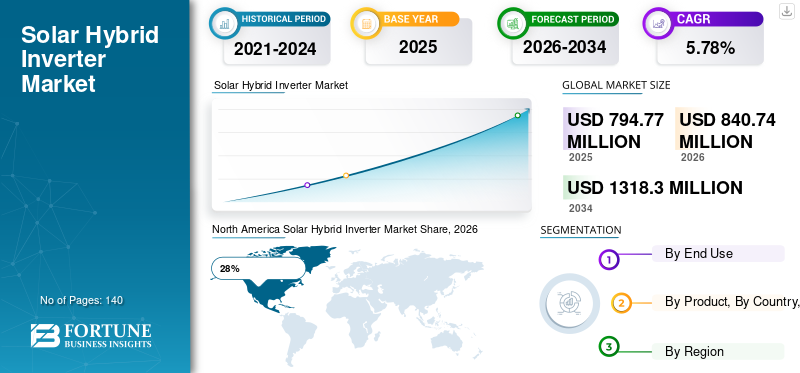
The solar hybrid inverter market size was valued at USD 794.76 million in 2025. The market is projected to grow from USD 840.73 million in 2026 to USD 1318.29 million by 2034, exhibiting a CAGR of 5.78% during the forecast period.

The solar hybrid inverter market is expanding steadily as businesses, utilities, and residential consumers seek reliable energy management systems that integrate solar generation, battery storage, and grid connectivity. Solar hybrid inverters have become essential components in modern renewable energy infrastructure because they support energy optimization, backup power functionality, and smart load management. The increasing deployment of rooftop solar systems, growing investments in distributed energy resources, and rising concerns regarding grid instability are strengthening demand across commercial and residential sectors. Solar hybrid inverter market analysis indicates that technological advancements in battery compatibility, remote monitoring capabilities, and intelligent energy control systems are accelerating adoption among end users seeking higher energy efficiency and operational flexibility.
The United States solar hybrid inverter market continues to benefit from strong solar installation activity, increasing battery storage deployment, and growing interest in energy independence. Businesses and homeowners are increasingly integrating hybrid inverter systems to manage electricity consumption, reduce exposure to power outages, and improve energy resilience. The market is also witnessing greater adoption of AI-enabled inverter technologies that support predictive energy management and real-time monitoring. Commercial facilities, industrial sites, and residential communities are investing in solar-plus-storage systems to enhance energy security while supporting sustainability initiatives. Solar hybrid inverter industry analysis highlights that smart grid integration and decentralized power generation remain major factors shaping market expansion throughout the country.
Download Free sample to learn more about this report.
Solar Hybrid Inverter Market Key Takeaways
 Global Market Size & Forecast
- 2025 Market Size: USD 794.76 Million
- 2026 Market Size: USD 840.73 Million
- 2034 Forecast Market Size: USD 1,318.29 Million
- CAGR: 5.78% from 2026–2034
 market share
- The market in Asia-Pacific dominated with a revenue share of 38% in 2025.
- Three-phase hybrid inverters held the largest share at 54%.
- Commercial applications accounted for the largest share at 58%.
 Key Regional Highlights
North America
North America accounted for 28% of the global market, supported by rising solar-plus-storage adoption.
Europe
Europe held a 24% share, driven by growing investments in distributed renewable energy systems.
Asia-Pacific
Asia-Pacific led with a 38% share, supported by expanding solar installations and energy storage deployment.
U.S
Rising residential and commercial solar adoption is supporting demand for hybrid inverter systems.
Japan
Increasing integration of solar power and battery storage is supporting market growth.
Read More

Solar Hybrid Inverter Market Latest Trends
One of the most significant solar hybrid inverter market trends is the growing integration of battery energy storage systems with solar installations. Organizations are increasingly adopting hybrid solutions that provide uninterrupted power supply during grid disruptions while maximizing renewable energy utilization. Demand for lithium-ion battery-compatible hybrid inverters continues to increase as battery prices become more competitive and energy storage adoption accelerates across residential and commercial applications.
Download Free sample to learn more about this report.
Another major trend involves the incorporation of smart digital technologies into inverter platforms. Manufacturers are introducing cloud-based monitoring, artificial intelligence, IoT connectivity, and predictive maintenance features to improve operational efficiency. solar hybrid inverter market research report findings indicate that businesses are prioritizing intelligent energy management systems capable of optimizing solar generation, battery charging, and grid interaction. Additionally, modular inverter architectures are becoming more popular because they simplify system expansion and maintenance. Growing emphasis on microgrids, virtual power plants, and distributed energy resources is also encouraging the deployment of advanced hybrid inverter technologies worldwide.
Solar Hybrid Inverter Market Dynamics
DRIVER
Rising Demand for Energy Storage-Integrated Solar Systems
The primary growth driver in the solar hybrid inverter market is the increasing adoption of solar-plus-storage installations across residential, commercial, and industrial sectors. Organizations are seeking solutions that provide both renewable energy generation and reliable backup power. Hybrid inverters offer a practical approach by enabling seamless coordination between solar panels, batteries, and utility grids. As electricity prices fluctuate and grid reliability concerns become more prominent, end users are prioritizing technologies that improve energy independence and reduce operational risks.
Commercial facilities are investing in hybrid inverter systems to support uninterrupted operations during outages, while residential consumers are adopting these solutions to manage peak electricity costs. Governments and utility providers are also promoting distributed energy infrastructure, creating favorable conditions for hybrid inverter deployment. solar hybrid inverter market growth is further supported by declining battery costs, increasing awareness of energy resilience, and expanding investments in decentralized renewable energy systems. The combination of energy efficiency, sustainability objectives, and backup power functionality continues to strengthen demand across multiple sectors.
RESTRAINT
High Initial Installation and System Integration Costs
A major restraint affecting the solar hybrid inverter market is the relatively high upfront cost associated with hybrid solar systems. Although operational savings can be attractive over the long term, many residential and small commercial users remain hesitant because of significant installation expenses. The requirement for compatible batteries, advanced monitoring platforms, and specialized installation services increases overall project costs.
Additionally, integrating hybrid inverter systems into existing electrical infrastructure often requires technical modifications that can extend project timelines and increase expenditures. In developing regions, limited financing options and lower consumer awareness can further restrict adoption. Businesses evaluating large-scale deployments must also consider maintenance requirements, battery replacement cycles, and compliance with evolving grid regulations. solar hybrid inverter market outlook suggests that while technology costs are gradually declining, affordability challenges continue to influence purchasing decisions, particularly in cost-sensitive markets where traditional grid electricity remains relatively accessible.
OPPORTUNITY
Expansion of Smart Grids and Distributed Energy Networks
The transition toward smart grids and distributed energy resources presents significant opportunities for the solar hybrid inverter market. Utilities, governments, and private organizations are investing heavily in infrastructure capable of supporting decentralized electricity generation. Hybrid inverters play a crucial role in enabling efficient communication between renewable energy assets, battery storage systems, and grid networks.
The growing development of microgrids in commercial campuses, industrial facilities, healthcare institutions, and remote communities creates additional opportunities for manufacturers and service providers. Advanced hybrid inverters equipped with intelligent control software can optimize energy flows, support demand response programs, and enhance grid stability. solar hybrid inverter market opportunities are also expanding due to increasing interest in virtual power plants that aggregate distributed energy assets into coordinated networks. Companies capable of delivering scalable, software-driven inverter solutions are expected to benefit from these evolving energy ecosystem requirements.
CHALLENGE
Supply Chain Complexity and Cybersecurity Concerns
The Solar hybrid inverter industry faces challenges related to component sourcing, technology standardization, and cybersecurity risks. Hybrid inverter manufacturing relies on semiconductor components, advanced electronics, communication modules, and battery management systems. Supply chain disruptions can affect production schedules and increase equipment costs, creating uncertainty for manufacturers and project developers.
Cybersecurity has also emerged as a significant concern due to the increasing connectivity of modern inverter systems. Smart hybrid inverters are often integrated with cloud platforms and remote monitoring networks, making security protocols increasingly important. Energy sector stakeholders are paying closer attention to software integrity, communication security, and grid protection measures. As renewable energy infrastructure becomes more interconnected, ensuring secure operation of inverter systems remains a critical challenge. solar hybrid inverter market forecast assessments indicate that companies investing in robust cybersecurity frameworks and diversified supply chains will be better positioned to address future industry requirements.
Solar Hybrid Inverter Market Segmentation
By End Use
The commercial segment accounts for approximately 58% of the solar hybrid inverter market share. Commercial facilities such as office buildings, retail centers, warehouses, educational institutions, and healthcare facilities increasingly deploy hybrid inverter systems to manage energy expenses and improve operational continuity. These installations often combine solar generation with battery storage to reduce dependence on conventional electricity sources while ensuring backup power availability during outages.
Businesses are also adopting advanced energy management strategies that rely on hybrid inverter technology to optimize electricity consumption patterns. Integration with building management systems and smart monitoring platforms enables greater control over energy resources. solar hybrid inverter market insights indicate that commercial users prioritize scalability, reliability, and energy efficiency, making this segment a major contributor to overall industry demand.
The residential segment represents approximately 42% of the solar hybrid inverter market share. Homeowners are increasingly investing in hybrid inverter systems to maximize rooftop solar utilization, reduce electricity expenses, and enhance energy security. Rising interest in battery storage solutions has significantly strengthened residential demand for hybrid inverters capable of managing both solar production and stored energy.
Modern residential systems increasingly feature smartphone-based monitoring applications, remote diagnostics, and intelligent energy optimization capabilities. solar hybrid inverter market research report findings suggest that consumers are becoming more aware of the benefits associated with self-consumption and backup power functionality. Growth in residential solar adoption, coupled with increasing concern about grid reliability, continues to support expansion within this segment.
To know how our report can help streamline your business, Speak to Analyst
By Product, By Country, And Segment Forecasts, Key Companies And Competitive Analysis
Single-phase hybrid inverters hold approximately 46% of the market share and are widely utilized in residential applications. These systems are particularly suitable for small and medium-sized solar installations where energy consumption requirements are relatively moderate. Homeowners favor single-phase configurations because of their cost efficiency, ease of installation, and compatibility with residential battery storage systems.
Manufacturers continue introducing compact designs featuring enhanced conversion efficiency and intelligent load management capabilities. solar hybrid inverter market trends reveal growing demand for residential energy resilience solutions, supporting sustained deployment of single-phase hybrid inverter technology. Increased adoption in suburban and semi-urban markets is further contributing to segment growth.
Three-phase hybrid inverters account for approximately 54% of the market share due to strong demand from commercial and industrial users. These systems support larger energy loads and provide improved operational stability for facilities requiring continuous power availability. Warehouses, manufacturing facilities, data centers, and commercial buildings increasingly deploy three-phase hybrid inverter systems to optimize energy consumption and enhance sustainability performance.
The segment benefits from expanding investments in distributed renewable energy infrastructure and battery-integrated power systems. solar hybrid inverter market analysis indicates that three-phase solutions are becoming increasingly sophisticated, offering advanced monitoring features, grid-support functions, and scalable architectures. Growing interest in microgrid development and commercial energy storage projects continues to reinforce demand for this product category.
Solar Hybrid Inverter Market Regional Outlook
North America Solar Hybrid Inverter Market Share, 2026 (%)
To get more information on the regional analysis of this market, Download Free sample
North America
North America accounts for approximately 28% of the global solar hybrid inverter market share. The region benefits from strong renewable energy deployment, growing battery storage adoption, and increasing investments in grid modernization initiatives. Businesses and homeowners continue to prioritize energy resilience as weather-related disruptions and electricity reliability concerns gain attention. Hybrid inverter installations are expanding across residential neighborhoods, commercial facilities, and community energy projects.
The United States remains the dominant contributor within the region due to extensive rooftop solar adoption and widespread deployment of energy storage systems. Canada is also experiencing growing interest in hybrid inverter solutions, particularly in remote locations and off-grid applications. solar hybrid inverter market outlook for North America remains favorable because of continued technological innovation, supportive renewable energy programs, and increasing demand for decentralized power generation.
Europe
Europe represents approximately 24% of the global solar hybrid inverter market share. The region continues to accelerate renewable energy adoption while promoting energy independence and carbon reduction strategies. Hybrid inverter systems are becoming increasingly important as consumers seek efficient methods for integrating solar generation with battery storage.
Countries across Europe are investing in decentralized energy systems and smart grid technologies. Rising electricity costs have encouraged homeowners and businesses to adopt hybrid inverter solutions that maximize self-consumption of solar power. Solar hybrid inverter industry Report assessments indicate that energy security concerns and sustainability targets continue to influence purchasing decisions throughout the region.
Germany Solar Hybrid Inverter Market
Germany accounts for approximately 31% of the European solar hybrid inverter market. The country maintains a strong position due to extensive solar deployment, advanced renewable energy infrastructure, and widespread consumer awareness regarding energy efficiency. Residential and commercial users increasingly invest in hybrid inverter systems to improve self-consumption rates and reduce reliance on conventional electricity sources.
German businesses are also adopting battery-integrated solar systems to support sustainability objectives and enhance operational resilience. The market benefits from strong engineering expertise, mature distribution networks, and continuous innovation in energy management technologies. Solar hybrid inverter market opportunities in Germany remain significant as organizations expand investments in distributed renewable energy systems and smart energy solutions.
United Kingdom Solar Hybrid Inverter Market
The United Kingdom contributes approximately 22% of the European solar hybrid inverter market. Rising demand for residential battery storage systems and increasing focus on energy resilience continue to support market development. Homeowners are investing in hybrid inverter technology to optimize rooftop solar installations and manage electricity expenses more effectively.
Commercial organizations are also deploying solar-plus-storage systems to support operational efficiency and sustainability goals. Smart energy management platforms, remote monitoring technologies, and advanced battery integration capabilities are becoming standard features in modern installations. solar hybrid inverter market forecast expectations for the United Kingdom remain positive as decentralized energy adoption expands across residential and commercial sectors.
Asia-Pacific
Asia-Pacific holds approximately 38% of the global solar hybrid inverter market share and remains the largest regional market. Rapid urbanization, expanding renewable energy capacity, and increasing electricity demand contribute significantly to market growth. Governments across the region continue implementing policies that support solar adoption, energy storage deployment, and distributed energy infrastructure development.
The region's manufacturing capabilities also strengthen industry expansion by enabling large-scale production of inverter technologies. solar hybrid inverter market research report findings indicate that residential, commercial, and industrial sectors are increasingly adopting hybrid systems to improve energy reliability and reduce grid dependency.
Japan Solar Hybrid Inverter Market
Japan accounts for approximately 18% of the Asia-Pacific solar hybrid inverter market. The country's emphasis on energy resilience and disaster preparedness has encouraged widespread adoption of solar-plus-storage systems. Hybrid inverters are increasingly utilized in residential applications where backup power functionality is considered a critical feature.
Advanced technological capabilities and strong consumer awareness contribute to sustained market demand. Manufacturers continue developing intelligent inverter systems that support efficient energy management and seamless battery integration. Solar hybrid inverter market insights suggest that Japan will remain a key market for premium hybrid inverter solutions designed for reliability and performance.
China Solar Hybrid Inverter Market
China represents approximately 43% of the Asia-Pacific solar hybrid inverter market. The country serves as both a major consumer and producer of hybrid inverter technologies. Large-scale renewable energy deployment, extensive manufacturing infrastructure, and strong government support continue to drive market expansion.
Chinese manufacturers are introducing innovative inverter platforms that combine high efficiency, intelligent monitoring, and advanced battery compatibility. Commercial, industrial, and residential sectors increasingly rely on hybrid systems to support distributed energy strategies. solar hybrid inverter market growth remains particularly strong in China due to ongoing investments in renewable energy infrastructure and energy storage technologies.
Rest of World
The Rest of World region accounts for approximately 10% of the global solar hybrid inverter market share. Countries in the Middle East, Africa, and Latin America are increasingly adopting hybrid inverter systems to address energy access challenges and support renewable energy initiatives. Hybrid technologies are particularly attractive in regions where grid infrastructure may be limited or unreliable.
Commercial facilities, remote communities, telecommunications sites, and industrial operations are deploying hybrid systems to improve energy reliability while reducing fuel consumption. solar hybrid inverter market opportunities continue to expand as governments and private investors support renewable energy projects designed to enhance energy security and sustainability outcomes.
List of Top Solar Hybrid Inverter Companies
- Huawei Technologies Co., Ltd.
- Sungrow Power Supply Co., Ltd.
- SMA Solar Technology AG
- Schneider Electric SE
- ABB Ltd.
- GoodWe Technologies Co., Ltd.
- DEYE (Ningbo Deye Inverter Technology Co., Ltd.)
- Growatt New Energy Technology Co., Ltd.
- Delta Electronics, Inc.
- Fimer S.p.A.
Top Two Companies by market share
- Huawei Technologies Co., Ltd. – 29%
- Sungrow Power Supply Co., Ltd. – 23%
Investment Analysis and Opportunities
Investment activity within the solar hybrid inverter market continues to increase as energy transition initiatives accelerate globally. Private investors, infrastructure funds, utilities, and technology companies are allocating capital toward renewable energy projects that incorporate battery storage and advanced inverter technologies. Demand for resilient power infrastructure is creating opportunities across residential, commercial, industrial, and utility-scale segments.
Significant opportunities exist in software-enabled energy management platforms, smart inverter technologies, and battery-integrated renewable energy systems. Investors are increasingly targeting companies capable of delivering scalable hybrid solutions that support decentralized energy networks. solar hybrid inverter market opportunities are also emerging in microgrid development, rural electrification projects, and virtual power plant ecosystems. As organizations prioritize sustainability and energy security, capital inflows into hybrid inverter manufacturing, distribution, and service networks are expected to remain strong.
New Product Development
Innovation remains a defining characteristic of the solar hybrid inverter market. Manufacturers are developing next-generation hybrid inverter platforms featuring artificial intelligence, cloud connectivity, predictive maintenance tools, and advanced battery management systems. These innovations enable more precise energy optimization while improving user experience and operational efficiency.
Product development efforts increasingly focus on modular architectures that simplify installation and facilitate future expansion. Companies are also introducing hybrid inverters compatible with multiple battery chemistries and renewable energy sources. Enhanced cybersecurity features, real-time diagnostics, and grid-support capabilities are becoming important differentiators. solar hybrid inverter market trends indicate that future product innovation will prioritize intelligent automation, higher conversion efficiency, improved thermal performance, and seamless integration with distributed energy ecosystems.
Five Recent Developments (2023-2025)
- Huawei expanded its smart energy portfolio with advanced hybrid inverter solutions supporting enhanced battery integration and intelligent monitoring capabilities.
- Sungrow introduced new hybrid inverter platforms designed for residential and commercial energy storage applications with improved efficiency and scalability.
- GoodWe expanded its energy storage-compatible inverter lineup to address growing demand for solar-plus-storage installations.
- Growatt launched upgraded hybrid inverter systems featuring advanced remote management functionality and smart energy optimization tools.
- Schneider Electric strengthened its distributed energy management portfolio through expanded integration of solar, storage, and intelligent inverter technologies.
Report Coverage of Solar Hybrid Inverter Market
The solar hybrid inverter market Report provides comprehensive evaluation of industry dynamics, competitive developments, technology trends, investment patterns, and regional demand characteristics. The report examines market performance across residential, commercial, and industrial applications while assessing the impact of energy storage integration, smart grid deployment, and renewable energy adoption on future industry development.
Request for Customization to gain extensive market insights.
Coverage includes detailed segmentation analysis, regional outlook assessments, competitive benchmarking, and evaluation of leading manufacturers. solar hybrid inverter market research report findings also explore supply chain developments, technological innovations, regulatory influences, and emerging business opportunities. The report is designed to support strategic decision-making for investors, manufacturers, distributors, energy developers, and policymakers seeking actionable solar hybrid inverter market insights and long-term industry intelligence.
Frequently Asked Questions
Fortune Business Insights says that the global market value stood at USD 7.17 billion in 2025 and is projected to reach USD 13.96 billion by 2034.
The market is expected to exhibit a CAGR of 7.69% during the forecast period of 2026-2034.
Residential was the leading application segment, supported by increasing rooftop solar installations, demand for backup power, and growing household adoption of battery energy storage.
Key players include SMA Solar Technology AG, Schneider Electric, Huawei Technologies Co., Ltd., SolarEdge Technologies Inc., Growatt, and GoodWe.
Major trends include increasing integration of battery storage and smart energy management and rising demand for high-efficiency, grid-interactive hybrid inverters. Asia Pacific leads the market, supported by rapid solar deployment and growing investments in distributed energy systems.



- 2021-2034
- 2025
- 2021-2024
- 140
-

(Offer valid till 15th Oct 2026)
Get 30-60 hrs Free Customization
Expand Regional and Country Coverage, Segments Analysis, Company Profiles, Competitive Benchmarking, and End-user Insights.



















-
US +1 833 909 2966 ( Toll Free )
-
Get In Touch With Us