Space Lander and Rover Market Size, Share & Industry Analysis, By Platform Type (Space Landers [Robotic and Delivery Landers] and Space Rovers [Scientific and Prospecting Rovers]), By Component (Structure & Mechanisms, Propulsion & Landing, and Guidance & Navigation), By Destination (Moon, Mars, and Asteroids), By Operating Mode (Autonomous, Semi-Autonomous, and Crewed), By Mission Application (Scientific Exploration, Payload Delivery, and Resource Prospecting), By End User (Civil Space Agencies, Defense Organizations, and Commercial Space Companies), and Regional Forecast, 2026-2034
 Download Free Sample
Space Lander and Rover Market Size & Future Outlook
 Listen to Audio Version
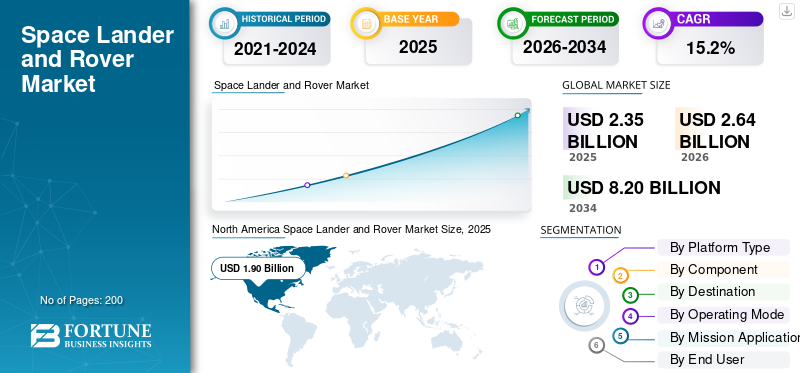
The global space lander and rover market size was valued at USD 2.35 billion in 2025. The market is projected to grow from USD 2.64 billion in 2026 to USD 8.20 billion by 2034, exhibiting a CAGR of 15.2% during the forecast period. North America dominated the space lander and rover market with a market share of 80.85% in 2025.
Space landers are spacecraft designed to descend and operate on the Moon, Mars, or other celestial bodies, while rovers offer mobile surface exploration. Factors such as growing lunar exploration, Mars exploration, planetary exploration missions, commercial payload delivery, space robotics, and demand for autonomous space vehicles that can support deep space missions are fueling the market growth.
Key players operating in the market include Space Exploration Technologies Corp., Blue Origin Enterprises, L.P., Intuitive Machines, Inc., Firefly Aerospace, Inc., Astrobotic Technology, Inc., Lockheed Martin Corporation, and Thales Alenia Space Italia S.p.A.
Download Free sample to learn more about this report.
GLOBAL SPACE LANDER AND ROVER MARKET KEY Takeaways
 Market Size & Forecast
- 2025 Market Size: USD 2.35 billion
- 2026 Market Size: USD 2.64 billion
- 2034 Forecast Market Size: USD 8.20 billion
- CAGR: 15.2% from 2026–2034
 Market Share
- North America dominated the space lander and rover market with an 80.85% share in 2025.
- Space landers held the leading market share in 2025.
- Autonomous navigation and software is expected to grow at the fastest CAGR of 16.8% during the forecast period.
 Key Regional Highlights
North America
North America led the market with an 80.85% share in 2025 and is expected to grow at a CAGR of 11.9%.
Europe
Europe is projected to expand at a CAGR of 23.9%, supported by lunar, Mars exploration, and space robotics programs.
Asia Pacific
Asia Pacific is expected to record the highest CAGR of 24.1%, driven by exploration programs in China, India, and Japan.
U.S.
The US market stood at approximately USD 1.87 billion in 2025 and is projected to grow at a CAGR of 11.5%.
Japan
Japan is supporting regional market growth through precision-landing technologies, lunar exploration, and planetary mission programs.
Read More

Space Lander and Rover MARKET TRENDS
Commercial Lunar Delivery Services are Reshaping the Market Structure
Government agencies are increasingly procuring lunar lander missions as commercial services rather than developing every spacecraft internally. This shift is increasing private-sector participation in space exploration and reducing entry barriers for robotic lander providers, also creating frequent demand for payload integration, spacecraft landing systems, surface operations, and space robotics. The service-based model is also supporting more frequent lunar exploration and planetary exploration missions.
- In March 2025, Firefly Aerospace’s Blue Ghost Mission 1 successfully landed on the Moon under NASA’s Commercial Lunar Payload Services initiative, delivering ten NASA science and technology instruments. NASA stated that five vendors had received 11 lunar-delivery awards under CLPS, with a cumulative maximum contract value of USD 2.6 billion through 2028.
MARKET DYNAMICS
MARKET DRIVERS
Download Free sample to learn more about this report.
Growing Government Investments in Crewed and Robotic Surface Mobility Drives Market Growth
National space agencies are increasing investments in lunar lander systems, planetary rovers, autonomous space vehicles, and supporting space mission technologies, further driving the space lander and rover market growth. These programs require advanced aerospace engineering across mobility, power, navigation, communications, thermal control, and surface autonomy. The transition from short-duration scientific missions toward sustained extraterrestrial surface exploration is therefore broadening demand across the lander and rover value chain.
- In April 2024, NASA selected Intuitive Machines, Lunar Outpost, and Venturi Astrolab to develop commercial Lunar Terrain Vehicle capabilities for Artemis missions. The milestone-based contract has a combined maximum potential value of USD 4.6 billion across all awards.
Market Drivers - Impact & CAGR Contribution (2026–2034)
| Rank | Market Drivers | Expected Impact on Market Growth | Estimated Gross Market Growth Contribution (USD Billion) | Impact: 2026-2028 | Impact: 2029-2031 | Impact: 2032-2034 |
|---|---|---|---|---|---|---|
| 1 | Rising government investment in crewed lunar landers and sustained lunar exploration programs | High | 2.15% | High | High | High |
| 2 | Expansion of commercial lunar payload delivery and privately developed lander services | High | 1.72% | Medium-High | High | High |
| 3 | Growing international Moon, Mars, and planetary exploration mission pipelines | Medium-High | 1.46% | Medium | High | High |
| 4 | Advances in autonomous navigation, precision landing, space robotics, and EDL technologies | Medium | 1.15% | Medium | Medium-High | High |
| 5 | Increasing investment in lunar mobility, resource prospecting, ISRU, and surface logistics | Medium-Low | 0.96% | Medium-Low | Medium | High |
| 6 | Others – sample return missions, scientific payload delivery, reusable architectures, commercial research missions, and emerging national programs | Low | 0.58% | Low | Low | Medium |
| Total Gross Growth Contribution | 8.02% | |||||
Source: Fortune Business Insights
Download Free sample For In-Depth Market Drivers & Impact Forecasts
MARKET RESTRAINTS
High Development Costs and Program Delays to Restrain Market Growth
Lunar lander, Mars rovers, and planetary rover programs require continued development, dedicated testing, and mission-specific hardware. Cost increases or delays in a launch vehicle, robotic lander, or payload can impact the entire mission architecture. These pressures are immense for government-funded deep space missions where budget overruns can lead to restructuring, delay, or cancellation.
Market Restraints - Impact & Negative CAGR Contribution (2026–2034)
| Rank | Market Restraints | Expected Impact on Market Growth | Estimated Reduction in Market Size (USD Billion) (2026-2034) |
Impact: 2026-2028 | Impact: 2029-2031 | Impact: 2032-2034 |
|---|---|---|---|---|---|---|
| 1 | High development, qualification, testing, and mission costs coupled with schedule and budget overruns | High | 1.03% | High | High | Medium-High |
| 2 | High technical and mission-failure risk associated with landing, surface operations, propulsion, and autonomous systems | Medium-High | 0.72% | High | Medium-High | Medium |
| 3 | Launch dependency, supply-chain constraints, export controls, and geopolitical fragmentation | Medium | 0.49% | Medium-High | Medium | Medium |
| 4 | Others – limited mission cadence, long procurement cycles, financing constraints, regulatory complexity, and constrained deep-space infrastructure | Low | 0.22% | Low | Low | Low |
| Total Market Reduction | 2.46% | |||||
Source: Fortune Business Insights
Download Free sample For In-Depth Market Restraints & Risk Analysis
MARKET OPPORTUNITIES
In-Situ Resource Utilization Creates New Opportunities for Surface Exploration Systems
The growing focus on identifying and extracting lunar water, minerals, and other resources is creating opportunities for planetary rover platforms, drilling systems, robotic arms, sample-processing equipment, and autonomous space vehicles. Resource-prospecting missions could move space robotics beyond scientific analysis toward operational support for propulsion, life support, energy generation, and long-duration lunar exploration.
MARKET CHALLENGES
Extreme Surface Conditions and Limited Recovery Options to Challenge Mission Reliability
Spacecraft landing systems and planetary rovers must operate through communication delays, uneven terrain, abrasive dust, radiation exposure, and extreme thermal cycles. Unlike terrestrial autonomous vehicles, a robotic lander or Mars rover generally cannot be physically repaired after deployment. A minor navigation, propulsion, power, or structural failure can therefore shorten an entire mission and reduce the commercial viability of future planetary exploration missions.
Impact of Ongoing Conflicts and Increasing Geopolitical Tensions
Geopolitical Fragmentation Disrupts Joint Missions but Accelerates Sovereign Space Capabilities
Ongoing wars and intensifying strategic competition are having a mixed impact on the market. Sanctions, export controls, and suspended international partnerships are disrupting component sourcing, launch arrangements, and planetary exploration missions. At the same time, competition for influence on the lunar surface is increasing government investment in domestic lunar lander systems, planetary rovers, autonomous space vehicles, and trusted space robotics supply chains. This results in higher development duplication and program costs, but creates stronger opportunities for national contractors and regionally controlled space mission technologies.
- In July 2022, the European Space Agency terminated cooperation with Roscosmos on the ExoMars rover and surface platform following Russia’s invasion of Ukraine.
Segmentation Analysis
By Platform Type
Space Landers Dominated the Market Owing to Higher Mission Value and Essential Surface-Access Functions
By platform type, the market is bifurcated into space landers and space rovers. The space landers segment is further classified into robotic scientific landers, commercial payload delivery landers, cargo and logistics landers, crewed landers, sample-return landers, and technology demonstration landers. The space rovers segment is also classified into scientific exploration rovers, resource prospecting and ISRU rovers, sample collection and caching rovers, cargo and logistics rovers, infrastructure and utility rovers, crewed surface mobility vehicles, and micro and nano rovers.
The space landers segment held the leading global market share in 2025, as they combined propulsion, spacecraft landing systems, structural assemblies, guidance, thermal control, avionics, and payload-deployment functions within a single high-value platform. Rovers generally depend on a robotic lander or cargo lander for surface delivery, while crewed lunar lander programs involve substantially higher engineering, testing, and mission-assurance expenditure.
- In August 2023, the Indian Space Research Organization successfully soft-landed the Chandrayaan-3 Vikram lander near the lunar south-polar region and deployed the Pragyan rover. Further, establishing India as the fourth country to achieve a controlled lunar landing.
The space rovers segment is expected to grow at the highest CAGR of 21.1% over the forecast period.
By Component
Propulsion and Entry, Descent, and Landing Systems Dominated the Market Due to the Complexity of Powered Descent and Precision Landing
On the basis of component, the market is classified into structure and mechanisms, propulsion and entry, descent, and landing systems, guidance, navigation, and control, avionics and onboard computing, autonomous navigation and software, power generation and energy storage, thermal control systems, communication systems, rover mobility and suspension systems, payload accommodation and deployment systems, and others.
The propulsion and entry, descent, and landing systems segment held the dominant global market share in 2025, as they determine whether a lunar lander, Mars rover delivery platform, or robotic lander can safely reach the surface. The segment includes engines, propellant-management systems, descent-control equipment, landing sensors, hazard-detection technologies, and associated qualification testing, making it one of the most capital-intensive areas of aerospace engineering.
The autonomous navigation and software segment is expected to witness the fastest growth, registering a CAGR of 16.8% over the forecast period.
By Destination
Moon Segment Dominated the Market Due to Concentrated Government and Commercial Mission Activity
By destination, the market is classified into moon, Mars, asteroids and comets, planetary moons, and other planetary bodies.
The moon segment held the leading global market share in 2025, supported by Artemis, commercial lunar delivery programs, crewed lunar lander development, resource-prospecting missions, and international lunar exploration initiatives. Compared with Mars and other celestial bodies, lunar exploration offers shorter transit times, lower communications delays, and a more developed procurement pipeline for payload delivery, surface mobility, and space robotics.
- In December 2024, NASA awarded Firefly Aerospace, Inc. a USD 179.00 million contract to deliver six scientific experiments and technology demonstrations to the Moon’s Gruithuisen Domes using the Blue Ghost lander.
The planetary moons segment is expected to witness the fastest growth, registering a CAGR of 25.9% over the forecast period.
To know how our report can help streamline your business, Speak to Analyst
By Operating Mode
Autonomous Systems Dominated the Market Due to Communication Delays and the Need for Independent Decision-Making
On the basis of operating mode, the market is classified into autonomous, semi-autonomous, remotely operated, and crewed.
The autonomous segment held the leading global market share in 2025. Planetary exploration missions cannot depend on continuous real-time control from Earth due to communication delays, which can affect mission reliability, making a need for independent decision-making. Autonomous space vehicles use onboard navigation, hazard detection, route planning, fault management, and landing algorithms to operate safely during descent and extraterrestrial surface exploration.
The semi-autonomous segment is expected to witness the fastest growth, registering a CAGR of 16.9% over the forecast period.
By Mission Application
Human Exploration and Transportation Segment Dominated the Market Due to High-Value Crewed Lander and Surface-Mobility Programs
On the basis of mission application, the market is classified into scientific exploration, payload delivery, human exploration and transportation, resource prospecting and ISRU, cargo and logistics transportation, sample acquisition and return support, technology demonstration, surface infrastructure deployment, communications and navigation support, and others.
The human exploration and transportation segment held the leading global space lander and rover market share in 2025. Although crewed missions are fewer in number, they require larger landers, redundant spacecraft systems, life-support interfaces, ascent and descent capabilities, crew accommodations, and extensive safety verification, resulting in significantly higher program expenditure.
The resource prospecting and ISRU segment is expected to witness the fastest growth, registering a CAGR of 19.7% over the forecast period.
By End User
Commercial Space Companies Dominated the Market Due to Shift Toward Service-Based Mission Procurement
Based on end user, the market is segmented into civil space agencies, defense and national security organizations, commercial space companies, research and academic institutions, and international and multinational space organizations.
Commercial space companies dominated the market in 2025, narrowly exceeding civil space agencies. Government agencies remain the primary mission sponsors, but an increasing proportion of the market revenue is recognized by commercial companies developing lunar landers, planetary rovers, payload-delivery services, and surface-mobility platforms under milestone-based contracts.
The international and multinational space organizations segment is expected to witness the fastest market growth, registering a CAGR of 16.9% over the forecast period.
Space Lander and Rover Market Regional Outlook
North America Dominates the Market Due to Large-Scale Artemis and Commercial Lunar Programs
By region, the market is categorized into North America, Europe, Asia Pacific, and the rest of the world.
North America
North America Space Lander and Rover Market Size, 2025 (USD Billion)
To get more information on the regional analysis of this market, Download Free sample
North America holds the leading market share and is anticipated to grow at a CAGR of 11.9% over the forecast period. The growth is supported by the scale of U.S. investment in the Human Landing System, CLPS robotic landers, lunar terrain vehicles, autonomous navigation, and supporting space mission technologies. The region also hosts the leading commercial providers developing crewed landers, robotic landing systems, planetary rover platforms, and deep space mission capabilities.
- In April 2021, NASA awarded Space Exploration Technologies Corp. a USD 2.89 billion firm-fixed-price, milestone-based contract to develop and demonstrate the Starship Human Landing System for the first crewed Artemis lunar landing.
U.S. Space Lander and Rover Market
Based on the strong contribution of North America to the market and the dominance of the U.S. within the region, the U.S. market stood at around USD 1.87 billion in 2025, growing at a CAGR of 11.5% during the forecast period.
Europe
The market in Europe is anticipated to grow at a CAGR of 23.9% during the forecast period, supported by ESA-led lunar exploration, Mars exploration, and space robotics programs. Regional demand is concentrated across robotic lander development, spacecraft landing systems, propulsion, guidance and navigation, onboard computing, and planetary rover technologies. Programs such as Argonaut and Rosalind Franklin are also strengthening cross-border aerospace engineering activity across Italy, France, Germany, the U.K., and other European countries.
U.K. Space Lander and Rover Market
The market in the U.K. reached approximately USD 0.05 billion in 2025, equivalent to around 27.69% of the European revenues.
Russia Space Lander and Rover Market
The market in Russia reached approximately USD 0.02 billion in 2025, and is anticipated to grow at the highest CAGR of 22.0% during the forecast period.
Asia Pacific
Asia Pacific is anticipated to grow at the highest CAGR of 24.1% over the forecast period, driven by sustained planetary exploration missions in China, India, and Japan. Regional programs increasingly cover lunar lander systems, sample-return missions, resource prospecting, autonomous space vehicles, and planetary rover development. China’s Chang’e roadmap, India’s Chandrayaan program, and Japan’s precision-landing technologies are creating demand across propulsion, autonomy, mobility, payload deployment, and other space mission technologies.
- In January 2024, the Japan Aerospace Exploration Agency confirmed that its Smart Lander for Investigating Moon successfully landed on the lunar surface, demonstrating Japan’s precision-landing and compact robotic-lander capabilities.
China Space Lander and Rover Market
The Chinese market revenues stood at around USD 0.12 billion in 2025, representing roughly 54.24% of Asia Pacific sales.
India Space Lander and Rover Market
The Indian market in 2025 stood at around USD 0.04 billion, growing at a CAGR of 28.4% during the forecast period.
Rest of the World
The rest of the world holds a comparatively smaller market share but is expected to grow at a CAGR of 23.7% over the forecast period. Current activity is smaller and largely government- or university-led. Still, programs in Türkiye and Mexico are building capabilities in micro-rovers, robotic lander payloads, autonomous navigation, and extraterrestrial surface exploration.
Middle East & Africa Space Lander and Rover Market
The market in the Middle East & Africa reached around USD 0.02 billion in 2025, growing at a CAGR of 22.7% during the forecast period.
Latin America Space Lander and Rover Market
The market in Latin America reached around USD 0.01 billion in 2025, growing at a CAGR of 25.5% during the forecast period.
COMPETITIVE LANDSCAPE
Key Industry Players
Key Players Focus on Commercial Lunar Delivery, Human Landing Systems, and Autonomous Surface Mobility to Strengthen Market Position
The competitive landscape is led by Space Exploration Technologies Corp., Blue Origin Enterprises, L.P., Intuitive Machines, Inc., Firefly Aerospace, Inc., Astrobotic Technology, Inc., Lockheed Martin Corporation, and Thales Alenia Space Italia S.p.A. These companies compete across crewed lunar lander development, robotic lander services, spacecraft landing systems, payload delivery, propulsion, autonomous navigation, and surface operations.
Competition is increasingly shaped by the ability to secure government-backed missions, demonstrate successful landings, reuse platform architectures, and provide end-to-end lunar exploration services. NASA’s commercial lunar portfolio includes multiple providers, while ESA has selected a Thales Alenia Space-led consortium to develop the Argonaut lunar lander. Rover competition is developing around Intuitive Machines, Inc., Lunar Outpost, Inc., and Venturi Astrolab, Inc., which are advancing commercially owned lunar terrain vehicles capable of crewed and remote operation.
LIST OF KEY SPACE LANDER AND ROVER COMPANIES PROFILED
- Space Exploration Technologies Corp. (U.S.)
- Blue Origin Enterprises, L.P. (U.S.)
- Intuitive Machines, Inc. (U.S.)
- Firefly Aerospace, Inc. (U.S.)
- Astrobotic Technology, Inc. (U.S.)
- Lockheed Martin Corporation (U.S.)
- The Charles Stark Draper Laboratory, Inc. (U.S.)
- Lunar Outpost Inc. (U.S.)
- Venturi Astrolab, Inc. (U.S.)
- MDA Space Ltd. (Canada)
- Thales Alenia Space Italia S.p.A. (Italy)
- OHB SE (Germany)
- ispace, Inc. (Japan)
- Toyota Motor Corporation (Japan)
- Mitsubishi Heavy Industries, Ltd. (Japan)
- China Aerospace Science and Technology Corporation (China)
- Israel Aerospace Industries Ltd. (Israel)
KEY INDUSTRY DEVELOPMENTS
- June 2026: NASA awarded Astrobotic Technology, Inc. USD 297.90 million for two lunar deliveries, Firefly Aerospace, Inc. USD 144.20 million, and Intuitive Machines, Inc. USD 148.30 million for additional CLPS missions planned for 2028.
- May 2026: NASA awarded Venturi Astrolab, Inc. USD 219.00 million and Lunar Outpost Inc. USD 220.00 million to build and deliver the first phase of commercial Lunar Terrain Vehicles. NASA also awarded Blue Origin a USD 188.00 million lunar-delivery task order with an additional option valued at USD 280.40 million.
- September 2025: NASA awarded Blue Origin Enterprises, L.P. a CLPS task order with a total potential value of USD 190.00 million to develop the accommodations and delivery approach for transporting the VIPER rover to the Moon’s south-polar region.
- July 2025: NASA awarded Firefly Aerospace, Inc. a USD 176.70 million contract to deliver two rovers and three scientific instruments to the lunar south-polar region.
- January 2025: The European Space Agency signed a contract with Thales Alenia Space Italia S.p.A. to lead the development of the Argonaut Lunar Descent Element, Europe’s first autonomous cargo lunar lander.
- January 2025: NASA awarded lunar logistics and surface-mobility study contracts with a combined value of USD 24.00 million to companies including Blue Origin, Intuitive Machines, Lockheed Martin, MDA Space, Sierra Space, and other industry participants.
- August 2024: NASA awarded Intuitive Machines, Inc. a USD 116.90 million CLPS task order to deliver six science and technology payloads to the Moon’s south-polar region.
- June 2024: China’s Chang’e-6 lander and ascent system completed the world’s first collection and return of samples from the far side of the Moon, retrieving approximately 1,935.3 grams of lunar material.
- May 2023: NASA awarded Blue Origin Enterprises, L.P. a USD 3.40 billion firm-fixed-price contract to develop the Blue Moon human landing system for the Artemis V mission, including uncrewed and crewed demonstration landings.
- March 2023: NASA awarded Firefly Aerospace, Inc. a contract valued at approximately USD 112 million to deliver scientific payloads and an ESA communications satellite to the far side of the Moon using the Blue Ghost lander.
REPORT COVERAGE
The global space lander and rover market analysis provides an in-depth study of market size, market segmentation, company profiling & forecast by all the market segments included in the report. It includes details on the market dynamics and trends that are expected to drive the market during the forecast period. It offers information on the technological advancements, new product launches, key market experts’ developments, and details on strategic partnerships, mergers & acquisitions. The market research report also encompasses a detailed competitive landscape with information on the market share and profiles of key players.
Request for Customization to gain extensive market insights.
Research Methodology
1. Bottom-Up Approaches
Approach 1: Company Revenue & Contract Analysis
- Collection of lander- and rover-related revenues, contract awards, backlog, and program disclosures from major companies such as SpaceX, Blue Origin, Intuitive Machines, Firefly Aerospace, Astrobotic Technology, ispace, Thales Alenia Space, and Lunar Outpost.
- Identification of revenue attributable to lunar landers, planetary rovers, surface mobility systems, payload-delivery services, and associated mission-support activities.
- Exclusion of launch services, orbiters, standalone scientific payloads, and other activities outside the defined market scope.
- Aggregation and triangulation of company-level revenues to estimate the global market.
Approach 2: Mission, Platform & Contract-Level Analysis
- Mapping of active and planned programs including Artemis Human Landing System, CLPS, Lunar Terrain Vehicle, Argonaut, ExoMars Rosalind Franklin, Chang’e, Chandrayaan, SLIM, and commercial lunar missions.
- Collection of contract values, annual funding, development milestones, platform delivery schedules, and mission expenditure.
- Allocation of multiyear contract values across individual years based on development stage, milestone completion, integration, testing, and spacecraft delivery.
- Estimation of undisclosed platform values using comparable missions, vehicle complexity, destination, payload capability, and historical program costs.
Approach 3: Engineering Cost & Mission Expenditure Model
- Breakdown of platform expenditure across structures, propulsion & EDL, GNC, avionics, autonomous navigation, power, thermal control, communications, rover mobility, and payload-deployment systems.
- Estimation of platform value based on subsystem costs, development intensity, qualification requirements, vehicle size, and mission complexity.
- Aggregation of country-level program expenditure to regional and global market values.
2. Top-Down Approaches
Approach 1: Space Exploration & Government Budget Allocation
- Analysis of civil-space, lunar exploration, Mars exploration, planetary science, and human exploration budgets of major space agencies and governments.
- Identification of expenditure attributable specifically to robotic landers, human landing systems, planetary rovers, lunar surface mobility, and related surface-exploration platforms.
- Removal of expenditure related to launch vehicles, orbiters, space stations, standalone payloads, and unrelated exploration infrastructure.
- Cross-validation of the resulting lander and rover market estimate with bottom-up company, contract, and mission-level calculations.
3. List of Key Sources
- NASA budget documents, NASA OIG reports, USAspending.gov, NASA procurement releases, and mission documentation.
- ESA budgets and program documents; JAXA, ISRO, CNSA, CSA, Roscosmos, and other national space-agency disclosures.
- Government procurement portals, parliamentary budget documents, and public contract databases.
- Company annual reports, SEC filings, investor presentations, contract announcements, and order-backlog disclosures.
- OEM technical documentation, spacecraft specifications, mission updates, and credible aerospace & space-industry publications.
4. Primary Interviews
Supply-Side Interviews: 60%
Key Respondents:
- Lander and rover manufacturers, spacecraft subsystem suppliers, propulsion providers, space robotics companies, program managers, engineering specialists, and business-development executives.
- Interviews focused on platform pricing, contract structure, supplier participation, program schedules, technology adoption, and competitive positioning.
Demand-Side Interviews: 40%
Key Respondents:
- Space agencies, government research organizations, mission planners, planetary scientists, research institutions, and commercial mission operators.
- Interviews focused on mission pipelines, procurement priorities, program budgets, platform requirements, technology preferences, and future lander and rover demand.
Report Scope & Segmentation
| ATTRIBUTE | DETAILS |
| Study Period | 2021-2034 |
| Base Year | 2025 |
| Estimated Year | 2026 |
| Forecast Period | 2026-2034 |
| Historical Period | 2021-2024 |
| Growth Rate | CAGR of 15.2% from 2026 to 2034 |
| Unit | Value (USD Billion) |
|
Segmentation |
By Platform Type
|
|
By Component
|
|
|
By Destination
|
|
|
By Operating Mode
|
|
|
By Mission Application
|
|
|
By End User
|
|
|
By Region
|
Frequently Asked Questions
Fortune Business Insights says that the global market value stood at USD 2.35 billion in 2025 and is projected to reach USD 8.20 billion by 2034.
In 2025, the market value stood at USD 1.90 billion.
The market is expected to exhibit a CAGR of 15.2% during the forecast period.
The commercial space companies segment led the market by end user.
Growing government investment in crewed and robotic surface mobility is the key factor driving the market growth.
Key players in the market include Space Exploration Technologies Corp., Blue Origin Enterprises, L.P., Intuitive Machines, Inc., and Firefly Aerospace, Inc.
North America dominated the market in 2025.



- 2021-2034
- 2025
- 2021-2024
- 200
Get 30-60 hrs Free Customization
Expand Regional and Country Coverage, Segments Analysis, Company Profiles, Competitive Benchmarking, and End-user Insights.




















Related Reports
-
US +1 833 909 2966 ( Toll Free )
-
Get In Touch With Us