Space Robotics Market Size, Share & Industry Analysis, By Solution (Robotic Systems, Software, and Services), By Platform Type (Orbital Robotics, Planetary Surface Robotics, Lunar Surface Robotics, Space Station Robotics, and Cislunar Robotics), By Robot Type (Robotic Arms & Manipulators, Rovers, Autonomous Mobile Robots, Inspection & Servicing Robots, and Construction & Assembly Robots), By End User (Government Space Agencies, Defense & Military, Commercial Satellite Operators, Space Infrastructure Companies, Research, Private Space Exploration) and Regional Forecast, 2026–2034
 Download Free Sample
Space Robotics Market Overview
 Listen to Audio Version
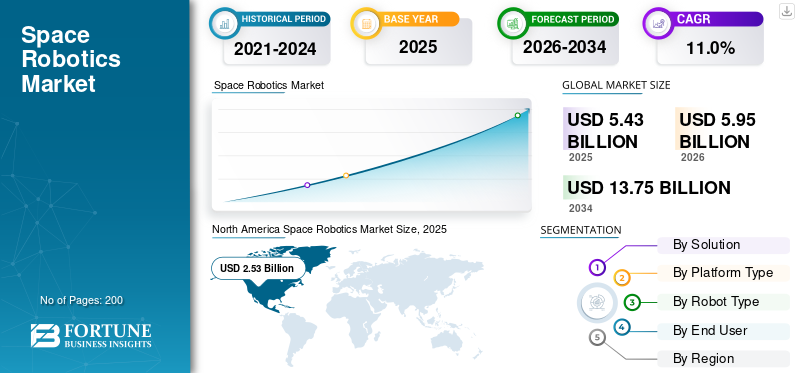
The space robotics market size was valued at USD 5.59 billion in 2025. The market is projected to grow from USD 6.13 billion in 2026 to USD 12.8 billion by 2034, exhibiting a CAGR of 9.63% during the forecast period. North America dominated the space robotics market with a market share of 45.26% in 2025.
The market encompasses robotic systems engineered to perform tasks in orbital, lunar, and deep-space environments where human presence is limited or impractical. These systems include robotic arms, autonomous rovers, servicing satellites, and exploration robots designed for assembly, repair, inspection, and scientific operations. The market integrates advancements in artificial intelligence, machine vision, autonomous navigation, and precision actuation to enable robots to operate independently or semi-autonomously under extreme conditions. Applications span from satellite servicing to debris removal, planetary exploration, and space station maintenance. The sector reflects a broader shift toward automation in space operations, reducing reliance on astronaut-led missions while expanding capabilities for long-duration, high-risk, and remote space activities.
Key players in the market include MDA Space, Northrop Grumman, Maxar Space Systems, Airbus Defence and Space, Thales Alenia Space, and Blue Origin. These companies compete through advanced robotic arm and manipulator technologies, autonomous navigation and docking capabilities, broader satellite servicing and in-orbit assembly portfolios, lunar and planetary exploration robots, and integrated solutions tailored for satellite life-extension, debris removal, space station maintenance, and exploration missions across government and commercial space programs.
Download Free sample to learn more about this report.
Space Robotics Market Key Takeaways
 Global Market Size & Forecast
- 2025 Market Size: USD 5.59 billion
- 2026 Market Size: USD 6.13 billion
- 2034 Forecast Market Size: USD 12.8 billion
- CAGR: 9.63% (2026–2034)
 Market Share
- North America dominated the market with a 45.26% share in 2025.
- The services segment is projected to grow at a 12.0% CAGR during the forecast period.
- The space infrastructure companies segment is projected to grow at a 13.1% CAGR during the forecast period.
 Key Regional Highlights
Asia Pacific
Asia Pacific is projected to reach USD 1.29 billion by 2026 and is expected to register the highest growth at an 11.8% CAGR during the forecast period.
North America
North America generated USD 2.53 billion in 2025 and is projected to maintain its leading position.
Europe
Europe is projected to reach USD 1.45 billion by 2026.
U.S.
U.S. market is projected to reach USD 2.48 billion by 2026.
Japan
Japan market is projected to reach USD 0.33 billion by 2026.
Read More

SPACE ROBOTICS MARKET TRENDS
Growing Adoption of Autonomous and AI-enabled Robotic Systems for Space Missions is Emerging Market Trend
A notable trend in the market is the increasing integration of artificial intelligence and autonomous decision-making capabilities into robotic platforms. Rather than relying solely on remote human operation, modern space robots are being designed to navigate, assess, and react to unpredictable environments independently. This shift is driven by communication delays inherent in deep-space missions, where real-time control from Earth is impractical. As a result, space agencies and private companies are prioritizing robots capable of self-diagnosis, adaptive path planning, and autonomous docking, reflecting a broader movement toward intelligent, semi-independent systems that can operate reliably across increasingly complex and distant mission environments.
MARKET DYNAMICS
MARKET DRIVERS
Download Free sample to learn more about this report.
Increasing Space Exploration Missions Requiring Robotic Assistance is Driving Market Growth
Rising investments in lunar, Martian, and deep-space exploration missions is driving space robotics market growth. Space agencies and private firms increasingly rely on robotic rovers, arms, and manipulators to conduct tasks such as sample collection, terrain mapping, and equipment assembly in environments unsuitable for prolonged human presence. These robots reduce mission risk and operational costs while extending mission duration and scientific output. Additional drivers include the growing complexity of space station maintenance and the need for precision-based repair tasks, both of which reinforce the deployment of space robotics as a core enabler of modern space exploration and infrastructure development.
MARKET RESTRAINTS
High Development and Deployment Costs Limits Widespread Adoption
The market faces restraints due to the substantial costs associated with designing, testing, and launching robotic systems capable of withstanding extreme space conditions. Developing radiation-hardened components, ensuring long-term reliability without on-site maintenance, and conducting extensive pre-launch testing significantly increase overall program expenses. These cost barriers limit participation to well-funded government agencies and a small number of private companies, restricting broader commercial entry. Additionally, the long development cycles required to validate robotic systems for space-grade reliability further slow market expansion, making it challenging for smaller players to compete without significant capital investment or strategic partnerships.
MARKET OPPORTUNITIES
Expansion of Satellite Servicing and Debris Removal Initiatives Offers Lucrative Market Opportunities
A significant market opportunity lies in the rising need for in-orbit satellite servicing and active debris removal solutions. As satellite constellations expand and orbital congestion increases, there is growing demand for robotic systems capable of refueling, repairing, or repositioning satellites without requiring astronaut intervention. This opens avenues for commercial players to develop specialized servicing robots and robotic tugs. Additionally, government and private partnerships aimed at sustainable space operations are creating funding pathways for debris mitigation technologies. Companies that can offer cost-effective, reusable robotic servicing platforms stand to capture substantial value as space sustainability becomes a priority across both commercial and governmental space programs.
MARKET CHALLENGES
Technical Complexity of Operating Robotics in Extreme Space Environments Hampers Market Growth
A key challenge in the market is designing systems capable of reliably functioning under extreme temperature fluctuations, radiation exposure, vacuum conditions, and microgravity. Ensuring precise motor control, sensor accuracy, and structural durability in such environments demands rigorous engineering and extensive testing, often extending development timelines. Communication latency further complicates real-time control, particularly for missions beyond low Earth orbit. Additionally, limited opportunities for in-mission repair mean systems must achieve near-flawless reliability before deployment. These technical hurdles increase the risk of mission failure and demands continuous innovation in materials, autonomy, and fault-tolerant design to maintain operational success.
Segmentation Analysis
By Solution
Increasing Reliance on Automation across Satellite and Exploration Missions is Driving Robotic Systems Segment Dominance
Based on solution, the market is classified into robotic systems, software, and services.
The robotic systems segment accounted for the largest market share in 2025. Demand for the robotic systems segment is rising as space missions increasingly require automated platforms capable of performing repair, assembly, and inspection tasks without human intervention. These systems reduce mission risk and operational costs while enabling longer mission durations, making them essential as exploration and satellite servicing programs continue expanding globally.
The services segment is anticipated to rise with a CAGR of 12.0% over the forecast period.
To know how our report can help streamline your business, Speak to Analyst
By Platform Type
Growing Satellite Servicing and Repositioning Needs Are Driving Orbital Robotics Segment Growth
Based on platform type, the market is segmented into orbital robotics, planetary surface robotics, lunar surface robotics, space station robotics, and cislunar robotics.
In 2025, the orbital robotics segment dominated the global market. Demand for orbital robotics segment is rising as satellite operators increasingly require in-orbit refueling, repair, and repositioning capabilities to extend asset lifespans. Orbital robots offer cost-effective alternatives to satellite replacement, making them more attractive as satellite constellations grow and operators prioritize sustainable, long-term orbital asset management strategies.
The cislunar robotics segment is projected to grow at a CAGR of 13.1% over the forecast period.
By Robot Type
Rising Need for Precision-Based Assembly and Repair Tasks Leads to Dominance of Robotic Arms & Manipulators Segment
Based on robot type, the market is divided into robotic arms & manipulators, rovers, autonomous mobile robots, inspection & servicing robots, and construction & assembly robots.
The robotic arms & manipulators segment is anticipated to witness a dominating space robotics market share over the forecast period. Demand for the robotic arms and manipulators segment is growing as space missions increasingly require precise handling capabilities for tasks such as satellite capture, equipment assembly, and sample collection. These tools enable accurate, repeatable operations in challenging environments, making them critical as missions demand higher dexterity and reliability standards.
The construction & assembly robots segment is projected to grow at a high CAGR of 13.3% over the forecast period.
By End User
Expanding National Space Programs is Driving Demand for Government Space Agencies Segment
Based on end user, the market is segmented into government space agencies, defense & military organizations, commercial satellite operators, space infrastructure companies, research & academic institutions, and private space exploration companies.
The government space agencies segment dominated the market in 2025. This is due to national programs prioritizing exploration, defense, and scientific missions requiring robotic support. Agencies increasingly invest in robotics to reduce astronaut risk and mission costs, making this segment a key driver as governments expand long-term space exploration and infrastructure ambitions.
In addition, space infrastructure companies are projected to grow at a CAGR of 13.1% during the study period.
Space Robotics Market Regional Outlook
By geography, the market is categorized into North America, Europe, Asia Pacific, and Rest of the World.
North America
North America Space Robotics Market Size, 2025 (USD Billion)
To get more information on the regional analysis of this market, Download Free sample
North America held the dominant share in 2024, valuing at USD 2.28 billion, and also maintained the leading share in 2025, with USD 2.53 billion. Demand in North America remains strong due to robust government space programs, significant private-sector investment, and continuous advancements in robotic exploration and satellite servicing technologies supporting both defense and commercial space initiatives.
U.S. Space Robotics Market
Based on North America’s strong contribution, the U.S. market can be analytically approximated at around USD 2.48 billion in 2026, representing roughly 11.0% CAGR of the forecast period. Demand in the U.S. remains dominant due to strong government funding, extensive private aerospace investment, and continuous advancements in robotic exploration, satellite servicing, and autonomous mission technologies.
Europe
Europe is estimated to reach USD 1.45 billion in 2026 and secure the position of second largest region in the market. The market growth is supported by coordinated space agency initiatives, growing investment in satellite servicing, and increasing collaboration between research institutions and private companies advancing robotic exploration and debris mitigation technologies.
U.K. Space Robotics Market
The U.K. market growth in 2026 is estimated at around USD 0.18 billion and growth with a 10.4% CAGR during the forecast period. The solution demand in the U.K. is growing as government-backed space initiatives and private aerospace firms increasingly invest in robotic systems supporting satellite servicing and exploration missions.
Germany Space Robotics Market
Germany’s market is projected to reach approximately USD 0.25 billion in 2026. This market growth is due to strong engineering capabilities and increasing investment in robotic technologies supporting European space exploration and satellite servicing programs.
Asia Pacific
Asia Pacific is projected to record a CAGR of 11.8% during the forecast period, which is the highest among all regions, and reach a valuation of USD 1.29 billion by 2026. The market is growing rapidly due to expanding national space programs, increasing satellite launches, and growing government investment in autonomous robotic systems supporting exploration and orbital servicing missions.
China Space Robotics Market
China’s market is projected to be one of the largest in Asia Pacific, with 2026 revenues estimated at around USD 0.57 billion. Demand in China is increasing rapidly due to aggressive national space program expansion, growing lunar exploration ambitions, and rising investment in autonomous robotic systems.
Japan Space Robotics Market
The Japan market share in 2026 is estimated at around USD 0.33 billion, accounting for roughly 11.4% of CAGR during the forecast period. The market continues growing as the country invests in robotic technologies supporting satellite servicing, lunar exploration, and international space station collaboration efforts.
India Space Robotics Market
The India market in 2026 is estimated at around USD 0.23 billion. The market is growing steadily due to expanding national space ambitions, growing satellite launch activity, and increasing investment in indigenous robotic exploration technologies.
Rest of the World
The rest of the world include Middle East & Africa and Latin America. These regions are expected to witness moderate growth during the forecast period. The Middle East & Africa and Latin America market is set to reach a valuation of USD 0.26 billion and USD 0.18 billion in 2026. Demand across the Rest of the World is gradually increasing as emerging space programs invest in foundational robotics capabilities, often through international partnerships supporting satellite operations and exploratory missions.
COMPETITIVE LANDSCAPE
Key Industry Players
Key Players Focus On On-Orbit Servicing, Lunar Mobility, and Autonomous Robotic Infrastructure to Boost Market Competition
The space robotics market is being strengthened by key players that are shifting space robotics from mission-specific engineering hardware toward reusable, service-based, and autonomy-driven space infrastructure. Companies such as MDA Space, Northrop Grumman, Airbus Defence and Space, Thales Alenia Space, and Blue Origin’s Honeybee Robotics, are focusing on robotic arms, lunar rovers, on-orbit servicing vehicles, autonomous inspection systems, in-space assembly tools, and planetary mobility platforms. MDA Space is reinforcing its leadership through Canadarm3 for the lunar Gateway, while Northrop Grumman is expanding commercial satellite life-extension and robotic servicing through SpaceLogistics and the Mission Robotic Vehicle. NASA’s Lunar Terrain Vehicle program is pushing Intuitive Machines, Lunar Outpost, and Astrolab toward commercial lunar mobility services, while Thales Alenia Space, and Airbus are supporting robotic infrastructure for lunar landers, space stations, and in-space assembly. Meanwhile, Astroscale and GITAI are advancing debris removal, inspection, life-extension, and autonomous robotic operations, helping shift the market from exploration-only demand toward recurring orbital servicing, lunar infrastructure, and commercial space operations.
LIST OF KEY SPACE ROBOTICS COMPANIES PROFILED
- MDA Space (Canada)
- Northrop Grumman (U.S.)
- Maxar Space Systems (U.S.)
- Airbus Defence and Space (Netherlands)
- Thales Alenia Space (France)
- Blue Origin (U.S.)
- Rocket Lab (U.S.)
- Astroscale (Japan)
- Astrobotic (U.S.)
- GITAI (U.S.)
KEY INDUSTRY DEVELOPMENTS
- June 2026: WeTouch Technology entered into a strategic sales and cooperation agreement with Shenzhen Sub-Space Robotics Co., Ltd. to co-develop embodied AI terminals and smart robotic hardware for space and aerospace applications.
- May 2026: Rocket Lab signed a definitive agreement to acquire Motiv Space Systems, a precision spacecraft robotics and motion control firm, expanding Rocket Lab's portfolio into space robotics manufacturing.
- May 2026: NASA awarded Motiv Space Systems an USD 84,847 Phase III contract to continue foundational robotics development.
- March 2026: Voyager Technologies finalized a mission management contract with Icarus Robotics to launch and test their free-flying "Joyride" robotic platform aboard the International Space Station.
- February 2026: The European Space Agency (ESA) signed a contract with Venturi Space to study and test next-generation lunar rover technologies, including high-performance batteries and suspension systems, utilizing the MONA LUNA rover demonstrator.
REPORT COVERAGE
This research offers a detailed analysis of emerging trends and rapidly adopted technologies in the industry across key regions. The report outlines key drivers of market growth and challenges to expansion, delivering a detailed overview of the maritime industry landscape. The study highlights recent advancements to boost industry insights and support stakeholders in making well-informed decisions.
Request for Customization to gain extensive market insights.
Report Scope & Segmentation
| ATTRIBUTE | DETAILS |
| Study Period | 2021-2034 |
| Base Year | 2025 |
| Estimated Year | 2026 |
| Forecast Period | 2026-2034 |
| Historical Period | 2021-2024 |
| Growth Rate | CAGR of 9.63% from 2026-2034 |
| Unit | Value (USD Billion) |
| Segmentation | By Power Rating, By Application, By End-User, By Product Type, By Sales Channel, By Fuel Type, and By Region |
| By Power Rating |
|
| By Application |
|
| By End-User |
|
| By Product Type |
|
| By Sales Channel |
|
| By Fuel Type |
|
| By Region |
|
Frequently Asked Questions
According to Fortune Business Insights, the global market value stood at USD 5.59 billion in 2025 and is projected to reach USD 12.8 billion by 2034.
In 2025, the North America market value stood at USD 2.53 billion.
The market is expected to exhibit a CAGR of 9.63% during the forecast period of 2026-2034.
By solution, the robotic systems segment is expected to dominate the market.
Increasing space exploration missions requiring robotic assistance is driving market growth.
MDA Space, Northrop Grumman, Maxar Space Systems, Airbus Defence and Space, and Thales Alenia Space are few major players in the global market.
North America dominated the market in 2025.



- 2021-2034
- 2025
- 2021-2024
- 200
Get 30-60 hrs Free Customization
Expand Regional and Country Coverage, Segments Analysis, Company Profiles, Competitive Benchmarking, and End-user Insights.




















-
US +1 833 909 2966 ( Toll Free )
-
Get In Touch With Us