Spintronics Market Size, Share & Industry Analysis, By Material Type (Giant Magnetoresistance (GMR), Tunnel Magnetoresistance (TMR), and Others (Ferromagnetic Metals, Graphene, etc.)), By Device Type (MRAM (Magnetoresistive RAM), Magnetic Sensors, Hard Disk Drives, Spin Transistors, and Quantum Computing Device), By End User (Consumer Electronics, Automotive, Healthcare, Industrial & Manufacturing, and Others (Aerospace & Defense, etc.), and Regional Forecast, 2026-2034
 Download Free Sample
SPINTRONICS MARKET SIZE AND FUTURE OUTLOOK
 Listen to Audio Version
The global spintronics market size was valued at USD 1.44 billion in 2025. The market is projected to grow from USD 1.72 billion in 2026 to USD 7.05 billion by 2034, exhibiting a CAGR of 19.30% during the forecast period. Asia Pacific dominated the spintronics market with a market share of 48.40% in 2025.
Spintronics, also known as spin electronics, examines the involvement of the electron's inherent spin, its electric charge, and its magnetic moment. This is crucial in solid-state physics and in creating devices that utilize the spin characteristics of particles.
The global market is expanding due to the increasing product deployment in advanced computing technologies. The top companies in this market cover Allegro MicroSystems, NXP Semiconductors, Avalanche Technology Inc., and Infineon Technologies AG.
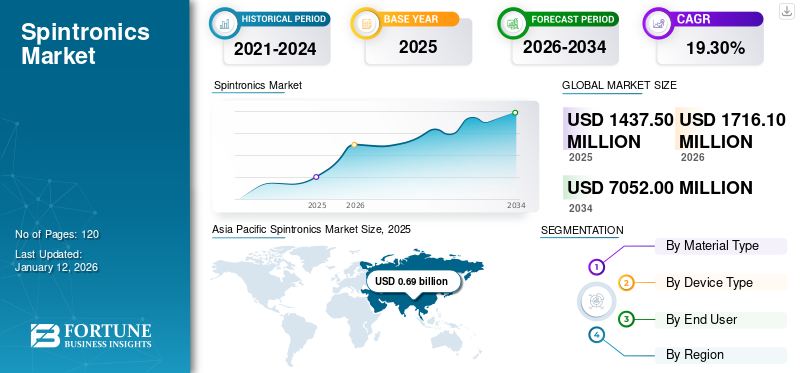
Download Free sample to learn more about this report.
Spintronics Market KEY TAKEAWAYS
 Global Market Size & Forecast
- 2025 Market Size: USD 1.44 billion
- 2026 Market Size: USD 1.72 billion
- 2034 Forecast Market Size: USD 7.05 billion
- CAGR: 19.30% from 2026–2034
 Market Share
- Asia Pacific dominated the spintronics market with a 48.40% share in 2025.
- The Tunnel Magnetoresistance (TMR) segment is projected to hold the largest market share with 42.34% in 2026.
- The MRAM (Magnetoresistive RAM) segment is projected to witness the fastest growth with a 24.38% CAGR.
 Key Regional Highlights
Asia Pacific
The market generated USD 696 million in 2025 and is projected to reach USD 854.5 million in 2026.
North America
The market reached USD 310.8 million in 2025 and is projected to grow to USD 353.6 million in 2026.
Europe
The market was valued at USD 287.9 million in 2025 and is projected to reach USD 339.7 million in 2026.
U.S.
The market is projected to reach USD 0.25 billion by 2026.
Japan
Japan is expected to witness steady growth in the spintronics market, supported by its strong semiconductor ecosystem.
Read More

Impact of Gen AI
Gen AI Technology Depicts a Significant Impact with Improved Performance and Scalability
Generative AI technology has a significant impact on the market. Generative AI can use various modeling and simulation techniques to find and develop new materials for spintronic, and identifying optimized materials with the desired magnetic, electrical, and spin performance. Additionally, the AI models can also simulate spintronic behavior under arrange of conditions making the optimization of device architecture much faster. The use of AI in spintronic will lead to better performance, scalability, and power efficiency in MRAM, spin transistors, and other components, which will drive market growth.
Impact of Reciprocal Tariff
Reciprocal Tariffs Create Instability by Disrupting Global Supply Chains
The spintronics market is a part of the broader semiconductor industry and is sensitive and vulnerable to tariffs that target electronic components and materials. Tariffs introduce uncertainty by disrupting established global supply chains which have been built for many years to maximize cost-efficiency and specialization. Tariffs affect the market by increasing manufacturing costs, and forcing companies to reconsider their cross-border trade approaches. These effects ripple through the entire ecosystem, from raw material pricing to final pricing for consumers.
MARKET DYNAMICS
Market Drivers
Expansion of Consumer Electronics Industry Drives the Market Growth
One of the key factors driving the spintronics market growth is increasing demand for consumer electronics. The heighted need for increasingly compact, faster, and more energy-efficient devices is driving the demand for spintronic components such as MRAM and magnetic sensors. Spintronics technology uses electron spin, in addition to charge, to support the creation of smaller, faster, and more efficient components ideally suited for modern consumer electronic needs.
According to India Brand Equity Foundation, 2021-22, it has been estimated that the electronics manufacturing and export market of India is expected to reach Market Restraints
Manufacturing Complexity and Yield to Hinder Growth
The complexity of manufacturing and low yield rates present challenges to the market development, which affects commercialization and scalability. The manufacturing process needs atomic-level precision, specialized equipment, and use of high-purity materials, which drive the up manufacturing cost far beyond conventional semiconductors. Additionally, the technical difficulties of integrating magnetic materials with silicon technology is demanding and raises process compatibility issues. These challenges lead to low manufacturing yield and unpredictable performance of spintronic devices, especially as components shrink. High costs and low yield ultimately restrict market growth opportunities for spintronics applications.
Market Opportunities
Growing Focus on Industrial Automation and Robotics Create Opportunities
The increasing need for high-performance, energy-efficient robotics is helping to drive the market growth. Spintronic devices provide higher speed in data processing and non-volatile memory such as MRAM, which is particularly helpful for industrial robots that typically need quick, reliable decision-making and data storage capability when the power signal is disrupted. High-sensitivity spintronic sensors also provide higher-level environmental perception for advanced robotics platforms including autonomous or collaborative robots. Also, spintronics-based neuromorphic computing is advancing AI in robotics by mimicking neural network capabilities with low power, enabling more sophisticated on-board intelligence.
SPINTRONICS MARKET TRENDS
Edge AI & IoT Proliferation Emerges as a Major Trend in the Market
The demand for quicker and more energy-efficient components for edge AI and IoT devices is propelling the spintronics market. With billions of connected IoT sensors and smart devices needing local, real-time processing of data, more advanced memory and logic chips are necessary. Spintronic peripherals, such as MRAM, offer lower power consumption, last longer, and have greater speeds than any traditional semiconductor technologies. This makes them well-suited for embedded intelligence in everything from wearables to autonomous vehicles, where low latency and performance is essential.
Download Free sample to learn more about this report.
SEGMENTATION ANALYSIS
By Material Type
High Sensitivity and Low Power Consumption Spurs Giant Magnetoresistance (GMR) Segment Growth
Based on the material type, the market is segmented into Giant Magnetoresistance (GMR), Tunnel Magnetoresistance (TMR), and others.
The Giant Magnetoresistance (GMR) segment held the largest revenue share of USD 0.52 billion in the overall global market in the year 2024. Giant Magnetoresistance (GMR) provides high sensitivity, compact size, and low power consumption, which make them suitable for widespread use in hard disk drives, automotive sensors, and industrial applications while driving the overall segment growth.
Tunnel Magnetoresistance (TMR) segment holds the highest CAGR of 22.14% in the global market. The segment’s growth is attributable to its superior signal output, scalability, and compatibility with advanced MRAM and next-generation sensor technologies used in automotive, IoT, and AI-driven electronics. The tunnel magnetoresistance (TMR) segment is expected to lead the market, contributing 42.34% globally in 2026.
By Device Type
Magnetic Sensors Leads Market Due to Its Extensive Adoption in Various Applications
Based on device type, the market is divided into MRAM (Magnetoresistive RAM), magnetic sensors, hard disk drives, spin transistors, and quantum computing device.
The magnetic sensors segment dominates with a market share of USD 0.55 billion. The segment continues to generate the major revenue due to its extensive adoption in automotive, consumer electronics, and industrial applications for position, speed, and current sensing due to high precision and energy efficiency. The magnetic sensors segment is projected to dominate the market with a share of 44.16% in 2026.
MRAM (Magnetoresistive RAM) holds the highest CAGR of 24.38% in the global market. The segment’s growth is mainly due its non-volatile nature, high speed, endurance, and scalability, making it a promising replacement for traditional DRAM and Flash in next-generation electronics and embedded systems.
By End User
Widespread Integration of Spintronic Components Augments the Consumer Electronics Segment Growth
In terms of the end user, the market is divided into consumer electronics, automotive, healthcare, industrial & manufacturing, and others (aerospace & defense, etc.).
The consumer electronics sector accounted for the largest spintronics market share at USD 0.42 billion in 2024. The segment’s growth has been influenced by the increasing use of spintronic sensors and MRAM in smartphones, laptops, and wearables, driven by the need for high performance, low power consumption, and compact memory solutions. The consumer electronics segment is expected to account for 34.11% of the market in 2026.
Automotive industry holds the highest CAGR at 22.36% in the global industry. The sector is growing due to the increasing use of spintronic sensors and MRAM in advanced driver-assistance systems (ADAS), electric vehicles, and infotainment systems for enhanced safety, reliability, and energy efficiency.
To know how our report can help streamline your business, Speak to Analyst
SPINTRONICS MARKET REGIONAL OUTLOOK
Geographically the market is segmented into North America, Europe, Asia Pacific, South America and Middle East & Africa.
North America
In 2025, North America represented USD 310.8 million, accounting for 21.60% of the worldwide market, and is projected to grow to USD 353.6 million in 2026. The growth is attributable to the region’s strong technological infrastructure, investment in scientific research, and robust industrial base.
The U.S. is at the forefront of the North American market, with expected revenue of USD 0.25 billion in 2026. The growth is due to high demand for energy-efficient and high-performing electronics.
Europe
The Europe market generated USD 287.9 million in 2025, representing 20.00% of the global market landscape, and is expected to reach USD 339.7 million in 2026. The region has been at the forefront of developing and applying spintronic technologies in data storage, sensor technology, quantum computing, and even renewable energy applications.
The U.K., Germany and France are some of the leading contributors to the growth in the market, with the required revenue stake of USD 0.065 billion, USD 0.063 billion and USD 0.05 billion respectively by 2026.
Asia Pacific
Asia Pacific Spintronics Market Size, 2025 (USD billion)
To get more information on the regional analysis of this market, Download Free sample
Asia Pacific is currently at the forefront of the global market. Asia Pacific contributed 48.40% to the global market in 2025, with a valuation of USD 696 million, and is projected to reach USD 854.5 million in 2026. The growth is attributable to the strong presence of semiconductor manufacturing hubs, expanding electronics and automotive industries, and significant research and development investments in spintronic memory and sensor technologies across countries of China, Japan, South Korea, and Taiwan.
At the same time, Asia Pacific is also expected to have the highest CAGR of 23.69%, further solidifying the market as the fastest growing. The region is growing due to rapid industrialization, rising demand for advanced consumer electronics and electric vehicles, and increasing adoption of spintronic devices by regional semiconductor manufacturers.
India and China are major contributors to the market growth with an expected revenue share of USD 0.12 billion, and USD 0.17 billion respectively by 2026.
South America and Middle East & Africa
The South America market has witnessed significant growth with an expected share of USD 0.06 billion in 2025. Industries in the region are largely focusing on traditional sectors such as agriculture, mining, energy, and manufacturing, with relatively fewer players investing in high-tech areas such as spintronics.
Additionally, the Middle East and Africa markets are anticipated to grow over the coming years with an expected share of USD 0.09 billion in 2025. Governments in the region are heavily investing in high-tech industries, advanced research, and innovation. The Middle East & Africa market was valued at USD 85.6 million in 2025, capturing 6.00% of global revenue, and is estimated to reach USD 102.2 million in 2026.
GCC countries are predicted to have a market share of USD 0.03 billion by 2025.
Latin America
The market in Latin America reached USD 57.3 million in 2025, representing 4.00% of total market revenue, and is projected to reach USD 66.3 million in 2026.
COMPETITIVE LANDSCAPE
Key Industry Players
Key Players Focus On Partnerships and Acquisitions to Lead the Industry
The global spintronics market is fragmented, with a large number of group and standalone providers. The top companies in the industry are Allegro MicroSystems, NXP Semiconductors, Avalanche Technology Inc., and Infineon Technologies AG. These companies are developing strategies around high-density data storage, energy-efficient devices, and emerging applications such as quantum computing. Major strategies involve advancing MRAM (Magnetoresistive Random-Access Memory) technology for faster, denser memory, focusing on materials with high spin-orbit coupling to create energy-efficient devices, and leveraging spin effects for applications in sensors, electric vehicles, and neuromorphic computing.
LIST OF KEY SPINTRONICS COMPANIES PROFILED:
- NVE Corporation (U.S.)
- Analog Devices (U.S.)
- Allegro MicroSystems (U.S.)
- NXP Semiconductors (Netherlands)
- Avalanche Technology Inc. (U.S.)
- Infineon Technologies AG (Germany)
- TDK-Micronas GmbH (Germany)
- Renesas Electronics (Japan)
- Asahi Kasei Microdevices (Japan)
- TSMC (Taiwan)
- asm OSRAM (Austria)
- MultiDimension Technology (China)
- QST Corporation (China)
- STMicroelectronics (Switzerland)
- GlobalFoundries (U.S.)
KEY INDUSTRY DEVELOPMENTS:
- July 2025- Renesas Electronics Corporation (TSE:6723), a premier supplier of advanced semiconductor solutions, introduced the RA8P1 microcontroller (MCU) Group targeted at Artificial Intelligence (AI) and Machine Learning (ML) applications, as well as real-time analytics. The RA8P1 MCUs are manufactured on the 22ULL (22nm ultra-low leakage) process from TSMC, enabling ultra-high performance with very low power consumption. This process also enables the use of embedded Magnetoresistive RAM (MRAM) in the new MCUs.
- April 2025- TDK demonstrates the world's first “Spin Photo Detector” capable of 10X data transmission speeds for the next generation of AI. A photo-spintronic conversion element capable of responding at ultra-high speeds of 20 picoseconds using light with 800 nm wavelengths, 10X faster than conventional semiconductor-based photo detectors.
- July 2024- Avalanche Technology, a developer of next generation MRAM technology, has announced the rollout of a new enhanced discrete product family called ‘Space Grade-E’. This product family is a response to what the company has described as ‘unprecedented demand’ from the aerospace and defence sectors for its Gen 3 high density, high reliability MRAM solutions that are intended to address decades-old system-level challenges.
- October 2023- Everspin Technologies Inc. announced the expansion of industrial STT-MRAM Devices. The expansion offers easy integration into clients' designs, great endurance, and compatibility with different memory types.
- October 2023- Allegro MicroSystems, Inc., a global leader in power and sensing semiconductor technology for motion control and energy efficient systems, announced that it has completed the acquisition of Crocus Technology, a leader in advanced TMR sensor technology, for USD 420 million in cash, subject to customary working capital adjustments. This acquisition accelerates Allegro’s TMR roadmap and strengthens its leading position in the magnetic sensing market.
REPORT COVERAGE
The global report provides a detailed analysis of the market and focuses on key aspects such as prominent companies, deployment modes, types, and end users of the product. Besides this, it offers insights into the spintronics market trends and highlights key industry developments and market share analysis for key companies. In addition to the aforementioned factors, the report encompasses several factors that have contributed to the growth of the market over recent years.
Request for Customization to gain extensive market insights.
Report Scope & Segmentation
| ATTRIBUTE | DETAILS |
| Study Period | 2021-2034 |
| Base Year | 2025 |
| Estimated Year | 2026 |
| Forecast Period | 2026-2034 |
| Growth Rate | CAGR of 19.30% from 2026-2034 |
| Historical Period | 2021-2024 |
| Unit | Value (USD Billion) |
| Segmentation |
By Material Type
By Device Type
By End User
By Region
|
Frequently Asked Questions
Fortune Business Insights says that the global market stood at USD 1.44 billion in 2025 and is projected to reach USD 7.05 billion by 2034.
The market is expected to exhibit steady growth at a CAGR of 19.30% during the forecast period.
Expansion of consumer electronics sector is speeding up the market growth.
NVE Corporation, Analog Devices, Allegro MicroSystems, NXP Semiconductors, Avalanche Technology Inc., and Infineon Technologies AG are some of the top players in the market.
The Asia Pacific region held the largest market with a share of 48.40% in 2025.
Asia Pacific was valued at USD 0.69 billion in 2025.



- 2021-2034
- 2025
- 2021-2024
- 120
Get 30-60 hrs Free Customization
Expand Regional and Country Coverage, Segments Analysis, Company Profiles, Competitive Benchmarking, and End-user Insights.




















-
US +1 833 909 2966 ( Toll Free )
-
Get In Touch With Us