Sports Composites Market Size, Share & Industry Analysis, By Resin Type (Epoxy, Polyamide, Polyurethane, and Others), By Fiber Type (Carbon, Glass, and Others), By Application (Golf Shafts, Hockey Sticks, Rackets, Bicycles, Skis & Snowboards, and Others), and Regional Forecast, 2026-2034
 Download Free Sample
KEY MARKET INSIGHTS
 Listen to Audio Version
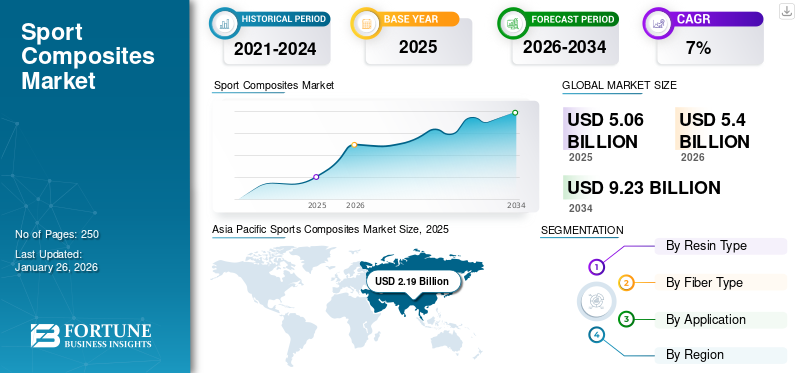
The global sports composites market size was valued at USD 5.06 billion in 2025 and is projected to grow from USD 5.40 billion in 2026 to USD 9.23 billion in 2034 at a CAGR of 7.0% during the forecast period. Asia Pacific dominated the sports composites market with a market share of 43.30% in 2025.
Sports composites are advanced materials composed of fibers, resins, and additives designed for sports equipment and apparel. These lightweight, high-strength materials enhance performance by providing superior strength-to-weight ratios. Commonly used in products such as tennis rackets, golf clubs, and bicycles, it offers durability, flexibility, and improved aerodynamics. The innovative use of these materials contributes to the development of high-performance sports gear, catering to athletes seeking enhanced efficiency and function ability in their equipment.
The COVID-19 pandemic disrupted supply chains and manufacturing, impacting production. Additionally, decreased sporting events and the closure of sports complexes reduced the demand, leading to a temporary market decline. However, the return of professionals, amateurs, and recreational sports at various levels, and the pandemic highlighting health awareness and motivating people to engage in outdoor activities and sports bolstered the demand.
Download Free sample to learn more about this report.
Sports Composites Market Key Takeaways
 Global Market Size & Forecast
- 2025 Market Size: USD 5.06 billion
- 2026 Market Size: USD 5.40 billion
- 2034 Forecast Market Size: USD 9.23 billion
- CAGR: 7.0% from 2026–2034
 Market Share
- Asia Pacific dominated the sports composites market with a 43.30% share in 2025.
- The epoxy resin segment is projected to account for 59.07% of the market in 2026.
- The carbon fiber segment is expected to hold 68.52% of the market in 2026.
 Key Regional Highlights
Asia Pacific
Valued at USD 2.19 billion in 2025 with a 43.30% market share and is projected to reach USD 2.36 billion in 2026.
North America
Generated USD 1.48 billion in 2025, accounting for 28.60% of the global market.
Europe
Reached USD 1.09 billion in 2025, representing 21.60% of the global market.
U.S
Sports composites market is projected to reach USD 1.23 billion by 2026.
Japan
Sports composites market is projected to reach USD 0.37 billion by 2026.
Read More

Sports Composites Market Trends
Emerging Sports and Recreational Trends to Propel Growth
Surge in emerging sports and recreational activities like stand-up paddle boarding, kayaking, and e-biking are creating a substantial market opportunities for the sports composites. These sports, which are popular among a wide range of people, rely on equipment made of high-strength materials, lightweight, and durable materials. Composites play an important part in meeting these requirements by providing an ideal mix of strength and weight, which is critical for improving the performance of paddleboards, kayaks, and electric cycles. As more people participate in these activities, manufacturers witness a growing market for advanced composites, which drives innovation and the creation of specialized materials to meet the unique demands of each sport.
Furthermore, the push towards eco-friendly and sustainable methods in sports is driving up demand for composites. As enthusiasts and manufacturers prioritize environmentally conscious choices, composites offer a sustainable alternative. The recyclability and energy efficiency of composite materials align with the sustainability goals of these emerging sports, creating a compelling market opportunities for eco-friendly composites in the sports equipment sector.
The rising demand for sports and leisure infrastructure, including parks, trails, and adventure locations, drives product adoption. From the design of lightweight yet durable structures to the development of innovative equipment for adventure sports, composites prove instrumental in shaping the landscape of these emerging activities, providing both performance advantage and contributing to sports composites market growth.
Download Free sample to learn more about this report.
Sports Composites Market Growth Factors
Increasing Adoption of Agile Sports Equipment to Drive Market Growth
The growing need for lightweight materials in sports and recreation is driving the market's rapid expansion. Athletes and sports enthusiasts alike are increasingly aware of the performance benefits offered by lightweight equipment. The desire for lighter gear has grown in sports such as cycling, where every ounce counts, and in hobbies like hiking or kayaking, where portability is crucial. This shift in preference towards lightweight solutions positions sports composites, including materials such as carbon fiber and fiberglass, as ideal choices for manufacturers aiming to meet these evolving needs.
The market benefits greatly from these materials' unique features. Carbon fiber, for example, has a good strength-to-weight ratio, which improves the overall performance of sporting equipment. This feature is especially helpful in applications like bicycle frames, tennis rackets, and snowboards, where lowering weight without sacrificing strength is vital to optimal performance.
The emphasis on improving agility and maneuverability in sports drives the demand for lightweight composites. Whether in sports like surfing or the production of high-performance footwear, the use of composites enables the manufacture of equipment that is not only lightweight but also durable, offering sportsmen a competitive advantage. As the sports and recreational industry prioritizes lightweight materials for greater performance, the market is expected to observe steady expansion, driven by the ongoing pursuit of innovation and quality in sports equipment design.
RESTRAINING FACTORS
Production Cost and Availability of Traditional Materials to Limit Market Growth
The market faces constraints due to the high cost of manufacturing composite materials. While composites provide superior strength-to-weight ratios and performance benefits, the cost of production remains a significant constraint. Traditional materials such as metals and plastic, despite their comparatively lower performance characteristics, often present a more cost-effective solution for manufacturers. This pricing discrepancy impedes the broad use of composites, particularly in price-sensitive industries and applications.
Furthermore, the industry faces competition from well-known traditional materials that have long been employed in sports equipment manufacturing. The familiarity, ease of processing, and cheaper production costs of these traditional materials make it difficult for composites to obtain widespread acceptance. Striking a balance between getting optimal performance through sports composites and managing cost implications remains a significant barrier to the market.
Sports Composites Market Segmentation Analysis
By Resin Type Analysis
To know how our report can help streamline your business, Speak to Analyst
Epoxy Led the Segment due to High Demand from High-Performance Sporting Equipment
Based on resin type, the market is segmented into epoxy, polyamide, polyurethane, and others.
Regarding resin type, the epoxy segment is expected to accounte for the largest sports composites market share by 59.07% in 2026 due to its excellent adhesion, durability, and versatility. Widely used in manufacturing high-performance sporting equipment, epoxy offers superior strength and high impact resistance, making it a preferred choice in applications such as carbon fiber reinforced composites for bicycles, golf sticks & clubs, and tennis rackets.
Polyurethane resin, known for its flexibility and resilience, finds applications in sports composites where shock absorption and impact resistance are crucial. It is commonly used in protective gear, athletic footwear, and components requiring a balance between strength and flexibility.
By Fiber Type Analysis
Carbon Fiber Type Leads the Segment Due to its Exceptional Strength to Weight Ratio
Based on fiber type, the market is segmented into carbon, glass, and others.
In terms of fiber type, the carbon fiber type segment is projected to hold the largest share of 68.52% in 2026. The segment is expected to record a CAGR of 6.6% during the forecast period. The carbon fiber segment thrives on its exceptional strength-to-weight ratio, making it a preferred choice for high performance sports equipment. From lightweight bicycle frames to sturdy tennis rackets, carbon fiber composites offer superior performance, driven by athletes seeking top-tier gear that enhances performance, although at a higher cost due to intricate manufacturing processes involved.
Glass fiber finds its niche, providing a cost-effective alternative to carbon fiber. The segment is expected to acquire 28% of the market share in 2025. While not as lightweight, glass fiber composites offer durability and affordability, making them suitable for various sports applications. From recreational equipment to entry-level sports gear, the glass fiber segment caters to a broader market, balancing performance and cost-effectiveness in various sporting disciplines.
By Application Analysis
Bicycles Segment Held the Largest Share Owing to High Product Demand for Durable and High-Performance Bike Frames
Based on end-use industries, the market is segmented into golf shafts, hockey sticks, rackets, bicycles, skis & snowboards, and others.
In terms of application, the bicycle segment is expected to hold the largest market share of 39.81% in 2026. The bicycle segment is likely to record a CAGR of 8.6% during the forecast period. Sports composites play a pivotal role in the cycling industry, where their lightweight properties contribute to faster and more agile bicycles. Carbon fiber composites, in particular, are widely utilized to create durable and high-performance bike frames, catering to the demands of professional cyclists.
Sports composite excels in golf shaft applications, providing a perfect blend of flexibility and strength. The lightweight nature of composites enhances swing performances, making them a preferred choice for precision and power on the course. The golf shaft segment is projected to acquire 17% of the market share in 2025.
In the realm of hockey, sports composites deliver superior stick performance. The material’s unique characteristics offer players enhanced control, responsiveness, and durability, making composite hockey sticks an ideal choice.
Rackets in sports like tennis and badminton benefit from sports composite, offering improved power, maneuverability, and reduced vibration. The exceptional strength-to-weight ratio of composites contributes to enhanced shot accuracy and overall racket performance.
The market finds a strong foothold in the winter sports segment, providing skis and snowboards with a winning combination of strength and weight reduction. Composites enhance maneuverability and responsiveness on slopes, delivering an optimal experience for winter sports in challenging conditions.
REGIONAL ANALYSIS
Based on geography, the market is segmented into North America, South America, Europe, the Asia Pacific, and the Middle East & Africa.
Asia Pacific
Asia Pacific Sports Composites Market Size, 2025 (USD Billion)
To get more information on the regional analysis of this market, Download Free sample
Asia Pacific recorded a market size of USD 2.19 billion in 2025, capturing 43.30% of the global market share, and is projected to reach USD 2.36 billion in 2026. The region held the dominant market share in 2025 and is projected to maintain its prominent position throughout the upcoming years. The region also led the market with a value of USD 2.36 billion in 2026. Several factors are driving sports composites market in the Asia Pacific region. The region’s expanding sports culture and rising disposable income drive involvement in sports and fitness activities. The demand for high-performance athletic equipment, particularly lightweight composites, has increased rapidly. Expansion of technologically advanced manufacturing capabilities in the region will drive market growth. As the Asia Pacific countries host important sporting events and invest in sports infrastructures, product demand is expected to rise. China is the leading country in the region owing to the large production of sports goods and equipment in the country. The market in China is expected to account a value of USD 1.36 billion in 2026. On the other hand, India is likely to reach USD 0.25 billion and Japan is projected to hit USD 0.37 billion in 2026.
To know how our report can help streamline your business, Speak to Analyst
North America
In 2025, North America generated USD 1.48 billion, contributing 28.60% to global market revenue, and is projected to grow to USD 1.54 billion in 2026. A robust sports culture, technical advancements, and cutting-edge sporting equipment contribute to the demand for sports composites. Athletes prefer lightweight materials that perform better, increasing adoption in sports such as cycling, golf, and winter sports. The market is further propelled by innovations in material technology, emphasizing the region’s commitment to staying at the forefront of sports equipment advancement. The U.S. market is projected to reach USD 1.23 billion by 2026.
Europe
The European market is thriving as the sports and fitness culture evolves. The Europe market accounted for USD 1.09 billion in 2025, representing 21.60% of the global industry, and is expected to reach USD 1.15 billion in 2026. The demand for innovative and lightweight materials in sports equipment, such as carbon fiber and fiberglass composites, is increasing. Innovations in sports equipment combined with a growing emphasis on durability, performance, and design propel composites’ acceptance across the region’s sporting disciplines. The market value for U.K. is expected to be USD 0.22 billion in 2026. On the other hand, Germany is likely to hit USD 0.29 billion in 2026 and France is projected to hit USD 0.14 billion in 2025.
Latin America
Latin America accounted for USD 0.11 billion in 2025, representing 2.10% of the global market share, and is projected to reach USD 0.12 billion in 2026. The market in Latin America is driven by rising interest in sports and outdoor activities, leading to an increased demand for lightweight and durable composites in sports equipment manufacturing.
Middle East & Africa
The Middle East & Africa market generated USD 0.22 billion in 2025, representing 4.40% of the global market landscape, and is expected to reach USD 0.34 billion in 2026. In the Middle East & Africa, the demand is influenced by growing sports infrastructure development, urbanization, and rising awareness of advanced material, fostering demand for high-performance sporting goods. The Saudi Arabia is expected to hit USD 0.07 billion in 2025.
List of Key Companies in the Sports Composites Market
Product Development is the Key Strategic Initiative Adopted by the Companies
The global market is fairly fragmented, with a mix of both large manufacturers and specialized companies. Key composite manufacturers engage in activities such as product development or innovation of products with specific characteristics. These market players are also enaging in collaborations and strategic partnerships to expand their presence. They focus on innovating lightweight materials for sports equipment, addressing performance requirements.
LIST OF KEY COMPANIES PROFILED
- Toray Composite Materials America, Inc. (U.S.)
- Mitsubishi Chemical Carbon Fiber and Composites (Japan)
- SGL Carbon (Germany)
- TEIJIN LIMITED. (Japan)
- Hexcel Corporation (U.S.)
- Rock West Composites (U.S.)
- Celanese Corporation (U.S.)
- Fischer Sports GmbH (Austria)
- FUJIKURA COMPOSITES Inc. (Japan)
- Exel Composites (Finland)
KEY INDUSTRY DEVELOPMENTS
- March 2023 – SGL Carbon introduced a new carbon fiber named ‘SIGRAFIL C T50-4.9/235’, characterized by high elongation and high strength. The new carbon fiber has applications in market segments such as sports, construction, and infrastructure that require fiber elongation high strength.
- February 2021 - TEIJIN LIMITED., launched Tena BM and Tenax PW brands of carbon fiber materials for sports applications. The introduction of these materials aligns with the increasing demand for high-performance, lightweight, and durable materials.
REPORT COVERAGE
The research report provides a comprehensive market analysis and emphasizes crucial aspects such as leading companies, resin type, fiber type, and application. Also, it provides quantitative data regarding volume and value, market analysis, research methodology for market data, and insights into market trends. The report highlights vital industry developments and the competitive landscape. In addition to the abovementioned factors, the report encompasses various factors contributing to the market's growth in recent years.
Request for Customization to gain extensive market insights.
Report Scope & Segmentation
|
ATTRIBUTE |
DETAILS |
|
Study Period |
2021-2034 |
|
Base Year |
2025 |
|
Estimated Year |
2026 |
|
Forecast Period |
2026-2034 |
|
Historical Period |
2021-2024 |
|
Unit |
Value (USD Billion) and Volume (Million Ton) |
|
Growth Rate |
CAGR of 7.0% during 2026-2034 |
|
Segmentation |
By Resin Type
|
|
By Fiber Type
|
|
|
By Application
|
|
|
By Geography
|
Frequently Asked Questions
Fortune Business Insights says that the global market size was USD 5.06 billion in 2025 and is projected to reach USD 9.23 billion by 2034.
Asia Pacific held the highest share of the market in 2025.
Growing at a CAGR of 7.0%, the market will exhibit rapid growth in the forecast period (2026-2034).
Carbon fiber type is the leading segment in the market.
Increasing adoption of agile sports equipment propels growth in sports composites market to be a key driving factor.
China held the highest share of the market in 2025.
Toray Composite Materials America, Inc., Mitsubishi Chemical Carbon Fiber and Composites, SGL Carbon, TEIJIN LIMITED., and Hexcel Corporation are the leading players in the market.
The growing demand for high-performance, lightweight, and durable sports materials is anticipated to boost product consumption.



- 2021-2034
- 2025
- 2021-2024
- 250
Get 30-60 hrs Free Customization
Expand Regional and Country Coverage, Segments Analysis, Company Profiles, Competitive Benchmarking, and End-user Insights.


















Related Reports
-
US +1 833 909 2966 ( Toll Free )
-
Get In Touch With Us