Potassium Chloride Market Size, Share & Industry Analysis, By Form (Granular, Powdered, Crystalline, and Others), By Application (Fertilizers, Industrial Processing, Food & Beverage, and Others), and Regional Forecast, 2026-2034
 Download Free Sample
 Potassium Chloride Market Overview
 Listen to Audio Version
The global potassium chloride market size was valued at USD 24.33 billion in 2025. The market is projected to grow from USD 25.95 billion in 2026 to USD 40.13 billion by 2034, exhibiting a CAGR of 5.6% during the forecast period. Asia Pacific Potassium Chloride industry with a market share USD 42.99% in 2025.
Potassium chloride (KCl) is an essential inorganic salt used primarily in potash fertilizers, where it supplies the potassium required for proper plant growth, higher crop yields, and improved quality. Its demand is strongly connected to fertilizer use across cereals, oilseeds, fruits, and vegetables, especially in countries with large agricultural sectors and nutrient-deficient soils. The market is mainly supported by steady farming activity and the need to improve crop productivity to meet food demand. Globally, KCI consumption depends more on agricultural cycles, crop economics, and fertilizer application patterns than on rapid growth from new industrial uses.
The market is dominated by a small group of integrated potash producers with large-scale mining assets, established supply networks, and strong distribution capabilities.
Major players such as Nutrien, Uralkali, K+S Aktiengesellschaft, vinipul Inorganics Pvt. Ltd., and Global Calcium, and regional suppliers focus on production scale, supply reliability, and long-term customer relationships. This results in a moderately consolidated market characterized by steady agricultural demand, high entry barriers, and controlled global capacity.
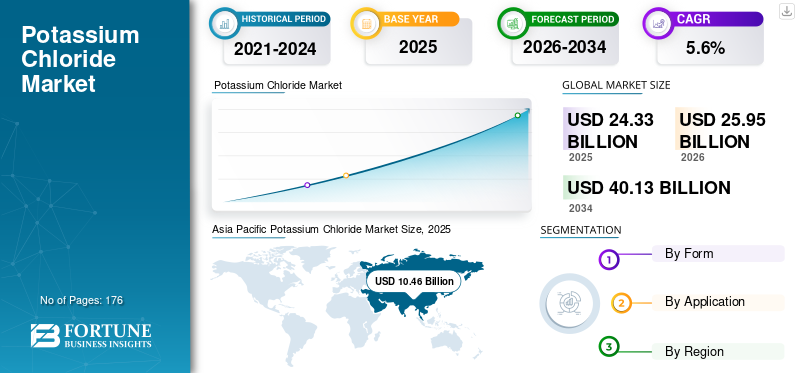
Download Free sample to learn more about this report.
Potassium Chloride Market Takeaways
 Market Size & Forecast
- 2025 Market Size: USD 24.33 billion
- 2026 Market Size: USD 25.95 billion
- 2034 Forecast Market Size: USD 40.13 billion
- CAGR: 5.6% from 2026–2034
 Market Share
- Asia Pacific dominated the potassium chloride market with a 42.99% share in 2025.
- The powdered segment is projected to grow at a CAGR of 5.4% during the forecast period.
- The industrial processing segment is expected to expand at a CAGR of 5.2% through 2034.
 Key Regional Highlights
North America
North America remained a significant regional market, valued at USD 3.03 billion in 2025.
Europe
Europe was valued at USD 3.26 billion in 2025.
Asia Pacific
Asia Pacific led the market with USD 10.46 billion in 2025 and is projected to reach USD 11.20 billion in 2026.
U.S.
The market reached USD 2.52 billion in 2025.
Japan
The market benefits from stable demand across industrial processing and specialty chemical applications.
Read More

POTASSIUM CHLORIDE MARKET TRENDS
Rising Focus on Balanced Fertilizer Use Is Shaping Product Demand
A key trend in the market is the growing focus on balanced fertilizer use, as farmers increasingly understand the importance of potassium for crop yield, quality, and soil health. Instead of relying too much on nitrogen-based fertilizers, farming practices are gradually shifting toward more balanced nutrient application to support long-term productivity. From a market perspective, this trend is influencing fertilizer planning, agronomy advice, and demand patterns across major agricultural regions. As this approach becomes more common, KCl demand is becoming more closely linked to efficient and balanced nutrient management.
- For instance, according to the USDA’s Fertilizer Recommendation Support Tool (FRST), the platform includes data from 3,562 field trials across 378 counties in 45 U.S. states, reflecting the growing focus on soil test-based and balanced potassium nutrient management.
MARKET DYNAMICS
MARKET DRIVERS
Download Free sample to learn more about this report.
Rising Fertilizer Consumption to Support Market Growth
Product demand is primarily driven by growing fertilizer consumption across cereals, oilseeds, fruits, and vegetables in major agricultural economies. It is widely used as a key potash fertilizer as potassium plays an essential role in improving crop yield, plant strength, water regulation, and overall nutrient balance. As farmers aim to enhance productivity from limited arable land and meet rising food demand, KCl remains a cost-effective and widely accepted nutrient source. This strong dependence on agricultural application creates a direct demand pull for potassium chloride, as higher fertilizer use directly increases market consumption.
- For instance, according to the USDA, potash was applied to 46% of U.S. soybean acres in 2023, totaling 3.3 billion pounds, showing strong fertilizer-driven product demand.
MARKET RESTRAINTS
Strong Dependence on Agricultural Activity to Boost Market Expansion
Potassium chloride demand is constrained by its strong dependence on agricultural activity, crop prices, and farmer purchasing decisions. Changes in farm income, unfavorable weather, weak crop prices, or delays in planting seasons can quickly reduce fertilizer application rates and weaken demand. Unlike specialty chemicals with more diversified end-use exposure, product consumption is closely tied to seasonal farming patterns and nutrient investment decisions. This makes the market vulnerable to fluctuations in agricultural economics, trade disruptions, and periods of uncertainty that affect fertilizer affordability and buying confidence.
MARKET OPPORTUNITIES
Increasing Focus of Farmers on Balanced Fertilizer Use to Improve Crop Yields Creates Significant Growth Opportunities
Potassium chloride market growth is driven by the increasing focus of farmers on balanced fertilizer use to improve crop yields and soil health. In many agricultural regions, potassium use is still lower than required, which can reduce long-term soil fertility and crop performance. As awareness of proper nutrient management improves and farm productivity becomes more important, product adoption is expected to increase. This creates a clear market opportunity, as future demand can grow from regular fertilizer use and from better potassium application across developing and underpenetrated farming markets.
- According to the Government of India, about 9% of mapped soils across 19 states were low in available potassium, supporting the need for higher balanced fertilizer use and future Product demand.
MARKET CHALLENGES
Concentrated Global Supply Base Increases Trade and Supply Chain Risk
A major challenge in the market is the concentration of global supply in a small number of producing countries, which increases exposure to trade restrictions, sanctions, freight disruptions, and geopolitical issues. Any disruption in export availability or supply routes can quickly affect prices, delivery schedules, and buyer confidence. This makes supply planning more difficult for producers, distributors, and import-dependent markets. As a result, maintaining stable market balance remains a key challenge across the potassium chloride value chain.
Segmentation Analysis
By Form
Granular Segment Dominated due to its Ease of Handling
Based on form, the market is segmented into granular, powdered, crystalline, and others.
The granular segment accounted for the largest potassium chloride market share in 2025. The granular form is expected to grow in the market as it is widely preferred for bulk fertilizer application in large-scale agriculture due to its ease of handling, storage, blending, and field distribution. It is especially suitable for direct application and compound fertilizer production, where uniform size and flow characteristics are important for operational efficiency. As modern farming continues to rely on efficient high-volume fertilizer use, the granular form remains the most commercially established and widely consumed segment of the market.
To know how our report can help streamline your business, Speak to Analyst
The powdered segment is expected to grow at a 5.4% CAGR over the forecast period.
By Application
Essential Role in Crop Nutrition Boosted Fertilizers Segment Growth
By application, the market is segmented into fertilizers, industrial processing, food & beverage, and others.
The fertilizers segment accounted for the largest potassium chloride market share in 2025. Fertilizers lead the market as the product serves as a major source of potassium, an essential nutrient required for crop growth, yield improvement, water regulation, and overall plant health. Its use is widespread across cereals, oilseeds, fruits, and vegetables, where balanced nutrient application is important for maintaining farm productivity. As agricultural systems continue to focus on improving output and soil nutrient balance, fertilizers remain the most established and volume-intensive application for the product.
The industrial processing segment is expected to grow at a 5.2% CAGR over the forecast period.
Potassium Chloride Market Regional Outlook
By geography, the market is categorized into North America, Europe, Asia Pacific, Latin America, and the Middle East & Africa.
Asia Pacific
Asia Pacific Potassium Chloride Market Size, 2025 (USD Billion)
To get more information on the regional analysis of this market, Download Free sample
Asia Pacific held the dominant position in 2025, valued at USD 10.46 billion, and is expected to maintain its leading share by 2026, reaching USD 11.20 billion. The region’s leadership is driven by its large agricultural base, high fertilizer consumption, and strong dependence on crop productivity improvement across major farming economies. Robust demand from cereals, oilseeds, fruits, and vegetables supports sustained KCl consumption, particularly in countries where balanced nutrient application and yield improvement remain critical to food production.
China Potassium Chloride Market
Based on Asia Pacific’s strong contribution and China’s large agricultural footprint, the China market stood at USD 4.44 billion in 2025, accounting for approximately 42.5% of global revenues. Demand is supported by high fertilizer consumption across major crops, ongoing efforts to improve crop productivity, and the country’s continued focus on balanced nutrient use to support agricultural output and soil fertility.
India Potassium Chloride Market
The Indian market stood at around USD 2.37 billion in 2025. Growth is supported by strong fertilizer demand, a large agricultural base, rising focus on crop yield improvement, and increasing adoption of balanced nutrient application practices.
North America
North America remains a significant regional market, reaching USD 3.03 billion in 2025. Demand is supported by strong fertilizer consumption across major crops such as corn, soybeans, and wheat, where potassium plays an important role in yield and crop quality. The region benefits from large-scale commercial farming, well-established input distribution systems, and consistent nutrient management practices. However, market growth remains moderate due to the mature nature of agricultural fertilizer demand in the region.
U.S. Potassium Chloride Market
The U.S. market stood at USD 2.52 billion in 2025, representing approximately 83.0% of global revenues. Consumption is driven by strong fertilizer demand across major crops such as corn, soybeans, wheat, and other field crops, where potassium is essential for yield improvement, crop quality, and balanced nutrient management in large-scale agricultural production.
Europe
Europe is projected to record modest growth over the forecast period. The market was valued at USD 3.26 billion in 2025. Mature agricultural systems, strict environmental regulations, and a strong focus on efficient fertilizer use characterize the region. Despite these factors, continued demand for the product from cereals, oilseeds, fruits, and vegetables supports its consumption, especially where balanced nutrient application remains important for crop productivity and soil health.
Germany Potassium Chloride Market
Germany’s market reached approximately USD 0.70 billion in 2025, equivalent to around 21.5% of the global market. Demand is supported by fertilizer use across cereals and oilseeds, along with balanced nutrient application practices that help maintain agricultural productivity and soil fertility.
U.K. Potassium Chloride Market
The U.K. market in 2025 stood at USD 0.54 billion, accounting for roughly 16.7% of global revenues. Consumption is concentrated in fertilizer use across cereals, oilseeds, and other crops, where potassium application supports crop yield and quality and promotes balanced nutrient management in agricultural production.
Latin America and Middle East & Africa
Latin America and the Middle East & Africa are expected to witness moderate growth during the forecast period. The Latin America market reached USD 5.30 billion in 2025, supported by strong agricultural activity, fertilizer demand across major crops, and continued efforts to improve crop yields and soil productivity.
In the Middle East & Africa, demand is driven by fertilizer use in crop cultivation, growing awareness of balanced nutrient application, and the need to improve farm output in nutrient-deficient areas. The MEA market reached USD 2.27 billion in 2025, driven by gradual improvements in agricultural practices and rising fertilizer consumption.
GCC Potassium Chloride Market
The GCC market accounted for around USD 1.18 billion in 2025, representing approximately 51.9% of regional revenues. Demand is supported by fertilizer use in crop cultivation, rising focus on farm productivity, and balanced nutrient application in water-stressed, nutrient-limited agricultural conditions across the region.
COMPETITIVE LANDSCAPE
Key Industry Players
Major Companies Focus on Operational Efficiency to Support Long-term Market Positioning
The potassium chloride market is relatively consolidated and capital-intensive, as large-scale mining operations, high investment requirements, and logistical complexity create significant barriers to entry. These factors limit new participation and concentrate supply among a small group of global potash producers with integrated operations and established mining and distribution expertise.
Leading players such as Nutrien, Uralkali, K+S Aktiengesellschaft, vinipul Inorganics Pvt. Ltd., and Global Calcium focus primarily on optimizing existing assets and strengthening supply chain integration rather than pursuing aggressive capacity expansion. Recent activities across these companies highlight a strategic emphasis on operational efficiency, cost competitiveness, and disciplined capacity management to support long-term market positioning.
LIST OF KEY POTASSIUM CHLORIDE COMPANIES PROFILED
- Nutrien (Canada)
- Uralkali (Russia)
- K+S Aktiengesellschaft (Germany)
- SQM (Chile)
- vinipul Inorganics Pvt. Ltd. (India)
- Global Calcium (India)
- Elchemy (India)
- The Mosaic Company (U.S.)
- ICL Group (Israel)
- TCI America (Japan)
KEY INDUSTRY DEVELOPMENTS
- December 2025: The Mosaic Company announced a definitive agreement to sell Mosaic Potash Carlsbad, Inc., including its Carlsbad potash mine operations and assets in New Mexico, to International Minerals Carlsbad, LLC, supporting portfolio optimization in the market.
- August 2025: The Mosaic Company announced an agreement to sell its Taquari-Vassouras potash mining operations in Brazil to VL Mineração Ltda., streamlining its potash portfolio and reshaping its asset base in the market.
REPORT COVERAGE
The global potassium chloride market analysis provides an in-depth study of market size & forecast by all the market segments included in the report. It includes details on market dynamics and trends expected to drive the market during the forecast period. It offers information on technological advancements, new product launches, key industry developments, and partnerships, mergers & acquisitions. The market research report also includes a detailed competitive landscape, including market share and profiles of key players.
Request for Customization to gain extensive market insights.
Report Scope & Segmentation
| ATTRIBUTE | DETAILS |
| Study Period | 2021-2034 |
| Base Year | 2025 |
| Estimated Year | 2026 |
| Forecast Period | 2026-2034 |
| Historical Period | 2021-2024 |
| Growth Rate | CAGR of 5.6% from 2026-2034 |
| Unit | Value (USD Billion) Volume (Kiloton) |
| Segmentation | By Form, Application, and Region |
| By Form |
|
| By Application |
|
| By Geography |
|
Frequently Asked Questions
Fortune Business Insights says that the global market size was valued at USD 24.33 billion in 2025 and is projected to reach USD 40.13 billion by 2034.
Recording a CAGR of 5.6%, the market is slated to exhibit steady growth during the forecast period.
By application, the fertilizers segment led in 2025.
Asia Pacific held the highest market share in 2025.
The growing demand for potash fertilizers to improve crop yields and farm productivity is the key factor driving market growth.



- 2021-2034
- 2025
- 2021-2024
- 176
Get 30-60 hrs Free Customization
Expand Regional and Country Coverage, Segments Analysis, Company Profiles, Competitive Benchmarking, and End-user Insights.


















Related Reports
-
US +1 833 909 2966 ( Toll Free )
-
Get In Touch With Us