BMI Resins Market Size, Share & Industry Analysis, By Type (Modified BMI Resins and Unmodified BMI Resins), By End-Use Industry (Aerospace & Defense, Electrical & Electronics, Industrial Equipment, Automotive & Transportation, and Others), and Regional Forecast, 2026-2034
 Download Free Sample
BMI Resins Market Size and Future Outlook
 Listen to Audio Version
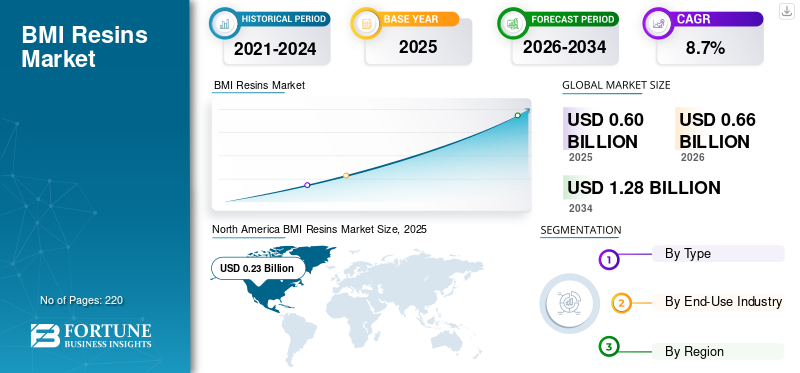
The global BMI resins market size was valued at USD 0.60 billion in 2025. The market is projected to grow from USD 0.66 billion in 2026 to USD 1.28 billion by 2034, growing at a CAGR of 8.7% during the forecast period. North america dominated the with a market share of 38.33% in 2025.
The BMI (Bismaleimide) resins include high-performance thermoset resin systems used in applications that require exceptional heat resistance, dimensional stability, mechanical strength, and long-term durability. The market covers BMI monomers, base resins, modified formulations, adhesives, molding compounds, and BMI-based materials used in advanced composites and electronic components. These resins are widely utilized in aerospace and defense structures, aircraft engines, satellites, high-temperature electrical insulation, semiconductor packaging, circuit substrates, industrial machinery, and specialized transportation components. The industry is supported by increasing aircraft production, rising defense and space investments, expanding use of lightweight composite materials, growing demand for high-temperature electronic systems, and the need for reliable materials capable of maintaining performance under severe thermal and mechanical conditions, driving the market growth.
Furthermore, leading participants in the industry include Evonik Industries AG, Syensqo, Hexcel Corporation, Toray Advanced Composites, and Renegade Materials Corporation. Their competitive strength is supported by established portfolios of high-performance BMI resins, prepreg systems, advanced composite materials, and specialty formulations for aerospace, defense, electronics, and industrial applications.
Download Free sample to learn more about this report.
BMI Resins Market Key Takeaways
 Global Market Size & Forecast
- 2025 Market Size: USD 0.60 billion
- 2026 Market Size: USD 0.66 billion
- 2034 Forecast Market Size: USD 1.28 billion
- CAGR: 8.7% from 2026-2034
 Market Share
- North America dominated the BMI resins market with a 38.33% share in 2025.
- The unmodified BMI resins segment is projected to grow at a 7.6% CAGR.
- The electrical & electronics segment is projected to grow at an 8.3% CAGR.
 Key Regional Highlights
North America
North America led the market with a value of USD 0.23 billion in 2025 and is projected to remain dominant.
Asia Pacific
Asia Pacific is expected to remain a rapidly developing market, supported by expanding aerospace manufacturing.
Europe
Europe is projected to reach USD 0.17 billion by 2026, reflecting steady market growth.
U.S.
The market is projected to reach USD 0.23 billion in 2026, supported by strong demand for advanced BMI resin applications.
Japan
The market is supported by growing demand for BMI resins across aerospace and electrical & electronics applications.
Read More

BMI RESINS MARKET TRENDS
Development of Toughened and Process-Efficient BMI Formulations to Emerge as a Significant Market Trend
One of the key trends in the market is the increasing development of modified bismaleimide resin systems designed to overcome traditional processing and brittleness limitations. Resin manufacturers are focusing on toughened BMI formulations with improved flow behavior, lower curing temperatures, shorter processing cycles, and enhanced compatibility with advanced reinforcement materials. These improvements are making BMI systems easier to process through prepreg manufacturing, resin transfer molding, compression molding, and other composite fabrication techniques. The introduction of more process-efficient grades is also helping manufacturers achieve better component consistency and reduce production complexity while maintaining the high-temperature performance associated with BMI resins. Supporting fact: According MDPI article, thermoplastic polyimide toughening was found to effectively improve the toughness of aerospace-grade bismaleimide resin while maintaining its thermal resistance and mechanical performance, supporting the development of advanced BMI formulations for high-performance composite applications.
MARKET DYNAMICS
MARKET DRIVERS
Download Free sample to learn more about this report.
Expanding Aerospace, Defense, and Space Programs Drive Demand for High-Temperature BMI Resins
The continued expansion of global aircraft production, fleet modernization, defense procurement, satellite programs, and commercial space activities is creating a favorable demand environment for bismaleimide resins. Higher production of commercial and military aircraft, unmanned aerial vehicles, spacecraft, launch systems, and advanced defense equipment is increasing the overall requirement for lightweight, high-performance composite materials. Rising aerospace manufacturing activity is consequently expanding the addressable volume for BMI resin suppliers across both new platform production and component replacement. In response, manufacturers are strengthening production capabilities, qualification support, supply reliability, and customer-specific material development to meet the increasing requirements of aerospace OEMs, Tier suppliers, and defense programs.
- According to Boeing’s 2025–2044 Commercial Market Outlook, the global aviation industry is expected to require approximately 43,600 new commercial aircraft deliveries, supporting long-term demand for advanced composite materials and high-performance resin systems used in aircraft production.
|
Rank |
Market Drivers |
CAGR Contribution (pp) |
2026–2028 |
2029–2031 |
2032–2034 |
|
1 |
Expansion of Aerospace, Defense, and Space Programs |
+2.70% |
High |
High |
High |
|
2 |
Growing Adoption of Lightweight and High-Temperature Composite Materials |
+2.25% |
High |
High |
High |
|
3 |
Rising Demand for High-Performance Electronic and Semiconductor Materials |
+1.90% |
Medium |
High |
High |
|
4 |
Increasing Use of BMI Resins in Aircraft Engines and Heat-Exposed Structural Components |
+1.65% |
Medium |
High |
High |
|
5 |
Development of Toughened and Easier-to-Process Modified BMI Formulations |
+1.35% |
Medium |
Medium |
High |
|
6 |
Others |
+1.05% |
Low |
Medium |
Medium |
|
Total Positive Contribution |
+10.90% |
MARKET RESTRAINTS
High Material Costs and Complex Processing Requirements Restrain Wider Adoption
The market faces a significant restraint on BMI resins market growth due to the high cost of BMI resin systems, specialized raw materials, and demanding processing conditions. Compared with conventional epoxy and other thermosetting resins, BMI materials generally require higher curing temperatures, controlled processing environments, advanced equipment, and skilled technical support. In aerospace, defense, and electronic applications, additional qualification, testing, certification, and traceability requirements further increase development expenses and extend product approval timelines. These factors can raise the overall cost of prepregs, adhesives, molded components, and composite structures, limiting adoption in price-sensitive or high-volume applications.
- According to the U.S. Federal Aviation Administration, composite aircraft structures require controlled cure cycles, environmental conditions, tooling, inspection, material characterization, storage, handling, and process qualification. These requirements add time and cost to the use of advanced resin systems in certified aerospace applications.
|
Rank |
Market Restraints |
CAGR Contribution (pp) |
2026–2028 |
2029–2031 |
2032–2034 |
|
1 |
High Material Costs and Complex Processing Requirements |
−0.80% |
High |
High |
Medium |
|
2 |
Competition from Advanced Epoxy, Cyanate Ester, Polyimide, and Other Resin Systems |
−0.60% |
High |
Medium |
Medium |
|
3 |
Lengthy Qualification, Certification, and Customer Approval Cycles |
−0.45% |
Medium |
Medium |
Medium |
|
4 |
Others |
−0.35% |
Low |
Low |
Low |
|
Total Negative Contribution |
−2.20% |
MARKET OPPORTUNITIES
Rising Demand for High-Temperature Electronics Creates New Growth Opportunities
A key opportunity in the market is the expanding use of bismaleimide resins in advanced electronic systems that must operate reliably under elevated temperatures and demanding service conditions. BMI-based materials are suitable for semiconductor packaging, printed circuit substrates, electrical insulation, power electronics, communication equipment, avionics, radar systems, and other high-performance electronic components. Their thermal stability, dimensional control, low moisture sensitivity, and resistance to mechanical stress make them attractive for applications where conventional resin systems may experience reliability limitations. This creates opportunities for resin producers to develop electronic-grade materials with improved processing, dielectric performance, adhesion, and long-term reliability.
- According to NASA, electronic systems operating in high-temperature environments require specialized packaging, dielectric materials, Printed Circuit Board (PCB) resins, interconnects, and passive components capable of functioning beyond normal commercial temperature limits. This supports the opportunity for thermally stable, electrically reliable BMI-based materials in advanced electronic packaging and insulation applications.
MARKET CHALLENGES
Competition from Alternative High-Performance Resin Systems Challenges Market Expansion
The market faces a significant challenge from alternative thermosetting polymer systems used across aerospace, electronics, industrial, and transportation applications. BMI resins compete with advanced epoxies, cyanate esters, polyimides, phenolic resins, and other specialty materials that may offer lower processing costs, easier curing, established qualification histories, or application-specific performance advantages. Material selection often depends on operating temperature, mechanical strength, dielectric properties, moisture resistance, production volume, certification requirements, and total component cost. This competitive pressure can limit BMI resin penetration, particularly in cost-sensitive programs and applications where performance requirements can be met by conventional high-performance resin systems.
- According to Science Direct, bismaleimide resins are positioned between epoxy and cyanate ester systems in terms of performance and cost, reflecting the availability of competing high-performance thermosetting materials for aerospace, electronics, and other advanced applications.
Segmentation Analysis
By Type
Superior Toughness and Processing Performance Supports Dominance of Modified BMI Resins Segment
Based on type, the market is segmented into modified BMI resins and unmodified BMI resins.
The modified BMI resins segment holds the largest market share as these formulations provide a better balance of thermal stability, mechanical strength, toughness, and processability than conventional unmodified BMI systems. Modified grades are widely used in aerospace structures, defense components, high-temperature adhesives, prepregs, electronic substrates, and advanced composite parts where crack resistance, reliable curing, and long-term performance are critical. Their dominance is further supported by the use of modifiers such as epoxies, thermoplastics, elastomers, and reactive diluents, which help reduce brittleness, improve flow characteristics, enhance fiber impregnation, and simplify component manufacturing.
- According to Science Direct, allyl-functional phenolic modification of bismaleimide resin improved processability while maintaining high thermal resistance and mechanical performance for composite applications.
The unmodified BMI resins segment is expected to grow at a CAGR of 7.6% over the forecast period.
By End-Use Industry
To know how our report can help streamline your business, Speak to Analyst
Strong Demand for High-Performance Composites to Drive Aerospace & Defense Segment’s Market Dominance
In terms of end-use industry, the market is categorized into aerospace & defense, electrical & electronics, industrial equipment, automotive & transportation, and others.
The aerospace & defense segment held the largest BMI resins market share in 2025, supported by the extensive use of BMI-based materials in aircraft structures, engine components, radomes, missiles, satellites, launch vehicles, and other high-performance composite parts. BMI resins are widely selected in these applications as they offer high thermal stability, strong mechanical performance, low moisture absorption, dimensional reliability, and resistance to demanding operating conditions. Continued aircraft production, military modernization, space programs, and growing adoption of lightweight composite structures are reinforcing the dominance of the segment.
- According to the Missouri University of Science and Technology, bismaleimides are commonly used as high-temperature resin matrices in aerospace composites, where materials are required to retain structural performance under prolonged thermal exposure.
The electrical & electronics segment is expected to grow at a CAGR of 8.3% over the forecast period.
BMI Resins Market Regional Outlook
By geography, the market is categorized into North America, Europe, Asia Pacific, Latin America, and the Middle East & Africa.
North America
North America BMI Resins Market Size, 2025 (USD Billion)
To get more information on the regional analysis of this market, Download Free sample
In 2024, North America accounted for the largest share of the market, valued at USD 0.20 billion, and retained its leading position in 2025 with a market value of USD 0.23 billion. Regional dominance is supported by the strong presence of aerospace manufacturers, defense contractors, aircraft engine producers, space-technology companies, and advanced composite processors across the U.S. and Canada. The region benefits from substantial investment in military modernization, commercial aircraft production, satellite programs, launch systems, and high-temperature electronic applications.
U.S. BMI Resins Market
By 2026, the U.S. market is projected to reach USD 0.23 billion. The country remains the largest demand center in North America due to its extensive aerospace and defense manufacturing base, established space sector, advanced electronics industry, and strong research capabilities. BMI resins are used in aircraft structures, propulsion components, radomes, missile systems, satellites, launch vehicles, high-temperature adhesives, and specialized electronic materials.
To know how our report can help streamline your business, Speak to Analyst
Europe
Europe is expected to register steady growth in the market over the forecast period, reaching a market valuation of USD 0.17 billion by 2026. Regional growth is supported by established aerospace manufacturing, defense programs, aircraft engine production, satellite development, and advanced composite processing across France, Germany, the U.K., Italy, and the rest of Europe. Demand is also strengthened by the use of BMI resins in high-temperature structural components, propulsion systems, radomes, electronic substrates, and specialty adhesives. Continued investment in commercial aviation, military modernization, space missions, and lightweight composite technologies is expected to support stable market expansion across the region.
U.K. BMI Resins Market
The U.K. market is estimated at around USD 0.035 billion in 2026, accounting for roughly 21.3% of regional revenues.
Germany BMI Resins Market
Germany’s market is estimated at around USD 0.048 billion in 2026, accounting for roughly 24.2% of regional revenues.
Asia Pacific
Asia Pacific is expected to remain a rapidly developing market for bismaleimide resins, supported by expanding aerospace manufacturing, defense modernization, electronics production, satellite programs, and advanced composite processing. The region benefits from strong industrial capabilities in China, Japan, South Korea, India, and other Asia Pacific countries, along with increasing investment in high-temperature materials for aircraft structures, propulsion components, semiconductor packaging, circuit substrates, and specialized industrial applications.
China BMI Resins Market
Given Asia Pacific’s significant contribution and China’s dominance, the Chinese market is estimated at around USD 0.21 billion in 2026, accounting for roughly 35.5% of regional sales.
Latin America and Middle East & Africa
Latin America and the Middle East & Africa account for comparatively smaller shares of the market, although both regions continue to present gradual growth opportunities. In Latin America, demand is supported by aerospace manufacturing, aircraft maintenance, defense-related programs, automotive production, industrial equipment, and advanced composite applications across Brazil, Mexico, and the rest of the region. In the Middle East & Africa, market growth is driven by defense procurement, aviation maintenance, satellite and space initiatives, the oil and gas industry, industrial applications, and specialized electronics.
Brazil BMI Resins Market
The Brazilian market is estimated at USD 0.010 billion in 2026, accounting for approximately 51.6% of regional revenues.
COMPETITIVE LANDSCAPE
Key Industry Players
Focus On Product Performance, Qualification Capabilities, and Application by Leading Companies to Strengthen Market Share
The BMI resins market is moderately consolidated, with competition shaped by manufacturers that can deliver consistent resin quality, reliable high-temperature performance, qualified production processes, and strong technical support for demanding aerospace, defense, electronics, and industrial applications.
Major participants such as Evonik Industries AG, Syensqo, Hexcel Corporation, Toray Advanced Composites, and Renegade Materials Corporation benefit from established portfolios of BMI resins, prepregs, adhesives, and advanced composite systems. Their competitive position is further strengthened by material science expertise, application-specific formulation capabilities, customer qualification support, close relationships with aerospace and defense manufacturers, and regional and international supply networks.
LIST OF KEY BMI RESINS COMPANIES PROFILED IN REPORT
- Evonik Industries AG (Germany)
- Syensqo (Belgium)
- Hexcel Corporation (U.S.)
- Toray Advanced Composites (U.S.)
- Renegade Materials Corporation (U.S.)
- JFE Chemical Corporation (Japan)
- SHENGQUAN GROUP (China)
- UFC CORPORATION (Taiwan)
- K・I Chemical Industry Co., LTD. (Japan)
- SHD Composite Materials Ltd (U.K.)
- HOS-Technik GmbH (Germany)
KEY INDUSTRY DEVELOPMENTS
- October 2025: Renegade Materials Corporation acquired an additional 20,000-square-foot facility in Miamisburg, Ohio, expanding its operational footprint and supporting higher demand for aerospace thermoset resins, prepregs, and adhesives, including bismaleimide systems.
REPORT COVERAGE
The global BMI resins market analysis provides an in-depth study of market size & forecast by all the market segments included in the report. It includes details on market dynamics and trends expected to drive the market during the forecast period. It offers information on technological advancements, new product launches, key industry developments, and partnerships, mergers & acquisitions. The market research report also encompasses a detailed competitive landscape with information on the market shares and profiles of key players.
Request for Customization to gain extensive market insights.
Report Scope & Segmentation
| ATTRIBUTE | DETAILS |
| Study Period | 2021-2034 |
| Base Year | 2025 |
| Estimated Year | 2026 |
| Forecast Period | 2026-2034 |
| Historical Period | 2021-2024 |
| Growth Rate | CAGR of 8.7% from 2026-2034 |
| Unit | Value (USD Billion) and Volume (Kiloton) |
| Segmentation | By Type, End-Use Industry, and Region |
| By Type |
|
| By End-Use Industry |
|
| By Region |
|
Frequently Asked Questions
Fortune Business Insights says that the global market size was valued at USD 0.60 billion in 2025 and is projected to reach USD 1.28 billion by 2034.
Recording a CAGR of 8.7%, the market is slated to exhibit steady growth during the forecast period.
The aerospace & defense end-use industry segment led in 2025.
North America held the highest market share in 2025.
Rising demand for lightweight and high-strength composite materials across aerospace, defense, and electronics applications is driving the market growth.



- 2021-2034
- 2025
- 2021-2024
- 220
Get 30-60 hrs Free Customization
Expand Regional and Country Coverage, Segments Analysis, Company Profiles, Competitive Benchmarking, and End-user Insights.


















Related Reports
-
US +1 833 909 2966 ( Toll Free )
-
Get In Touch With Us