Sports Food Market Size, Share & Industry Analysis, By Product Type (Energy Bars, Functional Dairy Products, Breakfast Cereals, Meal Kit, Fruits and Nuts, Energy Snacks, and Functional Bakery Products), By Category (Organic and Conventional), By Functionality (Energy, Muscle Growth, Recovery, Hydration, Cognitive Support, & Weight Management), By End User (Bodybuilders, Athletes, and Recreational Sportsman), and By Distribution Channel (Hypermarkets/Supermarkets, Convenience Stores, Drug Stores/Pharmacies, Specialty stores/Fitness Centres, & Online Retail) and Regional Forecast, 2026-2034
 Download Free Sample
(Offer valid till 15th Oct 2026)

KEY MARKET INSIGHTS
 Listen to Audio Version
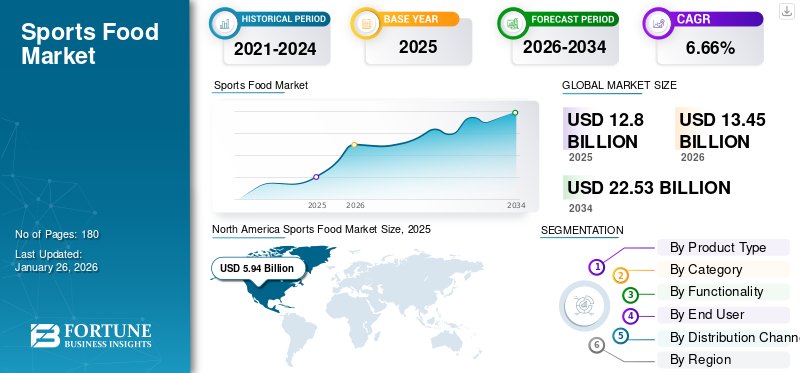
The global sports food market size was USD 12.80 billion in 2025 and is projected to grow from USD 13.45 billion in 2026 to USD 22.53 billion by 2034 at a CAGR of 6.66% during 2026-2034. North America dominated the sports food market with a market share of 46.41% in 2025.
Sports food refers to products specifically designed for athletes, weight lifters, and sports enthusiasts. These products help to enhance the performance of the consumer and reduce the recovery time of the body after an intense workout. These products provide nutrition and offer additional health benefits to consumers. Some of the products are also fortified with fiber, vitamins, and minerals, which improve the immunity and performance of the consumers. Apart from sports nutrition supplements and beverage products, a wide range of food products is also launched in the market to provide holistic nutrition to players.
Growing consumers' awareness about the importance of food and a proper diet in enhancing sportsmen's performance plays a crucial role in supporting the market's growth.
Mondelez International Group, General Mills (Nature Valley), and Mars Incorporated are some of the prominent manufacturers in the global market.
Download Free sample to learn more about this report.
Sports Food Market Key Takeaways
 Global Market Size & Forecast
- 2025 Market Size: USD 12.80 billion
- 2026 Market Size: USD 13.45 billion
- 2034 Forecast Market Size: USD 22.53 billion
- CAGR: 6.66% from 2026–2034
 Market Share
- North America dominated the sports food market with a market share of 46.41% in 2025.
- The energy bars segment is projected to dominate the market with a share of 45.80% in 2026.
- The conventional category segment is projected to dominate the market with a share of 58.59% in 2026.
 Key Regional Highlights
North America
North America accounted for USD 5.94 billion in 2025, representing 46.41% of the global market share, and is projected to reach USD 6.24 billion in 2026.
Europe
The Europe market was valued at USD 3.91 billion in 2025, capturing 30.55% of global revenue, and is estimated to reach USD 4.1 billion in 2026.
Asia Pacific
In 2025, Asia Pacific held 16.31% of the global market, reaching a valuation of USD 2.09 billion, and is projected to grow to USD 2.22 billion in 2026.
U.S.
The U.S. market is projected to reach USD 4.76 billion by 2026.
Japan
The Japan market is projected to reach USD 0.38 billion by 2026.
Read More

MARKET DYNAMICS
MARKET DRIVERS
Growing Enthusiasm for Sports Among Consumers to Support Market Growth
The global sports industry is growing at a rapid pace. People are spending significant time and money to view sports on the ground or through TV and other media forms. Such popularity of the sports among consumers is prompting both public and private sector companies to invest in the development of infrastructure, searching for and training the talents, and expanding the presence of new sorts in untapped markets. This has led to the increased demand for products that enhance the performance of athletes. Hence, the sports food products has increased and is expected to continue increasing in the future.
Rising Popularity of Recreational Sports and Nutritional Products to Drive Market Growth
Recreational sports are becoming increasingly popular, not just among children but also among adults. Some popular leisure sports people enjoy include bowling, golf, billiards, and shuffleboard, among others. Especially in North America and Europe, recreational sports activities are popular among consumers. For instance, as per data provided by the European Commission, around 44% of the population in the region practices physical activity at least once a week. People spend at least 150 minutes per week playing various recreational sports activities. Thus, consumer preferences for food products such as energy bars, functional dairy products, among others, to enhance their energy and performance is increasing. Therefore, the sports food market growth rate is expected to continue increasing.
MARKET RESTRAINTS
High Product Cost and Harmful Effect of Overconsumption to Hamper Market Growth
Products including energy bars, snacks, and others often contain a high quantity of sugar and artificial ingredients, which negatively impact the body when consumed in large quantities. Some of the products are also expensive, which deters cost-conscious consumers from purchasing the products. Heavy consumption of these products can cause nutritional deficiencies and health ailments. Hence, sportsmen must consume these products in moderation to prevent such problems.
MARKET OPPORTUNITIES
Scientific Advancement in Sports Food Manufacturing to Create Opportunity for Product Innovation
In recent years, sports and science-related technologies and methodologies for manufacturing products have undergone significant changes. Such rapid technological advancement has created a promising opportunity for people to develop personalized products based on the needs of athletes. Food products and diet plans designed to address national deficiencies and enhance performance are one of the key areas where food clients are currently working. Hence, sports food product-related innovation is expected to continue in the future as well.
SPORTS FOOD MARKET TRENDS
Rise of Clean Label and Plant Based Products is a Key Market Trend
Clean-label, minimal/low-additive products are growing in popularity among consumers. Professional athletes are opting for products made of naturally sourced, high-quality, nutrient-rich ingredients. Hence, manufacturers are launching products that cater to such consumer demands.
The diet preferences of athletes are also evolving, and several people are opting for plant-based, allergen-free products devoid of animal proteins. Hence, the demand for vegan-labeled products in the market is also rising.
In April 2025, CLIF Bar launched Caffeine-Infused energy bars, which are made of organic caffeine and non-GMO rolled oats. They are available in two flavors: vanilla almond and caramel chocolate chip.
Download Free sample to learn more about this report.
Impact of COVID-19
The COVID-19 pandemic had a negative impact on the sports nutrition industry and its growth. Several prescheduled sports events were canceled or postponed in response to the pandemic and government instructions on banning public gatherings. Hence, sports food consumption also declined during that period. Manufacturers also had to diversify their distribution channels to sell their products to consumers. As home sports activities continued to thrive, people shifted to e-commerce platforms to purchase the products, prompting manufacturers to open online websites selling their products or collaborate with third-party service providers to sell their products to consumers.
Segmentation Analysis
By Product Type
Energy bars Hold High Market Share Due to Its Convenient Packaging
On the basis of product type, the market is segmented into energy bars, functional dairy products, breakfast cereals, meal kit, fruits and nuts, energy snacks, and functional bakery products.
Energy bars segment is projected to dominate the market with a share of 45.80% in 2026. These products are available in convenient packages, which helps sportsmen consume them anytime and anywhere. These products have a high portion of readily available carbohydrates that can be absorbed by the body. They can provide quick energy boosts to individuals engaged in long workouts.
Functional dairy products account for the second largest market share as consumers age. They are high in nutrients and help provide energy, muscle growth, and recovery and boost overall performance of the consumers. Products such as cheese and yogurt are rich in calcium and vitamin D and also help in post-exercise recovery of the consumers.
By Category
Organic Segment is the Fastest Category Owing to Going Consumer Preferences
On the basis of category, the market is segmented into organic and conventional.
The organic category is the fastest-growing segment and is expected to grow at a significant rate in the future. Consumers are prioritizing food products made of natural organic ingredients, leading to the significant growth of this segment. However, the price of organic products is higher than that of conventional products.
The conventional category segment is projected to dominate the market with a share of 58.59% in 2026. Manufacturers continue to launch products in this category for consumers, especially in emerging markets.
By Functionality
Increased Demand for Calories Among Sports Professionals Drives Energy Segment Growth
The market is segmented by functionality into energy, muscle growth, recovery, hydration, cognitive support, weight management, and others.
Energy functionality segment is projected to dominate the market with a share of 59.63% in 2026. Products such as energy bars, chews, and crisps provide nutrition in convenient packages that can be consumed anywhere, anytime. This functionality is widely preferred by consumers to provide the calories required to carry out intense, long-duration training sessions.
Muscle growth is another key functionality preferred by consumers. Food products that are rich in protein drive segment growth. These products are specifically formulated to support protein synthesis, prevent muscle damage, and enhance the performance of athletes.
By End User
Athletes Hold Largest Market Share Owing To Higher Energy Expenditure During Sports Activities
On the basis of end user, the market is segmented into bodybuilders, athletes, and recreational sportsman.
Among these athletes segment is projected to dominate the market with a share of 57.70% in 2026. They require 2,000-7,000 calories per day due to their high energy expenditure caused by body training. Thus, such athletes need food that helps to boost energy, muscle growth, and post-workout recovery.
Bodybuilders need food to provide energy for high-intensity training, support muscle growth, and reduce muscle damage. Food products are formulated with protein, carbohydrates, and fats to provide balanced nutrition to consumers.
By Distribution Channel
To know how our report can help streamline your business, Speak to Analyst
Hypermarkets/Supermarkets Held Largest Market Share Owing to Extensive Product Availability
The market is divided into hypermarkets/supermarkets, convenience stores, drug stores/pharmacies, specialty stores/fitness centers, and online retail based on distribution channel.
Hypermarkets/Supermarkets held the highest market share during the forecast period. This channel provides consumers with the choice to purchase products from a wide range of collections. Heavy discounts also play a crucial role in influencing consumers' purchase behavior and shifting toward this distribution channel.
Specialty stores and fitness centers are another major channel for selling such products to consumers. Special edition products are also available through such centers for sports enthusiasts. Sports physicians and specialized staff are also present in such stores to educate consumers about each product and which will suit their nutritional requirements.
SPORTS FOOD MARKET REGIONAL OUTLOOK
Regionally, the market is studied across North America, Europe, Asia Pacific, South America, and the Middle East & Africa.
North America
North America Sports Food Market Size, 2025 (USD Billion)
To get more information on the regional analysis of this market, Download Free sample
North America accounted for USD 5.94 billion in 2025, representing 46.41% of the global market share, and is projected to reach USD 6.24 billion in 2026. North America is the largest consumer of sports food products in the world, thus holds the largest market share in terms of region. Countries such as Canada, the U.S. spend a significant portion of their week in sports-related activities, which fuels the demand for food that provides energy and supports recovery. The region has a flourish sports industry which conducts multiple sporting events such as the Super Bowl (NFL), World Series (MLB), NBA Finals (NBA), and Stanley Cup Finals (NHL) throughout the year. Thus, athletes who take part in such events consume sports food and sports drinks to enhance their performance in such events. The U.S. market is projected to reach USD 4.76 billion by 2026.
The U.S. government has made significant investments in building up its sports-related infrastructure. It has also created a culture that supports competition and encourages widespread participation in sporting activities. As nutrition is key to unlocking the potential of athletes, consumers are placing significant importance on adopting a balanced diet that can boost energy, immunity, and enhance performance. Hence, the sports nutrition products are highly sought after by health-conscious consumers in the country.
Europe
The European market is another major region where the consumption of sports food products is high. Sports as a recreation are enjoyed across European countries, and some of the popular sports in this region are soccer, tennis, and rugby. Significant investment has also been made in recent years, which has transformed the professional sports industry into a hyper-industrialized and commercialized sector. Hence, the demand for food products, dietary supplements, and others that can provide nutrition and boost the performance of the sportsman has increased in the region. The UK market is projected to reach USD 0.82 billion by 2026, and the Germany market is projected to reach USD 0.89 billion by 2026. The Europe market was valued at USD 3.91 billion in 2025, capturing 30.55% of global revenue, and is estimated to reach USD 4.1 billion in 2026.
Asia Pacific
Asia Pacific is the fastest growing market in the world, owing to the growing popularity of various competitive sports in the region, growth in disposable population, and presence of a large young population in countries such as India, Indonesia, Thailand, and others. There is an increasing number of gyms/fitness centers in this region, which is promoting fitness culture. Hence, the demand for food such as protein supplements, bars, snacks, and other items is also growing in popularity in several Asian countries. The Japan market is projected to reach USD 0.38 billion by 2026, the China market is projected to reach USD 0.73 billion by 2026, and the India market is projected to reach USD 0.08 billion by 2026. In 2025, Asia Pacific held 16.31% of the global market, reaching a valuation of USD 2.09 billion, and is projected to grow to USD 2.22 billion in 2026.
South America
Popularity of sporting events such as football and expansion in the fitness culture, with growing young people opting to train as athletes or bodybuilders, are key factors supporting the market’s growth in this region. More consumers are leading an active lifestyle, and hence, recreational sporting activities are also growing in popularity in the region. Meal replacement food, healthy sugar-free sports snacks are becoming popular among gym goers and novice athletes.
Middle East & Africa
The sports industry in the Middle Eastern and African market is still at an early stage of growth, but the market is expected to increase in the future. However, governments in major economies such as the UAE, Saudi Arabia, and Qatar are undertaking steps to expand the sports industry in their countries. They are hosting mega sporting events, such as the Qatar FIFA World Cup, cricket tournaments, and others to boost the industry’s growth in the region. As the popularity of sports, fitness culture continues to grow, the demand for nutritious food items is also expected to increase. Middle East & Africa contributed approximately USD 0.35 billion to the global market in 2025, accounting for 2.74% share, and is expected to reach USD 0.36 billion in 2026.
Latin America
The Latin America region captured 3.98% of the global market in 2025, generating USD 0.51 billion in revenue, and is projected to reach USD 0.53 billion in 2026.
COMPETITIVE LANDSCAPE
Key Industry Players
Key Players Focus On New Product Launches to Gain Competitive Advantage
The market is fragmented, and several companies are launching new products in different categories in both developed and emerging economies. Some of the key companies operating in the market include Mars Incorporated, Mondelez International Group, General Mills, and others. The manufacturers are expanding their market presence in India, China, and other emerging countries in organic and conventional categories for consumers.
Major Players in the Sport Food Market
|
Rank |
Company Name |
|
1 |
Mondelez International Group. |
|
2 |
MusclePharm |
|
3 |
General Mills |
|
4 |
Science in Sport |
|
5 |
Mars Incorporated |
The market is fragmented, with the 5 key players accounting for a limited portion of the global market share.
LIST OF KEY SPORTS FOOD COMPANIES PROFILED
- Mondelez International group. (U.S.)
- MusclePharm Corporation (U.S.)
- Science in Sport (U.K.)
- General Mills (U.S.)
- Nourish Organic Foods Pvt. Ltd. (India)
- Stokely-Van Camp, Inc. (U.S.)
- Kellanova (U.S.)
- Nestle S.A. (Switzerland)
- Quest Nutrition (U.S.)
- Grenade (U.K.)
KEY INDUSTRY DEVELOPMENTS
- June 2025: Sports nutrition company Science in Sport launched Energy Oat Bars in the market. The products are available in white chocolate, macadamia, and blueberry flavors.
- June 2025: Mars Incorporated launched fruit flavored energy bars in the U.S. market through its “Kind” brand. The product is available in mango, mixed berry and strawberry banana flavor. These bars provide long-lasting fuel to the consumers.
- February 2025: India-based food and beverage brand Curefoods launched energy bars under the brand name of Hustl. The product is available in Fruit Pop and Choco Pop Flavors.
- February 2025: Canadian food and beverage brand Oikos launched yogurt based products named Oikos PRO in the Canadian market. The product line up has 6 different flavors and has a high concentration of protein that ranges from 18 to 24 grams.
- January 2025: Energy bar company Triber successfully raised USD 3.25 million to launch new energy bar products which are made using adaptogens.
REPORT COVERAGE
The global sports food market report provides qualitative and quantitative insights into the market. It also offers a detailed analysis of the market size and growth rate for all possible segments in the market. Various key insights presented in the report are an overview of related sports food demand, market segments, recent industry developments, global trends, recent developments such as mergers & acquisitions, market trends, the regulatory scenario in critical countries, and key industry trends which are used in global market forecast.
Request for Customization to gain extensive market insights.
Report Scope & Segmentation
|
ATTRIBUTE |
DETAILS |
|
Study Period |
2021-2034 |
|
Base Year |
2025 |
|
Estimated Year |
2026 |
|
Forecast Period |
2026-2034 |
|
Historical Period |
2021-2024 |
|
Growth Rate |
CAGR of 6.66% from 2026-2034 |
|
Unit |
Value (USD Billion) |
|
Segmentation |
By Product Type
By Category
By Functionality
By End User
By Distribution Channel
By Region
|
Frequently Asked Questions
Fortune Business Insights says that the global sports food market size was USD 12.80 billion in 2025.
Registering a CAGR of 6.66%, the sports food market will exhibit steady growth during the forecast period.
Supermarkets/Hypermarkets is the leading distribution channel in the global market.
Growing enthusiasm for sports among consumers to support the market’s growth globally.
Mondelez International Group, MusclePharm, Mars Incorporated, General Mills are the leading players in the market.
North America dominated the sports food market with a market share of 46.41% in 2025.
Scientific advancement in sports food manufacturing creates an opportunity for product innovation.
Rise of clean label and plant based products is a key market trend.



- 2021-2034
- 2025
- 2021-2024
- 180
-
(Offer valid till 15th Oct 2026)
Get 30-60 hrs Free Customization
Expand Regional and Country Coverage, Segments Analysis, Company Profiles, Competitive Benchmarking, and End-user Insights.




















Related Reports
-
US +1 833 909 2966 ( Toll Free )
-
Get In Touch With Us