Sports Hospitality Market Size, Share & Industry Analysis, By Service Type (Food & Beverage, Accommodations, Events, and Others), By Sports Type (Tennis, Cricket, Football/Soccer, and Others), By Attendee (Corporate, Groups, Families, and Individuals), By Tourist Type (Domestic and International), By Channel (Direct Bookings, Third Party, and Online Platforms), and Regional Forecast, 2026-2034
 Download Free Sample
(Offer valid till 15th Oct 2026)

KEY MARKET INSIGHTS
 Listen to Audio Version
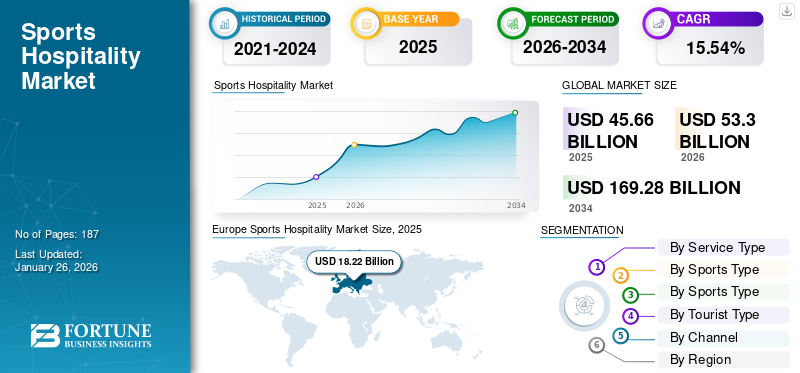
The global sports hospitality market size was valued at USD 45.66 billion in 2025 and is projected to grow from USD 53.3 billion in 2026 to USD 169.28 billion by 2034, exhibiting a CAGR of 15.54% over the forecast period. Europe dominated the sports hospitality market with a market share of 39.9% in 2025.
Sports hospitality refers to the provision of premium services and exclusive experiences to guests attending live sporting events. It encompasses a range of offerings such as VIP seating, private suites, fine dining, complimentary beverages, and tailored entertainment packages. Designed to enhance the overall event experience, hospitality services in the sports industry are often used by businesses for client engagement, networking, and brand promotion, as well as by families, groups, and individuals seeking a luxury spectator experience. The market is a dynamic and growing sector, driven by increasing global interest in live sports experiences and premium spectator services. With rising disposable incomes and demand for unique experiences, the market is expanding across emerging regions.
Key players in the market include CSM Sports and Entertainment LLP, DTB Sports Hospitality and Event Management Limited, Delaware North, Sodexo Live, and Compass Group. Players are also integrating technology through mobile apps, Augmented Reality (AR) and Virtual Reality (VR) experiences, and real-time engagement to enhance customer experience and have strong foothold in the market.
Europe witnessed sports hospitality market growth from USD 18.22 Billion in 2025 to USD 21.15 Billion in 2026.
Download Free sample to learn more about this report.
SPORTS HOSPITALITY MARKET KEY TAKEAWAYS
 Market Size & Forecast
- 2025 Market Size: USD 45.66 Billion
- 2026 Market Size: USD 53.30 Billion
- 2034 Forecast Market Size: USD 169.28 Billion
- CAGR: 15.54% from 2026–2034
 Market Share
- Europe dominated the market with a 39.90% share in 2025.
- Food & Beverage services are expected to hold a 31.22% share in 2026.
- Tennis is projected to grow at the highest CAGR of 19.10% during the forecast period.
 Key Regional Highlights
North America
North America accounted for 28.74% of the market in 2025, valued at USD 13.12 Billion, and is expected to reach USD 15.37 Billion in 2026.
Europe
Europe held a 39.90% share in 2025, valued at USD 18.22 Billion, and is projected to reach USD 21.15 Billion in 2026.
Asia Pacific
Asia Pacific captured 21.14% of global revenue in 2025, valued at USD 8.21 Billion, and is projected to reach USD 9.65 Billion in 2026.
U.S.
The market is projected to reach USD 12.83 Billion in 2026.
Japan
The market is projected to reach USD 1.52 Billion in 2026.
Read More

SPORTS HOSPITALITY MARKET TRENDS
Rising Demand for Premium Customized Fan Experiences Drives Market Trends
A major ongoing trend in the sports hospitality industry is the growing demand for premium, personalized fan experiences. Consumers increasingly seek more than just tickets. They demand VIP lounges, behind-the-scenes access, gourmet catering, and tech-driven amenities including mobile ordering and augmented reality. Stadiums and arenas are evolving into entertainment destinations, integrating luxury suites and exclusive clubs tailored to fan preferences. Data analytics play a crucial role in customizing offerings, boosting engagement and loyalty. This shift reflects a broader movement toward experiential consumption, where the quality of the experience outweighs mere attendance at the sporting event.
MARKET DYNAMICS
Market Drivers
Evolving Fan Expectations Boosts Sports Hospitality Services
The modern day sports audience increasingly seeks more than just a seat at the game, as they demand immersive, high-end experiences that blend entertainment, exclusivity, and convenience. This shift has significantly boosted demand for sports hospitality services that include VIP seating, gourmet dining, private lounges, and direct athlete management. As fan expectations evolve, rights holders and event organizers are leveraging hospitality offerings to drive revenue and enhance brand loyalty, positioning premium experiences as a critical revenue stream.
Businesses Elevate Client Engagement with Sports Event Hospitality
Corporations are increasingly turning to sports events hospitality as a strategic tool for client engagement, brand positioning, and executive networking. Hospitality suites and event-based packages offer a controlled, high-impact environment to build relationships with key stakeholders. As businesses continue to prioritize personalized, experience-led marketing strategies over traditional advertising, investments in hospitality assets at marquee sporting events are expected to grow, driving expansion across the ecosystem.
Market Restraints
High Cost of Sports Hospitality Packages to Restrain Market Growth
The growth of the market is primarily limited due to the high cost associated with premium packages. These offerings, which cover VIP seating, exclusive access, gourmet dining, and luxury amenities, often come with a hefty price tag, making them accessible only to high-income individuals or corporate clients. This impedes the market’s accessibility and diminishes engagement from a wider audience, especially in developing economies. Moreover, economic uncertainties and budget constraints in businesses may lead to reduced spending on corporate hospitality, further affecting market expansion and slowing down overall growth.
Market Opportunities
Surge in Sports Tourism Packages to Offer Lucrative Growth Opportunities
One of the prominent opportunities in the market is the expansion of sports tourism that opens doors for the hospitality service providers. Fans are increasingly travelling domestically and internationally to attend major sporting events, combining leisure with live sports experiences. This in turn has spurred demand for all-inclusive travel packages that bundle event tickets, accommodations, local experiences, and hospitality services. Tour operators, event organizers, and travel agencies can tap into this trend by offering customized, seamless packages that cater to both casual fans and corporate clients. With global sporting calendars growing, sports tourism presents a scalable and profitable avenue for hospitality-focused businesses. Moreover, sustainability and eco-friendly practices such as promoting renewable energy, reducing waste, and implementation of energy efficient systems at events and sporting venues is likely to create numerous growth opportunities for market players in the coming years.
Market Challenges
Balancing Exclusivity with Accessibility to Stand as Challenge
One key challenge in the market is striking a balance between offering exclusive, high-end experiences and maintaining accessibility for a broader audience. Premium packages often heavily focus on exclusivity that can alienate average supporters and limit long-term brand loyalty. With rising costs and evolving fan expectations, hospitality providers must find innovative ways to deliver value across various price points while preserving the prestige of their premium offerings. This balancing act is a critical hurdle for sustaining growth and audience engagement.
Impact of COVID-19
The COVID-19 pandemic severely affected the market, causing widespread event cancellations and reduced demand for VIP experiences due to countrywide lockdown imposed by governments and travel restrictions. Corporate spending on hospitality packages declined, and supply chain disruptions further strained operations. While the sector is gradually recovering, the pandemic highlighted the industry’s vulnerability to global crisis and the need for adaptive strategies.
Download Free sample to learn more about this report.
SEGMENTATION ANALYSIS
By Service Type
Premium Pricing Strategies to Spur Food and Beverages Revenue
Based on service type, the market is segmented into food & beverage, accommodations, events, and others.
The food & beverage segment dominates the global market. Guests attending live sports events seek hearty meals within gourmet options, crafted beverages, and curated menus, especially in corporate hospitality settings. Furthermore, food & beverage offerings drive a huge revenue stream for stadiums and arenas with exclusive deals commanding premium pricings. Fans often spend as much on food and drinks as on tickets. This segment is expected to dominate the market in 2026 with a share of 31.22%.
Event services segment is expected to grow at the fastest CAGR during the forecast period due to evolving fan expectations and the push for year-round engagement. Diversified fan experiences beyond the game offering live entertainment, gaming lounges, interactive activities along with family-friendly zones such as kids’ areas, meet-and-greet make it appealing for families.
- The Food & Beverages segment is expected to hold a 31.35% share in 2024.
To know how our report can help streamline your business, Speak to Analyst
By Sports Type
Global Appeal of Tennis to Spur the Segment’s Growth
The market is segmented by sports type into tennis, cricket, football/soccer, and others.
The tennis segment is forecasted to grow at the highest CAGR of 19.10% during the assessment period 2025-2032. The segment’s growth driven by its global appeal, exclusive event format, and premium audience base. Prestigious tournaments such as Wibledon, the US Open, Roland Garros, and the Australian Open attract high-net-worth individuals and corporate clients seeking upscale hospitality experiences.
The football/soccer segment accounted for the second largest sports hospitality market share in 2024. This sports leads the sector growth due to its global popularity, massive fan base, and year-round schedule of high-profile events. Major league such as the English Premier Leagues, UEFA Champions Leagues, La Liga, and FIFA World Cup draw millions of spectators from all over the globe, including affluent fans and corporate clients who invest in VIP experiences, executive boxes, and premium seating. This segment is poised to capture a share of 31% in 2025. The others segment is expected to lead the market, contributing 41.67% globally in 2026.
By Attendee
Group Packages Offering Better Value and Enhanced Social Experience to Drive Segmental Growth
The market is segmented by attendee into corporate, groups, families, and individuals.
Group segment dominated the global market, as group packages often offer discounted or value-added deals for groups, making it more attractive for fans to attend events in larger numbers. Moreover, watching live sports is inherently a social activity. Group of friends, colleagues, or fan club prefer to experience it together, which aligns with hospitality offerings that provide shared experiences such as private suites of VIP lounges. The segment is expected to reach a market share of 39.4% in 2026.
On the other hand, individual attendees are projected to grow at the fastest CAGR of 18.21% over the forecast period (2025-2032). Rising disposable incomes and lifestyle shifts, especially in emerging markets, is fueling demand for premium leisure experiences. As younger consumers are prioritizing spending on experiences over material goods, it boosts individual demand for hospitality at sporting events.
By Tourist Type
Convenience of Travel & Cost and Strong Connect with Local Teams Drives Growth of Domestic Tourist Type
The market is segmented by tourist type into domestic and international.
The domestic tourist type segment is expected to account for the largest sports hospitality market share of 64.86% in 2026. The growth of the segment is ascribed to fewer travel restrictions, lower costs, and less travel time for domestic sports events. Easier access to local events makes spontaneous or short-notice travel possible. Additionally, local fans often have a stronger cultural or regional loyalty to teams and events, driving consistent attendance. Factors such as national pride also play a big role, especially in major tournaments such as cricket in India and football in Europe. The segment is anticipated to reach a market share of 65% in 2025.
The international tourist type segment is anticipated to expand at the highest CAGR of 18.95% over the assessment period from 2025-2032. Rise of experiential travel prioritizing experiences over possessions and desire for memorable and immersive experiences is likely to uplift segment’s growth.
By Channel
Surge in Marketing Through Social Media Platforms is Supplementing Online Platform’s Expansion
By channel, the market is segmented into direct bookings, third party, and online platforms.
Online platform channel contributed the highest market share in 2024 and is foreseen to grow at the highest rate during the forecast period. Easier online bookings and marketing through global social platforms have made hospitality packages more accessible and visible to domestic as well as international audiences. Furthermore, direct access to hospitality packages such as premium seating, VIP suites, and exclusive lounges without intermediaries enhances pricing transparency, thereby increasing consumer confidence and improving conversion rates.
Online platforms use data analytics and digital marketing to target high-value customers globally. They reach corporate clients, tourists, and high-net-worth individuals with personalized offers, which boosts demand for luxury hospitality, driving segment’s growth.
Direct channel is poised to be reach 33.62% of the market share in 2025.
Third party is estimated to grow with a CAGR of 17.71% during the forecast period (2025-2032).
Sports Hospitality Market Regional Outlook
Geographically, the market is divided into North America, South America, Europe, Asia Pacific, and the Middle East & Africa.
Europe
Europe Sports Hospitality Market Size, 2025 (USD Billion)
To get more information on the regional analysis of this market, Download Free sample
The Europe market was valued at USD 18.22 billion in 2025, capturing 39.90% of global revenue, and is estimated to reach USD 21.15 billion in 2026, owing to increased popularity of live sports including major leagues such as the English Premier Leagues, UEFA Champions Leagues, Formula 1, and Wimbledon that continue to attract global attention. The U.K. market is set to be valued at USD 1.79 billion in 2026. The growing demand for premium experiences at these events drives hospitality sales. Moreover, renovations and new stadiums across Europe are being designed with high-end hospitality suites and VIP services, catering to a growing market of affluent fans and business clients further consolidating the region’s growth. Germany is likely to hit USD 1.47 billion in 2026, while France is estimated to be worth USD 3.72 billion in 2025.
North America
North America accounted for USD 13.12 billion in 2025, representing 28.74% of the global market share, and is projected to reach USD 15.37 billion in 2026. The region's growth is driven by sustained popularity and commercial strength of leagues such as the NBA, NFL, MLB, and NHL contributing to high attendance and strong demand for premium seating and hospitality services.
The U.S. is a major contributor in the North American market as fans travel across cities or states to attend marquee events including NBA Finals, Super Bowl, or MLB World Series, triggering demand for bundled hospitality packages. These packages often include travel, lodging, and event access, which strengthens sports hospitality market growth. The U.S. market is poised to expand with the valuation of USD 12.83 billion in 2026.
Asia Pacific
In 2025, Asia Pacific held 21.14% of the global market, reaching a valuation of USD 8.21 billion, and is projected to grow to USD 9.65 billion in 2026 due to economic growth across major countries leading to a larger middle class with more disposable incomes. China is set to be worth USD 3.62 billion in 2026. Additionally, the region hosting mega sports international events such as the Olympics, Asian Games, Cricket World Cup, and FIFA tournaments in countries including Japan, China, India and Australia has significantly boosted interest in sports hospitality. Consistently growing investments in stadiums and fan engagement technology across the region are enabling better experiences and attracting more spectators to sports events. Furthermore, enhanced media coverage and digital marketing have amplified the visibility and appeal of sports events, contributing to a more engaged fan base eager to access exclusive hospitality services.
Moreover, sports tourism is on the rise, with international and domestic tourists seeking out sports events as part of their travel experience, further driving the market growth in the region. India is projected to reach a value of USD 2.65 billion in 2026, while Japan is expected to be valued at USD 1.52 billion in the same year.
South America and the Middle East & Africa
The South America market accounted for USD 2.63 billion in 2025, representing 5.75% of the global industry, and is expected to reach USD 3.03 billion in 2026. The South America and the Middle East & Africa markets benefit from government support encouraging sports tourism initiatives to boost the local economy and international image, fueling the hospitality segment. Middle East & Africa contributed approximately USD 2.04 billion to the global market in 2025, accounting for 4.47% share, and is expected to reach USD 2.35 billion in 2026. Moreover, driven by long-term visions such as Saudi Arabia’s Vision 2030, nations are using sports and hospitality to diversify their economies beyond oil. The UAE market is experiencing growth and is projected to reach USD 0.57 billion in 2025.
Competitive Landscape
Key Industry Players
Market Players are Adopting Multiple Organic Growth Strategies to Stay Ahead of Competition
The market is highly competitive, due to key players such as Legends, IMG, and Sodexo Live!, driven by increased demand for premium experiences at live events. The market is shaped by innovation in VIP services, digital integration, and personalization offered by venue operators and sports franchises. Emerging competitors focus on mid-tier and regional offerings, creating pricing pressure. Strategic partnerships and collaborations with major sports teams, leagues, and sporting venues are crucial for market presence to secure long-term contracts and exclusive rights.
LIST OF KEY SPORTS HOSPITALITY COMPANIES PROFILED
- Delaware North (U.S.)
- Sodexo Live (France)
- Compass Group (U.K.)
- Legends Hospitality (U.S.)
- ASM Global (U.S.)
- CSM Sport & Entertainment LLP (U.K.)
- DTB Sports Hospitality and Event Management Ltd. (U.K.)
- IMG (U.S.)
- Hospitality Group Australia (Australia)
- MATCH Hospitality (Switzerland)
- Gourmet Sports Hospitality (Germany)
Key Industry Developments
- May 2025: Monumental Sports & Entertainment (MSE), American integrated sports and entertainment company, announced an expanded partnership with DXC Technology. As an official global partner, MSE aims to leverage DXC’s expertise in digital transformation to enhance the experience of millions of fans. DXC’s is bringing their technology innovation to upkeep MSE’s vision as part of an entertainment district transformation happening at the Capital One Arena in downtown Washington, D.C. with the budget of USD 800 million.
- April 2025: USA Flag, one of the largest operators of flag football tournaments and camps in the world, announced a multi-year strategic partnership with Athletes Hospitality, to provide customized, tech-enabled housing solutions and logistical support for all of USA Flag’s tournaments and camp series.
- September 2024: Radisson Hotel Group, an international hospitality company based in Brussels, Belgium, announced a strategic partnership with Bengaluru Football Club for the 2024-25 season of the Indian Super League (ISL). This collaboration highlights the company’s aim to strengthen sports hospitality in India by offering unmatched hospitality experiences to fans and athletes.
- August 2024: Legends, a global premium experiences company specializing in delivering holistic solutions for sports and entertainment announced the completion of acquisition of ASM Global. This acquisition has created the world’s premium live events company committed to providing fans with top-notch experiences globally.
- April 2023: Sodexo Live!, a dedicated business for sports, events and hospitality, announced a new step in the implementation of its strategy with the full ownership of STH (Sports, Travel and Hospitality). This has enabled Sodexo to become the sole owner of the global provider of travel, hospitality, and ticketing programmes.
REPORT COVERAGE
The sports hospitality market report provides a detailed analysis of the market and focuses on key aspects such as the competitive landscape, services, and leading product types. It also offers market trends, insights, and highlights key industry developments. In addition to the aforementioned factors, the report includes several factors that have contributed to the market's growth in recent years.
Request for Customization to gain extensive market insights.
Report Scope & Segmentation
|
ATTRIBUTE |
DETAILS |
|
Study Period |
2021-2034 |
|
Base Year |
2025 |
|
Estimated Year |
2026 |
|
Forecast Period |
2026-2034 |
|
Historical Period |
2021-2024 |
|
Growth Rate |
CAGR of 15.54% from 2026 to 2034 |
|
Unit |
Value (USD Billion) |
|
Segmentation |
By Service Type
|
|
By Sports Type
|
|
|
By Attendee
|
|
|
By Tourist Type
|
|
|
By Channel
|
|
|
By Region
|
Frequently Asked Questions
According to Fortune Business Insights, the global market value is anticipated to be USD 53.3 billion in 2026 and to reach USD 169.28 billion by 2034.
In 2025, the global market stood at USD 45.66 billion.
The market will grow at a CAGR of 15.54% and exhibit a steady growth rate during the forecast period.
By service type, the food & beverage segment dominated the market.
Corporate investment in experiential marketing and rising demand for premium fan experiences drive global market growth.
Legends, IMG, and Sodexo Live!, ASM Global, and Delaware North are among the few significant players in the global market.
Europe held the highest market share in 2025.
Premium and personalized fan experience along with surge in sports tourism packages is likely to drive the market's growth.



- 2021-2034
- 2025
- 2021-2024
- 187
-
(Offer valid till 15th Oct 2026)
Get 30-60 hrs Free Customization
Expand Regional and Country Coverage, Segments Analysis, Company Profiles, Competitive Benchmarking, and End-user Insights.



















Related Reports
-
US +1 833 909 2966 ( Toll Free )
-
Get In Touch With Us