Still Wine Market Size, Share & Industry Analysis, By Type (White Wine, Red Wine), By Distribution Channel (Liquor Stores, Internet Retailing), and Regional Forecast, 2026-2034
 Download Free Sample

Still Wine Market Overview
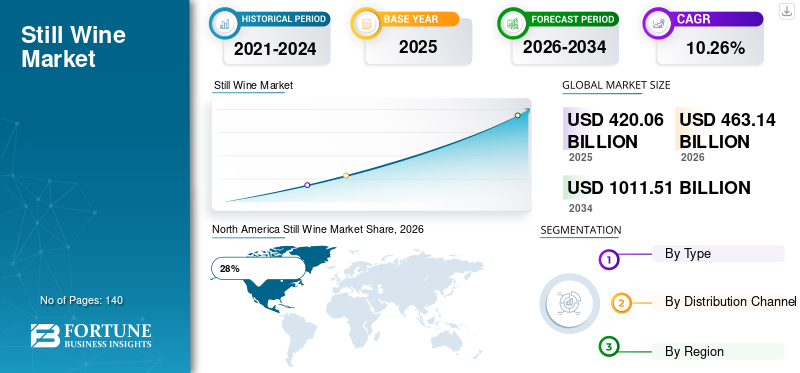
The global Still Wine market size was valued at USD 420.06 billion in 2025. The market is projected to grow from USD 463.14 billion in 2026 to USD 1011.51 billion by 2034, exhibiting a CAGR of 10.26% during the forecast period.

The Still Wine Market remains one of the most established segments within the global alcoholic beverage industry, driven by evolving consumer preferences, premiumization trends, and expanding distribution channels. Still wine, characterized by the absence of carbonation, continues to attract consumers seeking diverse flavor profiles, regional varieties, and food-pairing experiences. The market benefits from increasing demand for premium and organic wine offerings, growing wine tourism activities, and rising interest in sustainable viticulture practices. Producers are focusing on product differentiation, packaging innovation, and brand positioning to strengthen competitiveness. The Still Wine Market Report highlights changing consumption patterns and expanding opportunities across developed and emerging markets.
The United States accounts for approximately 31% market share in the global Still Wine Market and remains one of the largest wine-consuming countries worldwide. Consumer interest in premium wine products, locally produced varieties, and sustainable wine production continues supporting market growth. Retail channels, restaurants, and direct-to-consumer sales platforms contribute significantly to product accessibility. California remains the dominant wine-producing region, supporting domestic supply and export activities. Younger consumers are increasingly exploring diverse wine styles and premium offerings, influencing purchasing behavior. The USA Still Wine Market Outlook remains strong due to evolving consumer preferences, innovative marketing strategies, and expanding wine culture.
Download Free sample to learn more about this report.
Still Wine Market Key Takeaways
 Global Market Size & Forecast
- 2025 Market Size: USD 420.06 Billion
- 2026 Market Size: USD 463.14 Billion
- 2034 Forecast Market Size: USD 1,011.51 Billion
- CAGR: 10.26% from 2026-2034
 Market Share
- The market in Europe dominated with a revenue share of 39% in 2025.
- Red wine dominated by type with a market share of approximately 57%.
- Liquor stores dominated by distribution channel with a market share of approximately 68%.
 Key Regional Highlights
Europe
Europe led the market with a 39% share, supported by strong wine consumption and established winemaking industries.
North America
North America accounted for 28% of the market, driven by growing demand for premium wines and expanding wine culture.
Asia-Pacific
Asia-Pacific held a 22% share, supported by rising disposable incomes, changing consumer preferences, and expanding wine consumption.
U.S
The U.S. remains a key market, supported by strong demand for premium wines and expanding wine retail channels.
Japan
Japan accounted for approximately 18% of the Asia-Pacific market, supported by growing wine consumption and increasing interest in premium wine products.
Read More

Still Wine Market Latest Trends
The Still Wine Market Trends indicate growing consumer demand for premium, organic, and sustainably produced wine products. Consumers are increasingly seeking wines that reflect regional authenticity, environmental responsibility, and high-quality production methods. This shift has encouraged wineries to adopt sustainable farming practices and transparent sourcing strategies. Another important trend within the Still Wine Market Analysis landscape is the expansion of digital retail channels. Online wine purchasing has gained popularity due to convenience, broader product selection, and direct consumer engagement opportunities.
Download Free sample to learn more about this report.
Producers are investing in digital marketing campaigns and personalized customer experiences to strengthen brand loyalty. Packaging innovation is also shaping the market. Lightweight bottles, recyclable materials, and alternative packaging formats are becoming increasingly common as sustainability concerns grow. Producers are also expanding premium and limited-edition product portfolios to attract affluent consumers. Growing interest in wine education, tasting experiences, and wine tourism further supports market development. These factors continue influencing the Still Wine Market Research Report environment and driving competitive differentiation.
Still Wine Market Dynamics
DRIVER
Rising consumer preference for premium and specialty wines
The primary driver of the Still Wine Market Growth is the increasing consumer preference for premium, specialty, and region-specific wine products. Consumers are becoming more knowledgeable about wine varieties, production methods, and tasting profiles, creating demand for higher-quality offerings. Premium wine consumption is expanding across both mature and emerging markets as purchasing power and lifestyle aspirations evolve. Wineries are responding by introducing premium product lines, limited releases, and unique varietal offerings. The growing popularity of wine tourism and experiential consumption further strengthens market demand. These factors collectively contribute to expansion within the Still Wine Industry Analysis landscape.
RESTRAINT
Stringent regulations and taxation policies
A major restraint affecting the Still Wine Market is the presence of strict regulatory requirements and taxation policies governing alcohol production, distribution, and marketing. Regulations vary significantly across countries and can create operational complexity for manufacturers and distributors. Excise taxes, labeling requirements, and advertising restrictions may influence market accessibility and pricing strategies. Additionally, public health initiatives aimed at reducing alcohol consumption can impact demand in certain markets. These factors create challenges for industry participants seeking expansion while maintaining regulatory compliance.
OPPORTUNITY
Growth of organic and sustainable wine production
A significant opportunity within the Still Wine Market Opportunities landscape is the growing demand for organic and sustainably produced wines. Consumers increasingly value environmental responsibility, ethical sourcing, and natural production practices. Wineries adopting sustainable viticulture techniques and obtaining organic certifications can differentiate their offerings in competitive markets. Emerging consumer segments are willing to explore premium products associated with sustainability and authenticity. Increasing awareness regarding environmental issues and responsible consumption continues supporting this opportunity. These trends provide favorable conditions for long-term market development.
CHALLENGE
Climate variability affecting grape production
One of the major challenges facing the Still Wine Market is climate variability and its impact on grape cultivation. Changes in temperature patterns, rainfall distribution, and extreme weather events can influence grape quality and production volumes. Wine producers must continuously adapt agricultural practices to maintain product consistency and quality standards. Climate-related risks may also affect supply chain stability and production planning. Increasing investment in sustainable farming techniques and vineyard management strategies is helping address these concerns. Nevertheless, environmental uncertainty remains a significant challenge within the Still Wine Market Forecast landscape.
Still Wine Market Segmentation
By Type
White wine accounts for approximately 43% market share in the Still Wine Market and remains a highly popular category among consumers seeking lighter flavor profiles and versatile food-pairing options. The segment benefits from strong demand across North America, Europe, and Asia-Pacific, particularly among younger consumers and casual wine drinkers. Popular varietals continue attracting interest due to their refreshing characteristics and broad accessibility. Producers are introducing premium white wine offerings, organic varieties, and region-specific selections to strengthen market presence. White wine also benefits from increasing consumption during social gatherings, hospitality events, and dining experiences. These factors support continued expansion within the white wine segment.
Red wine holds approximately 57% market share in the Still Wine Market and remains the dominant product category globally. Consumers frequently associate red wine with premium quality, traditional winemaking heritage, and complex flavor profiles. The segment benefits from strong demand across established wine-producing regions and growing acceptance in emerging markets. Producers continue expanding premium portfolios featuring varietals, blends, and reserve collections designed to appeal to diverse consumer preferences. Red wine consumption is particularly strong among experienced wine enthusiasts and premium product buyers. The segment’s broad appeal and extensive product diversity continue reinforcing its leadership position within the Still Wine Market Outlook.
To know how our report can help streamline your business, Speak to Analyst
By Distribution Channel
Liquor stores account for approximately 68% market share in the Still Wine Market and remain the dominant distribution channel. Consumers frequently purchase wine through specialized retail outlets due to product variety, expert recommendations, and immediate availability. Liquor stores provide access to premium, imported, and locally produced wines across a broad range of price categories. Retailers increasingly enhance customer experiences through tasting events, educational programs, and curated product selections. The continued importance of physical retail locations supports sustained demand within this segment. Strong consumer trust and convenient purchasing experiences contribute significantly to segment leadership.
Internet retailing represents approximately 32% market share within the Still Wine Market and continues experiencing strong growth. Consumers increasingly appreciate the convenience of online purchasing, home delivery services, and access to extensive product catalogs. Digital platforms enable wineries and retailers to engage directly with consumers through personalized recommendations and targeted marketing initiatives. Subscription services and virtual tasting experiences further strengthen customer engagement. The expansion of e-commerce infrastructure and changing consumer purchasing habits continue supporting growth within the internet retailing segment. These factors contribute positively to the evolution of the Still Wine Market Insights landscape.
Still Wine Market Regional Outlook
North America Still Wine Market Share, 2026 (%)
To get more information on the regional analysis of this market, Download Free sample
North America
North America accounts for approximately 28% market share in the global Still Wine Market and remains one of the most influential wine consumption regions worldwide. The market benefits from strong consumer awareness, established wine culture, and extensive retail distribution networks. The United States dominates regional demand through significant domestic wine production and premium wine consumption. Consumers increasingly prefer premium, organic, and sustainably produced wines that align with changing lifestyle preferences. Direct-to-consumer sales channels and online wine platforms continue expanding product accessibility. Wine tourism activities across major wine-producing regions further support consumer engagement and brand loyalty. Younger consumers are exploring diverse varietals and premium offerings, contributing to category expansion. Investments in product innovation and premium packaging continue strengthening competitiveness. These factors reinforce North America's position within the Still Wine Market Outlook.
Europe
Europe holds approximately 39% market share in the global Still Wine Market and remains the largest regional market due to its long-standing winemaking heritage and extensive vineyard infrastructure. Countries across the region continue leading both production and consumption of still wines across various quality categories. Consumer demand remains strong for premium wines, protected-origin products, and sustainable wine offerings. Producers are increasingly investing in environmentally responsible vineyard management and advanced production techniques. Wine tourism remains a major contributor to regional demand, attracting domestic and international visitors. Retailers continue expanding premium product portfolios and specialty wine selections. Export activities also contribute significantly to market performance. Strong cultural connections to wine consumption and established distribution systems support continued growth. These factors maintain Europe’s leadership within the Still Wine Market Analysis landscape.
Germany Still Wine Market
Germany accounts for approximately 16% market share within the European Still Wine Market and remains one of the largest wine-consuming countries in the region. The market is supported by strong consumer appreciation for quality wines and increasing interest in premium product categories. White wine continues to dominate consumption patterns, although demand for premium red wines is steadily increasing. Consumers are becoming more attentive to sustainability, organic production, and regional authenticity when selecting wine products. Retail stores, supermarkets, and digital sales channels provide broad product accessibility. Wine festivals, vineyard tourism, and educational events contribute to consumer engagement and market awareness. Producers continue introducing innovative products tailored to evolving preferences. These developments support growth within the Germany Still Wine Market.
United Kingdom Still Wine Market
The United Kingdom represents approximately 14% market share within the European Still Wine Market and remains a major consumer and importer of still wine products. Consumers increasingly favor premium wines, international varietals, and sustainably produced offerings. Retailers continue expanding online sales channels and subscription-based services to meet changing purchasing behaviors. The hospitality sector remains an important source of demand, particularly for premium wine categories. Wine education initiatives and growing consumer knowledge regarding food pairing support premiumization trends. Digital marketing strategies and personalized recommendations are enhancing customer engagement. Demand for imported wines remains particularly strong among urban consumers. These factors continue strengthening the United Kingdom Still Wine Market Growth environment.
Asia-Pacific
Asia-Pacific accounts for approximately 22% market share in the global Still Wine Market and represents one of the fastest-growing consumption regions. Rising disposable incomes, expanding middle-class populations, and increasing exposure to international wine culture are driving market expansion. Consumers are increasingly viewing wine as a premium lifestyle product suitable for social gatherings and dining occasions. China, Japan, Australia, and South Korea remain major contributors to regional demand. Premium and imported wine categories continue gaining popularity among urban consumers. Wine education programs, tasting events, and digital marketing campaigns are improving consumer awareness. E-commerce platforms play a critical role in product accessibility and market penetration. Producers continue expanding distribution networks and promotional activities. These factors support long-term growth within the Asia-Pacific Still Wine Market.
Japan Still Wine Market
Japan accounts for approximately 18% market share within the Asia-Pacific Still Wine Market and is characterized by growing demand for premium and imported wines. Consumers increasingly seek wines that complement sophisticated dining experiences and international cuisines. The market benefits from strong appreciation for product quality, craftsmanship, and brand reputation. Retailers continue expanding premium wine selections and educational initiatives that improve consumer understanding of wine varieties and origins. Wine consumption is particularly strong among urban professionals and affluent households. Restaurants and hospitality venues continue promoting wine culture through curated offerings and pairing experiences. Increasing interest in premium red and white wines supports category development. These trends contribute positively to the Japan Still Wine Market Outlook.
China Still Wine Market
China represents approximately 42% market share within the Asia-Pacific Still Wine Market, making it the largest market in the region. Rising disposable incomes and expanding middle-class populations continue supporting wine consumption growth. Consumers increasingly perceive wine as a premium product suitable for gifting, celebrations, and business occasions. Domestic wineries and international brands are expanding market presence through targeted marketing campaigns and broader distribution networks. E-commerce platforms have become a major sales channel, providing convenient access to diverse wine selections. Premium wine demand remains particularly strong among younger consumers and affluent households. Wine education initiatives are helping improve awareness and product understanding. These factors position China as a key growth driver within the Still Wine Market Insights landscape.
Rest of World
Rest of World accounts for approximately 11% market share in the global Still Wine Market and includes Latin America, the Middle East, Africa, and emerging wine-consuming regions. Increasing urbanization, rising disposable incomes, and expanding retail infrastructure continue supporting market development. Consumers are becoming more familiar with wine through tourism, hospitality experiences, and international dining trends. Premium and imported wines are gaining popularity among affluent consumer groups seeking diverse beverage experiences. Producers continue strengthening distribution networks and introducing region-specific marketing strategies. Hospitality and tourism sectors play an important role in promoting wine consumption and awareness. Although overall consumption remains lower than in established wine markets, long-term growth opportunities remain significant. These factors continue supporting expansion within the Rest of World Still Wine Market.
List of Top Still Wine Companies
- Diageo
- Pernod-Ricard
- Constellation
- E&J Gallo Winery
- Treasury Wine Estates (TWE)
- Castel
- Trinchero Family
- Changyu Group
- Casella Wines
- Kendall-Jackson Vineyard Estates
- The Wine Group
- Dynasty
- Accolade Wines
- Concha y Toro
- Stil
Top Two Companies with Highest Market Share
- E&J Gallo Winery – 12% market share
- Treasury Wine Estates (TWE) – 9% market share
Investment Analysis and Opportunities
The Still Wine Market continues attracting substantial investment due to increasing consumer interest in premium beverages, sustainable production methods, and diversified wine portfolios. Investors are focusing on wineries and beverage companies that demonstrate strong brand positioning, distribution capabilities, and product innovation. Premium wine categories remain particularly attractive because consumers are increasingly willing to explore higher-quality offerings associated with authenticity and regional heritage. Sustainable viticulture practices represent another major investment area. Producers are allocating resources toward environmentally responsible vineyard management, water conservation, and organic cultivation techniques.
These initiatives help companies differentiate products while meeting evolving consumer expectations. Digital transformation is also influencing investment strategies, particularly through direct-to-consumer sales platforms and online retail channels. Emerging markets offer significant opportunities as wine awareness and purchasing power continue increasing. Companies are expanding production capabilities, strengthening distribution networks, and introducing localized marketing campaigns to improve market penetration. Investments in wine tourism, experiential marketing, and premium brand development are further supporting long-term growth. The Still Wine Market Opportunities landscape remains favorable for businesses capable of adapting to changing consumer preferences and evolving retail environments.
New Product Development
Innovation within the Still Wine Market is increasingly focused on premiumization, sustainability, and product differentiation. Producers continue introducing limited-edition collections, vineyard-specific labels, and regionally distinctive varietals designed to attract discerning consumers. Premium packaging formats, lightweight bottles, and environmentally friendly materials are becoming important components of product development strategies. Organic and sustainably produced wines represent a major area of innovation. Wineries are adopting environmentally responsible farming practices and introducing products that align with consumer demand for transparency and sustainability. Enhanced labeling and traceability features help communicate production standards and brand values.
Manufacturers are also expanding low-intervention winemaking approaches that emphasize natural production characteristics and authenticity. Digital technologies are supporting product development through consumer data analysis and targeted marketing initiatives. Wine producers continue experimenting with alternative grape blends, aging techniques, and packaging formats to appeal to evolving consumer tastes. These innovations continue shaping the Still Wine Market Trends landscape and strengthening competitive differentiation throughout the industry.
Five Recent Developments (2023–2025)
- Treasury Wine Estates expanded premium wine offerings and strengthened luxury brand positioning during 2023.
- Constellation enhanced direct-to-consumer sales capabilities and digital engagement initiatives in 2024.
- Pernod-Ricard increased investment in sustainable vineyard management and environmental programs during 2024.
- E&J Gallo Winery expanded premium product portfolios and distribution capabilities in 2025.
- Accolade Wines introduced additional sustainability-focused packaging initiatives and operational improvements during 2025.
Report Coverage
The Still Wine Market Report provides a comprehensive assessment of industry structure, consumption patterns, product segmentation, and regional market dynamics. The report examines key growth drivers including premiumization trends, expanding wine culture, increasing demand for sustainable products, and evolving retail distribution strategies.
Request for Customization to gain extensive market insights.
Market restraints, opportunities, and industry challenges are analyzed to provide a balanced view of current market conditions. The report covers segmentation by type and application. White wine and red wine categories are evaluated based on consumer preferences, purchasing patterns, and market positioning. Distribution channel analysis includes liquor stores and internet retailing, highlighting changing consumer buying behavior and the growing role of digital commerce. These segments collectively illustrate the evolving structure of the global wine industry.
Frequently Asked Questions
Fortune Business Insights says that the global market value stood at USD 420.06 billion in 2025 and is projected to reach USD 1,011.51 billion by 2034.
The market is expected to exhibit a CAGR of 10.26% during the forecast period of 2026-2034.
Red wine led the type segment with approximately 57% market share, supported by its premium positioning, traditional winemaking heritage, and broad product diversity.
Key players include Diageo, Pernod-Ricard, Constellation, E&J Gallo Winery, Treasury Wine Estates (TWE), and Castel.
Major trends include growing demand for premium, organic, and sustainably produced wines and the expansion of digital retail channels and innovative packaging. Europe led with approximately 39% market share.


- 2021-2034
- 2025
- 2021-2024
- 140
-

(Offer valid till 31st Oct 2026)
Get 30-60 hrs Free Customization
Expand Regional and Country Coverage, Segments Analysis, Company Profiles, Competitive Benchmarking, and End-user Insights.
















-
US +1 833 909 2966 ( Toll Free )
-
Get In Touch With Us