Strength Training Equipment Market Size, Share & Industry Analysis, By Product (Free Weights, Resistance Equipment, and Benches), By Distribution Channel (Specialty Sports Retail Stores, Online Retail, Hypermarkets & Supermarkets, Department Stores, Institutional/Direct Sales (B2B), and Others), and Regional Forecast, 2026-2034
 Download Free Sample
(Offer valid till 31st Oct 2026)

Strength Training Equipment Market Size and Future Outlook
 Listen to Audio Version
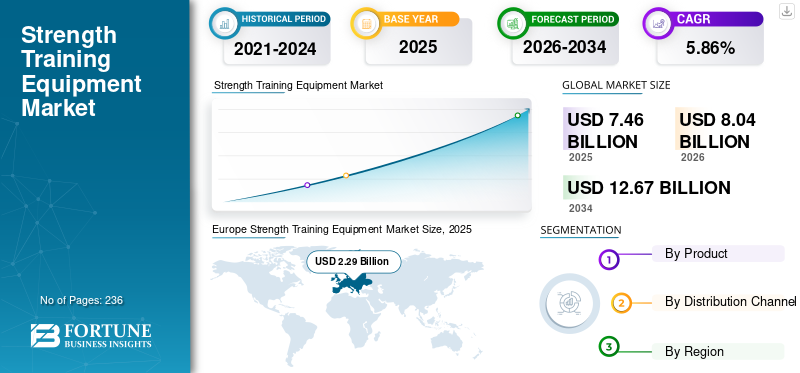
The strength training equipment market size was valued at USD 7.46 billion in 2025. The market is projected to grow from USD 8.04 billion in 2026 to USD 12.67 billion by 2034, exhibiting a CAGR of 5.86% during the forecast period. Europe dominated the strength training equipment market with a market share of 30.69% in 2025.
Strength training with modern equipment, including dumbbells, barbells, and benches, builds muscle strength, endurance, and overall body tone. Exercising with this equipment also helps improve bone density and weight management. The growing awareness of health benefits of working out with strength training equipment, including improved muscle strength, healthy aging, injury prevention, and metabolic health, is driving demand for such products. In addition, the rising number of gyms installing muscle-building equipment on gym floors is also favoring market growth.
Key companies operating in the market include Johnson Health Tech Co., Ltd., Technogym S.p.A., Life Fitness, LLC, iFIT Health & Fitness Inc., and BowFlex Inc.
Download Free sample to learn more about this report.
STRENGTH TRAINING EQUIPMENT MARKET TRENDS
Rising Number of Older Individuals Buying Muscle Building Equipment Augments Market Growth
The increase in aging population and growing number of aged individuals emphasizing strength training to maintain muscle mass, bone density, balance, and overall functional mobility is emerging market trend. In addition, the growing number of fitness centers, rehabilitation facilities, and community wellness programs that incorporate strength-training equipment designed for safer, controlled resistance exercises is driving demand for such products. Besides, consistent manufacturers’ efforts to produce muscle-building equipment with adjustable resistance levels, ergonomic designs, and user-friendly features suitable for older individuals and beginners are driving market expansion globally.
MARKET DYNAMICS
MARKET DRIVERS
Increasing Women's Participation in Strength Training to Drive Product Demand
Fitness centers are expanding their strength-training zones and introducing beginner-friendly equipment to accommodate the growing consumer demographic of fitness enthusiasts. The increasing participation of women in strength training activities and their growing spending on gym memberships is driving the strength training equipment market growth. Additionally, the surging number of social media fitness influencers promoting the health benefits of resistance training is driving growth in the global market.
Download Free sample to learn more about this report.
MARKET RESTRAINTS
High Initial Cost of Advanced Strength Training Equipment to Restrain Market Growth
Advanced strength training equipment, including plate-loaded systems, resistance machines, and other equipment, is sold at higher prices to gym facilities. This equipment features high-strength steel frames, precision biomechanics, and durable components, which require high upfront costs for fitness facilities. The high initial cost of such equipment is reducing its demand among small-scale gyms, independent health clubs, and other price-sensitive consumers. Additionally, space constraints and high prices for muscle-building machinery are negatively affecting demand among budget-conscious homeowners.
MARKET OPPORTUNITIES
Rising Demand for Product Integrated with Digital Ecosystems to Create New Market Growth Opportunities
The rising demand for strength training equipment integrated with digital ecosystems, including mobile applications, cloud-based platforms, and virtual coaching programs that allow users to track workouts, monitor progress, and receive personalized training recommendations, is creating new market growth opportunities. In addition, consistent manufacturers’ provision of muscle-building equipment with guided workouts, on-demand training sessions, and performance analytics is augmenting global market expansion.
MARKET CHALLENGES
Intense Competition from Local Manufacturers to Challenge Key Players' Business Expansion
Intense competition from local manufacturers offering strength training equipment at competitive prices is hampering the key players’ product sales globally. Furthermore, the growing number of small-scale manufacturers offering cheaper-priced dumbbells, benches, and resistance training equipment is hindering sales of premium products worldwide.
Segmentation Analysis
By Product
Widespread Use of Free Weights among Commercial Home Gym Environments Led to its Dominance
By product, the market is segmented into free weights, resistance equipment, and benches.
The free weights segment accounted for the leading strength training equipment market share of 59.91% in 2025. Its leading share is attributed to the versatility, affordability, and widespread use of free weights, including dumbbells, barbells, weight plates, and others, across commercial and home gyms. In addition, the increasing use of free weights among users for functional training, Olympic weightlifting, and strength-based workout programs is driving the segment’s growth.
To know how our report can help streamline your business, Speak to Analyst
The resistance equipment segment is projected to grow at the fastest rate of 6.21% from 2026 to 2034. The rising demand for pin-loaded, plate-loaded, cable machines, and other resistance equipment among commercial gyms, rehabilitation centers, and sports training facilities is driving the segment’s growth.
By Distribution Channel
Rising Adoption of Online Shopping of Muscle Building Equipment to drive Online Retail Segment at Fastest CAGR
Based on the distribution channel, the market is segmented into specialty sports retail stores, online retail, hypermarkets & supermarkets, department stores, institutional/direct sales (B2B), and others.
The online retail segment exhibited a leading global market share of 40.48% in 2025. The segment is also growing at the fastest CAGR of 6.83% from 2026 to 2034. Online marketplaces offer a wide range of basic free weights to advanced muscle-building equipment, enabling customers to compare product features, prices, and other customer reviews. The rising adoption of online shopping for these personal utility goods is driving the online retail segment’s growth. In addition, the growing number of manufacturers partnering with digital marketing agencies and fitness influencers to implement Direct-To-Consumer (DTC) marketing strategies is strengthening their online product sales, thereby favoring the growth of the online retail segment.
The institutional/direct sales (B2B) segment is growing at the second-fastest CAGR of 6.02% from 2026 to 2034. The growing number of commercial fitness chains, boutique studios, and institutional fitness infrastructure, and their preference for setting up connected fitness environments, are boosting the product replacement rate and driving the segment’s growth.
Strength Training Equipment Market Regional Outlook
By region, the market is categorized into North America, Europe, Asia Pacific, South America, and Middle East & Africa.
North America
Europe Strength Training Equipment Market Size, 2025 (USD Billion)
To get more information on the regional analysis of this market, Download Free sample
The North America region held the third-largest global market share of 28.48% in 2025. The region is projected to maintain its position during the forecast period. The North American market size is estimated to reach USD 2.26 billion by 2026. Significant growth in the demand for personalized free weights and the increasing number of fitness enthusiasts seeking to upgrade their existing muscle-building items are favoring North American market growth. In addition, the rising adoption of advanced plate-loaded systems and digitally connected strength solutions is driving the product sales across the region.
U.S. Strength Training Equipment Market
The U.S. market size reached USD 1.76 billion in 2025. The market accounted for around 23.60% of the global market sales in 2025. A robust fitness culture, widespread adoption of strength-building exercise habits among all age groups, and a dense network of commercial fitness centers, including large gym chains and boutique studios, are driving considerable demand for strength-training products across the U.S.
Europe
The European region exhibited a leading global market share of 30.74% in 2025. However, the region’s market is projected to rank second from 2026 to 2034. The region’s market size reached USD 2.43 billion in 2026. The rising number of fitness operators seeking high-quality, ergonomically designed, and aesthetically appealing strength equipment that aligns with their modern gym facility layout and user expectations is driving growth in the European market. In addition, the growing emphasis on preventive healthcare & active lifestyles, and the consistent government promotion of physical activity, are driving product demand across the region.
U.K. Strength Training Equipment Market
The U.K. market in 2025 reached at USD 0.36 billion, representing approximately 4.81% of global product revenues.
Germany Strength Training Equipment Market
Germany’s market was valued at USD 0.44 billion in 2025, equivalent to around 5.85% of global product sales.
Asia Pacific
The Asia Pacific region held the second-largest global market share of 30.55% and a market size of USD 2.28 billion in 2025. However, the region is expected to hold a leading global market position from 2026 to 2034. The region’s market is projected to grow at the second-fastest rate of 7.01% during the forecast period. Increasing urbanization rates and rising consumer spending on home-gym equipment, including dumbbells & barbells to maintain their body figures, are driving market growth across China, India, and Southeast Asia. In addition, the growing number of gyms installing connected, technology-based fitness products to enhance their customers’ exercise experience is driving product sales growth across the region.
Japan Strength Training Equipment Market
The Japanese market, in 2025, reached a valuation of USD 0.42 billion, accounting for roughly 5.58% of global product revenues.
China Strength Training Equipment Market
China’s market is projected to be one of the largest in the Asia Pacific, with revenues estimated at around USD 0.84 billion in 2025, representing roughly 11.26% of global product sales. The rapid expansion of commercial gym centers, fitness boutiques, and large gym chains across major cities, including Beijing, Shanghai, Guangzhou, and Shenzhen, is fueling product demand in these geographies.
India Strength Training Equipment Market
The Indian market in 2025 reached USD 0.415 billion, accounting for 5.57% of global market revenues. The growing awareness of gyms and fitness centers is uplifting the market growth across India.
South America
Over the market forecast period, the South American market is expected to grow at a moderate rate of 6.56%. The South America market in 2025 reached a valuation of USD 0.45 billion. The growing popularity of bodybuilding, functional fitness, and group training programs is driving consumer adoption of strength-building equipment across Chile, Brazil, Colombia, and Peru, fueling South American market growth.
Middle East & Africa
The Middle East & African market is projected to grow at the fastest rate of 7.87% during 2026-2034. The growing awareness of health and fitness, and the rising number of international fitness chains expanding their presence across South Africa, the UAE, and Saudi Arabia, are positively contributing to market growth across the Middle East & Africa. In the Middle East & Africa market, Saudi Arabia's market size reached USD 0.071 billion in 2025.
South Africa Strength Training Equipment Market
The South African market reached USD 0.068 billion by 2025, accounting for roughly 0.91% of the global market revenues.
COMPETITIVE LANDSCAPE
Key Industry Players
Consistent Product Innovation and Provision of Integrated Fitness Solutions to Uplift Key Players’ Market Position
The key players operating in the global market are Johnson Health Tech Co., Ltd., Technogym S.p.A., Life Fitness, LLC, iFIT Health & Fitness Inc., and BowFlex Inc. These players consistently focus on launching connected technology-based products to increase product revenues. In addition, they offer market driven, integrated fitness solutions, including app-connected muscle-building products, to drive product sales and maintain their market position.
LIST OF KEY STRENGTH TRAINING EQUIPMENT COMPANIES PROFILED
- Johnson Health Tech Co., Ltd. (U.S.)
- Technogym S.p.A. (Italy)
- Life Fitness, LLC (U.S.)
- iFIT Health & Fitness Inc. (U.S.)
- BowFlex Inc. (U.S.)
- Rogue Fitness (U.S.)
- Precor Incorporated (U.S.)
- Core Health & Fitness, LLC (U.S.)
- Eleiko Group AB (Sweden)
- Escape Fitness Ltd. (U.K.)
KEY INDUSTRY DEVELOPMENTS
- March 2026: RITFIT, a U.S. home fitness brand, launched a localized online platform, training scenario presentations, and collaborations with fitness exhibitions to expand its strength-building equipment in Germany.
- March 2026: Jerai Fitness Limited announces a strategic collaboration with Plus Fitness India to to broaden its product distribution capabilities across the partnered company’s 100 gyms located across India.
- August 2025: OKPRO launched the New V Series Fitness Equipment, innovative fitness equipment for worldwide strength-training gyms.
- December 2024: Portl, a home fitness technology innovator launched Portl UltraGym, a portable strength training system for the Indian consumers.
- March 2024: Life Fitness launched a new generation of cardio, strength training, and digital product innovations at the 2024 IHRSA Convention & Trade Show. The strength portfolio includes the Dual Adjustable Pulley and the Assisted Nordic Ham.
- October 2023: Nike, Inc., in partnership with FitLab, launched Nike Strength, a line of equipment including dumbbells, kettlebells, bumper plates, barbells, full and half squat racks, benches, and dumbbell storage
- June 2023: TRX, a global training equipment maker, acquired YBell, an Australian fitness equipment company, to enhance TRX's cutting-edge, multi-purpose, patented product offerings and training solutions.
REPORT COVERAGE
The strength training equipment market analysis provides an in-depth study of market insights, market size, and forecast by distribution channel, as well as all other market segments included in the report. In addition, the report on the market outlooks market dynamics, consumer preferences for products, and market trends expected to drive the market in the forecast period. The report on the market includes information on technological advancements, new product launches, key developments in the fitness & strength training goods industry, and details on partnerships, mergers & acquisitions. The market research report also encompasses a detailed competitive landscape with information on the market share and profiles of key operating players.
Request for Customization to gain extensive market insights.
Report Scope & Segmentation
| ATTRIBUTE | DETAILS |
| Study Period | 2021-2034 |
| Base Year | 2025 |
| Estimated Year | 2026 |
| Forecast Period | 2026-2034 |
| Historical Period | 2021-2024 |
| Growth Rate | CAGR of 5.86% from 2026 to 2034 |
| Unit | Value (USD Billion) |
| Segmentation | By Product, Distribution Channel, and Region |
| By Product |
|
| By Distribution Channel |
|
| By Geography |
|
Frequently Asked Questions
Fortune Business Insights says that the global market value stood at USD 7.46 billion in 2025 and is projected to reach USD 12.67 billion by 2034.
In 2025, the Europe market value stood at USD 2.29 billion.
At a CAGR of 5.86%, the global market forecasted to grow during 2026-2034.
By product, the free weights segment leads the global market share.
Increasing womens participation in strength training is driving market growth.
Johnson Health Tech Co., Ltd., Technogym S.p.A., Life Fitness, LLC, iFIT Health & Fitness Inc., and BowFlex Inc. are among the prominent players in the market.
Europe dominated the market in 2025.
The rising demand for strength training equipment integrated with digital ecosystems is creating new market growth opportunities.



- 2021-2034
- 2025
- 2021-2024
- 236
-
(Offer valid till 31st Oct 2026)
Get 30-60 hrs Free Customization
Expand Regional and Country Coverage, Segments Analysis, Company Profiles, Competitive Benchmarking, and End-user Insights.



















Related Reports
-
US +1 833 909 2966 ( Toll Free )
-
Get In Touch With Us