Stroke Post Processing Software Market Size, Share & Industry Analysis, By Installation (Desktop, Mobile Phones & Tablets), By Modality (CT Scan, MRI), By Type, By End-use, and Regional Forecast, 2026-2034
 Download Free Sample
 Stroke Post Processing Software Market Overview
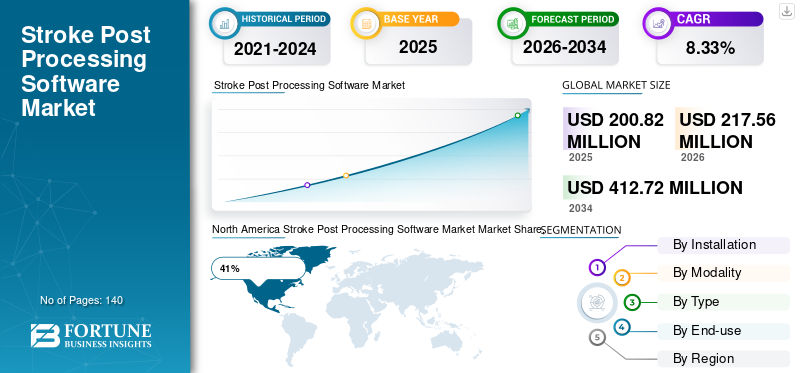
The Stroke Post Processing Software market size was valued at USD 200.82 Million in 2025. The market is projected to grow from USD 217.56 Million in 2026 to USD 412.72 Million by 2034, exhibiting a CAGR of 8.33% during the forecast period.

The Stroke Post Processing Software Market is an essential segment within advanced medical imaging and neurological diagnostics. Stroke post processing software is designed to analyze imaging data from CT scans and MRI systems to support rapid diagnosis, lesion identification, perfusion assessment, vessel analysis, and treatment planning for ischemic and hemorrhagic stroke patients. Healthcare providers increasingly depend on automated imaging workflows to improve clinical decision-making and reduce interpretation time during emergency stroke interventions.
The market is benefiting from rising stroke incidence worldwide, increasing adoption of artificial intelligence in radiology, expansion of stroke care centers, and growing demand for faster image processing solutions. Integration of cloud computing, machine learning algorithms, and automated workflow systems is transforming stroke imaging practices. Healthcare institutions are investing in advanced software platforms capable of delivering real-time diagnostic support, facilitating multidisciplinary collaboration, and improving patient management across acute stroke care pathways.
Download Free sample to learn more about this report.
Key Takeaways
Market Size & Growth
- Global market size 2025: USD 200.82 Million
- Global market size 2034: USD 412.72 Million
- CAGR (2025–2034): 8.33%
Market Share – Regionals
- North America: 41%
- Europe: 29%
- Asia-Pacific: 22%
- Rest of World: 5%
Country-Level Shares
- Germany: 26% of Europe’s market
- United Kingdom: 21% of Europe’s market
- Japan: 24% of Asia-Pacific market
- China: 36% of Asia-Pacific market
USA Stroke Post Processing Software Market
The United States represents the most advanced market for stroke post processing software due to its established healthcare infrastructure, widespread deployment of advanced imaging equipment, and strong adoption of artificial intelligence technologies in medical diagnostics. Stroke remains one of the leading causes of disability, encouraging hospitals and stroke centers to implement sophisticated imaging software solutions for rapid clinical assessment.
Download Free sample to learn more about this report.
The presence of major software developers, extensive clinical research activities, and favorable reimbursement support for advanced stroke imaging contribute significantly to market expansion. Large hospital networks increasingly utilize automated perfusion imaging, vessel tracking, and decision-support tools to improve treatment eligibility assessments. Growing investments in tele-stroke networks and integrated healthcare information systems continue to strengthen the position of the United States in the Stroke Post Processing Software Market Report and Stroke Post Processing Software Industry Analysis.
Stroke Post Processing Software Market Latest Trends
Artificial intelligence continues to redefine the Stroke Post Processing Software Market. Advanced AI algorithms are increasingly capable of automatically detecting large vessel occlusions, estimating infarct core volumes, and identifying salvageable brain tissue within minutes. Healthcare providers are prioritizing software platforms that offer automated notifications and real-time image interpretation support for emergency stroke teams.
Cloud-based deployment is another significant trend influencing the Stroke Post Processing Software Market Analysis. Hospitals seek scalable solutions that allow imaging data sharing across multiple locations while supporting telemedicine initiatives. Cloud-enabled platforms facilitate faster collaboration among neurologists, radiologists, and emergency physicians.
Another emerging trend involves integration with hospital information systems and picture archiving systems. Software vendors are developing comprehensive workflow solutions that connect imaging analysis directly with treatment planning and clinical documentation. Mobile accessibility is also gaining traction, enabling physicians to review critical imaging findings remotely.
The market is witnessing increasing adoption of advanced visualization technologies, including three-dimensional reconstruction, perfusion mapping, and automated vascular analysis. These innovations improve diagnostic confidence and support evidence-based treatment decisions. Such developments continue to strengthen Stroke Post Processing Software Market Trends, Stroke Post Processing Software Market Insights, and Stroke Post Processing Software Market Outlook across global healthcare systems.
Stroke Post Processing Software Market Dynamics
DRIVER
Increasing Demand for Rapid Stroke Diagnosis and Treatment
The most significant driver supporting the Stroke Post Processing Software Market Growth is the increasing need for rapid diagnosis during acute stroke emergencies. Clinical outcomes in stroke management depend heavily on treatment speed. Every minute of delayed intervention can lead to substantial neurological damage, making rapid image interpretation a critical component of modern stroke care.
Stroke post processing software significantly reduces the time required for image analysis by automating complex calculations related to cerebral blood flow, tissue perfusion, infarct volume, and vascular obstruction detection. Healthcare institutions are increasingly adopting these technologies to support faster therapeutic decisions and improve patient outcomes.
Growing awareness regarding stroke management guidelines has further accelerated software implementation across hospitals and specialized stroke centers. Advanced algorithms assist clinicians in identifying treatment candidates for thrombectomy and thrombolytic therapies with greater confidence. The expansion of comprehensive stroke centers, increasing availability of CT and MRI systems, and broader utilization of AI-assisted diagnostics continue to strengthen demand within the Stroke Post Processing Software Market Research Report and Stroke Post Processing Software Industry Report.
RESTRAINT
High Implementation and Integration Costs
One of the primary restraints affecting the Stroke Post Processing Software Market is the substantial cost associated with software deployment, integration, training, and maintenance. Healthcare organizations often face significant financial commitments when implementing advanced imaging analysis platforms, particularly in resource-constrained environments.
Integration with existing hospital information systems, radiology workflows, and imaging infrastructure may require extensive customization and technical support. Smaller healthcare facilities frequently encounter budget limitations that restrict adoption of premium software solutions. Licensing fees, software upgrades, cybersecurity investments, and personnel training expenses further contribute to total ownership costs.
The complexity of integrating multiple imaging modalities into a unified workflow can also create operational challenges. Regulatory compliance requirements and validation procedures increase implementation timelines and expenses. In developing healthcare systems, limited availability of advanced imaging equipment further restricts software utilization. These factors collectively create adoption barriers that influence Stroke Post Processing Software Market Size and limit penetration in certain healthcare segments.
OPPORTUNITY
Expansion of Artificial Intelligence and Tele-Stroke Networks
Artificial intelligence presents a substantial opportunity for participants operating within the Stroke Post Processing Software Market. AI-enabled platforms can rapidly process large imaging datasets, identify abnormalities, and prioritize critical cases for physician review. Continuous improvements in machine learning models are enhancing diagnostic accuracy while reducing interpretation variability.
The expansion of tele-stroke networks is creating additional growth opportunities. Remote consultation programs increasingly rely on advanced imaging software to facilitate real-time collaboration among neurologists, radiologists, and emergency physicians. These networks help extend specialized stroke care to underserved regions and community hospitals.
Growing demand for cloud-based imaging solutions further supports market opportunities. Healthcare providers seek platforms capable of enabling secure image sharing, centralized analysis, and remote access. Software vendors investing in interoperability, automation, and predictive analytics are well-positioned to capitalize on emerging Stroke Post Processing Software Market Opportunities. Increased adoption of precision medicine and personalized treatment planning is also expected to stimulate innovation across the market landscape.
CHALLENGE
Data Security, Regulatory Compliance, and Workflow Standardization
A major challenge facing the Stroke Post Processing Software Market involves ensuring data security while maintaining compliance with evolving healthcare regulations. Stroke imaging platforms process highly sensitive patient information, making cybersecurity protection a critical priority for healthcare organizations.
Cloud deployment models introduce additional concerns related to data storage, transmission security, and access control. Healthcare providers must implement comprehensive safeguards to prevent unauthorized access and protect patient confidentiality. Compliance requirements vary across regions, creating complexity for software developers seeking international market expansion.
Workflow standardization presents another challenge. Hospitals often utilize diverse imaging equipment, software platforms, and clinical protocols, making interoperability difficult. Variations in imaging quality, scanning procedures, and reporting standards can impact software performance and user adoption. Vendors must continuously update their solutions to maintain compatibility with evolving imaging technologies and healthcare infrastructure. Addressing these challenges remains essential for sustaining long-term growth in the Stroke Post Processing Software Market Forecast and Stroke Post Processing Software Market Share landscape.
Stroke Post Processing Software Market Segmentation
By Installation
Desktop-based stroke post processing software accounts for approximately 68% of the global Stroke Post Processing Software Market Share. These solutions remain the preferred choice among hospitals, comprehensive stroke centers, and large diagnostic imaging facilities because of their high processing capability, extensive visualization tools, and direct integration with imaging infrastructure. Desktop installations support advanced image reconstruction, perfusion analysis, vessel segmentation, and treatment planning functions that are essential in acute stroke diagnosis.
Healthcare providers continue to rely on desktop platforms for handling large imaging datasets generated by CT and MRI systems. These solutions offer greater computational power and support sophisticated analytical workflows used by radiologists and neurologists. Desktop software is commonly deployed within radiology departments where high-performance workstations can process imaging studies rapidly and deliver detailed clinical insights. The segment continues to maintain a dominant position in the Stroke Post Processing Software Market Report due to its established presence in hospital environments and compatibility with existing imaging ecosystems.
Mobile phones and tablets represent approximately 32% of the Stroke Post Processing Software Market Size. The segment is experiencing increasing adoption due to growing demand for remote accessibility, tele-stroke services, and rapid physician communication. Mobile-enabled software allows neurologists and stroke specialists to review imaging results, receive alerts, and collaborate on treatment decisions regardless of physical location.
Healthcare organizations increasingly incorporate mobile solutions into emergency stroke workflows to accelerate clinical response times. Advanced mobile applications provide access to perfusion maps, vascular images, and automated diagnostic reports. These capabilities support faster treatment decisions during critical intervention windows. As telemedicine infrastructure expands globally and healthcare providers prioritize workflow flexibility, mobile deployment is becoming an increasingly important component of the Stroke Post Processing Software Industry Analysis. Continued improvements in cloud connectivity and secure data transmission are expected to strengthen adoption across both developed and emerging healthcare markets.
To know how our report can help streamline your business, Speak to Analyst
By Modality
CT Scan-based applications account for approximately 61% of the Stroke Post Processing Software Market. CT imaging remains the most commonly utilized modality in acute stroke diagnosis because of its widespread availability, rapid acquisition speed, and ability to support emergency treatment decisions. Stroke post processing software designed for CT imaging enables automated perfusion assessment, vessel analysis, infarct estimation, and hemorrhage detection.
Healthcare institutions prioritize CT-based software solutions because they facilitate rapid patient evaluation within emergency departments. Automated processing capabilities help clinicians determine eligibility for thrombectomy and thrombolytic therapies while minimizing interpretation delays. Continuous advancements in CT perfusion technology and AI-powered image analysis are enhancing diagnostic accuracy and workflow efficiency. The segment remains a cornerstone of Stroke Post Processing Software Market Growth due to increasing demand for fast and reliable stroke assessment tools.
MRI-based applications represent approximately 39% of the Stroke Post Processing Software Market Share. MRI provides detailed visualization of brain tissue, making it highly valuable for evaluating stroke severity, lesion characteristics, and treatment outcomes. Post processing software for MRI supports advanced diffusion imaging, perfusion studies, and tissue viability assessment.
Many specialized neurological centers rely on MRI software platforms for comprehensive stroke evaluation and follow-up monitoring. The ability to generate detailed anatomical and functional information contributes to improved treatment planning and patient management. Increasing availability of advanced MRI systems and growing demand for precision diagnostics continue to support market expansion. MRI-focused software solutions are becoming increasingly sophisticated through integration of artificial intelligence and automated reporting functions.
By Type
Ischemic stroke analysis software accounts for approximately 72% of the Stroke Post Processing Software Market. This dominance reflects the high prevalence of ischemic stroke cases worldwide. These software solutions focus on evaluating cerebral perfusion, identifying vessel occlusions, estimating infarct core volume, and determining salvageable tissue.
Healthcare providers utilize ischemic stroke analysis tools to support rapid treatment decisions and improve clinical outcomes. Automated algorithms significantly reduce image interpretation time while enhancing diagnostic consistency. Continuous improvements in AI-driven analytics, visualization technologies, and workflow integration contribute to strong demand for ischemic stroke software across hospitals and stroke centers. The segment remains central to Stroke Post Processing Software Market Research Report activities due to its critical role in emergency stroke management.
Hemorrhagic Stroke Analysis Software: Hemorrhagic stroke analysis software represents approximately 28% of the Stroke Post Processing Software Market Size. These solutions are designed to detect intracranial bleeding, assess hematoma characteristics, and support treatment planning. Accurate identification of hemorrhagic stroke is essential because management approaches differ significantly from ischemic stroke interventions.
Software platforms increasingly incorporate automated hemorrhage detection capabilities to support emergency diagnosis and clinical decision-making. Advanced visualization and quantification tools enable clinicians to evaluate bleeding progression and monitor treatment effectiveness. Growing awareness of hemorrhagic stroke management and improvements in imaging analytics continue to support segment growth across healthcare institutions worldwide.
By End-use
Hospitals account for approximately 74% of the Stroke Post Processing Software Market Share. Acute stroke care is primarily delivered within hospital settings where rapid access to imaging equipment, multidisciplinary teams, and intervention capabilities is available. Hospitals increasingly deploy advanced software solutions to improve diagnostic efficiency and streamline treatment workflows.
Comprehensive stroke centers represent major adopters of sophisticated post processing platforms capable of integrating CT and MRI analysis, automated notifications, and clinical decision support. Growing emphasis on reducing treatment delays and improving patient outcomes continues to drive investment in advanced imaging software. Hospital adoption remains a key contributor to Stroke Post Processing Software Market Outlook and Industry Analysis.
Stroke Post Processing Software Market Regional Outlook
North America Stroke Post Processing Software Market Market Share, 2026 (%)
To get more information on the regional analysis of this market, Download Free sample
North America
North America holds approximately 41% of the global Stroke Post Processing Software Market Share. The region benefits from advanced healthcare infrastructure, widespread deployment of CT and MRI systems, and strong adoption of artificial intelligence technologies. Healthcare providers actively invest in software solutions that improve diagnostic speed and support acute stroke intervention workflows.
The region also benefits from a high concentration of specialized stroke centers, advanced emergency medical services, and strong clinical research activities. Continuous innovation in imaging technologies and increasing adoption of tele-stroke networks contribute to market development. North America remains a leading contributor to Stroke Post Processing Software Market Insights and Market Forecast activities.
Europe
Europe accounts for approximately 29% of the global Stroke Post Processing Software Market. Growing emphasis on early stroke diagnosis, expansion of neurological care services, and modernization of imaging infrastructure support regional growth. Healthcare systems across the region increasingly adopt automated imaging solutions to improve treatment efficiency and clinical outcomes.
European healthcare providers prioritize software platforms that support interoperability, regulatory compliance, and evidence-based treatment decisions. Continued investments in digital healthcare initiatives and AI-enabled diagnostics contribute to strong demand throughout the region. Europe remains an important market for software innovation and clinical implementation.
Germany Stroke Post Processing Software Market
Germany represents approximately 26% of the European Stroke Post Processing Software Market. The country maintains one of Europe's most advanced healthcare systems and demonstrates strong adoption of digital imaging technologies. Hospitals and neurological centers continue investing in sophisticated software solutions to support stroke diagnosis and treatment planning.
Strong clinical research capabilities and extensive deployment of advanced imaging equipment contribute to Germany's leadership position. Healthcare providers emphasize workflow optimization, diagnostic accuracy, and integration of artificial intelligence technologies. Growing collaboration between healthcare institutions and technology developers supports ongoing market advancement.
United Kingdom Stroke Post Processing Software Market
The United Kingdom accounts for approximately 21% of the European Stroke Post Processing Software Market. National efforts to improve stroke care pathways and reduce treatment delays have encouraged adoption of advanced imaging software platforms. Hospitals increasingly utilize automated analysis tools to support emergency stroke management.
Growing implementation of digital healthcare strategies and telemedicine services further strengthens market development. Healthcare organizations continue investing in technologies that improve diagnostic efficiency and facilitate multidisciplinary collaboration. The UK remains a key market within the European Stroke Post Processing Software Industry Report.
Asia-Pacific
Asia-Pacific accounts for approximately 22% of the global Stroke Post Processing Software Market Share. The region is experiencing significant adoption of advanced neurological imaging technologies due to increasing stroke prevalence, expanding healthcare infrastructure, and growing investments in digital healthcare transformation. Countries across the region are enhancing stroke treatment capabilities through modernization of hospitals and diagnostic facilities. Healthcare providers are increasingly implementing software solutions that support rapid image analysis and clinical decision-making during emergency stroke care.
The region benefits from rising awareness regarding early stroke intervention and growing availability of CT and MRI systems. Government-supported healthcare initiatives, expansion of telemedicine services, and increased focus on artificial intelligence applications in healthcare are strengthening demand. Hospitals and neurological centers continue to invest in automated imaging analysis platforms that improve workflow efficiency and treatment outcomes. Asia-Pacific remains one of the fastest-evolving regions within the Stroke Post Processing Software Market Analysis and Stroke Post Processing Software Market Outlook.
Japan Stroke Post Processing Software Market
Japan represents approximately 24% of the Asia-Pacific Stroke Post Processing Software Market. The country's advanced healthcare system, aging population, and strong emphasis on technological innovation contribute to substantial demand for stroke imaging software. Healthcare institutions actively adopt advanced diagnostic solutions that support rapid identification of ischemic and hemorrhagic stroke conditions.
Japanese hospitals are increasingly integrating artificial intelligence technologies into radiology workflows to improve diagnostic efficiency and reduce clinical workload. The country maintains extensive deployment of advanced imaging equipment and continues investing in healthcare digitalization. Growing collaboration between healthcare providers and technology developers supports innovation in stroke diagnosis and treatment planning. Japan remains an important contributor to Stroke Post Processing Software Market Research Report activities within the Asia-Pacific region.
China Stroke Post Processing Software Market
China accounts for approximately 36% of the Asia-Pacific Stroke Post Processing Software Market. The country has witnessed significant expansion in healthcare infrastructure, particularly in advanced diagnostic imaging services. Rising stroke incidence and growing awareness of early intervention have accelerated adoption of automated imaging analysis platforms.
Healthcare providers across major urban centers increasingly deploy artificial intelligence-enabled software solutions to enhance diagnostic accuracy and improve patient management. Government initiatives supporting healthcare modernization and digital transformation continue to encourage implementation of advanced medical technologies. Expanding hospital networks, growing investments in healthcare innovation, and increasing utilization of telemedicine services position China as a major growth center within the Stroke Post Processing Software Industry Analysis landscape.
Rest of World
Rest of World accounts for approximately 8% of the global Stroke Post Processing Software Market Share. This region includes Latin America, the Middle East, and Africa, where healthcare systems continue to expand diagnostic imaging capabilities. Although adoption levels remain lower than in developed regions, increasing investments in healthcare infrastructure are supporting market development.
Healthcare providers are gradually implementing advanced stroke imaging solutions to improve diagnostic performance and support better treatment outcomes. Expansion of private healthcare facilities, growing awareness regarding stroke management, and increasing availability of imaging technologies contribute to market growth. International technology partnerships and healthcare modernization initiatives continue to improve access to advanced software platforms. As healthcare systems evolve, demand for automated stroke imaging analysis solutions is expected to strengthen across emerging markets.
List of Top Stroke Post Processing Software Companies
- Brainomix
- Viz.Ai, Inc.
- General Electric Company
- ISchemaView, Inc.
- Siemens
Top Two Companies by Market Share
- Brainomix – 24%
- Viz.Ai, Inc. – 21%
Investment Analysis and Opportunities
The Stroke Post Processing Software Market continues to attract investment due to increasing demand for rapid stroke diagnosis and expanding implementation of artificial intelligence in healthcare. Investors are focusing on companies developing automated image analysis solutions capable of improving clinical workflow efficiency and treatment outcomes. Significant opportunities exist in cloud-based deployment models, advanced analytics, and integrated diagnostic platforms.
Healthcare providers increasingly seek software solutions that support remote collaboration, tele-stroke services, and real-time decision support. These trends create favorable conditions for technology providers and investors pursuing expansion within the market. Emerging economies also present substantial opportunities as healthcare systems modernize diagnostic capabilities and expand access to advanced imaging technologies.
Strategic partnerships between software developers, healthcare institutions, and imaging equipment manufacturers continue to drive innovation. Investment activity is particularly strong in AI-enabled applications, workflow automation technologies, and interoperability solutions. As stroke care pathways become increasingly data-driven, demand for sophisticated software platforms is expected to support continued market expansion and technology development.
New Product Development
Innovation remains a major focus within the Stroke Post Processing Software Market. Software developers are introducing advanced artificial intelligence algorithms capable of identifying stroke-related abnormalities with greater speed and precision. Automated lesion detection, vessel occlusion analysis, and perfusion mapping technologies continue to improve diagnostic efficiency.
Cloud-native architectures are becoming increasingly common in new product development strategies. These platforms facilitate secure data sharing, remote image access, and seamless integration across healthcare networks. Mobile accessibility features are also being enhanced to support rapid physician communication and emergency treatment coordination.
Developers are incorporating predictive analytics, automated reporting functions, and advanced visualization tools into next-generation software platforms. Three-dimensional imaging reconstruction and machine learning-based treatment recommendations are becoming more prevalent. These innovations support improved clinical decision-making and strengthen the value proposition of stroke imaging software solutions across hospitals and diagnostic centers.
Five Recent Developments (2023–2025)
- Brainomix expanded its artificial intelligence-based stroke imaging platform with enhanced automated perfusion analysis capabilities in 2023.
- Viz.Ai introduced upgraded workflow coordination features designed to accelerate stroke team communication and treatment planning in 2024.
- Siemens enhanced integration between advanced MRI imaging systems and stroke post processing software platforms during 2024.
- General Electric Company expanded AI-assisted neuroimaging capabilities within its diagnostic imaging software portfolio in 2025.
- ISchemaView introduced improved cloud-based imaging analysis functionality to support multi-site stroke care networks in 2025.
Report Coverage
This Stroke Post Processing Software Market Report provides comprehensive analysis of industry structure, technological developments, competitive landscape, segmentation trends, and regional performance. The report evaluates major software deployment models, imaging modalities, clinical applications, and end-user adoption patterns across healthcare systems worldwide.
Request for Customization to gain extensive market insights.
The study examines factors influencing market expansion, including advancements in artificial intelligence, increasing demand for rapid stroke diagnosis, and growth of telemedicine services. Detailed assessment of drivers, restraints, opportunities, and challenges provides insights into evolving industry dynamics. The report also reviews competitive positioning of leading companies, innovation strategies, investment trends, and product development activities.
Regional analysis covers North America, Europe, Asia-Pacific, and Rest of World markets while highlighting country-level developments in Germany, the United Kingdom, Japan, and China. The report offers valuable information for healthcare providers, investors, technology developers, imaging equipment manufacturers, and stakeholders seeking actionable Stroke Post Processing Software Market Insights and Stroke Post Processing Software Market Opportunities.



- 2021-2034
- 2025
- 2021-2024
- 140
Get 30-60 hrs Free Customization
Expand Regional and Country Coverage, Segments Analysis, Company Profiles, Competitive Benchmarking, and End-user Insights.




















-
US +1 833 909 2966 ( Toll Free )
-
Get In Touch With Us