Subsea Boosting Systems Market Size, Share & Industry Analysis, By Component (Pump {Helico-axial, Centrifugal, Twin-screw, ESP, and Others}, Control System, Hydraulic Jumpers, Variable Speed Drive, and Others), By Application (Oil Field and Gas Field), By Water Depth (Shallow Water, Deep Water, and Ultra-Deepwater), and Regional Forecast, 2026-2034
 Download Free Sample
KEY MARKET INSIGHTS
 Listen to Audio Version
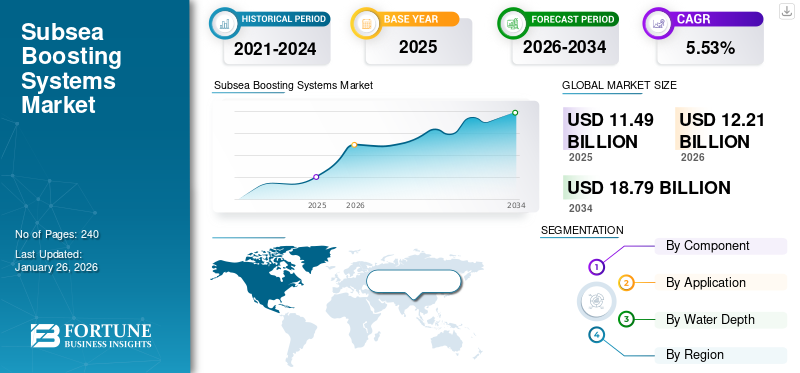
The global subsea boosting systems market size was valued at USD 11.49 billion in 2025. It is projected to be worth USD 12.21 billion in 2026 and expected to reach USD 18.79 billion by 2034, exhibiting a CAGR of 5.53% during the forecast period. Latin America dominated the subsea boosting systems market with a market share of 33.24% in 2025.
Subsea boosting systems refer to technologies and solutions used to increase the pressure of fluids produced from subsea wells, enabling their efficient transport to surface facilities or onward processing. Subsea boosting plays a critical role in modern offshore oil and gas production, helping operators enhance recovery rates, lower operating costs, and improve the overall economics of complex deep-water projects.
As offshore fields mature and new developments move into deeper, more challenging environments, such systems have become an essential tool for maintaining and even increasing output. By supporting higher flow rates and extending the productive life of reservoirs, these systems provide operators with a reliable way to maximize returns from high-cost offshore investments.
The market encompasses players such as Subsea 7, SLB Ltd., Baker Hughes, Technip FMC, and others. Implementation of subsea technologies is complex and challenging; thus, over the years, these players have undertaken various demanding projects in offshore environments and provided supporting technologies and solutions.
Download Free sample to learn more about this report.
Subsea Boosting Systems Market Key Takeaways
 Global Market Size & Forecast
- 2025 Market Size: USD 11.49 billion
- 2026 Market Size: USD 12.21 billion
- 2034 Forecast Market Size: USD 18.79 billion
- CAGR: 5.53% from 2026-2034
 Market Share
- Latin America dominated the subsea boosting systems market with a 33.24% share in 2025.
- The pump sub-segment accounted for the largest share of 53.92% under the component segment.
- The oil field application segment dominated the market with a 68.33% share.
 Key Regional Highlights
North America
North America is projected to reach USD 2.11 billion in 2025, supported by the fastest regional growth rate of 7.10%.
Asia Pacific
Asia Pacific reached USD 1.84 billion in 2025 and is projected to grow to USD 1.94 billion in 2026.
Europe
Europe generated USD 0.92 billion in 2025 and is expected to reach USD 0.98 billion in 2026.
U.S.
The market is projected to reach USD 1.99 billion in 2026.
Japan
Increasing offshore energy investments are expected to support market growth during the forecast period.
Read More

MARKET DYNAMICS
MARKET DRIVERS
Growing Investments in Offshore Projects to Drive Market Growth
With increasing energy demand, elevated oil prices, and dwindling onshore reserves, global oil and gas companies are investing heavily in offshore developments, especially in deep water and ultra-deepwater. Offshore fields frequently experience long tiebacks, elevated backpressure, and complex flow assurance difficulties, making subsea boosting systems crucial for maximizing production efficiency. Boosting systems increase wellhead pressure, increase flow rates, and improve recovery from low-energy or remote wells. Enabling Economically Viable Projects - reducing dependence on costly surface facilities by situating pumping systems and processing equipment on the seabed.
- In October 2024, SLB's OneSubsea joint venture secured a contract from energy group BP for a subsea boosting system for the greenfield development Kaskida project in the deep-water U.S. Gulf of Mexico. The project scope includes a supplier-led high-pressure subsea pump solution with integrated power and controls umbilical and associated topside equipment.
MARKET RESTRAINTS
Competition from Alternative Recovery Technologies to Restrain Market Growth
One of the major restraints for the global subsea boosting system market is the availability of alternative production enhancement methods that can, in many cases, deliver similar outcomes at lower cost or risk. For example, gas lift, where compressed gas is injected into the production stream to lighten the fluid column and improve flow, has been used in offshore developments for decades. Gas lift systems are comparatively less complex, easier to maintain, and can often be integrated into existing infrastructure without requiring expensive subsea hardware.
Similarly, topside boosting solutions (installing pumps on the platform or FPSO) can achieve additional pressure support while keeping critical rotating equipment in an accessible environment. This greatly simplifies operations and reduces intervention costs, since repairs or upgrades can be performed without deploying specialized subsea vessels. For operators who already have sufficient topside space and power capacity, topside pumps are often anticipated as a lower-risk alternative to subsea systems.
MARKET OPPORTUNITIES
Technological Advancements to Create Opportunities for Market Growth
As new and improved technologies including high-efficiency multiphase pumps, wet gas compression, variable speed drive systems, as well as modular & standardized designs, are making these systems more reliable, easier to install, and more maintenance friendly, operators are optimizing to even longer tie-backs, deeper water applications, and harsher subsea environments while ensuring stable production flow and improved recovery rates.
- For instance, in February 2024, Curtiss-Wright Corporation announced it entered into a Technology Cooperation Agreement with PETRÓLEO BRASILEIRO S.A. – PETROBRAS to develop, design, manufacture, test, and provide operational support for a Subsea Canned Motor Boosting System, which will be installed mudline at a Petrobras production field in the Campos Basin, Brazil. Curtiss-Wright and Petrobras are collaborating to develop a subsea boosting system for unprocessed hydrocarbon fluid that is a mixture of oil, gas, and particulates.
SUBSEA BOOSTING SYSTEMS MARKET TRENDS
Growing Focus on Offshore Developments in Various Regions to Support Market Growth.
The global market is experiencing significant growth, fueled by growing focus on offshore developments in various regions. For instance, the market in the U.S. is growing largely due to the increase in deep water and ultra-deepwater projects in the Gulf of Mexico, which have reservoirs with long tie-backs and declining natural pressure. Growth is further supported by strong investment from major U.S. offshore operators, redevelopment of mature Gulf of Mexico fields to sustain output, technological innovations in multiphase pumps and modular systems that lower installation and maintenance costs, focus on domestic energy security, and encouraging utilization of offshore resources.
Similarly, Norway’s offshore oil and gas industry has long been renowned for its technical sophistication and deep-water prowess. Operators are increasingly turning to seabed-based technologies, notably subsea boosting and compression systems, to sustain and enhance production. For instance, in June 2025, Shell and partners-initiated operations of two subsea compression stations—North Sea's installations designed to elevate gas recovery from 75% to 85%, unlocking an estimated 30 to 50 billion cubic meters of additional gas. Shell holds a 17.8% ownership in the Ormen Lange field, where it serves as the operator.
MARKET CHALLENGES
High Capital and Installation Costs to Restrain Market Growth
Subsea boosting system market growth is restrained by high capital and installation costs. Subsea boosting projects require specialized subsea equipment, installation vessels, and integrated systems with existing infrastructure, making projects capital-intensive, which affects adoption, especially in marginal fields and for smaller operators. Projects can and will get delayed or cancelled during times of oil price volatility, which also limits capital being allocated to small offshore oil operators.
Complex environmental regulations and process controls add layers of complexity and also drive large capital investments for compliance and environmental requirements. The additional regulatory burden results in some delays and added costs. Operators usually will defer or cancel heavy capex offshore projects during periods of declining oil prices, and an industry-wide contraction in the demand directly follows.
Download Free sample to learn more about this report.
SEGMENTATION ANALYSIS
By Component
Pumps Anticipated to Dominate Component Segment over Forecasted Period
Based on the component, the market is segmented into pump, control system, hydraulic jumpers, variable speed drive, and others. Globally, the pump sub-segment is projected to dominate the market with a share of 53.92% share under the component segment over the forecasted period.
The segment’s growth can be attributed to its ability to enhance oil and gas production by increasing pressure in subsea pipelines, enabling efficient transportation of hydrocarbons to surface facilities. They are crucial for maintaining or increasing production rates from mature or depleted reservoirs, extending field life, and making marginal fields viable.
- SLB offers Subsea Boosting Pump under its OneSubsea brand, suitable for deepwater developments, subsea water injection, and long-distance subsea tiebacks. It helps in decarbonizing operations, increasing recovery and accelerating production, and improving flow assurance.
Control Systems is the second dominating segment in the market growing at the rate of 5.53% in the forecast period due to the requirement of advanced control systems to manage equipment synchronization, start/stop sequences, pressure balancing, and fault detection in real time.
By Application
Oil Field to Lead Application Segment Owing to Capital Capital-Intensive Nature of Offshore Oil Field Operations
By application, the market is divided into oil field and gas field. The application segment is anticipated to be dominated by the oil field with 68.33% share owing to the relatively more capital-intensive nature of offshore oil field operations.
Such systems have become an increasingly important technology in offshore oil and gas operations, offering solutions to both production challenges and economic pressures. These systems are primarily applied in situations where natural reservoir pressure is insufficient to sustain flow, such as in low-pressure or depleted reservoirs, long-distance tieback projects, and mature fields with high water cut.
The gas field segment is forecasted to grow at the 5.53% in the coming years supported by benefits of adopting subsea boosting that offers both operational and financial efficiency. By lowering wellhead backpressure, these systems can increase production rates, improve recovery factors, and extend the productive life of a field.
By Water Depth
To know how our report can help streamline your business, Speak to Analyst
Ultra-deepwater to Expected to Grow Fastest Over Coming Years
The global market by water depth is segregated into shallow water, deep water, and ultra-deepwater.
Currently, ultra-deepwater depth is anticipated to lead the market growth and is expected to grow at a 6.56% CAGR over the forecast period owing to growing focus of operators and oil companies in these environments.
The deep-water segment is projected to dominate the market with a share of 46.57% owing to increasing oil and gas offshore activities in these water depths. Boosting technology plays a direct role in achieving target production rates, improving recovery factors, and ensuring economic viability over the project’s life.
SUBSEA BOOSTING SYSTEMS MARKET REGIONAL OUTLOOK
The market has been studied regionally across five main regions: North America, Europe, Asia Pacific, Latin America, and the Middle East & Africa.
Latin America
In 2025, Latin America represented USD 3.59 billion, accounting for 31.25% of the worldwide market, and is projected to grow to USD 3.82 billion in 2026. The Latin America subsea boosting system market growth is due to a mix of focused upstream investments, significant deep water and ultra-deepwater project developments, and national energy policies that support offshore growth. A major factor is Brazil's ongoing commitment to investing in pre-salt ultra-deepwater fields, where Petrobras and its partners are dedicating investments to long-term development initiatives.
Latin America Subsea Boosting Systems Market Size, 2025 (USD Billion)
To get more information on the regional analysis of this market, Download Free sample
North America and Middle East & Africa
Other regions such as North America and the Middle East & Africa are anticipated to witness a notable growth in the coming years. During the forecast period, the North America region is anticipated to record a growth rate of 7.10%, which is the fastest among all regions, and is expected to reach the valuation of USD 2.11 billion in 2025. The huge presence of the U.S. in the global oil and gas industry and its production from offshore fields make North America one of the prominent regions presenting immense opportunities for the subsea boosting system market. Backed by these factors, countries including the U.S. are expected to record the valuation of USD 1.99 billion in 2026, and Canada to record USD 0.26 billion. Further, The Middle East & Africa market accounted for USD 3.02 billion in 2025, representing 26.23% of the global industry, and is expected to reach USD 3.2 billion in 2026.
Europe and Asia Pacific
Over the forecast period, Europe and Asia Pacific is expected to witness moderate growth. Asia Pacific maintained a strong presence in the global market, reaching USD 1.84 billion in 2025, accounting for 15.91% share, and is expected to reach USD 1.94 billion in 2026. The Europe region captured 8.05% of the global market in 2025, generating USD 0.92 billion in revenue, and is projected to reach USD 0.98 billion in 2026. The China market is projected to reach USD 0.45 billion by 2026, and the India market is projected to reach USD 0.16 billion by 2026.
COMPETITIVE LANDSCAPE
KEY INDUSTRY PLAYERS
Globally, SLB, Technip FMC, and Subsea 7 are some of the key players in the market. These players offer a suite of solutions for better adoption of subsea boosting systems as well, and are involved in efforts to develop and make subsea boosting systems a viable solution.
TechnipFMC is a leading market player that provides subsea separation, boosting, and compression solutions for both new and existing projects, allowing its customers to extract and recover oil and gas from remote reserves.
The presence of Schlumberger N.V. in the market can be attributed to its joint venture, OneSubsea, where the company holds a majority stake. OneSubsea is renowned for undertaking EPCI contracts at subsea/offshore settings and provides a range of technologies and solutions.
List of the Key Subsea Boosting Systems Companies Profiled
- SLB (U.S.)
- Subsea 7 S.A. (U.K.)
- Technip FMC (U.K.)
- Baker Hughes (U.S.)
- NOV Inc (U.S.)
- Oceaneering International (U.S.)
- Proserv Ltd. (U.K.)
- Halliburton (U.S.)
- Sulzer (Switzerland)
- Leistritz Advanced Technologies Corp. (U.S.)
KEY INDUSTRY DEVELOPMENTS
- April 2025 - BW Energy made an FID for the Golfinho Boost project, which intends to contribute an additional 3,000 barrels per day of oil production starting in 2027. The initiative consists of several strategies designed to enhance production efficiency and raise recoverable reserves. These strategies involve updating the subsea boosting system by substituting gas lifts with Electrical Submersible Pumps (ESPs) on the seabed, restarting previously shut-in wells, replacing umbilicals, optimizing field logistics, and augmenting FPSO capacities.
- March 2025 - BP p.l.c. signed a Memorandum of Understanding (MoU) with Subsea Integration Alliance which comprises Subsea7 and OneSubsea™, an SLB company, to improve integrated subsea project performance. The agreement will leverage bp’s expertise in framing, building, and executing projects alongside the Alliance’s ability to deliver integrated subsea production systems (SPS) and subsea umbilicals, risers, and flowlines (SURF).
- December 2024 - Beacon Offshore Energy LLC and its partners approved the subsequent stage of development at Shenandoah Phase 2, located in the deep-water Gulf of Mexico. The operations planned for Shenandoah Phase 2 involve drilling and completing two more producing wells, increasing the throughput capacity of the Shenandoah FPS to 140,000 bopd through debottlenecking efforts by early 2026, and adding a subsea booster pump to enhance hydraulic support by decreasing back pressure on the wells in the dual infield flowline and riser system.
- February 2024 - Curtiss-Wright signed a deal with Petrobras to develop “topside-less” subsea canned motor boosting systems designed to operate at depths up to 1,500 m, offering lighter, more flexible deployment options for long tiebacks.
- July 2022 – Kosmos Energy Gulf of Mexico Operations, LLC, awarded engineering, procurement, construction, and installation (EPCI) contract to Subsea Integration Alliance for the Odd Job field in the Gulf of Mexico. Under the EPCI contract, OneSubsea, a branch of Schlumberger specializing in subsea technologies, production, and processing systems, will provide a subsea multiphase boosting system, surface equipment, and a 16-mile integrated power and control umbilical.
REPORT COVERAGE
The global subsea boosting systems market report delivers a detailed insight into the market and focuses on key aspects such as leading companies in subsea boosting systems. Besides, the report offers insights into the market trends & technology and highlights key industry developments. In addition to the factors above, the report encompasses several factors that contributed to the growth of the market in recent years.
Request for Customization to gain extensive market insights.
Report Scope & Segmentation
|
ATTRIBUTE |
DETAILS |
|
Study Period |
2021-2034 |
|
Base Year |
2025 |
|
Estimated Year |
2026 |
|
Forecast Period |
2026-2034 |
|
Historical Period |
2021-2024 |
|
Growth Rate |
CAGR of 5.53% from 2026 to 2034 |
|
Unit |
Value (USD Billion) |
|
Segmentation |
By Component · Pump o Helico-axial o Centrifugal o Twin-screw o ESP o Others · Control System · Hydraulic Jumpers · Variable Speed Drive · Others |
|
By Application · Oil Field · Gas Field |
|
|
By Water Depth · Shallow Water · Deep Water · Ultra-deepwater |
|
|
By Region
|
Frequently Asked Questions
As per the Fortune Business Insights study, the market size was USD 11.49 billion in 2025.
The market is likely to grow at a CAGR of 5.53% over the forecast period.
The Pump segment is expected to dominate the market in the forecast period.
The market size of Latin America stood at USD 3.38 billion in 2025.
Increasing deepwater and ultra-deepwater exploration and production activities to drive market growth
Some of the top players in the market are Subsea 7, SLB, and Technip FMC, among others.
The global market size is expected to reach USD 18.79 billion by 2034.


- 2021-2034
- 2025
- 2021-2024
- 240
Get 30-60 hrs Free Customization
Expand Regional and Country Coverage, Segments Analysis, Company Profiles, Competitive Benchmarking, and End-user Insights.









Related Reports
-
US +1 833 909 2966 ( Toll Free )
-
Get In Touch With Us