Suppositories Market Size, Share & Industry Analysis, By Product (Laxatives & Stool Evacuants, Hormonal Preparations, Anti-inflammatory Drugs, Analgesics & Antipyretics, Antifungals, Anti-hemorrhoidal Preparations, Antiemetics), By Disease Indication (Constipation, Women’s Health, IBD, Pain & Fever, Vaginal Infections, Hemorrhoids, Nausea & Vomiting), By Age Group (Adults and Pediatrics), By Type (OTC and Prescription), By Route of Administration (Rectal, Vaginal and Urethral), By Distribution Channel (Pharmacies, Drug Stores), and Regional Forecast, 2026-2034
 Download Free Sample
Suppositories Market Size and Future Outlook
 Listen to Audio Version
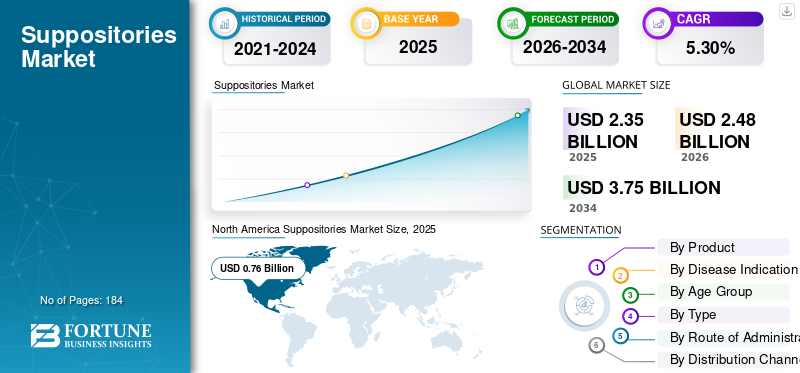
The global suppositories market size was valued at USD 2.35 billion in 2025. The market is projected to grow from USD 2.48 billion in 2026 to USD 3.75 billion by 2034, exhibiting a CAGR of 5.30% during the forecast period. North America dominated the suppositories market with a market share of 32.34% in 2025.
The global suppositories market includes solid or semi-solid pharmaceutical formulations intended for insertion into the rectal, vaginal, or urethral pathways, where they melt, dissolve, or soften to provide local or systemic therapeutic benefits. The market demand is driven by the necessity for alternative drug administration in patients unable to ingest oral medications, quicker localized relief for anorectal and vaginal issues, and ongoing consumption of OTC products for managing constipation and hemorrhoids.
Key players in the global market consist of Chattem, Inc., Bayer AG, Haleon group of companies, and Ferring Pharmaceuticals. The leadership of these companies is supported by strong OTC brands, established prescription suppository portfolios, broad vaginal and rectal dosage-form capabilities, and wide pharmacy distribution networks.
Download Free sample to learn more about this report.
Suppositories Market KEY TAKEAWAYS
 Global Market Size & Forecast
- 2025 Market Size: USD 2.35 billion
- 2026 Market Size: USD 2.48 billion
- 2034 Forecast Market Size: USD 3.75 billion
- CAGR: 5.30% during 2026–2034
 Market Share
- North America dominated the global market with a 32.34% share in 2025.
- Constipation dominated the market in 2025 and is expected to account for 30.0% of the market in 2026.
- Rectal held the largest route-of-administration share in 2025 and is expected to account for 70.8% in 2026.
 Key Regional Highlights
North America
The market reached USD 0.76 billion in 2025, maintaining its leading position due to strong demand for OTC constipation.
Europe
The market is expected to grow at a 4.53% CAGR during the forecast period, supported by an aging population.
Asia Pacific
The market is expected to reach USD 0.66 billion in 2026, supported by a large patient population.
U.S.
The U.S. market is estimated at approximately USD 0.74 billion in 2026.
Japan
The Japanese market is estimated at approximately USD 0.14 billion in 2026.
Read More

SUPPOSITORIES MARKET TRENDS
Strong OTC Availability and Pharmacy-Led Self-Care is a Remarkable Market Trend
Robust OTC access and pharmacy-driven self-care are emerging as significant trends in the global market, as numerous rectal and vaginal disorders are persistent, uncomfortable, and typically addressed initially with over-the-counter products. Consumers are increasingly opting for accessible remedies for constipation, hemorrhoids, and vaginal discomfort prior to consulting a doctor, which bolsters demand via retail pharmacies, drug stores, and online pharmacy platforms. Suppositories provide quicker local effects than most oral medications, making them appropriate for immediate relief from constipation and internal hemorrhoid issues. This trend aids established OTC brands in sustaining repeat purchases, while pharmacy chains and online platforms enhance product visibility and ease of access. Consequently, items including bisacodyl, glycerin, and hemorrhoidal suppositories remain increasingly significant in self-care segments. The trend also favors both private-label and branded products, as shoppers assess availability, prices, reviews, and delivery choices online. In general, broader OTC availability is broadening the role of suppositories beyond prescription use and enhancing their status in routine gastrointestinal and anorectal treatment. These factors are supporting the overall global suppositories market growth during the forecast period.
- For instance, in 2025, Haleon’s Preparation H Hemorrhoidal Suppositories label listed the product as an OTC hemorrhoidal suppository distributed by Haleon and indicated for relief of internal hemorrhoidal symptoms, with directions allowing use up to four times daily, especially at night, in the morning, or after bowel movements. This supports the pharmacy-led self-care trend in the market by showing how branded OTC rectal products remain available for consumer-managed hemorrhoid relief.
MARKET DYNAMICS
MARKET DRIVERS
Download Free sample to learn more about this report.
Rising Need for Non-Oral Drug Delivery Options is Driving Market Growth
Increasing demand for non-oral medication delivery methods is a significant factor propelling the global market growth, as numerous patients struggle to take oral drugs comfortably due to nausea, vomiting, difficulty swallowing, unconsciousness, restrictions in pediatrics, or gastrointestinal discomfort. Suppositories offer a different pathway to administer the drug via rectal or vaginal mucosa, proving valuable when oral intake isn't feasible. This pathway is also significant for localized issues such as ulcerative proctitis, hemorrhoids, vaginal infections, and fertility assistance, as targeted delivery can enhance treatment effectiveness. In certain situations, suppositories can additionally minimize contact with the digestive system and promote quicker local effects. Demand for rectal and vaginal dosage forms remains steady as patient groups including children, the elderly, post-surgical patients, and those with GI symptoms continue to require convenient non-oral options. This is motivating companies to broaden both branded and generic suppository ranges in pain, inflammation, women’s health, and gastrointestinal care. In general, the increasing demand for alternative delivery methods is enhancing the market position of suppositories in both OTC and prescription sectors. All these factors cumulatively drive the overall market growth.
- For instance, in December 2024, Hikma Pharmaceuticals launched Indomethacin Suppositories 50 mg in the U.S., expanding physician and patient access to a non-oral anti-inflammatory option for conditions such as moderate to severe rheumatoid arthritis, osteoarthritis, ankylosing spondylitis, acute painful shoulder, and acute gouty arthritis. This supports the market driver by showing continued company investment in rectal dosage forms where non-oral delivery can broaden treatment choice.
MARKET RESTRAINTS
Low Patient Preference and Social Discomfort with Rectal and Vaginal Administration to Hamper Market Growth
Limited patient preference and social unease regarding rectal and vaginal delivery hinder the global market growth, as numerous patients perceive suppositories as more inconvenient, intrusive, or humiliating than oral tablets, capsules, creams, or gels. This impacts repeat purchases, particularly in OTC categories including constipation, hemorrhoids, and vaginal infections, where consumers can readily transition to more familiar formats. Although suppositories offer localized effects, the necessity for insertion, potential leakage, expulsion, or discomfort may diminish patient adherence. This limitation is more pronounced in adult self-care markets, where convenience and privacy frequently dictate product selection. It also restricts physician advice when equally effective oral or topical options are present. Consequently, businesses need to allocate greater resources toward patient education, unmarked packaging, enhanced formulation design, and simplified application formats to boost acceptance. In general, social unease and hesitation regarding the method can hinder acceptance even with the therapeutic benefits of suppositories.
- For example, in February 2025, Tools for Practice reviewed treatment options for uncomplicated vulvovaginal candidiasis and noted that route and duration may not materially change efficacy, so patient preference should guide treatment choice.
MARKET OPPORTUNITIES
Growing Focus on Women’s Health, Especially Vaginal Infections to Offer Market Growth Opportunities
Growing focus on women’s health, especially vaginal infections, is creating a strong opportunity in the global market as vaginal suppositories allow localized delivery directly at the site of infection or imbalance. Conditions such as vulvovaginal candidiasis, recurrent odor, pH imbalance, and bacterial/vaginal microbiome disruption are common and often require repeat treatment, creating steady product demand. As women increasingly seek discreet, easy-to-use, pharmacy-accessible products, companies have an opportunity to expand antifungal, boric acid, probiotic, and pH-support suppository lines. This also opens space for differentiated products backed by clinical trials, as consumers and healthcare providers are becoming more cautious about unverified vaginal health claims. Companies that can combine women’s health branding, clinical evidence, and retail/online availability may gain stronger positioning in this category. The opportunity is especially relevant as vaginal suppositories fit both OTC self-care and prescription-led treatment pathways. Overall, rising awareness of vaginal health is moving suppositories from a traditional treatment format into a broader women’s wellness and infection-management opportunity. All these factors would drive the market growth in the coming years.
- For instance, in August 2025, pH-D Feminine Health announced the launch of an FDA-cleared Phase 3 clinical trial for its boric acid vaginal suppository for recurrent vulvovaginal candidiasis, highlighting the shift toward clinically validated vaginal suppository products in women’s health.
MARKET CHALLENGES
Availability of Alternative Dosage Forms Pose a Prominent Challenge to Market Growth
Availability of alternative dosage forms is a key challenge for the global market as most target conditions can also be treated with oral, topical, cream, spray, wipe, gel, or enema-based products. For constipation, patients may choose oral laxatives, stool softeners, fiber supplements, or liquid enemas instead of rectal suppositories. In hemorrhoids, creams, ointments, sprays, pads, and wipes often feel easier and more discreet than suppository insertion. Similarly, vaginal infections and women’s health conditions can be managed through oral tablets, vaginal creams, gels, or inserts, creating direct competition for suppository products. This wide choice reduces dependence on suppositories, especially in OTC categories where consumers decide based on convenience, comfort, and privacy. As a result, brands must differentiate through faster relief, localized action, improved applicators, and better patient education. Overall, the presence of convenient substitutes can limit repeat use and slow growth across. All the factors cumulatively affect the market growth.
- For instance, in September 2025, Norms Hemorrhoid Relief launched a hemorrhoid care system including cream, spray, medicated wipes, single-use cream packets, and a full treatment bundle, all positioned for convenient OTC hemorrhoid relief. This highlights the challenge for suppositories.
Segmentation Analysis
By Product
Laxatives & Stool Evacuants Segment Dominated Due to High Constipation Burden, Strong OTC Availability, and Faster Relief Need
In terms of product, the market is divided into laxatives & stool evacuants, hormonal preparations, anti-inflammatory drugs, analgesics & antipyretics, antifungals, anti-hemorrhoidal preparations, antiemetics, and others.
The laxatives & stool evacuants segment accounted for the dominant global suppositories market share in 2025. As constipation is one of the most common conditions treated through rectal suppositories across adults, pediatrics, and geriatric patients. Moreover, laxative suppositories have broader OTC availability, lower treatment complexity, and higher repeat usage through drug stores, retail pharmacies, and online pharmacies. Their demand is also supported by patients who need non-oral options due to swallowing difficulty, nausea, post-surgical recovery, or poor response to oral laxatives. In addition, strong brand presence along with private-label availability, improves consumer access and supports market dominance.
- For instance, Prestige Consumer Healthcare has highlighted Fleet as the “#1 enema and suppository brand” for fast, safe, and effective relief from occasional constipation, with all Fleet products available without prescription. This supports the dominance of laxatives & stool evacuants, as leading OTC constipation brands continue to drive broad consumer access and repeat demand for suppository-based bowel relief.
The hormonal preparations segment is anticipated to rise with a CAGR of 6.14% over the forecast period.
To know how our report can help streamline your business, Speak to Analyst
By Disease Indication
High Patient Pool, Frequent OTC Use, and Fast Rectal Relief Led to Constipation Segment Dominance
On the basis of disease indication, the market is segmented into constipation, women’s health, IBD, pain & fever, vaginal infections, hemorrhoids, nausea & vomiting, and others.
The constipation segment dominated the global market in 2025. It is one of the most common conditions treated through suppositories across adults, children, elderly patients, post-surgical patients, and individuals with limited oral intake. Moreover, the segment also benefits from strong OTC availability, as many constipation suppositories can be purchased through retail pharmacies, drug stores, and online channels without a prescription. Furthermore, the segment is set to hold 30.0% share in 2026.
- For instance, in January 24, 2025, DailyMed updated the label for Oncor Pharmaceuticals’ bisacodyl suppositories, which are OTC rectal suppositories used to relieve occasional constipation.
The women’s health segment is growing at a CAGR of 6.16% over the forecast period.
By Age Group
Adults Segment Dominated Due to Higher Constipation Burden, Broader OTC Use, and Wider Therapeutic Applications
Based on age group, the market is classified into pediatrics and adults.
The adults segment held the dominating share of the global market in 2025. This is owing to the fact that suppositories are more widely used among adult patients for various diseases. Adults have higher exposure to factors such as sedentary lifestyle, low-fiber diet, pregnancy, aging, chronic medication use, and post-surgical bowel issues, which increases the need for rectal laxative suppositories. In addition, several prescription suppositories, including mesalamine, progesterone, and anti-inflammatory products, are primarily used in adult populations. The segment is further supported by strong availability of adult-labeled glycerin and bisacodyl suppositories for occasional constipation.
- For instance, in March 2025, DailyMed updated the label for Walgreens’ Glycerin Adult suppository, an OTC rectal product containing glycerin 2 grams and indicated for relief of occasional constipation. The product’s adult-specific positioning supports the dominance of the adults’ segment, as constipation relief remains one of the highest-volume uses of suppositories among adult consumers.
The pediatrics segment is anticipated to rise with a CAGR of 4.77% over the forecast period.
By Type
OTC Segment Dominated Due to Easy Pharmacy Access, High Self-care Use, and Strong Demand for Constipation & Hemorrhoid Relief
In terms of type, the market is divided into OTC and prescription.
The OTC segment captured the highest share of the global market in 2025. OTC products have broader consumer reach and higher repeat purchase frequency. The segment is also supported by rising preference for quick relief, discreet purchasing, and home-based treatment for mild to moderate symptoms. In addition, private-label OTC suppositories offered by pharmacy chains improve affordability and expand product access across developed and emerging markets.
- For instance, in October 2025, DailyMed updated the label for Good Neighbor Pharmacy’s glycerin suppository, categorized as a human OTC drug and indicated for occasional constipation.
The prescription segment is anticipated to rise with a CAGR of 5.81% over the forecast period.
By Route of Administration
Rectal Segment Dominated Due to Higher Use in Constipation, Hemorrhoids, IBD, and Pain & Fever Management
On the basis of route of administration, the market is divided into rectal, vaginal, and urethral.
The rectal segment captured the highest share of the global market in 2025. Rectal suppositories are widely used across multiple high-volume indications, including constipation, hemorrhoids, and others. Moreover, the rectal route has broader use across both OTC and prescription products, which increases its overall revenue contribution. Furthermore, the segment is set to hold 70.8% share in 2026.
- For instance, in October 2025, Zydus Lifesciences received Health Canada’s Notice of Compliance for generic Mesalamine Suppositories 1000 mg, indicated for mildly to moderately active ulcerative proctitis.
The vaginal segment is anticipated to rise with a CAGR of 5.64% over the forecast period.
By Distribution Channel
Higher Use of Prescription Suppositories in Inpatient and Specialist Care Supported Leading Position of Hospital Pharmacies Segment
In terms of distribution channel, the market is segmented into hospital pharmacies, specialty pharmacies, drug stores & retail pharmacies, and online pharmacies.
In 2025, the hospital pharmacies segment held the leading position in the global market. The segment’s dominance can be attributed to the fact that suppositories are frequently used in hospitals for patients who cannot take oral medicines due to surgery, nausea, vomiting, swallowing difficulty, unconsciousness, or severe gastrointestinal discomfort. The segment is further supported by inpatient use among elderly, pediatric, post-surgical, and critically ill patients who often require non-oral dosage forms. In addition, hospital pharmacies ensure controlled dispensing, proper storage, and patient counseling for rectal and vaginal therapies. Furthermore, the segment is set to hold 63.7% share in 2026.
- For instance, in April 2025, Rising Pharma Holdings, the U.S. marketing and distribution partner of Bliss GVS Pharma, received final U.S. FDA approval for Mesalamine Suppositories 1000 mg, a prescription rectal product for mildly to moderately active ulcerative proctitis.
In addition, drug stores & retail pharmacies are projected to witness 8.30% growth rate during the forecast period.
Suppositories Market Regional Outlook
By geography, the market is divided into North America, Latin America, Asia Pacific, Europe, and the Middle East & Africa.
North America
North America Suppositories Market Size, 2025 (USD Billion)
To get more information on the regional analysis of this market, Download Free sample
The North America market reached USD 0.73 billion in 2024 and led the global market. In 2025, the region continued to hold its leading position, with USD 0.76 billion. North America’s growth is supported by high use of OTC constipation and hemorrhoid products, strong pharmacy chains, and high consumer awareness of self-care products.
U.S. Suppositories Market
The U.S. market dominated the North American market and can be analytically approximated at around USD 0.74 billion in 2026, accounting for roughly 29.9% of global market.
Europe
Europe’s market size is anticipated to grow at 4.53% CAGR during the forecast period. Europe benefits from an aging population, high burden of constipation among older adults, and long-established use of rectal and vaginal dosage forms.
U.K. Suppositories Market
The U.K. market is estimated at around USD 0.13 billion in 2026, representing roughly 5.1% of global revenues.
Germany Suppositories Market
Germany’s market size is projected to reach approximately USD 0.14 billion in 2026, equivalent to around 5.8% of global sales.
Asia Pacific
The Asia Pacific’s market is expected to reach a valuation of USD 0.66 billion by 2026. Asia Pacific is expected to grow strongly due to its large patient population, increasing healthcare access, rising OTC product availability, and expanding pharmacy/e-commerce channels. The region is also supported by a growing aging population and rising awareness of alternative drug delivery systems, which can increase demand for rectal and vaginal suppositories.
Japan Suppositories Market
The Japanese market is estimated at around USD 0.14 billion in 2026, accounting for roughly 5.5% of global revenues.
China Suppositories Market
China’s market is projected to reach revenues of around USD 0.22 billion in 2026, representing roughly 8.9% of global sales.
India Suppositories Market
The Indian market is estimated at around USD 0.09 billion in 2026, accounting for roughly 3.7% of global revenues.
Latin America and Middle East & Africa
The Middle East & Africa and Latin America regions are likely to witness a slower growth throughout the forecast period. The market in Latin America is projected to attain a valuation of USD 0.21 billion by 2026. Prominent factors such as increasing self-medication practices, expanding retail pharmacy access, and growing demand for affordable OTC gastrointestinal and women’s health products are boosting the market growth in these regions.
GCC Suppositories Market
The GCC market is projected to reach approximately USD 0.06 billion by 2026, representing about 2.3% of global revenues.
COMPETITIVE LANDSCAPE
Key Industry Players
OTC Laxatives, Anti-hemorrhoidal Suppositories, Vaginal Inserts, and Prescription Rectal Therapies to Support Players’ Market Position
The global suppositories market reflects a moderately competitive landscape, consisting of large consumer healthcare companies, specialty pharmaceutical manufacturers, generic drug players, and niche suppository/pessary manufacturers. Key players include Opella/Sanofi Consumer Healthcare, Haleon, Prestige Consumer Healthcare, Bayer, and Ferring Pharmaceuticals. Their market position is supported by well-known products such as Dulcolax suppositories, ENDOMETRIN vaginal inserts, mesalamine suppositories, and large-scale suppository/pessary manufacturing capabilities.
Additional key contributors include Teva Pharmaceutical Industries, Zydus Lifesciences, Amneal Pharmaceuticals, and Cosette Pharmaceuticals. These companies are also focusing on OTC accessibility, generic launches, private-label supply, and regional expansion to strengthen their presence.
LIST OF KEY SUPPOSITORIES COMPANIES PROFILED IN REPORT
- Sanofi (Chattem, Inc.) (France)
- Bayer AG (Germany)
- Haleon group of companies (U.K.)
- B. Fleet Company, Inc. (U.S.)
- Ferring Pharmaceuticals (Switzerland)
- Cosette Pharmaceuticals (U.S.)
- Teva Pharmaceutical Industries Ltd. (Israel)
- Zydus Lifesciences Ltd. (India)
- Amneal Pharmaceuticals, Inc. (U.S.)
- Bliss GVS Pharma Ltd. (India)
KEY INDUSTRY DEVELOPMENTS
- November 2025: Medicine Mama launched a hormone-free vaginal suppository formulated with clinically tested hyaluronic acid for vaginal dryness, irritation, and intimate wellness support.
- November 2025: Hello Again launched Hello Again Menopause, a non-hormonal vaginal suppository designed for peri- and post-menopause support.
- September 2025: Xiromed announced the approval and launch of Progesterone Vaginal Insert 100 mg, generic to Endometrin. The product received the U.S. FDA approval with Competitive Generic Therapy designation and 180-day CGT market exclusivity.
- November 2024: Evvy launched prescription-grade at-home vaginal symptom relief products, including Pure Boric Acid Suppositories and Hyaluronic Acid Suppositories.
- September 2024: O Positiv launched URO Boric Acid Suppository, positioned for vaginal odor and pH support as part of its vaginal and urinary health portfolio.
REPORT COVERAGE
The global suppositories market analysis encompasses an extensive examination of the market size and projections for all market segments featured in the report. It provides information on the market dynamics and trends that are anticipated to propel the market during the forecast period. It offers insights into crucial elements, such as innovations in products, the regulatory landscape, and the introduction of new products. Furthermore, it outlines collaborations, mergers & acquisitions, along with significant advancements in the industry within the market. The global market forecast report additionally offers a comprehensive competitive landscape with details on market share and profiles of major active participants.
Request for Customization to gain extensive market insights.
Report Scope & Segmentation
| ATTRIBUTE | DETAILS |
| Study Period | 2021-2034 |
| Base Year | 2025 |
| Forecast Period | 2026-2034 |
| Historical Period | 2021-2024 |
| Growth Rate | CAGR of 5.30% from 2026-2034 |
| Unit | Value (USD Million) |
| Segmentation | By Product, Disease Indication, Age Group, Type, Route of Administration, Distribution Channel, and Region |
| By Product |
|
| By Disease Indication |
|
| By Age Group |
|
| By Type |
|
| By Route of Administration |
|
| By Distribution Channel |
|
| By Region |
|
Frequently Asked Questions
According to Fortune Business Insights, the global market value stood at USD 2.35 billion in 2025 and is projected to reach USD 3.75 billion by 2034.
In 2025, the North America’s market value stood at USD 0.76 billion.
The market is expected to exhibit a CAGR of 5.30% during the forecast period of 2026-2034.
By product, the laxatives & stool evacuants segment led the market in 2025.
The need for alternative drug delivery in patients who cannot take oral medicines, faster local relief in anorectal and vaginal conditions, and continued use of OTC products for constipation and hemorrhoid management are primarily driving market expansion.
Chattem, Inc., Bayer AG, Haleon group of companies, and C.B. Fleet Company, Inc. are the top players in the market.
North America held the largest market share in 2025.



- 2021-2034
- 2025
- 2021-2024
- 184
Get 30-60 hrs Free Customization
Expand Regional and Country Coverage, Segments Analysis, Company Profiles, Competitive Benchmarking, and End-user Insights.













.webp)






-
US +1 833 909 2966 ( Toll Free )
-
Get In Touch With Us