Surgical Tourniquets Market Size, Share & Industry Analysis, By Product (Tourniquet Systems, Tourniquet Cuffs, and Accessories), By Limb Type (Upper Limb Tourniquets and Lower Limb Tourniquets), By Application (Orthopedic Surgery, Plastic & Reconstructive Surgery, Vascular Surgery, General Surgery, and Others), By End-user (Hospitals, Specialty Clinics, and Others), and Regional Forecast, 2026-2034
 Download Free Sample
Surgical Tourniquets Market Size and Future Outlook
 Listen to Audio Version
The global surgical tourniquets market size was valued at USD 896.6 million in 2025. The market is projected to grow from USD 933.2 million in 2026 to USD 1,353.6 million by 2034, exhibiting a CAGR of 4.8% during the forecast period. North America dominated the global surgical tourniquets market with a market share of 37.83% in 2025.
Surgical tourniquets are devices used during limb surgeries to temporarily reduce blood flow for clear view and faster work. Moreover, these devices are commonly used in orthopedic procedures such as knee replacements, trauma repairs, and ligament surgeries. The market’s growth is attributed to rising number of bone and joint surgeries, growing emphasis of hospitals on shorter operation time, and surgeons’ preference for consistent pressure control for safer outcomes. In addition, gradual shifts toward better hygiene and faster turnover in operating rooms is also estimated to have a positive impact on the market.
- In June 2023, SourceMark Medical announced the launch of its new self-branded, single-use pneumatic tourniquet cuff line. The new product offers better handling and minimizes infection risks.
Many key industry players, such as Zimmer Biomet, Stryker Corporation, Delfi Medical Innovations, VBM Medizintechnik, and Ulrich Medical are focusing on developing various innovative technologies to offer better products with improved accuracy and efficiency.
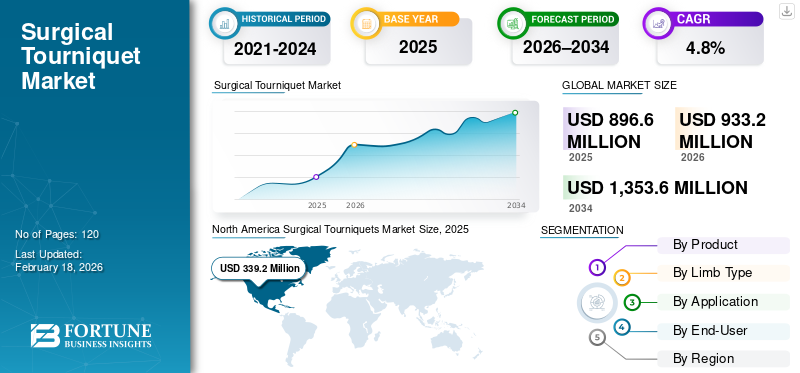
Download Free sample to learn more about this report.
SURGICAL TOURNIQUETS MARKET KEY TAKEAWAYS
 Global Market Size & Forecast
- 2025 Market Size: USD 896.6 million
- 2026 Market Size: USD 933.2 million
- 2034 Forecast Market Size: USD 1,353.6 million
- CAGR: 4.80% from 2026–2034
 Market Share
- North America dominated the global surgical tourniquets market with a market share of 37.83% in 2025.
- The tourniquet cuffs segment is anticipated to rise with a CAGR of 5.1% over the forecast period.
- The upper limb tourniquets segment is anticipated to rise with a CAGR of 4.3% over the forecast period.
 Key Regional Highlights
North America
North America dominated the market with a 32.21% share in 2025, supported by strong demand from e-commerce and logistics industries.
Europe
Europe is projected to grow at a 7.21% CAGR, driven by increasing adoption of sustainable packaging and advanced printing technologies.
Asia Pacific
Asia Pacific reached USD 8.77 billion in 2025, supported by expanding manufacturing activities and logistics networks.
U.S.
The U.S. market was valued at USD 10.92 billion in 2025, accounting for approximately 26.27% of global revenue.
Japan
The Japan market was valued at USD 1.59 billion in 2025, driven by demand for high-quality packaging solutions and expanding e-commerce activities.
Read More

SURGICAL TOURNIQUETS MARKET TRENDS
Rising Preference for Standardized Hospital-approved Brands is a Critical Trend
A noticeable trend in the surgical tourniquets market is the growing preference for standardized, hospital-approved brands rather than mixed or low-cost alternatives. Moreover, hospitals are reducing the number of vendors they work with and are preferring suppliers that can provide consistent quality across all operating rooms. This helps hospitals to avoid confusion, training issues, and product mismatch during surgeries. In addition, growing number of product approvals with enhanced handling is also estimated to augment this market trend.
Download Free sample to learn more about this report.
MARKET DYNAMICS
MARKET DRIVERS
Substantial Rise in Volume of Orthopedic Surgical Procedures to Drive Market Growth
Considerable rise in volume of orthopedic surgical procedures is estimated to accelerate the global surgical tourniquets market growth. In addition, growing prevalence of orthopedic conditions is also projected to drive the number of surgical procedures. Moreover, rising emphasis on infection prevention for better surgical outcome is also expected to accelerate market expansion during the forecast period.
- According to data published by the American Joint Replacement Registry in 2022, an estimated 2.8 million hip and knee surgeries are performed each year in the U.S.
MARKET RESTRAINTS
Safety Concerns and Strict Protocols to Hamper Market Growth
Safety concerns associated with the strict protocols are estimated to deter market growth. Tourniquets are helpful, however, there is a need for careful utilization. Problems can occur during surgery if pressure applied by the device is incorrect, or a cuff does not meet the necessary quality. These aspects enable hospitals to follow strict protocols and for product quality. Regulatory actions and recalls also make buyers cautious.
MARKET OPPORTUNITIES
Expansion of Surgery Infrastructure in Emerging Countries is Projected to Offer Lucrative Opportunities
Expansion of hospitals and surgical facilities in emerging countries creates growth opportunities for the market. Moreover, governments and private hospital chains are investing in new operation theatres outside major metro cities to meet rising healthcare demand. In addition, new hospitals offering orthopedic and trauma surgeries need essential surgical tools, including tourniquets. Many of these hospitals prefer cost-effective, reliable, and easy-to-train products rather than complex systems.
MARKET CHALLENGES
Product Performance and Compliance Pressure May Pose a Critical Challenge to Market Growth
The market faces a constant challenge for usage of tourniquets cuffs. Performance failures by these devices can lead to critical cases in surgery. Manufacturers must maintain tight quality control and comply with regulations across countries. Recalls also create operational pressure for hospitals and suppliers, such as the FDA recall for Stryker SmartPump tourniquet products where cuff flange detachment caused leakage during a procedure.
Segmentation Analysis
By Product
Higher Replacement Rate of Tourniquet Cuffs to Drive Segment Growth
Based on product, the market is divided into tourniquet systems, tourniquet cuffs, and accessories.
The tourniquet cuffs segment is anticipated to account for the largest surgical tourniquets market share as tourniquet cuffs are the most frequently replaced part of the setup. In addition, the rising number of surgical volumes is also projected to leverage segment growth. The segment is anticipated to rise with a CAGR of 5.1% over the forecast period.
To know how our report can help streamline your business, Speak to Analyst
The tourniquet systems segment is estimated to register CAGR of 4.3% during the forecast period.
By Limb Type
Substantial Volume of Leg Surgeries Boost Growth of Upper Limb Tourniquets
Based on limb type, the market is segmented into upper limb tourniquets and lower limb tourniquets.
In 2025, the lower limb tourniquets segment dominated the global market as many high-volume procedures are done on legs, especially knee surgeries, trauma fixation, and other orthopedic operations. In addition, lower limb procedures also often need stronger control due to larger limb size and longer operating time compared to many upper-limb cases. This increases demand for reliable cuffs, correct sizing, and stable pressure performance.
The upper limb tourniquets segment is anticipated to rise with a CAGR of 4.3% over the forecast period.
By Application
Considerable Number of Orthopedic Surgical Procedures to Propel Segment Growth
Based on application, the market is segmented into orthopedic surgery, plastic & reconstructive surgery, vascular surgery, general surgery, and others.
In 2025, the orthopedic surgery segment dominated the global market driven by substantial prevalence of orthopedic conditions and considerable volume of bone surgeries. In addition, emphasis of hospitals to prevent bleeding and strict focus on infection prevention is also projected to drive segment growth.
The plastic & reconstructive surgery segment is anticipated to rise with a CAGR of 4.8% over the forecast period.
By End-User
Higher Volume of Surgeries in Hospitals makes it a Leading End-user
Based on end-user, the market is segmented into hospitals, specialty clinics, and others.
In 2025, hospitals held the highest market share and is also set to hold 61.8% market share in 2026 as they perform the highest volume of surgeries and handle complex cases. In addition, they also have standardized procurement systems and typically buy full setups, tourniquet systems plus cuff inventory, across multiple operating rooms. Hospitals are very sensitive to compliance and safety, so they track recalls, labeling accuracy, and performance history.
The specialty clinics segment is projected to grow at a CAGR of 5.0% during the study period.
Surgical Tourniquets Market Regional Outlook
By geography, the market is categorized into Europe, North America, Asia Pacific, Latin America, and the Middle East & Africa.
North America
North America Surgical Tourniquets Market Size, 2025 (USD Million)
To get more information on the regional analysis of this market, Download Free sample
North America held the dominant share in 2024 at USD 327.1 million, and also maintained the leading share in 2025, with USD 339.2 million. The regional market is expected to increase due to higher emphasis on infection prevention during surgeries and high volume of orthopedic surgical procedures.
U.S Surgical Tourniquets Market
Based on North America’s strong contribution and the U.S. dominance within the region, the U.S. market can be analytically approximated at around USD 302.6 million in 2026, accounting for roughly 32.4% of global sales.
Europe
Europe is projected to record a growth rate of 4.2% in the coming years, and reach USD 251.1 million in 2026. The region is estimated to witness considerable growth due to rising investments for new product development, and growing incidence of orthopedic conditions.
U.K Surgical Tourniquets Market
The U.K. is estimated to reach USD 42.6 million in 2026, representing roughly 4.6% of global revenues.
Germany Surgical Tourniquets Market
Germany’s market is projected to reach approximately USD 59.0 million in 2026, equivalent to around 6.3% of global sales.
Asia Pacific
Asia Pacific is estimated to reach USD 231.1 million in 2026 and become the third-largest region. Improving healthcare infrastructure coupled with rising emphasis on safety protocols during surgical procedures are also estimated to accelerate regional growth.
Japan Surgical Tourniquets Market
In 2026, Japan is estimated to touch USD 40.3 million, accounting for roughly 4.3% of global revenues.
China Surgical Tourniquets Market
China’s market is projected to be one of the largest worldwide, with 2026 revenues estimated at around USD 76.9 million, representing roughly 8.2% of global sales.
India Surgical Tourniquets Market
The Indian market in 2026 is estimated at around USD 51.5 million, accounting for roughly 5.5% of global revenues.
Latin America and the Middle East & Africa
The Latin America and the Middle East & Africa are expected to witness moderate growth during the forecast period. Latin America is set to reach USD 59.1 million in 2026. In the Middle East & Africa, the GCC is set to achieve USD 11.0 million in 2026.
South Africa Surgical Tourniquets Market
The South African market is projected to reach around USD 4.5 million in 2026, representing roughly 0.49% of global revenues.
COMPETITIVE LANDSCAPE
Key Industry Players
Increasing Investments by Market Players for Advancements in Technology to Boost Market Progress
The global surgical tourniquets market holds a semi-consolidated market structure, constituting prominent players such as Zimmer Biomet, Stryker Corporation, Delfi Medical Innovations, VBM Medizintechnik, and Ulrich Medical. The market share of these companies is due to numerous strategic activities, including massive investments and product approvals.
- For instance, in January 2026, Healthcare Holding Schweiz AG completed acquisition of PlusORTHO Prothetik GmbH. Through this acquisition, the company is planning to consolidate its presence in the orthopedic surgical procedures market.
Other notable players in the global market are AneticAid, Hammarplast Medical, OHK Medical Devices, B. Braun Melsungen AG, and Medline Industries. These companies are expected to prioritize collaborations to increase their global market share during the forecast period.
LIST OF KEY SURGICAL TOURNIQUETS COMPANIES PROFILED
- Zimmer Biomet (U.S.)
- Stryker Corporation (U.S.)
- Delfi Medical Innovations (Canada)
- VBM Medizintechnik (Germany)
- Ulrich Medical (Germany)
- AneticAid (U.K.)
- Hammarplast Medical (Sweden)
- OHK Medical Devices (Israel)
- Braun Melsungen AG (Germany)
- Medline Industries (U.S.)
- Cardinal Health (U.S.)
KEY INDUSTRY DEVELOPMENTS
- November 2025: Advita Ortho launched as a global orthopedic medical device company focused on integrated surgical technologies, AI-powered platforms, and implants to support surgeons and enhance patient care.
- August 2025: Arthrex NanoScope system received pediatric clearance, expanding its use in minimally invasive orthopedic and laparoscopic procedures, reflecting ongoing innovation in surgical visualization tools.
- July 2025: Zimmer Biomet announced its plan to acquire Monogram Technologies with an aim to consolidate its presence in robotic surgical procedures and other associated products.
- March 2025: Johnson & Johnson MedTech showcased its latest digital orthopedics innovations, including advanced implants and data-driven surgical technologies, at the AAOS 2025 annual meeting.
- March 2024: AW Technologies entered into strategic collaboration with Asahi Kasei Medical for distribution of pressure cuffs in Japan.
REPORT COVERAGE
Request for Customization to gain extensive market insights.
Report Scope & Segmentation
|
ATTRIBUTE |
DETAILS |
|
Study Period |
2021-2034 |
|
Base Year |
2025 |
|
Estimated Year |
2026 |
|
Forecast Period |
2026-2034 |
|
Historical Period |
2021-2024 |
|
Growth Rate |
CAGR of 4.8% from 2026-2034 |
|
Unit |
Value (USD Million) |
|
Segmentation |
By Product, Limb Type, Application, End-User, and Region |
|
By Product |
|
|
By Limb Type |
|
|
By Application |
|
|
By End-User |
|
|
By Region |
|
Frequently Asked Questions
According to Fortune Business Insights, the global market value stood at USD 896.6 million in 2025 and is projected to reach USD 1,353.6 million by 2034.
In 2025, North Americas market value stood at USD 339.2 million.
The market is expected to exhibit a CAGR of 4.8% during the forecast period of 2026-2034.
By product, the tourniquet cuffs segment is expected to lead the market.
Rising emphasis on infection prevention during surgical procedures and rising number of orthopedic procedures are driving market expansion.
Zimmer Biomet, Stryker Corporation, Delfi Medical Innovations, VBM Medizintechnik, and Ulrich Medical are the major players in the global market.
North America dominated the market in 2025 by holding the largest share.



- 2021-2034
- 2025
- 2021-2024
- 120
Get 30-60 hrs Free Customization
Expand Regional and Country Coverage, Segments Analysis, Company Profiles, Competitive Benchmarking, and End-user Insights.













.webp)






Related Reports
-
US +1 833 909 2966 ( Toll Free )
-
Get In Touch With Us