Sustainable Aerosol Packaging Market Size, Share & Industry Analysis, By Material (Metal, Plastic, and Others), By Product Type (Bottles & Cylinders, Cans, Caps & Closures, and Others), By End-use Industry (Personal Care & Cosmetics, Household, Food & Beverages, Automotive, Healthcare, and Others), and Regional Forecast, 2026-2034
 Download Free Sample
(Offer valid till 15th Oct 2026)

Sustainable Aerosol Packaging Market Size and Future Outlook
 Listen to Audio Version
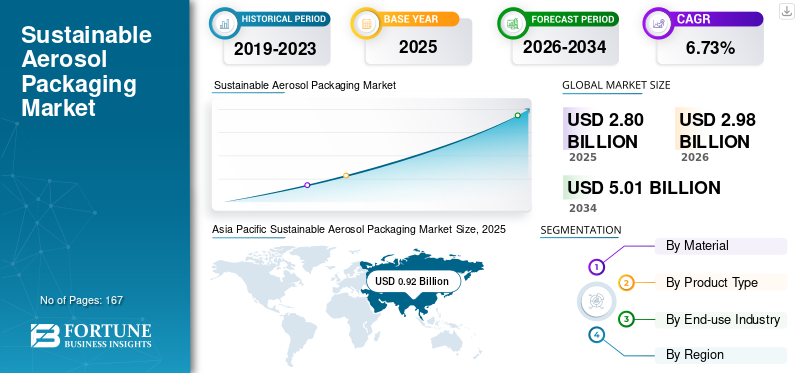
The global sustainable aerosol packaging market size was valued at USD 2.80 billion in 2025 and is projected to grow from USD 2.98 billion in 2026 to USD 5.01 billion by 2034, exhibiting a CAGR of 6.73% during the forecast period. Asia Pacific dominated the global sustainable aerosol packaging market with a market share of 32.86% in 2025.
Sustainable aerosol packaging refers to eco-friendly aerosol containers designed to minimize their environmental impact throughout their entire lifecycle, encompassing material sourcing, production, use, disposal, and recycling. These packages utilize materials that are recyclable, reusable, renewable, or have a lower carbon footprint, and are designed to reduce waste, energy use, and emissions.
The market is dominated by several major players, including Crown Holdings, Inc., Ball Corporation, and Silgan Dispensing Systems. A broad portfolio, innovative product launches, and strong geographic presence expansion have supported the dominance of these companies.
Download Free sample to learn more about this report.
Sustainable Aerosol Packaging Market Key Takeaways
 Market Size & Forecast
- 2025 Market Size: USD 2.80 billion
- 2026 Market Size: USD 2.98 billion
- 2034 Forecast Market Size: USD 5.01 billion
- CAGR: 6.73% from 2026-2034
 Market Share
- Asia Pacific dominated the sustainable aerosol packaging market with a 32.86% share in 2025.
- The metal segment held the largest market share of 54.10% in 2025.
- The bottles and cylinders segment captured a 44.54% share in 2025.
 Key Regional Highlights
Asia Pacific
Asia Pacific reached USD 0.92 billion in 2025, maintaining its leadership due to strong demand for sustainable packaging solutions.
North America
North America recorded USD 0.77 billion in 2025, supported by increasing adoption of recyclable aerosol packaging materials.
Europe
Europe attained USD 0.57 billion in 2025, driven by stringent environmental regulations and sustainability initiatives.
U.S.
The market achieved USD 0.62 billion in 2025 due to rising consumer preference for eco-friendly packaging products.
Japan
Growing investments in sustainable packaging technologies are supporting market expansion.
Read More

MARKET DYNAMICS
MARKET DRIVERS
Growing Focus on Eco-friendly Packaging Solutions Fuels Market Growth
The growing global focus on sustainability and environmental protection is a significant factor propelling the sustainable aerosol packaging market growth. Increasing concerns about plastic waste and greenhouse gas emissions are prompting manufacturers to utilize eco-friendly materials, such as aluminum, steel, recycled plastics, and bio-based polymers, in aerosol packaging. Regulatory measures, such as the EU Packaging and Packaging Waste Directive, along with efforts toward circular economy models, are motivating companies to transition from traditional packaging to recyclable and refillable aerosol systems. Additionally, the growing consumer inclination toward sustainable personal care, household, and food products is driving the demand for environmentally friendly aerosol packaging solutions.
MARKET RESTRAINTS
High Production Costs and Limited Material Availability Hamper Growth
Despite the growing demand, the high expenses associated with producing sustainable aerosol packaging continue to pose a considerable limitation. Materials such as post-consumer recycled (PCR) aluminum or bioplastics often incur higher procurement and processing costs compared to traditional materials. Furthermore, the restricted access to advanced recycling facilities in developing areas hampers the scalability of sustainable packaging manufacturing. The intricate design and compatibility issues associated with substituting conventional propellants with environmentally friendly alternatives further complicate the manufacturing process and intensify the financial pressures faced by producers.
MARKET OPPORTUNITIES
Innovation in Material Technologies and Circular Economy Strategies Creates Growth Avenues
The market offers considerable opportunities due to progress in material science and packaging technologies. Innovations in bio-based polymers, lightweight metal alloys, and aerosol refill systems are leading to the development of fully recyclable and carbon-neutral packaging solutions. Companies are progressively investing in closed-loop systems and forming partnerships with recycling firms to enhance circular economy practices. Furthermore, emerging markets in Asia Pacific and Latin America, where awareness of sustainability is growing rapidly, present profitable expansion opportunities for global manufacturers seeking to establish local eco-friendly production facilities and supply chains.
SUSTAINABLE AEROSOL PACKAGING MARKET TRENDS
Shift Toward Refillable and Recyclable Aerosol Systems Gain Momentum
The market is experiencing a significant shift toward the use of refillable, recyclable, and mono-material aerosol packaging. Leading brands are launching aluminum and steel aerosol cans that contain a high percentage of recycled materials and are establishing return-and-refill initiatives to reduce waste. Collaboration among FMCG brands, packaging converters, and material innovators is increasing to create carbon-neutral packaging solutions. Furthermore, the integration of digital printing and smart labeling is being implemented to improve traceability and communication regarding sustainability. The increasing adoption of Life-Cycle Assessment (LCA) tools by companies to evaluate and disclose their carbon footprint indicates a heightened dedication to transparent and sustainable packaging practices.
MARKET CHALLENGES
Regulatory Complexity and Recycling Infrastructure Gaps Pose Challenges
One of the primary challenges facing the sustainable aerosol packaging industry is the fragmented and constantly changing regulatory landscape across different regions. The differing standards for recyclability, labeling, and material safety complicate international operations. Additionally, the absence of uniform recycling systems and insufficient collection facilities in various parts of the globe restricts the effectiveness of sustainable packaging efforts. Technical difficulties associated with preserving product integrity and performance, particularly in high-pressure aerosol systems, while ensuring compliance with environmental regulations, also impede swift adoption.
Download Free sample to learn more about this report.
Segmentation Analysis
By Material
Superior Recyclability and Performance Capabilities Drive Metal Segment Leadership
In terms of material, the market is categorized into metal, plastic, and others.
The metal segment dominated the market in 2025 with a 54.10% share due to its outstanding recyclability, durability, and compatibility with high-pressure aerosol applications. Aluminum and steel, the two predominant metals utilized, provide nearly infinite recyclability without compromising quality, thus aligning closely with global sustainability and circular economy objectives. In contrast to plastics, which deteriorate after several recycling processes, metals can be reprocessed continuously, greatly minimizing environmental impact and facilitating closed-loop recycling systems.
The plastic material segment is expected to grow at a CAGR of 6.57% over the forecast period.
By Product Type
Versatility, High Compatibility, and Strong Sustainability Performance Drive Bottles & Cylinders Segment Dominance
In terms of product type, the market is categorized into bottles & cylinders, cans, caps & closures, and others.
In 2205, the bottles and cylinders segment captured the largest sustainable aerosol packaging market share of 44.54% due to the exceptional structural integrity, functionality, and environmental performance these formats provide, which are essential for contemporary aerosol applications. Bottles and cylinders, predominantly constructed from aluminum, steel, or recyclable materials, exhibit excellent pressure resistance, rendering them suitable for containing eco-friendly propellants and ensuring product safety. This durability ensures compatibility with a wide range of formulations used in personal care, household, automotive, and food aerosols.
The cans segment is expected to grow at a CAGR of 6.60% over the forecast period.
By End-use Industry
High Consumption Volume and Strong Sustainability Demand Fuel Personal Care & Cosmetics Segment
Based on end-use industry, the market is segmented into personal care & cosmetics, household, food & beverages, automotive, healthcare, and others.
To know how our report can help streamline your business, Speak to Analyst
In 2025, the global market was dominated by personal care and cosmetics in terms of end-user and captured a 32.27% share. The personal care and cosmetics sector is driven by significant product consumption, the swift implementation of sustainability initiatives, and a robust consumer inclination and demand for eco-friendly packaging options. Products in aerosol form, including deodorants, hair sprays, shaving foams, dry shampoos, body sprays, and setting sprays, are commonly used in everyday routines, resulting in substantial global demand for aerosol packaging in this industry. Consequently, brands within the personal care category account for the largest portion of total aerosol packaging demand, thereby naturally spearheading the transition toward sustainable packaging formats.
The household end-use industry is projected to grow at a CAGR of 7.09% during the study period.
Sustainable Aerosol Packaging Market Regional Outlook
By geography, the market is categorized into Europe, North America, Asia Pacific, Latin America, and the Middle East & Africa.
Asia Pacific
Asia Pacific held the dominant share in 2024, valued at USD 0.86 billion, and maintained its leading position in 2025, with a value of USD 0.92 billion. The region is experiencing rapid market expansion driven by urbanization, rising disposable incomes, and heightened awareness of sustainable consumption in China, Japan, South Korea, and India. Government initiatives that encourage eco-friendly packaging, including Japan’s Plastic Resource Circulation Act and India’s Extended Producer Responsibility (EPR) framework, are facilitating greater adoption. In 2025, China generated a revenue of USD 0.31 billion, while India captured 0.25 billion.
Asia Pacific Sustainable Aerosol Packaging Market Size, 2025 (USD Billion)
To get more information on the regional analysis of this market, Download Free sample
North America
North American holds the second position and is projected to record a growth rate of 6.85%. In 2025, the region attained a market size of USD 0.77 billion. In North America, significant sustainability efforts by leading consumer goods companies, along with strong regulatory measures such as the waste reduction policies of the U.S. EPA, are promoting the use of environmentally friendly aerosol packaging. Both the U.S. and Canada are experiencing an increase in investments in recycled aluminum and steel aerosol formats, driven by heightened consumer demand and corporate ESG objectives. In 2025, the U.S. market achieved USD 0.62 billion.
Europe
Europe’s market size reached USD 0.57 billion in 2025, securing third position in the global market. Europe continues to lead the sustainable aerosol packaging market, largely due to rigorous EU regulations, such as the Packaging and Packaging Waste Regulation (PPWR), and the effective implementation of the European Green Deal. With these regulations, Germany achieved 0.13 billion in 2025, while the U.K. and France recorded USD 0.11 billion and USD 0.08 billion respectively. The region's well-established recycling infrastructure and significant consumer inclination toward sustainable products serve as key factors for growth.
Latin America and the Middle East & Africa
Latin America in 2025 garnered USD 2.81 billion. In Latin America, the market momentum is largely driven by multinational consumer goods firms expanding their sustainable product offerings in Brazil, Mexico, and Chile. Additionally, the increasing environmental consciousness among urban consumers is contributing to this transformation.
In the Middle East & Africa, South Africa reached a value of USD 0.07 billion in 2025. The Middle East and Africa (MEA) region represents a growing market for sustainable aerosol packaging, driven by increasing consumer interest in international brands that prioritize environmentally friendly packaging. The primary leadership in sustainability initiatives is coming from the Gulf Cooperation Council (GCC) nations, where national strategies prioritize waste minimization and green manufacturing. Industries such as personal care and cosmetics will also provide potential growth opportunities.
COMPETITIVE LANDSCAPE
Key Industry Players
Prominent Firms Concentrate on Deploying Strategic Activities to Expanding Regional Share
The sustainable aerosol packaging market is semi-consolidated as it includes a variety of small and mid-size companies, who focus on innovation, partnerships, and increasing regional market share. Crown Holdings, Inc., Ball Corporation, and Silgan Dispensing Systems lead with their wide range of product portfolio and robust distribution network. These companies also have a strong focus on partnerships and collaborations. Apart from this, other prominent players in the market include Sonoco Products Company, CCL Container, and Trivium Packaging.
LIST OF KEY SUSTAINABLE AEROSOL PACKAGING COMPANIES PROFILED
- Crown Holdings, Inc. (U.S.)
- Ball Corporation (U.S.)
- Silgan Dispensing Systems (U.S.)
- Sonoco Products Company (U.S.)
- CCL Container (U.S.)
- Trivium Packaging (Netherlands)
- Tecnocap S.p.A. (Italy)
- Aeropak A/S. (Denmark)
- Graham Packaging (U.S.)
- Tubex GmbH (Germany)
- Montebello Packaging (Canada)
- Canpack (Poland)
- Hindustan Tin Works Ltd (India)
- Signature Filling Company, LLC. (U.S.)
- CPM (U.S.)
KEY INDUSTRY DEVELOPMENTS
- November 2025: Alcoa, along with the aluminum packaging provider Ball Corporation and the global consumer goods firm Unilever, launched the inaugural consumer personal and home care packaging that utilizes the ELYSIS carbon-free aluminum smelting technology. The innovative aerosol cans are composed of 50% ELYSIS primary aluminum and 50% recycled content from post-consumer sources. The collaborating partners have characterized this product as one of the lowest-carbon alternatives available in the market.
- September 2023: Ball Corporation published a new report detailing the transformative capabilities of Eyeris, its proprietary advanced printing technology designed for aluminum cans and impact extruded bottles. Eyeris offers exceptional visual appeal, aligning with the growing consumer preferences for sustainable packaging.
- June 2022: Ball Corporation launched its most sustainable aluminum aerosol can on a global scale, featuring a carbon footprint that is only half that of a conventional can. This initiative will support Ball's goal of meeting its 2030 science-based targets and achieving net-zero emissions by 2050.
- April 2022: Sidel introduced PressureSAFE, a groundbreaking design for PET aerosol containers, providing home and personal care brands with the opportunity to deliver more environmentally sustainable spray packaging. This novel PET packaging solution is certified for the conventional PET recycling stream. PressureSAFE upholds the utmost standards of product safety, ensuring that PET containers are as secure as their metal aerosol counterparts.
- June 2021: The German consortium, Beiersdorf, collaborated with the Swiss packaging expert Nussbaum to manufacture aerosol cans entirely composed of post-consumer recycled aluminum. This innovative aerosol packaging, made solely from used beverage cans, underwent a year of development. All aluminum beverage cans utilized as raw materials are procured locally from southern Germany, Austria, and Switzerland, ensuring short transportation routes.
REPORT COVERAGE
The global sustainable aerosol packaging market analysis provides an in-depth study of the market size & forecast by all the market segments included in the report. It includes details on market dynamics and trends expected to drive the market during the forecast period. It offers information on the technological advancements, new product launches, key industry developments, and details on partnerships, mergers & acquisitions. The report also encompasses a detailed competitive landscape, including market share and profiles of key operating players.
Request for Customization to gain extensive market insights.
Report Scope & Segmentation
| Attribute | Details |
| Study Period | 2021-2034 |
| Base Year | 2025 |
| Forecast Period | 2026-2034 |
| Historical Period | 2021-2024 |
| Growth Rate | CAGR of 6.73% from 2026-2034 |
| Unit | Value (USD Billion) |
| Segmentation | By Material, Product Type, End-use Industry, and Region |
| By Material |
|
| By Product Type |
|
| By End-use Industry |
|
| By Geography |
|
Frequently Asked Questions
Fortune Business Insights says that the global market value stood at USD 2.80 billion in 2025 and is projected to reach USD 5.01 billion by 2034.
In 2025, Asia Pacific’s market value stood at USD 0.92 billion.
The market is expected to exhibit a CAGR of 6.73% during the forecast period of 2026-2034.
The bottles and cylinders segment led the market by product type.
The key factor driving market growth is the growing focus on eco-friendly packaging solutions.
Crown Holdings, Inc., Ball Corporation, Silgan Dispensing Systems, Sonoco Products Company, CCL Container, and Trivium Packaging are some of the prominent players in the market.
Asia Pacific dominated the market in 2025 by capturing the largest share.
The increase in demand for personal care household products favors product adoption.



- 2021-2034
- 2025
- 2021-2024
- 167
-
(Offer valid till 15th Oct 2026)
Get 30-60 hrs Free Customization
Expand Regional and Country Coverage, Segments Analysis, Company Profiles, Competitive Benchmarking, and End-user Insights.










Related Reports
-
US +1 833 909 2966 ( Toll Free )
-
Get In Touch With Us