Sustainable Food Market Size, Share & Industry Analysis, By Product Category (Sustainably Produced Conventional Foods, Organic Foods, Sustainably Sourced Seafood, Plant-Based & Alternative Proteins, and Upcycled & Circular Economy Foods), By Distribution Channel (Retail (Supermarkets, Hypermarkets, Specialty), Foodservice (HORECA, Institutional), Online/DTC, and B2B/Industrial (Ingredients, Private Label Supply)), By Certification Type (Third-Party Certified, Company-Verified/Self-Declared, and Non-Certified Sustainable Practices), and Regional Forecast, 2026-2034
 Download Free Sample
(Offer valid till 15th Oct 2026)

Sustainable Food Market Size and Future Outlook
 Listen to Audio Version
The global sustainable food market size was valued at USD 928.36 billion in 2025 and is projected to grow from USD 998.77 billion in 2026 to USD 1,880.68 billion by 2034, exhibiting a CAGR of 8.23% during the forecast period. Asia Pacific dominated the global sustainable food market with a market share of 35.19% in 2025.
Sustainable food is food that is produced, processed, and distributed with minimal environmental impact, supporting social responsibility and meeting the nutritional needs of consumers. Such practices help to lower greenhouse gas emissions and environmental degradation and animal welfare. Food products can either be certified by third parties or verified through company-led sustainability frameworks. Some of the food products are Not Certified but are manufactured using Sustainable Practices. Some of the food is manufactured in accordance with recognized sustainability principles but is not formally verified through third-party certification schemes. Sustainable food production is gaining traction globally as producers adopt resource-efficient practices to reduce environmental impact while maintaining scalable food output.
Companies such as Danone S.A., Nestlé S.A., and Unilever PLC, among others are some of the key players operating in this market. Strategic Collaboration is the key strategy adopted to boost product sales and support the sustainable food market growth.
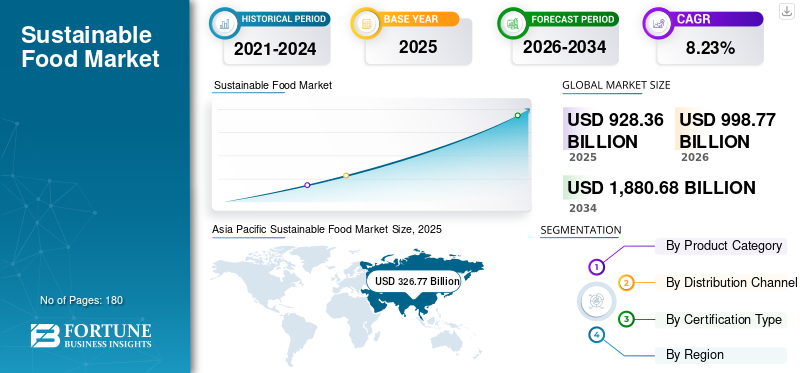
Download Free sample to learn more about this report.
Sustainable Food Market Key Takeaways
 Global Market Size & Forecast
- 2025 Market Size: USD 928.36 billion
- 2026 Market Size: USD 998.77 billion
- 2034 Forecast Market Size: USD 1,880.68 billion
- CAGR: 8.23% from 2026–2034
 Market Share
- Asia Pacific dominated the sustainable food market with a 35.19% share in 2025.
- Sustainably produced conventional foods held the leading segment share in 2025 due to high consumption.
- Retail distribution channel accounted for the largest market share in 2025.
 Key Regional Highlights
Asia Pacific
Asia Pacific reached USD 326.77 billion in 2025, holding the largest market share due to urbanization and rising sustainable food demand.
Europe
Europe recorded USD 235.02 billion in 2025, supported by strong regulations and consumer awareness.
North America
North America reached USD 214.57 billion in 2025, driven by organic and plant-based food adoption.
U.S.
The U.S. market reached USD 172.51 billion in 2025, led by demand for sustainable and certified food products.
Japan
The Japan market reached USD 46.17 billion in 2025, accounting for 4.97% of global revenues.
Read More

SUSTAINABLE FOOD MARKET TRENDS
Rising Focus On Measurable Sustainability Outcomes is a key trend Shaping Up Industry Growth
Export-oriented supply chains are increasingly seeking heightened certification requirements, pushing domestic companies to adopt government-verified sustainability frameworks. Similarly, in the foodservice sector, food creators are incorporating sustainability criteria for procuring food products to create their menus. Furthermore, advancements in alternative proteins, food waste reduction initiatives, and sustainable packaging solutions are also fueling the market growth. There is also a rising focus on measurable sustainability outcomes, including lifecycle assessments and the verification of environmental impact, which is expected to support long-term market growth.
Download Free sample to learn more about this report.
MARKET DYNAMICS
MARKET DRIVERS
Growing Concern on Health and Environment Sustainability Supports Market Growth
Growing urbanization, higher disposable incomes, and the expansion of modern retail and foodservice channels also support the scalable adoption of sustainable food products globally. There is a rising awareness among consumers about the necessity of environmental, social, and health impacts of consuming food products, and this increasing concern has accelerated demand for responsibly sourced, ethically produced foods. Rising consumer awareness and health concerns are driving strong demand for organic foods, particularly in developed markets with established certification frameworks. There are several favorable regulatory policies undertaken by governments in several countries that boost sustainable agriculture, fisheries management, and food traceability, especially in the developed economies. Such factors have positively fueled the global sustainable food market growth.
MARKET RESTRAINTS
Supply Chain Complexity and High Cost Risk Impede Market Growth
The cost of sustainable food production remains a key challenge, as higher input, compliance, and certification expenses continue to influence pricing and adoption rates. Companies that manufacture food using sustainable methods have to incur high production costs and certification expenses. Moreover, such programs can also lead to increased complexity in the supply chain, leading to a higher cost of the products. Certification standards are also fragmented and vary from region to region, creating further compliance burden. Moreover, yield variability, climate-related disruptions, and limited access to financing for smallholder farmers constrain consistent supply, hindering market growth.
MARKET OPPORTUNITIES
Adoption of Sustainable Farming Practices Create Opportunity For Growth
Several farmers have adopted advanced agricultural practices to produce crops. Regenerative agriculture, sustainable aquaculture, and water-efficient farming are some of the key agricultural practices that are used to scale production. The Food and Agriculture Organization of the United Nations plays a critical role in promoting global sustainability standards and best practices across agriculture and food systems. Hence, with the growing adoption of such practices, more farmers would want to comply with sustainability standards, leading to increased adoption of such certifying programs to boost sales. Emerging markets offer long-term demand potential as incomes rise and retail infrastructure improves. Digital traceability, data-driven sourcing, and supplier transparency also create opportunities for differentiation and operational efficiency.
Segmentation Analysis
By Product Category
Sustainably Produced Conventional Foods Accounts For Majority Market Share Due to High Consumption
The market is segmented by product category type into sustainably produced conventional foods, organic foods, sustainably sourced seafood, plant-based & alternative proteins, and upcycled & circular economy foods.
The sustainably produced conventional foods segment is projected to hold the largest market share in 2025 dominating the cereal ingredients market. Sustainably produced conventional foods maintain the largest market share due to their widespread consumption in food categories such as grains, fruits, vegetables, meat, and dairy. Such products are produced in high volume and sold through supply chains, and adopt regenerative agriculture. Lower certification costs and flexible compliance frameworks further promote widespread adoption in both developed and emerging markets.
Organic food is another major segment, amounting to 8.25% CAGR during the forecast period. Organic food consumption is popular in the market due to consumer trust in certification and a clear value proposition centered on chemical-free production and environmental stewardship. But high production costs, yield constraints, and premium pricing limit volume growth.
To know how our report can help streamline your business, Speak to Analyst
By Distribution Channel
Retail distribution channel Accounted for Leading Market Share Due to High Consumer Confidence On Product Sold
Based on the distribution channel, the sustainable food market segment includes retail (supermarkets, hypermarkets, and specialty), foodservice (HORECA, institutional), online/DTC, and B2B/industrial (ingredients, private label supply).
Retail distribution channel accounts for the largest market share in 2025. The retail sector remains the leading distribution channel for sustainable food products, driven by its extensive product assortment, enhanced accessibility, and high consumer confidence on certified offerings sold through such channels. Physical retail outlets offer a wide range of fresh produce, meat, dairy, and seafood, enabling consumers to assess product quality before purchase. In addition, retailers implement sustainability compliance requirements across their supplier networks, which further supports the expansion of this segment.
Online/DTC is another major segment, amounting to 9.57% CAGR during the forecast period. Online distribution follows retail as the fastest-growing channel, as consumers can directly purchase the products from the convenience of their home. Such platforms provide consumers access to premium, niche, and plant-based sustainable foods, and such websites detail the certification programs of each company.
By Certification Type
Third-Party Certified Held Majority Market Share Due To High Consumer Trust
The market is segmented, by certification type into third-party certified, company-verified/self-declared, and non-certified sustainable practices.
Third-party certified is the largest segment accounting for the largest market share in 2025. Third-party certified products account for the largest share of the sustainable food market due to strong regulatory backing, standardized compliance frameworks of these companies, and high consumer trust on such organizations. These certifications are often mandated or strongly preferred by regulatory bodies, large retailers, and importers. As a result, certified products are popular in Europe and developed markets with stringent labeling and procurement standards.
Company-verified/self-declared is another major category that has a CAGR of 8.06% during the forecast period. Many manufacturers have internal sustainability standards that help to reduce cost, certification time, and operational complexity. Private labels for manufacturers to use such certifications to establish trust in their products among consumers.
Sustainable Food Market Regional Outlook
By region, the market is categorized into Europe, North America, Asia Pacific, South America, and the Middle East & Africa.
Asia Pacific
Asia Pacific Sustainable Food Market Size, 2025 (USD Billion)
To get more information on the regional analysis of this market, Download Free sample
The Asia Pacific market is valued at USD 326.77 billion in 2025 and is one of the fastest growing regions in the world. The Asia Pacific region is the leading region that consumes sustainable food owing to the high disposable income and urbanization in the region. Governments and industry stakeholders are increasingly focused on building sustainable food systems that balance environmental protection, food security, and economic viability. Such products are consumed on a regular basis, and the products generate export-oriented supply chains. Expansion of e-commerce platforms and modern retail in this region also accelerates the access to sustainable products across the region.
India Sustainable Food Market
The India market in 2025 was around USD 32.91 billion, accounting for roughly 3.54% of global market revenues.
China Sustainable Food Market
China’s market in 2025 was around USD 141.12 billion, representing roughly 15.20% of global market sales.
Japan Sustainable Food Market
The Japan market in 2025 reached around USD 46.17 billion, accounting for roughly 4.97% of global market revenues.
North America
The market in North America cereal ingredients market reached USD 214.57 billion in 2025. Consumers are highly willing to pay huge amounts for organic, plant-based, and responsibly sourced foods. The sale of such products is heavily influenced by Corporate ESG commitments, private-label sustainability programs, and foodservice procurement standards. Companies continue to innovate and generate premium-quality products for health-conscious consumers. Organic farming is expanding steadily, supported by regulatory incentives and growing consumer trust in certified production methods.
U.S. Sustainable Food Market
In 2025, the U.S. market reached USD 172.51 billion and represents the largest and most commercially mature sustainable food market globally. The strong demand in the region is driven by high consumption of organic foods, sustainably sourced seafood, and plant-based alternatives. Foodservice, particularly institutional and quick-service restaurants, is increasingly integrating sustainably sourced products in their menus to meet transparency and climate goals.
Europe
The European market reached USD 235.02 billion by 2025 and secured the position of the second-largest region in the market. Europe is a mature market for sustainable food products, and the region has strong regulatory enforcement, high consumer awareness, and widespread trust in certified food products. Organic food products are consumed heavily in the region, and several retailers sell certified products in the region. Preference for locally sourced food is increasing as consumers seek transparency, freshness, and reduced supply-chain complexity. Companies are further aligning their policies, improving and enhancing institutional procurement, and increasing their penetration further in unexplored markets in Southern and Eastern Europe.
Germany Sustainable Food Market
The market in Germany in 2025 reached around USD 48.71 billion, representing roughly 5.25% of global market revenues.
U.K. Sustainable Food Market
U.K. Cereal Ingredients market reached approximately USD 35.40 billion in 2025, equivalent to around 3.81% of global market sales.
South America and Middle East & Africa
Over the forecast period, South America is expected to experience significant growth in this market. The South America market in 2025 recorded USD 90.41 billion and the countries produce agricultural products such as grains, meat, seafood, and organic products, which are primarily exported to several other countries. Countries such as Brazil, Chile, and Argentina therefore have a stringent regulatory framework which helps them to ensure that their products are export-friendly and environmentally friendly to Europe and North American markets. However, domestic consumption remains limited owing to the high cost of the products. The Middle East and Africa region was estimated to be USD 61.59 billion in 2025. The Middle East market is a sustainable food-driven market, and the market in the region is value-driven, supported by imports, expansion of premium retail brands in the market, and hospitality-led procurement in the region. Sustainability initiatives are increasingly influencing the production and sourcing of dairy products and other produce, with emphasis on animal welfare, emissions reduction, and traceability. The region’s growth is primarily supported by a high expat population, export-oriented compliance, and growth in premiumized product consumption across urban and tourism-focused areas.
GCC Countries Sustainable Food Market
GCC Countries market is set to grow at a CAGR of 7.56% during the forecast period. Sustainable products are sold across major retail channels as they are growing in popularity among consumers.
COMPETITIVE LANDSCAPE
Key Industry Players
Strategic Collaboration is the Key Strategy Used By Companies To Differentiate Their Products
The global sustainable food market exhibits a moderately fragmented market with several multinational food companies, regional champions, and emerging niche players competing with each other. Such companies are adopting strategic initiatives such as private-label partnerships, certification programs, and long-term supplier contracts. to boost sales. A long term shift toward sustainability is reshaping agricultural investment, policy frameworks, and food supply-chain strategies worldwide. Hence several manufacturers are focusing on specializing in organic foods, plant-based alternatives, or certified export-oriented products. Competition is shifting from brand-led sustainability claims toward supply-chain credibility, boosting cost efficiency, and delivering sustainability initiatives across diverse markets.
LIST OF SUSTAINABLE FOOD COMPANIES PROFILED
- Danone S.A. (France)
- Nestlé S.A. (U.S.)
- Unilever PLC (U.K.)
- General Mills, Inc. (U.S.)
- Kellogg Company (U.S.)
- The Kraft Heinz Company (US)
- Olam Group (Singapore)
- Associated British Foods plc (U.K.)
- Hormel Foods Corporation (U.S.)
- Tyson Foods, Inc. (U.S.)
KEY INDUSTRY DEVELOPMENTS
- December 2024: Kraft Heinz Company integrated sustainability practices into its core food brands, focusing on reducing supply-chain emissions and responsibly source ingredients such as tomatoes while reducing waste generation.
- March 2023: Olam Group advanced traceability across its supply chains, by partnering with 483,000 farmers to meet sustainability goals and adapt itself with the regulations such as the EUDR.
- September 2021: Nestlé S.A. invested USD 1.3 billion to help farmers switch to regenerative agriculture practices. Crops manufactured using these practices are used for manufacturing a wide range of products.
- March 2021: Tyson Foods partnered with Protix, to develop insect-based ingredients for sustainable protein while reducing food industry waste generation.
- January 2021: Danone S.A. advanced its "One Planet. One Health" strategy by emphasizing on sustainability commitments and pivoting toward healthier, locally tailored, and regenerative food systems.
REPORT COVERAGE
Request for Customization to gain extensive market insights.
Report Scope & Segmentation
|
ATTRIBUTE |
DETAILS |
|
Study Period |
2021-2034 |
|
Base Year |
2025 |
|
Estimated Year |
2026 |
|
Forecast Period |
2026-2034 |
|
Historical Period |
2021-2024 |
|
Growth Rate |
CAGR of 8.23% from 2026-2034 |
|
Unit |
Value (USD Billion) |
|
Segmentation |
By Product Category, Distribution Channel , Certification Type and Region |
|
By Product Category |
|
|
By Distribution Channel |
|
|
By Certification Type |
|
|
By Region |
North America (By Product Category, Distribution Channel, Certification Type and Country)
Europe (By Product Category, Distribution Channel, Certification Type and Country)
Asia Pacific (By Product Category, Distribution Channel, Certification Type and Country)
South America (By Product Category, Distribution Channel , Certification Type and Country)
Middle East and Africa (By Product Category, Distribution Channel, Certification Type and Country)
|
Frequently Asked Questions
Fortune Business Insights says that the global market value stood at USD 928.36 billion in 2025 and is projected to reach USD 1,880.68 billion by 2034.
In 2025, the market value stood at USD 326.77 billion.
The market is expected to exhibit a CAGR of 8.23% during the forecast period.
By product category, sustainably produced conventional foods segment led the global market in 2025.
The growing concern on health and environment sustainability supports market growth.
Danone S.A., Nestle S.A., and Unilever PLC, among others are a few of the players in the sustainable food market.
Asia Pacific held the largest market share in 2025.
The rising focus on measurable sustainability outcomes is a key trend shaping up industry growth.



- 2021-2034
- 2025
- 2021-2024
- 180
-
(Offer valid till 15th Oct 2026)
Get 30-60 hrs Free Customization
Expand Regional and Country Coverage, Segments Analysis, Company Profiles, Competitive Benchmarking, and End-user Insights.




















-
US +1 833 909 2966 ( Toll Free )
-
Get In Touch With Us