Computer on Module Market Size, Share & Industry Analysis, By Product Type (ARM Architecture, x86 Architecture, and Power Architecture), By Standard (QSEVEN, SMARC, COM Express, COM-HPC, and Others), By Application (Industrial Automation, Healthcare, Automotive, Consumer Electronics, Test & Measurements, Entertainment, and Others) and Regional Forecast, 2026–2034
 Download Free Sample
COMPUTER ON MODULE MARKET SIZE AND FUTURE OUTLOOK
 Listen to Audio Version
The global computer on module market size was valued at USD 1.52 billion in 2025. The market is expected to grow from USD 1.59 billion in 2026 to USD 2.38 billion by 2034, exhibiting a CAGR of 5.2% during the forecast period. Asia Pacific dominated the computer on module market with a market share of 52.63% in 2025.
Computer on Modules (COMs) are compact embedded computing solutions that integrate core processing components such as the processor, memory, and input/output interfaces into a small, standardized module. These modules are designed to be mounted on a carrier board, allowing system developers to build customized embedded systems while reducing development time and complexity. COMs are widely used in applications such as industrial automation, medical devices, transportation systems, and edge computing, where reliable performance, scalability, and long lifecycle support are essential.
The growing demand for modular, upgradeable embedded computing platforms is a key driver of Computer on Module adoption. By separating the computing core from the application-specific carrier board, COMs allow manufacturers to easily upgrade processing capabilities without redesigning the entire system. This flexibility helps reduce development costs, accelerate product time-to-market, and extend the lifecycle of embedded devices. As industries increasingly adopt automation, IoT-enabled equipment, and intelligent edge devices, demand for compact, high-performance computing modules continues to grow.
Leading companies such as Kontron, Congatec, Advantech, ADLINK, and SECO are strengthening their market positions through continuous product innovation, expanded module portfolios, and strategic collaborations with semiconductor manufacturers and system integrators. These players are focusing on enhancing processing performance, improving connectivity features, and supporting widely adopted COM standards to address evolving application requirements.
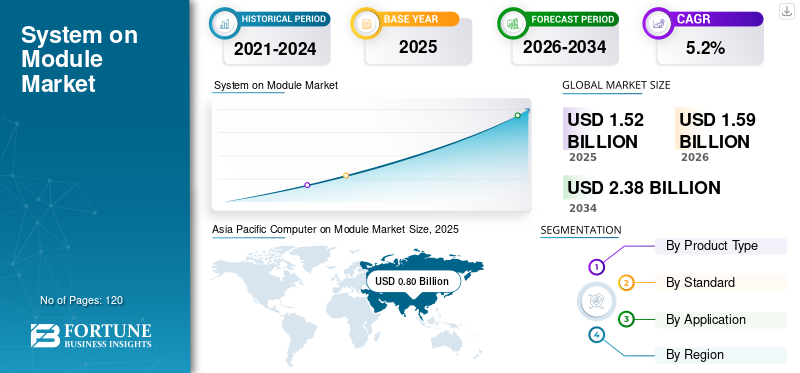
Download Free sample to learn more about this report.
Computer On Module Market Key Takeaways
 Market Size & Forecast
- 2025 Market Size: USD 1.52 billion
- 2026 Market Size: USD 1.59 billion
- 2034 Forecast Market Size: USD 2.38 billion
- CAGR: 5.2% from 2026-2034
 Market Share
- Asia Pacific dominated the computer on module market with a 52.63% share in 2025.
- The automotive segment is projected to register the highest CAGR of 7.3% during the forecast period.
- The ARM architecture segment is expected to witness the highest CAGR of 7.2% during the forecast period.
 Key Regional Highlights
Asia Pacific
Asia Pacific is projected to reach USD 0.80 billion in 2025 and is expected to record the highest regional CAGR of 6.2%.
Europe
Europe is projected to reach USD 0.37 billion in 2025, growing at a CAGR of 3.6% during the forecast period.
North America
North America is expected to witness significant growth, supported by the strong presence of semiconductor and embedded system companies.
U.S.
The market stood at approximately USD 0.23 billion in 2025, accounting for around 15.0% of global sales.
Japan
The market stood at around USD 0.09 billion in 2025, representing roughly 6.0% of global revenues.
Read More

IMPACT OF Reciprocal Tariffs
Reciprocal tariffs can affect the market by increasing the cost of importing key components, such as semiconductors, processors, and electronic modules, which are commonly traded across regions. Since the supply chain for embedded computing hardware is highly globalized, tariffs between major manufacturing and consumption regions can raise production costs for module manufacturers and system integrators. This may lead to higher product prices, margin pressures, and potential delays in procurement. In response, companies may shift sourcing strategies, diversify supply chains, or increase regional manufacturing to reduce tariff exposure.
Computer on Module Market Trends
Growing Demand For Battery-Operated Devices is a Key Market Trend
Energy efficiency has emerged as a critical trend in the market, driven by the growing demand for battery-operated devices, portable electronics, and energy-conscious industrial and IoT applications. As devices become more compact and applications more computationally intensive, managing power consumption without compromising performance has become a key challenge for system designers.
To address this, COM manufacturers are increasingly developing modules based on low-power processors, integrating advanced power management features, and optimizing thermal performance. These innovations allow devices to operate longer on limited power sources, maintain stable performance under continuous workloads, and reduce heat generation, which is especially important for space-constrained embedded systems.
MARKET DYNAMICS
Market Drivers
Download Free sample to learn more about this report.
Growing Proliferation of Compact and Embedded Devices to Fuel Market Progress
The proliferation of compact and embedded devices across industrial, medical, automotive, and consumer electronics sectors is creating a significant demand for high-performance computing in small form factors. As devices become more sophisticated and feature-rich, manufacturers are seeking solutions that deliver powerful processing while minimizing space and power consumption. Computer on Module platforms offer a space-efficient, modular approach that integrates advanced processors, memory, and interfaces into a compact form factor. For instance,
- In November 2025, AAEON launched the HPC-ARHm COM-HPC Mini Computer on Module powered by Intel Core Ultra Arrow Lake or Meteor Lake processors. The module offers up to 64GB of LPDDR5x memory, an Intel Arc GPU with up to 140T of performance, and an Intel AI Boost NPU delivering up to 96 TOPS for AI workloads.
This enables developers to implement complex functionalities such as real-time data processing, artificial intelligence inference, multimedia handling, and connectivity even in environments with limited physical space.
Market Restraints
High Initial Development Cost Can Hamper Market Growth
One of the primary restraints on the Computer on Module market growth is the high initial development cost of designing and deploying COM-based solutions. Developing a COM involves creating the hardware platform and integrating firmware, software drivers, and a compatible ecosystem, all of which require substantial investment in time and resources.
The costs begin with procuring and utilizing advanced integrated circuit (IC) design tools and hiring skilled engineers capable of handling complex embedded system designs. Additionally, each module must undergo rigorous certification and testing procedures to ensure reliability, compliance with industry standards, and seamless interoperability with peripheral systems.
Market Opportunities
Expanding Automotive Electronics Unlocks Significant Market Potential
The automotive sector is undergoing a rapid transformation, with modern vehicles increasingly relying on sophisticated electronics to support infotainment, telematics, advanced driver-assistance systems (ADAS), and autonomous driving technologies. As vehicles become smarter and more connected, automakers face growing demand for computing platforms that are both high-performance and flexible enough to handle complex, real-time processing requirements. For instance,
- In January 2026, Ford developed an in-house computer module for its future software-defined vehicles that integrates infotainment, advanced driver assistance, audio, and network functions into a single compact unit. The module reduces production costs by 10 to 15 percent, simplifies vehicle architecture, and increases flexibility for software updates, including automated driving features.
COM platforms offer a compelling solution in this context. Their modular, scalable design allows manufacturers to integrate advanced electronic systems across multiple vehicle models without requiring complete hardware redesigns. This shortens development cycles and accelerates time-to-market and enables incremental upgrades, such as improved processing power, enhanced connectivity, or AI-based functionalities, to be implemented efficiently over the vehicle's lifecycle.
Segmentation Analysis
By Application
Growing Adoption of Embedded Computing Solutions in Manufacturing Fueled Industrial Automation Segment Growth
Based on application, the market is divided into industrial automation, healthcare, automotive, consumer electronics, test & measurements, entertainment, and others.
Industrial automation held the majority of the computer on module market share in 2024. This is due to the increasing adoption of advanced embedded computing solutions in manufacturing, robotics, and smart factory systems. Industries require reliable, high-performance, and scalable computing platforms to support real-time monitoring, machine control, and data processing in automated environments. The product offers flexibility, long lifecycle support, and the ability to operate in harsh industrial conditions, making it highly suitable for automation equipment and industrial control systems.
Automotive is expected to witness the highest Compound Annual Growth Rate (CAGR) of 7.3% during the forecast period.
To know how our report can help streamline your business, Speak to Analyst
By Product Type
Strong Processing Capabilities and Software Compatibility Supported x86 Architecture Segment Expansion
Based on product type, the market is fragmented into ARM architecture, x86 architecture, and power architecture.
The x86 architecture held the majority share in 2024. In 2025, the segment is dominated with a 49.6% share due to its strong processing performance, broad software compatibility, and well-established ecosystem. Many industrial and commercial applications rely on x86-optimized operating systems and software platforms, making integration easier for developers. In addition, x86-based modules support high-performance computing, advanced graphics, and a wide range of interfaces, making them suitable for demanding applications such as industrial automation, edge computing, and embedded systems.
ARM architecture is expected to witness the highest Compound Annual Growth Rate (CAGR) of 7.2% during the forecast period.
By Standard
High Performance and Scalability of COM Express Standard Support Segment Dominance
Based on standard, the market is segregated into QSEVEN, SMARC, COM Express, CPM-HPC and others.
COM express held the majority share of the application market in 2024. In 2025, the segment is dominated with a 47.4% share, driven by its high performance, scalability, and wide adoption in industrial and embedded computing applications. The standard supports powerful processors, high-speed interfaces, and larger memory capacities, making it suitable for demanding workloads such as industrial automation, medical imaging, and edge computing.
COM-HPC is expected to witness the highest Compound Annual Growth Rate (CAGR) of 11.9% during the forecast period.
COMPUTER ON MODULE MARKET REGIONAL OUTLOOK
By geography, the market is categorized into Europe, North America, Asia Pacific, South America, and the Middle East & Africa.
North America
Asia Pacific Computer on Module Market Size, 2025 (USD Billion)
To get more information on the regional analysis of this market, Download Free sample
North America is expected to grow at a significant CAGR in the market, driven by the strong presence of advanced technology companies, semiconductor developers, and embedded system manufacturers in the region. The increasing adoption of edge computing, artificial intelligence, and IoT-enabled solutions across industries such as industrial automation, healthcare, and defense is driving demand for high-performance modular computing platforms. The North American market was the largest, at USD 0.27 billion in 2025. In addition, the region is witnessing growing investments in smart manufacturing and robotics, particularly in the U.S., which is accelerating the deployment of embedded computing technologies.
U.S. Computer on Module Market
Given North America's strong contribution and the U.S. dominance in the region, the U.S. market stood at around USD 0.23 billion in 2025, accounting for roughly 15.0% of sales.
Europe
Europe is projected to grow at 3.6% over the coming years and reach a valuation of USD 0.37 billion in 2025. The expansion is driven by the region's strong emphasis on technological reliability, regulatory compliance, and long product lifecycles in industrial and transportation systems. Many European industries, particularly in sectors such as railway systems, industrial equipment, and medical devices, prioritize durable, standardized embedded computing solutions that enable consistent adoption of COM platforms. In addition, Europe has a well-developed network of embedded system developers and engineering firms that integrate modular computing technologies into specialized applications.
U.K. Computer on Module Market
The U.K. market in 2025 stood at around USD 0.03 billion, representing roughly 2.1% of global revenues.
Germany Computer on Module Market
Germany's market reached approximately USD 0.09 billion in 2025, equivalent to around 6.0% of global sales.
Asia Pacific
Asia Pacific holds the majority share and is projected to grow at 6.2% over the coming years, the highest among all regions, and reach a valuation of USD 0.80 billion in 2025. It is due to the region's strong electronics manufacturing ecosystem and large-scale industrial automation deployments. Countries such as China, Japan, South Korea, and Taiwan serve as global hubs for semiconductor production, embedded computing hardware, and electronic component manufacturing, which directly support the development and integration of COM solutions. The region also has a high concentration of OEMs and system integrators involved in robotics, industrial machinery, and smart factory equipment, particularly in China and Japan.
Additionally, the rapid expansion of automotive electronics in Japan and South Korea, and the presence of major semiconductor fabrication facilities in Taiwan, further strengthen demand for embedded computing platforms.
Japan Computer on Module Market
The Japanese market in 2025 stood at around USD 0.90 billion, accounting for roughly 6.0% of global revenues.
China Computer on Module Market
China's market is projected to be one of the largest worldwide, with 2025 revenues standing at around USD 0.49 billion, representing roughly 32.2% of global sales.
India Computer on Module Market
The Indian market in 2025 stood at around USD 0.05 billion, accounting for roughly 3.6% of the global sales.
South America and the Middle East & Africa
The Middle East & Africa reached USD 0.06 billion in 2025, making it the fourth-largest market and emerging as a significant player with the second-highest CAGR. It is driven by the region's strong presence of advanced technology companies, semiconductor developers, and embedded system manufacturers. The increasing adoption of edge computing, artificial intelligence, and IoT-enabled solutions across industries such as industrial automation, healthcare, and defense is driving demand for high-performance modular computing platforms.
South America is expected to grow at a notable CAGR in the market during the study period, driven by the gradual expansion of industrial automation and digital infrastructure across countries such as Brazil, Argentina, and Chile. Many industries in the region, particularly manufacturing, mining, and energy, are increasingly adopting embedded computing technologies to improve operational efficiency and system monitoring.
GCC Computer on Module Market
The GCC market reached approximately USD 0.02 billion in 2025, accounting for roughly 1.1% of global revenues.
COMPETITIVE LANDSCAPE
Key Industry Players
Leading Computer on Module Vendors Strengthen their Market Presence Through Product Innovation and Strategic Collaborations
Key market players in the market are expanding their product portfolios and technological capabilities to meet the growing demand for high-performance, modular embedded computing solutions. Companies are focusing on strategic initiatives such as partnerships with semiconductor manufacturers, product innovation, and collaborations with system integrators to enhance module performance and broaden application capabilities. In addition, vendors are investing in advanced COM standards, increased processing power, and enhanced connectivity to support emerging applications in industrial automation, automotive electronics, edge computing, and medical devices.
LIST OF KEY COMPUTER ON MODULE COMPANIES PROFILED
- Kontron (Austria)
- congatec GmbH (Germany)
- Advantech Co., Ltd. (Taiwan)
- ADLINK Technology Inc. (Taiwan)
- Portwell Inc. (U.S.)
- SECO S.p.A (Italy)
- Eurotech S.p.A (Italy)
- AAEON Technology (Taiwan)
- Axiomtek Co., Ltd. (Taiwan)
- Avalue Technology Inc. (Taiwan)
- Toradex AG (Switzerland)
- PHYTEC Messtechnik GmbH (Germany)
- TechNexion Ltd (Taiwan)
KEY INDUSTRY DEVELOPMENTS
- January 2026: Portwell introduced the PCOM B65B COM Express Type 6 Computer-on-Module and the WADE 807A Mini-ITX motherboard, both powered by Intel Core Ultra Series 3 processors. The solutions deliver up to 180 TOPS of AI performance with integrated Intel Arc GPU and NPU acceleration for edge computing.
- January 2026: congatec launched a broad portfolio of Computer-on-Modules powered by Intel Core Ultra Series 3 processors to support high-performance embedded AI applications. The new modules deliver up to 180 TOPS of AI computing power with integrated NPUs and GPUs, reducing the need for separate accelerator cards. These COMs target edge AI use cases across industrial automation, robotics, smart cities, healthcare, and retail systems.
- January 2026: ADLINK Technology introduced its new Express PTL Computer-on-Module powered by Intel Core Ultra Series 3 processors to support advanced edge AI workloads. The module combines CPU, GPU, and NPU capabilities, delivering up to 180 TOPS of AI performance, along with Intel Arc graphics and support for up to 128 GB of DDR5 memory.
- December 2025: Toradex introduced two new Computer-on-Module families, OSM and Lino, designed for edge AI, industrial automation, and IoT applications. The compact 30×30 mm modules are based on NXP Semiconductors.MX 91 and I.MX 93 processors with Arm Cortex A55 cores and optional neural processing for on-device AI workloads.
- September 2025: Avalue Technology introduced three new Open Standard Modules, OSM-IMX93, OSM-IMX8MM, and OSM-3568, designed for energy-efficient, high-performance IoT and industrial applications. The modules feature processors from NXP and Rockchip, support rich connectivity, operate over wide temperature ranges, and enable AI acceleration, multimedia, and real-time processing.
- July 2025: Advantech introduced two new compact Computer-on-Modules, the AOM 5521 and AOM 2521, powered by the NXP i.MX 95 processor for edge AI and machine vision applications. The modules offer up to 6 Arm Cortex-A55 cores, a 2 TOPS NPU, and an integrated GPU ISP and VPU to support advanced AI inference and vision processing. They also provide high-speed connectivity, including 10GbE TSN networking, PCIe Gen3 CAN FD, and LPDDR5 memory for industrial and IoT systems.
REPORT COVERAGE
The report provides a detailed analysis of the computer on module market size and focuses on key aspects, including leading companies, product types, and the leading applications of the product. Besides, it offers insights into the market trends and highlights key industry developments. In addition to the factors above, the market's growth in recent years was driven by several other factors.
Request for Customization to gain extensive market insights.
Report Scope & Segmentation
| ATTRIBUTE | DETAILS |
| Study Period | 2021-2034 |
| Base Year | 2025 |
| Estimated Year | 2026 |
| Forecast Period | 2026-2034 |
| Historical Period | 2021-2024 |
| Growth Rate | CAGR of 5.2% from 2026 to 2034 |
| Unit | Value (USD Billion) |
| Segmentation | By Product Type, Standard, Application, and Region |
| By Product Type |
|
| By Standard |
|
| By Application |
|
| By Geography |
|
Frequently Asked Questions
According to Fortune Business Insights, the global market value stood at USD 1.52 billion in 2025 and is projected to reach USD 2.38 billion by 2034.
In 2025, the market was valued at USD 0.80 billion.
The market is projected to grow at a CAGR of 5.2% during the forecast period of 2026- 2034.
The industrial automation segment held the highest share of the market.
Growing proliferation of compact and embedded devices is a key factor driving the markeṭ.
Kontron, Advantech, Adlink, and SECO are the top players in the market.
Asia Pacific holds the highest market share.
By application, automotive is expected to grow with the highest CAGR during the forecast period.



- 2021-2034
- 2025
- 2021-2024
- 120
Get 30-60 hrs Free Customization
Expand Regional and Country Coverage, Segments Analysis, Company Profiles, Competitive Benchmarking, and End-user Insights.




















Related Reports
-
US +1 833 909 2966 ( Toll Free )
-
Get In Touch With Us