Thermal Conductive Polymer Material Market Size, Share & Industry Analysis, By Type (Polyamide, Polybutylene Terephthalate, Polycarbonate, Polyphenylene Sulfide, Polyetherimide, and Others), By Application (Electrical & Electronics, Industrial, Automotive, Healthcare, Aerospace, and Others), and Regional Forecast, 2026-2034
 Download Free Sample
KEY MARKET INSIGHTS
 Listen to Audio Version
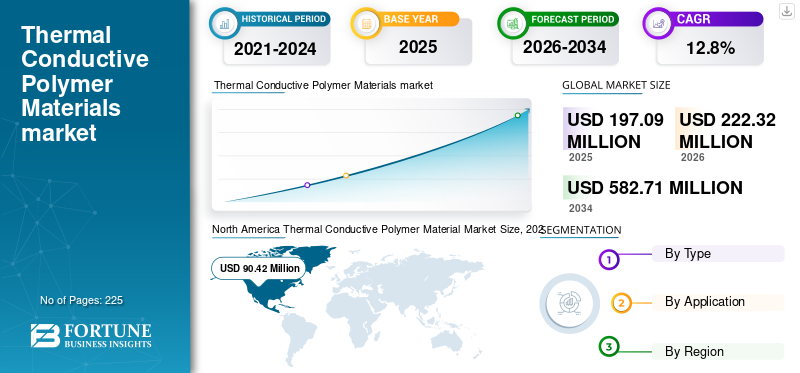
The global thermal conductive polymer materials market size of USD 197.09 million in 2025 and is projected to expand from USD 222.32 million in 2026 to USD 582.71 million by 2034, growing at a CAGR of 12.80% over the forecast period. North America dominated the thermal conductive polymer materials market with a market share of 45.88% in 2025. Moreover, the thermal conductive polymer materials market size in the U.S. is projected to grow significantly, reaching an estimated value of USD 153.4 million by 2032, driven by substantial demand for consumer electronics
Thermal conductive polymers possess the properties to replace metal, ceramic, and conventional plastics in thermal management applications. These polymers are added to composite materials to increase their thermal conductivity. They are lighter in weight and have a lower density; hence, they find application in several end-use industries such as automotive, electrical/electronics, and medical. The demand for thermal conductive polymer material is expected to increase, owing to their greater impact strength, lower cost, processability, and ability to mold into different shapes.
Download Free sample to learn more about this report.
Thermal Conductive Polymer Materials Market KEY TAKEAWAYS
 Market Size & Forecast
- 2025 Market Size: USD 197.09 Million
- 2026 Market Size: USD 222.32 Million
- 2034 Forecast Market Size: USD 582.71 Million
- CAGR: 12.80% from 2026–2034
 Market Share
- North America dominated the thermal conductive polymer materials market with a 45.88% share in 2025.
- The polyamide segment accounted for the largest market share.
- The electrical & electronics segment held the largest market share.
 Key Regional Highlights
North America
Generated USD 90.42 million in 2025, driven by strong R&D activities, high adoption, and major manufacturers.
Europe
Growth is driven by increasing adoption in automotive applications, including EV battery modules and thermal management.
Asia Pacific
Growth is supported by rapid industrialization, EV expansion, charging infrastructure, and electronics manufacturing.
U.S.
The thermal conductive polymer materials market is projected to reach USD 153.4 million by 2032.
Japan
The market is driven by expanding electronics manufacturing and increasing adoption of thermally conductive materials
Read More

THERMAL CONDUCTIVE POLYMER MATERIAL MARKET TRENDS
Download Free sample to learn more about this report.
Increasing Demand due to Expanding Electric Vehicle Industry is the Key Trend
Among the biggest challenges facing Electric Vehicles (EVs) in the industry is related to thermal control. Poor thermal management can lead to inferior product performance, a shorter lifecycle, and a severe risk of thermal runaway. Thermal management plays a critical role in increasing the efficiency of electric vehicles, including charging systems, LEDs, battery packs and enclosures, housings for Advanced Driver Assistance Systems (ADAS), and Phase Change Materials (PCM) for battery cooling. Recent developments in thermally conductive polymer materials address such problems where thermal conductivity is regarded as a key attribute.
- North America witnessed a thermal conductive polymer materials market growth from USD 56.7 million in 2021 to USD 63.0 million in 2022.
The new fast charging method for electric vehicles is built around polymeric insulated wire with good thermal performance and high ampacity. Advanced polymer materials with good thermal and electrical properties to improve the performance of EV charging cables have been produced extensively in recent times. With rising demand for EV and thermal management systems in the automotive industry, product development is expected to create multiple opportunities for the global thermal conductive polymer material and plastics market.
DRIVING FACTORS
Changing Electronics Industry Trends to Increase the Demand
Factors, such as electronic device miniaturization, thermal conductivity, space constraints, and technological advancement, in the electronic device industry have prompted material demand for thermally conductive polymers in the electrical and electronics industries. Thermal conductive polymers are challenging traditional materials, such as ceramics, metal and conventional plastics, as they provide a variety of benefits such as being lighter in weight compared to metal, having reduced component counts, being easy to mold, being resistant to scratching and abrasion, having impact strength, and costing less than metal.
Thermally conductive polymer composites, which are flexible and light in weight, are used in electronics to dissipate heat generated to the surrounding area. Using fillers with specific orientations that promote heat flow results in efficient heat dissipation. For applications where heat management is crucial, such as Light Emitting Diodes (LED), photovoltaics, and automotive electronics, thermally conducting and electrically insulating plastics are of greater interest.
Thermally conductive polymer materials are used as thermal paste in laptops, phones, and others. The rising electronics production is anticipated to escalate the market growth during the forecast period.
RESTRAINING FACTORS
Lack of Thermal Properties and Processing Difficulties to Suffocate Demand
Plastic’s limited thermal conductivity restricts its range of use. The size of electronic components has decreased massively in recent times due to the rapid development of integration and assembly technology in the electric field, necessitating the use of insulating packaging materials with good heat dissipation.
Thermally conductive polymers are neither pure plastic nor metal. Plastic has excellent mechanical and corrosion-resistant qualities but poor thermal conductivity compared to other metals. For instance, the thermal conductivity of high-density polyethylene with maximum thermal conductivity is only 0.44 W/mK, whereas the thermal conductivity of aluminum and its alloys ranges from 88 to 251 W/mK.
Thermally conductive polymer materials possess certain processing challenges that dampen the production process. Such as
- Thermal conductive polymers are heavier due to the filler content, creating concerns while processing these products.
- Due to the substantial volume of solid, granular filler, there may be settling during transportation and storage, necessitating mixing before use.
- To provide low viscosity for processing and chemical curing for stiffness and strength, many thermally conductive polymers are created as two-component systems. The mix ratio must be tested and monitored regularly within a tight window for proper curing.
THERMAL CONDUCTIVE POLYMER MATERIAL MARKET SEGMENTATION Analysis
By Type Analysis
Polyamide Segment Leads the Market Due to its Lower Cost and Exceptional Thermal Conductivity
On the basis of type, the market is segmented into polyamide, polybutylene terephthalate (PBT), polycarbonate, polyphenylene sulfide, polyetherimide, and others. The polyamide segment accounted for a significant market share owing to its exceptional thermal conductivity and lower cost. The polyamide segment was followed by the polycarbonate segment, which grew at a significant rate. Polycarbonates are thermally stable up to almost 135°C and are used in applications that demand thermal stability.
Polybutylene terephthalate is one of the thermoplastic polymers with high thermal conductivity. Properties, including high strength, rigidity, resistance to thermal deformation, and high dimensional stability, characterize polycarbonates. Polyphenylene sulfide is a polymer with exceptional chemical and thermal resistance. It is highly employed in applications that need thermal stability. It is a precursor to thermal conductive polymers and materials and can be converted to semiconducting by oxidizing or using dopants.
Polyetherimide, a high-performance engineering plastic, is one of the new classes of polymers that exhibit exceptional properties such as thermo-oxidative stability, high strength-to-weight ratio, high-temperature resistance, and others. However, the demand for polyetherimide is comparatively lower owing to its high price.
By Application Analysis
To know how our report can help streamline your business, Speak to Analyst
Demand from Electric & Electronic Industry to Increase the Demand
In terms of application, the market is segmented into electrical & electronics, industrial, automotive, healthcare, aerospace, and others. Thermal conductive polymers find applications in electrical and electronics as the industry always needs new and advanced solutions. Due to the need for thermal management in devices, there has been a significant increase in demand for heat sinks, heat removal devices, electric battery housing, and LED enclosures. Growing demand for electronics and electrical equipment, in turn, is boosting the thermally conductive plastics market.
The electrical and electronics segment held the largest share in 2022. Plastic compounds are comparatively lower in cost, moldable, and customizable, and they offer high thermal stability, impact strength, scratching, and abrasion resistance. The adoption of such materials owing to their exceptional properties is expected to bolster the demand for thermally conductive polymer materials.
In the automotive sector, thermal conductive polymer materials are used in various automotive components. Heat dissipation is one of the most critical aspects of the performance and reliability of automotive systems. Growing demand from all-electric vehicles, multifaceted automotive and large commercial LED lighting, battery modules, and brackets is driving the segment’s growth.
Thermal conductive polymer materials are used in general industrial applications owing to their chemical and thermal stability, versatility, and cost-effectiveness. In the healthcare industry, conductive thermoplastic compounds are employed in manufacturing minuscule, high-strength components. These polymer materials can withstand sterilization procedures, such as autoclaves, and are thus employed in healthcare applications. The electrical and electronics segment is expected to hold a 40.1% share in 2022.
REGIONAL ANALYSIS
North America Thermal Conductive Polymer Material Market Size, 2025 (USD Million)
To get more information on the regional analysis of this market, Download Free sample
North America
The thermal conductive polymer material market share of North America is dominant and was valued at USD 90.42 million in 2025. North America is estimated to hold the largest market share during the forecast period owing to the high adoption rate of thermally conductive polymers. A high focus on research & development activities is a prime reason driving the regional market. Besides, the presence of major manufacturers, including Avient Corporation (PolyOne Corporation), RTP Company, and DuPont, in the U.S. is expected to aid growth in the region.
Europe
Followed by North America, Europe is expected to show significant growth by the end of the forecast period. Europe is a well-established automotive market. The growing adoption of thermally conductive polymer materials for automotive applications, including battery modules, brackets, and others is boosting the demand for thermal conductive polymer materials in European countries.
Asia Pacific
In the Asia Pacific region, rapid industrial expansion and intensive research activities are expected to bolster thermal conductive polymer material growth. Electric two and three-wheeler vehicles account for approximately half of China’s sales. The rapidly growing charging infrastructure in China compared to other regions is driving the growth of Asia Pacific. Additionally, the booming electrical and electronics industries in India, South Korea, and Japan are creating demand for conductive polymer materials.
Latin America
Latin America is a swiftly advancing region in terms of urbanization and technological advancement. Industrial development activities are the key driving factors. Thermal conductive polymer materials are widely used in automobiles, EVs, machineries, and other applications. The shifting preference of consumers toward versatile and flexible materials for various end-use applications is bolstering the demand.
Middle East & Africa
In the Middle East & Africa, increasing demand from countries, such as Saudi Arabia, the UAE, Bahrain, and Kuwait, is expected to bolster market growth. The rapidly growing industrial sector in Middle Eastern countries such as Egypt, Turkey, Iran, and others is driving market growth.
KEY INDUSTRY PLAYERS
Key Players are Focusing on Merger & Acquisitions and Providing Customized Products
Several manufacturers provide customized products to cater to the emerging market’s demands. For instance, the Nytex Composites Co., Ltd. focuses on strategic choices to increase overall sales volume. With an extensive product offering coupled with product innovation, the company is catering to the demand from the latest and emerging industries such as electric vehicles, WIFI 6, thermal conductive materials, and green energy storage systems.
The adoption of EVs is one of the latest trends in the market. Developing products specialized for EV applications is significantly benefitting market players. At the same time, many players are engaging in mergers & acquisitions and expanding production capacity at various manufacturers across the globe to cater for the increasing demand.
List of Top Thermal Conductive Polymer Material Companies:
- SABIC (Saudi Arabia)
- RTP Company (U.S.)
- Avient Corporation (U.S.)
- Celanese Corporation (U.S.)
- Covestro AG (Germany)
- DSM (Netherlands)
- MITSUBISHI ENGINEERING-PLASTICS CORPORATION (Japan)
- HELLA GmbH & Co. KGaA (Germany)
- TORAY INDUSTRIES, INC. (Japan)
- DuPont (U.S.)
- LANXESS (Germany)
- LATI Industria Termoplastici S.p.A. (Italy)
- Ensinger Group (Germany)
- Lehmann&Voss&Co (Germany)
- Nytex Composites Co., Ltd (Taiwan)
- KANEKA CORPORATION (Japan)
- LOTTE Chemical Corporation (South Korea)
- BASF SE (Germany)
- Ovation Polymers, Inc. (U.S.)
KEY INDUSTRY DEVELOPMENTS:
- December 2022: The Ensinger PolyTech, Inc. a group subsidiary, acquired the assets of Poly-Tech Industrial, Inc. that includes production facility and high-performance material knowledge.
- September 2022: X2F has joined a collaboration with Covestro AG to develop a thermally conductive automotive heat-sink with in-mold electronics using X2F’s transformative controlled viscosity molding technology as new heat-sink molded of Makrolon polycarbonate (PC) is approximately half as heavy as the typical aluminum part.
- May 2021: TORAY INDUSTRIES, INC. developed a technology for carbon fiber-reinforced plastic (CFRP), high thermal conductivity technology, which assists in easing the heat-dissipating properties of CFRP. Such technology finds application in electronic devices to boost the performance while suppressing battery degradation.
REPORT COVERAGE
The global thermal conductive polymer material market research report provides a detailed analysis of the market and focuses on crucial aspects such as leading companies, product types, and applications. Also, the report offers insights into market trends and dynamics, highlighting vital industry developments. In addition to the insights mentioned above, the report encompasses various factors driving the growth of the market in recent years.
Request for Customization to gain extensive market insights.
REPORT SCOPE & SEGMENTATION
|
ATTRIBUTE |
DETAILS |
|
Study Period |
2021-2034 |
|
Base Year |
2025 |
|
Estimated Year |
2026 |
|
Forecast Period |
2026-2034 |
|
Historical Period |
2021-2024 |
|
Growth Rate |
CAGR of 12.8% from 2026-2034 |
|
Unit |
Value (USD Million), Volume (Kiloton) |
|
Segmentation |
By Type, Application, and Geography |
|
By Type |
|
|
By Application |
|
|
By Geography |
|
Frequently Asked Questions
Fortune Business Insights says that the global market size was USD 197.09 million in 2025 and is projected to reach USD 582.71 million by 2034.
In 2025, the market size stood at USD 197.09 million.
Growing at a CAGR of 12.8%, the market will exhibit significant growth in the forecast period (2026-2034).
The electrical & electronics segment is the leading segment based on application.
Rising demand from the electric & electronics industry is anticipated to drive market growth.
North America dominated the global market in 2025.
SABIC, Celanese Corporation, Aviation Corporation, BASF, and Celanese Corporation are a few of the leading players in the market.
Rising electric vehicle production to increase demand is the key trend leading to market growth.



- 2021-2034
- 2025
- 2021-2024
- 225
Get 30-60 hrs Free Customization
Expand Regional and Country Coverage, Segments Analysis, Company Profiles, Competitive Benchmarking, and End-user Insights.


















Related Reports
-
US +1 833 909 2966 ( Toll Free )
-
Get In Touch With Us