 Download Free Sample



Get a Quote
Receive a tailored pricing based on your needs.
- Choose license type
- Multiple user options
- Custom scope & coverage
- Fast turnaround
"Electrifying your pathway to success through in-depth market research"
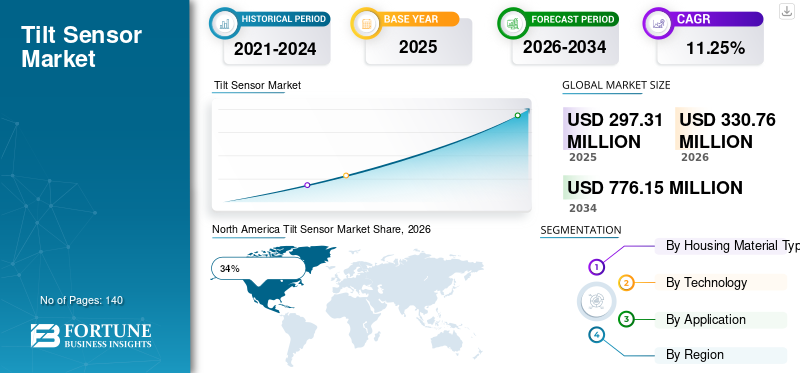
The tilt sensor market size was valued at USD 297.31 Million in 2025. The market is projected to grow from USD 330.76 Million in 2026 to USD 776.15 Million by 2034, exhibiting a CAGR of 11.25% during the forecast period.

The tilt sensor market is witnessing steady expansion due to increasing integration of inclination measurement systems across industrial automation, automotive electronics, construction equipment, aerospace platforms, and smart manufacturing facilities. Tilt sensors are widely used to detect angular movement, monitor equipment positioning, improve operational safety, and support precision control systems. Demand continues to rise as industries adopt advanced monitoring technologies to reduce equipment downtime and improve workplace efficiency. The growing adoption of MEMS-based sensing solutions, combined with digital connectivity and industrial IoT deployment, is reshaping the tilt sensor market landscape. Manufacturers are focusing on compact designs, enhanced sensitivity, rugged housing materials, and long-term reliability to strengthen their market position and support evolving industrial requirements.
The United States tilt sensor market remains a significant contributor to global industry development due to widespread implementation of industrial automation systems, autonomous machinery, construction equipment monitoring, and advanced automotive safety technologies. Manufacturing facilities across the country are increasingly integrating tilt sensing systems into robotics, material handling equipment, and predictive maintenance platforms. Defense and aerospace applications continue to create strong demand for high-precision inclination monitoring solutions. Smart infrastructure projects and renewable energy installations are also supporting market expansion. Approximately 31% of North American demand originates from the United States, reflecting the country's strong industrial base and continued investments in sensor-enabled operational technologies.
Download Free sample to learn more about this report.
 Global Market Size & Forecast
 Market Share
 Key Regional Highlights
North America
North America held the largest regional share at 34% in 2025.
Asia-Pacific
Asia-Pacific accounted for 30% of the global market, driven by industrial automation and expanding manufacturing activities.
Europe
Europe represented 28% of the market, supported by growing adoption of advanced sensing technologies.
U.S
The U.S. remains a key market, supported by industrial automation, IoT adoption, and advanced manufacturing.
Japan
Japan accounted for 22% of the Asia-Pacific market, driven by robotics, automation, and precision manufacturing.
Read More

One of the most prominent tilt sensor market trends is the rapid adoption of MEMS technology across industrial and automotive sectors. MEMS-based tilt sensors offer compact size, improved durability, lower power consumption, and enhanced measurement accuracy. These advantages have encouraged manufacturers to replace traditional mechanical inclination monitoring systems with semiconductor-based alternatives. Integration with industrial IoT networks is further strengthening adoption across factories, warehouses, and intelligent transportation systems.
Download Free sample to learn more about this report.
Another significant trend shaping the tilt sensor market analysis is the growing demand for real-time equipment monitoring and predictive maintenance. Construction machinery, mining equipment, cranes, agricultural vehicles, and renewable energy installations increasingly rely on tilt sensors for safety and performance optimization. Wireless connectivity and digital output interfaces are becoming standard features in newly developed products. Additionally, manufacturers are investing in multi-axis sensing technologies capable of delivering precise inclination measurements under harsh environmental conditions. The emergence of smart factories, autonomous vehicles, and Industry 4.0 initiatives continues to create new opportunities for advanced tilt sensing solutions across multiple end-use industries.
Rising Demand for Industrial Automation and Intelligent Monitoring Systems
Industrial automation remains the primary growth driver for the tilt sensor market. Manufacturing facilities are increasingly deploying automation technologies to improve operational efficiency, enhance safety, and reduce maintenance costs. Tilt sensors play a critical role in monitoring machinery orientation, positioning automated equipment, and supporting precision control functions. Industries such as mining, logistics, construction, energy, and material handling rely heavily on inclination measurement systems to prevent equipment failure and improve productivity.
The growing implementation of robotics and smart factory infrastructure is further accelerating demand. tilt sensor market research report findings indicate that manufacturers are integrating sensors into industrial platforms to enable predictive maintenance and remote monitoring capabilities. Automated cranes, conveyor systems, aerial work platforms, and heavy machinery require accurate angle detection to maintain operational stability. The widespread adoption of industrial IoT frameworks is also increasing sensor deployment, as real-time inclination data contributes to comprehensive asset management strategies. These factors continue to support long-term tilt sensor market Growth across global industrial sectors.
High Integration and Calibration Requirements for Advanced Sensing Systems
A major restraint affecting the tilt sensor market is the complexity associated with integration, calibration, and maintenance of advanced sensing technologies. High-precision tilt sensors often require sophisticated installation procedures and specialized calibration methods to ensure accurate performance. This can increase implementation costs, particularly for small and medium-sized enterprises operating under budget constraints.
Environmental factors such as vibration, temperature fluctuations, electromagnetic interference, and mechanical shock can influence measurement accuracy. As a result, organizations must invest in additional protective systems and maintenance procedures to ensure reliable operation. Tilt Sensor Industry Analysis shows that industries requiring ultra-precise angular measurements frequently face challenges related to system compatibility and long-term calibration stability. These concerns can delay adoption among cost-sensitive end users. Furthermore, replacing traditional mechanical systems with advanced electronic sensors often requires infrastructure modifications, adding another layer of investment and slowing deployment across certain industrial environments.
Expansion of Renewable Energy and Smart Infrastructure Projects
The expansion of renewable energy installations presents significant opportunities for the tilt sensor market. Wind turbines, solar tracking systems, and smart grid infrastructure increasingly depend on accurate inclination measurement technologies to optimize performance and maintain operational stability. Tilt sensors enable precise positioning of solar panels and assist in monitoring structural alignment within renewable energy facilities.
Smart city developments are also creating favorable conditions for market expansion. Modern infrastructure projects incorporate sensor technologies to improve safety, monitor structural health, and support intelligent transportation systems. tilt sensor market Opportunities are further expanding through the adoption of autonomous construction equipment, intelligent agricultural machinery, and connected industrial platforms. Demand from infrastructure monitoring applications continues to rise as governments invest in transportation networks, bridges, tunnels, and public utilities. Manufacturers capable of delivering highly reliable, low-power, and digitally connected tilt sensing solutions are expected to benefit from these emerging growth areas across global markets.
Increasing Competition and Pressure On Product Differentiation
One of the most significant challenges facing the tilt sensor market is growing competition among sensor manufacturers. Rapid technological advancements have lowered barriers to entry, resulting in a larger number of suppliers offering similar inclination sensing solutions. This competitive environment places considerable pressure on pricing strategies and profit margins.
Customers increasingly demand sensors that provide higher accuracy, enhanced durability, digital connectivity, and compact form factors while maintaining cost efficiency. Meeting these expectations requires continuous investment in research and development. Tilt Sensor Industry Report assessments indicate that product differentiation has become increasingly difficult as MEMS technology becomes more widely available. Manufacturers must also address evolving industry standards, certification requirements, and application-specific customization demands. Balancing innovation, affordability, and regulatory compliance remains a complex challenge for market participants seeking to expand their global presence and strengthen customer loyalty.
Non-metal housing tilt sensors account for approximately 42% of the tilt sensor market Share. These products are widely utilized in consumer electronics, lightweight industrial equipment, medical devices, and portable monitoring systems. Non-metal housings provide advantages including corrosion resistance, reduced weight, lower manufacturing costs, and ease of integration into compact devices. Engineering plastics and advanced polymer composites are commonly used to manufacture these sensor enclosures.
The increasing demand for lightweight sensing solutions has strengthened adoption across automotive electronics and battery-powered industrial devices. tilt sensor market Insights indicate that manufacturers are introducing reinforced polymer structures capable of withstanding harsh industrial conditions while maintaining electrical insulation properties. The segment benefits from expanding applications in robotics, warehouse automation, and smart infrastructure projects where weight reduction and design flexibility remain critical purchasing considerations.
Metal housing tilt sensors represent nearly 58% of the tilt sensor market Size due to their superior durability and performance in demanding industrial environments. These sensors are commonly installed in construction machinery, mining equipment, marine systems, defense platforms, and heavy manufacturing facilities. Metal enclosures offer enhanced resistance to impact, vibration, extreme temperatures, and mechanical stress.
Industrial operators often prefer metal-housed sensors because they deliver long-term reliability in mission-critical applications. tilt sensor market Forecast studies suggest continued growth in this segment as infrastructure development and industrial automation projects expand globally. Stainless steel and aluminum housings remain particularly popular due to their strength and corrosion resistance. The segment is also benefiting from increased deployment in renewable energy installations, where equipment must withstand challenging outdoor operating conditions for extended periods.
To know how our report can help streamline your business, Speak to Analyst
Fluid-filled tilt sensors hold approximately 21% of the global tilt sensor market. These sensors utilize conductive or electrolytic fluids to detect changes in inclination and are widely recognized for delivering smooth and stable measurements. Fluid-filled technology remains particularly valuable in specialized industrial applications requiring high sensitivity and reliable angle detection over extended periods.
Many engineering applications continue to utilize fluid-filled sensors because of their proven performance characteristics and measurement consistency. tilt sensor market research report findings indicate that infrastructure monitoring, geotechnical analysis, and precision leveling systems remain major end-use sectors. Although newer technologies have gained popularity, fluid-filled designs maintain relevance in applications requiring continuous angular monitoring and environmental stability.
MEMS technology dominates the tilt sensor market with an estimated 54% share. MEMS-based tilt sensors offer compact dimensions, low power consumption, high accuracy, and cost-effective manufacturing advantages. These attributes have made MEMS devices the preferred choice across automotive, industrial automation, aerospace, consumer electronics, and smart infrastructure sectors.
The segment continues to experience strong expansion due to widespread adoption of IoT-enabled monitoring systems and autonomous machinery. tilt sensor market trends highlight increasing investments in multi-axis MEMS solutions capable of supporting advanced positioning and motion analysis functions. Their compatibility with digital communication protocols further enhances deployment across Industry 4.0 environments, making MEMS technology the leading category within the global market.
Force balanced tilt sensors account for approximately 25% of the tilt sensor market Share and are primarily utilized in high-precision applications. These sensors deliver exceptional accuracy and stability, making them suitable for aerospace systems, defense equipment, structural monitoring projects, and advanced industrial instrumentation.
Organizations requiring extremely precise angular measurements continue to invest in force balanced technologies despite higher costs. Tilt Sensor Industry Analysis demonstrates growing utilization in critical infrastructure monitoring, aviation systems, and scientific research applications. Enhanced sensitivity and long-term measurement reliability position force balanced sensors as a preferred solution where operational accuracy is more important than installation cost considerations.
Industrial automation represents the largest application segment in the tilt sensor market, accounting for approximately 32% market share. Tilt sensors are extensively used in automated production lines, robotic systems, conveyor equipment, material handling machinery, and factory monitoring systems. These sensors provide accurate angular measurements that help maintain operational precision, improve equipment safety, and reduce unplanned downtime. As manufacturing facilities continue to adopt Industry 4.0 technologies, the demand for advanced tilt sensing solutions is increasing significantly.
The growing integration of industrial IoT platforms has further strengthened the use of tilt sensors in predictive maintenance and real-time equipment monitoring applications. Manufacturers rely on these sensors to detect positional changes, monitor machine stability, and optimize process efficiency. The segment continues to benefit from investments in smart factories and digital manufacturing infrastructure worldwide.
North America Tilt Sensor Market Share, 2026 (%)
To get more information on the regional analysis of this market, Download Free sample
North America accounts for approximately 34% of the global tilt sensor market. The region benefits from strong industrial automation adoption, advanced manufacturing capabilities, and substantial investments in aerospace and defense technologies. Construction equipment manufacturers, logistics operators, and renewable energy developers continue to deploy tilt sensing solutions to improve operational efficiency and safety standards. The presence of major sensor manufacturers further supports innovation and product development across the region.
The United States remains the dominant market within North America due to extensive use of smart manufacturing technologies and industrial IoT systems. Demand is also increasing from autonomous vehicle development projects, warehouse automation platforms, and infrastructure modernization initiatives. tilt sensor market Outlook assessments indicate continued growth opportunities through digital transformation programs and increased deployment of predictive maintenance solutions across industrial sectors.
Europe represents approximately 28% of the global tilt sensor market Share. The region's emphasis on industrial automation, energy efficiency, and advanced transportation technologies continues to support market expansion. Manufacturers across automotive, aerospace, and industrial equipment sectors increasingly integrate tilt sensors into production systems and intelligent machinery.
European regulations emphasizing workplace safety and equipment reliability further encourage adoption. tilt sensor market Growth within the region is supported by investments in smart factories, renewable energy infrastructure, and precision engineering applications. Strong research capabilities and technological innovation remain key competitive advantages for European sensor manufacturers.
Germany accounts for approximately 29% of Europe's tilt sensor market. As Europe's largest industrial economy, Germany maintains strong demand for advanced sensing technologies across manufacturing, automotive engineering, robotics, and industrial automation sectors. German factories continue to accelerate Industry 4.0 implementation, increasing the need for precision inclination monitoring systems.
tilt sensor market analysis for Germany highlights significant opportunities in machine tools, intelligent logistics systems, and renewable energy installations. Automotive manufacturers rely heavily on advanced sensors for vehicle stability systems and autonomous mobility technologies. Investments in digital manufacturing infrastructure and engineering innovation continue to strengthen Germany's position as a leading market for tilt sensor deployment across Europe.
The United Kingdom represents approximately 18% of Europe's tilt sensor market. Demand is driven by industrial modernization, infrastructure monitoring initiatives, aerospace manufacturing, and renewable energy projects. The country's growing focus on smart transportation systems and digital infrastructure is creating additional opportunities for sensor manufacturers.
Tilt Sensor Industry Report evaluations indicate increasing adoption within offshore wind energy installations, automated warehouses, and intelligent construction equipment. Research institutions and technology developers continue to support innovation in sensing technologies, while industrial operators seek enhanced monitoring capabilities to improve operational efficiency and reduce maintenance expenses.
Asia-Pacific holds approximately 30% of the global tilt sensor market and remains one of the most dynamic regional markets. Rapid industrialization, expanding manufacturing activity, and large-scale infrastructure development projects contribute significantly to demand. Countries across the region are investing heavily in automation technologies, robotics, and intelligent transportation systems.
tilt sensor market Opportunities continue to emerge through smart city projects, renewable energy investments, and advanced electronics manufacturing. Growing automotive production and industrial equipment deployment further support regional expansion. The presence of major electronics manufacturers also strengthens supply chain capabilities and technological innovation throughout the Asia-Pacific market.
Japan contributes approximately 22% of the Asia-Pacific tilt sensor market. The country's strong reputation for precision engineering, robotics, and advanced manufacturing continues to drive demand for high-performance sensing technologies. Industrial automation remains a major application area, with manufacturers utilizing tilt sensors to improve production efficiency and machine reliability.
tilt sensor market research report assessments show growing implementation across automotive electronics, semiconductor production equipment, and smart factory systems. Japanese companies continue investing in miniaturized sensor technologies and advanced MEMS development. The market also benefits from strong adoption within transportation infrastructure and renewable energy projects requiring accurate inclination monitoring.
China accounts for approximately 41% of the Asia-Pacific tilt sensor market, making it the region's largest national market. Massive industrial production capacity, expanding automation investments, and infrastructure development programs continue to support substantial demand. Construction machinery, manufacturing equipment, logistics systems, and smart transportation projects represent major application sectors.
tilt sensor market Insights indicate that domestic manufacturers are increasing investments in sensor technology development to reduce dependence on imported components. The growth of electric vehicles, industrial robotics, and renewable energy installations further accelerates demand. Government support for advanced manufacturing initiatives and smart infrastructure projects continues to strengthen China's position within the global tilt sensor industry.
The Rest of World region accounts for approximately 8% of the global tilt sensor market Share. This segment includes Latin America, the Middle East, and Africa, where industrial modernization and infrastructure development projects are creating new growth opportunities. Mining operations, oil and gas facilities, and construction activities represent key demand drivers.
tilt sensor market Forecast evaluations indicate rising adoption across transportation infrastructure, utility networks, and renewable energy projects. Governments in emerging economies are investing in industrial automation and smart infrastructure initiatives to improve productivity and operational efficiency. These developments are expected to encourage broader deployment of tilt sensing technologies across multiple sectors throughout the region.
The tilt sensor market continues to attract investment due to growing demand for industrial automation, intelligent transportation systems, renewable energy infrastructure, and smart manufacturing technologies. Investors are increasingly focusing on companies developing MEMS-based solutions, multi-axis sensing platforms, and industrial IoT-compatible products. Venture funding and strategic acquisitions have accelerated innovation across sensor technologies, enabling manufacturers to expand product portfolios and strengthen market presence.
tilt sensor market Opportunities are particularly strong in renewable energy, autonomous equipment, robotics, and predictive maintenance applications. Industrial operators seek advanced monitoring capabilities to improve safety, optimize productivity, and reduce operational costs. Investments in smart infrastructure projects, warehouse automation systems, and connected machinery platforms are creating substantial long-term demand. Companies capable of delivering highly accurate, energy-efficient, and digitally integrated tilt sensing solutions are expected to benefit from expanding commercial opportunities across multiple industries.
Innovation remains a major competitive factor within the tilt sensor market. Manufacturers are introducing compact MEMS-based sensors with improved sensitivity, enhanced environmental resistance, and lower power consumption. Advanced products now incorporate wireless communication capabilities, enabling real-time monitoring and seamless integration with industrial IoT ecosystems.
tilt sensor market trends indicate increasing development of multi-axis sensors capable of measuring complex motion and positioning data. New products are designed to withstand harsh industrial environments while maintaining high accuracy levels. Companies are also integrating artificial intelligence and predictive analytics capabilities into sensor platforms to provide more valuable operational insights. Enhanced digital interfaces, miniaturized designs, and improved calibration technologies continue to drive product differentiation and support broader adoption across industrial, automotive, aerospace, and renewable energy applications.
The tilt sensor market Report provides a detailed evaluation of industry structure, technology developments, competitive positioning, and application trends across major regions. The study covers housing material categories, technology segments, industrial applications, regional demand patterns, and company-level competitive analysis. Market participants utilize these insights to identify emerging opportunities, optimize investment strategies, and strengthen business expansion initiatives.
Request for Customization to gain extensive market insights.
The tilt sensor market research report also examines factors influencing adoption across manufacturing, automotive, aerospace, construction, renewable energy, and infrastructure sectors. Comprehensive analysis of market drivers, restraints, opportunities, and challenges enables stakeholders to understand evolving industry dynamics. The report further evaluates technological advancements, product innovation trends, and strategic developments among leading companies, providing valuable intelligence for manufacturers, investors, distributors, and business decision-makers operating within the global tilt sensor industry.
Fortune Business Insights says that the global market value stood at USD 297.31 million in 2025 and is projected to reach USD 776.15 million by 2034.
The market is expected to exhibit a CAGR of 11.25% during the forecast period of 2026-2034.
MEMS technology was the leading technology segment, accounting for approximately 54% of the market, supported by its compact size, low power consumption, accuracy, and cost-effective manufacturing.
Key players include TE Connectivity, Murata Manufacturing Co., Ltd., SICK AG, Pepperl+Fuchs SE, Level Developments Ltd., and The Fredericks Company.
Major trends include the rapid adoption of MEMS-based tilt sensors and growing demand for real-time equipment monitoring and predictive maintenance. North America led the market with approximately 34% share.


(Offer valid till 31st Oct 2026)
Get 30-60 hrs Free Customization
Expand Regional and Country Coverage, Segments Analysis, Company Profiles, Competitive Benchmarking, and End-user Insights.




















Get In Touch With Us
US +1 833 909 2966 ( Toll Free )
Receive a tailored pricing based on your needs.
Discuss your questions with our industry experts.
Have questions? Get quick answers before you purchase.

