Trike Market Size, Share & Industry Analysis, By Type (Motorized Trikes and Non-Motorized Trikes), By Propulsion (Electric Trikes (E-Trikes) and Internal Combustion Engine (ICE) Trikes), By Design Configuration (Delta Trike and Tadpole Trike), By Application (Personal Mobility, Recreational & Touring, and Commercial/Cargo Transport), and Regional Forecast, 2026-2034
 Download Free Sample
(Offer valid till 30th Sep 2026)

KEY MARKET INSIGHTS
 Listen to Audio Version
The global trike market size was valued at USD 2.74 billion in 2025 and is projected to grow from USD 2.92 billion in 2026 to USD 4.45 billion by 2034, exhibiting a CAGR of 5.39% during the forecast period. North America dominated the global market with a share of 57.04% in 2025.
The trike market refers to the industry focused on the design, production, and commercialization of three-wheeled vehicles primarily intended for personal mobility, recreation, and light commercial applications. Trikes, also known as three-wheeled motorcycles, combine the open-road experience of a motorcycle with the enhanced stability of an automobile, appealing to both leisure riders and consumers seeking safer, more comfortable alternatives to two-wheeled vehicles. These vehicles are offered in both motorized and non-motorized formats, powered by internal combustion engines, hybrid systems, or increasingly, electric drivetrains. They are widely used across multiple applications, ranging from touring and sports riding to urban commuting and cargo delivery.
The global trike market is moderately consolidated, featuring a blend of established power sports manufacturers and emerging electric mobility start-ups. Leading players include Polaris Inc., BRP Inc., and Harley-Davidson, which dominate the North American and European touring segments. In the electric trike domain, innovators such as Arcimoto, Electra Meccanica, and Vanderhall Motor Works are expanding the market through compact, urban-oriented electric models.
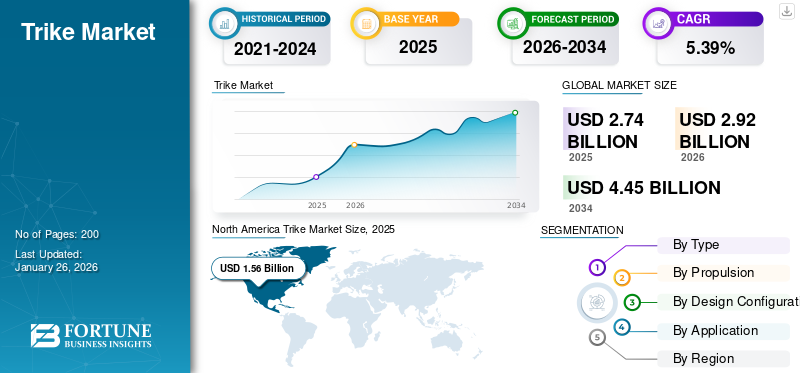
Download Free sample to learn more about this report.
Trike Market Key Takeaways
 Global Market Size & Forecast
- 2025 Market Size: USD 2.74 billion
- 2026 Market Size: USD 2.92 billion
- 2034 Forecast Market Size: USD 4.45 billion
- CAGR: 5.39% from 2026–2034
 Market Share
- North America dominated the global market with a share of 57.04% in 2025.
- The motorized trike segment is projected to lead the market with a 92.61% share in 2026.
- The tadpole trike segment is expected to account for a 60.11% share in 2026.
 Key Regional Highlights
North America
The region generated USD 1.56 billion in 2025 and is projected to reach USD 1.67 billion in 2026, supported by strong recreational vehicle demand and continued product innovation.
Asia Pacific
The market stood at USD 0.36 billion in 2025 and is expected to reach USD 0.39 billion in 2026, driven by growing electric trike adoption and supportive mobility initiatives.
Europe
The regional market was valued at USD 0.68 billion in 2025 and is projected to reach USD 0.72 billion in 2026, benefiting from favorable low-emission policies and tourism-driven demand.
U.S.
The U.S. market is projected to reach USD 1.42 billion by 2026, supported by leading manufacturers, strong dealership networks, and high consumer demand for three-wheel vehicles.
Japan
The Japan market is projected to reach USD 0.09 billion by 2026, supported by expanding electric mobility initiatives and increasing adoption of trikes for urban transportation.
Read More

MARKET DYNAMICS
MARKET DRIVERS
Rising Demand for Recreational and Leisure Mobility to Accelerate the Market Growth
The increasing consumer inclination toward recreational and leisure mobility is a significant factor propelling the growth of the global trike market. In developed economies such as the U.S., Canada, Germany, and France, trikes are increasingly being adopted as a premium alternative to conventional motorcycles, offering a combination of performance, stability, and comfort. The market is benefitting from the rise in adventure tourism, long-distance touring culture, and powersports participation, which has expanded the customer base among both experienced riders and new entrants seeking safe yet engaging mobility options. For instance, Polaris Inc. has reported sustained growth in its Slingshot series in the U.S. market, supported by growing interest among younger consumers and retirees. This trend underscores the broader shift toward lifestyle-oriented mobility solutions, reinforcing trikes’ position within the recreational vehicle segment.
MARKET RESTRAINTS
Complex Regulatory and Licensing Constraints May Limit the Market Growth
Regulatory inconsistency remains a significant barrier to the global trike market’s expansion, as licensing requirements, vehicle classifications, and safety standards for trikes vary considerably across regions. The segment falls between the conventional motorcycle and passenger vehicle categories, creating compliance and consumer confusion. For example, in the U.S., trikes are classified as autocycles in certain states, allowing operation with a standard driver’s license, while others mandate a motorcycle endorsement. Similarly, within Europe, category-A licensing exemptions apply only to select models, depending on weight and engine displacement, while Asia-Pacific markets still lack uniform homologation frameworks for electric trikes. This fragmented regulatory landscape complicates market entry strategies for OEMs and slows product approvals, particularly for electric variants that require dual compliance with automotive and two-wheeler norms. Thus, the regulatory ambiguity and licensing constraints may limit the trike market growth.
MARKET OPPORTUNITIES
Expansion of Electric Trikes in Urban Mobility and Logistics to Create Lucrative Growth Opportunities
The growing shift toward sustainable and low-emission transport solutions presents a major opportunity for electric trike manufacturers. As urban centers face congestion and emission restrictions, compact e-trikes are emerging as a viable alternative for both personal commuting and last-mile delivery. Their smaller footprint, lower operating cost, and improved battery range make them ideal for city environments. Governments in Europe, China, and India are introducing policies that support electric three-wheeled mobility through incentives, tax exemptions, and investments in charging infrastructure. Logistics companies and fleet operators are also exploring electric trikes for micro-delivery and courier services, particularly in densely populated areas. Thus, the expansion of electric trikes in urban mobility and logistics creates lucrative growth opportunities.
TRIKE MARKET TRENDS
Integration of Smart and Connected Mobility Features is One of the Significant Trike Market Trends
The integration of digital connectivity and smart vehicle technologies is emerging as a key trend in the trike market. Manufacturers are incorporating IoT-based telematics, GPS navigation, and app-linked diagnostic systems into modern trike models. These advancements enhance user convenience, improve maintenance scheduling, and increase overall safety. For electric trikes, connectivity also enables battery health monitoring, range prediction, and real-time charging updates, making fleet management more efficient for logistics operators. Companies such as BRP (Can-Am) and Polaris Inc. are introducing connected platforms that allow riders to access performance data and navigation through integrated dashboards. The growing intersection of mobility and digital ecosystems is transforming trikes from standalone recreational vehicles into connected mobility solutions. This trend enhances the ownership experience but also opens new revenue streams through software services, remote diagnostics, and telematics-based insurance models.
Download Free sample to learn more about this report.
MARKET CHALLENGES
Limited Infrastructure for Electric Trikes is a Challenging Factor for the Market
The electrification of trikes faces significant hurdles due to inadequate charging infrastructure and the absence of standardized battery technologies. While EV charging networks are expanding in regions such as Europe and China, their availability remains insufficient in developing economies where urbanization and mobility demand are growing the fastest. Additionally, many trikes are designed with non-standardized voltage and charging interfaces, creating interoperability challenges across charging networks. Range anxiety and long charging times also limit the use of electric trikes for long-distance touring or commercial operations. In countries such as India, Thailand, and Brazil, the lack of dedicated service and battery-swapping infrastructure delays EV adoption. Thus, the limited infrastructure for electric trikes presents a significant challenge to the market.
Segmentation Analysis
By Type
Motorized Trikes Dominate the Market Due to Higher Performance and Consumer Appeal
Based on type, the market is segmented into motorized trikes and non-motorized trikes.
The motorized trike segment is projected to dominate the market with a share of 92.61% in 2026, driven by its superior performance, convenience, and suitability for both recreational and long-distance applications. These trikes, powered by internal combustion or electric motors, offer enhanced comfort, speed, and range compared to manual counterparts, appealing to leisure riders and touring enthusiasts. High consumer preference in North America and Europe further reinforces segment leadership, supported by established OEMs such as Polaris Inc. and BRP (Can-Am). Continuous product innovation, integration of safety features, and expansion of electric variants are expected to sustain the motorized trike segment’s dominance throughout the forecast period.
By Propulsion Type
Rising Demand for Touring and High-Performance Trikes Drives Segment Growth
By propulsion, the market is segmented into Internal Combustion Engine (ICE) trikes and Electric Trikes (E-trikes).
The increasing popularity of touring and high-performance trikes is significantly fueling the growth of the Internal Combustion Engine (ICE) trike segment. The Propulsion - Internal Combustion Engine (ICE) Trikes segment is projected to dominate the market with a share of 78.97% in 2026. ICE-powered trikes are favored for their superior power delivery, longer range, and enhanced comfort, making them ideal for long-distance travel and adventure touring. Enthusiasts in markets such as the U.S., Canada, and Germany prefer these models for their reliability and dynamic riding experience. Leading manufacturers such as Harley-Davidson and BRP (Can-Am) continue to invest in powerful touring trikes that feature advanced suspension, infotainment systems, and stability controls. As leisure mobility and recreational touring trends expand globally, the preference for high-performance ICE trikes is expected to sustain strong market growth throughout the forecast period.
By Design Configuration
Tadpole Trike Configuration Gains Traction Owing to Superior Stability and Performance
Based on design configuration, the market is categorized into Delta trikes (one wheel in front and two at the rear) and Tadpole trikes (two wheels in front and one at the rear).
The tadpole trike segment is projected to dominate the market with a share of 60.11% in 2026 due to its enhanced stability, aerodynamic efficiency, and superior cornering performance. This configuration offers improved weight distribution and braking balance, making it ideal for sport and touring applications. Leading OEMs such as Polaris Inc. and BRP (Can-Am) have adopted this design in their flagship models, including the Polaris Slingshot and Can-Am Spyder, both of which are gaining strong consumer traction in North America and Europe. This development drives the market growth.
By Application
To know how our report can help streamline your business, Speak to Analyst
Recreational and Touring Applications Lead the Market with the Growing Popularity of Leisure Mobility
Based on application, the trike market is segmented into personal mobility, recreational & touring, and commercial / cargo transport.
The recreational and touring segment is projected to dominate the market with a share of 66.25% in 2026, driven by rising consumer interest in leisure riding, adventure touring, and long-distance travel. Trikes offer enhanced comfort, safety, and road stability, making them a preferred choice among aging motorcycle riders and lifestyle enthusiasts in North America and Europe.
Meanwhile, the personal mobility and commercial / cargo transport segments are also witnessing rising adoption, particularly in the Asia-Pacific region, where electric trikes are being utilized for urban commuting and last-mile delivery applications, creating new opportunities for the market.
Trike Market Regional Outlook
By region, the market is categorized into Europe, North America, Asia Pacific, and the Rest of the World.
North America
North America Trike Market Size, 2025 (USD Billion) To get more information on the regional analysis of this market, Download Free sample
The North America market accounted for USD 1.56 billion in 2025, representing 57.04% of the global industry, and is expected to reach USD 1.67 billion in 2026. North America holds the majority of the trike market share, driven by high consumer spending on powersports and recreational vehicles. North America dominated the global market in 2025, with a market size of USD 1.56 billion. The U.S. remains the primary hub, accounting for the majority of global trike sales due to strong brand presence, advanced product portfolios, and well-established dealership networks. Leading manufacturers such as Polaris Inc., BRP (Can-Am), and Harley-Davidson continue to expand their three-wheel lineups, catering to both touring enthusiasts and lifestyle-oriented consumers. The region’s mature recreational vehicle culture, coupled with a growing preference for safer alternatives to motorcycles, supports sustained demand. Furthermore, technological innovations and the gradual electrification of trike models are reinforcing North America’s leadership, positioning it as the key revenue-generating region throughout the forecast period. The U.S. market is projected to reach USD 1.42 billion by 2026.
Asia-Pacific and Europe are witnessing rapid growth, driven by shifting mobility trends and electrification initiatives.
Asia Pacific
In 2025, Asia Pacific represented USD 0.36 billion, accounting for 13.13% of the worldwide market, and is projected to grow to USD 0.39 billion in 2026. In the Asia-Pacific region, countries including China, Japan, and India are emerging as major manufacturing and consumption hubs, supported by local EV incentives, cost-effective production, and increasing adoption of electric trikes for urban commuting and cargo delivery. The Japan market is projected to reach USD 0.09 billion by 2026, the China market is projected to reach USD 0.14 billion by 2026, and the Australia market is projected to reach USD 0.07 billion by 2026.
Europe
Europe recorded a market size of USD 0.68 billion in 2025, capturing 24.89% of the global market share, and is projected to reach USD 0.72 billion in 2026. Meanwhile, Europe demonstrates steady expansion due to favorable regulatory frameworks that promote low-emission mobility solutions and a well-established tourism sector, driving demand for recreational trikes. The France market is projected to reach USD 0.14 billion by 2026, while the Germany market is projected to reach USD 0.13 billion by 2026.
Rest of the World
The Rest of the World (RoW) region, comprising Latin America, the Middle East, and Africa, represents a nascent but steadily expanding market for trikes. Growth is primarily driven by tourism, leisure rentals, and luxury imports, particularly in countries such as Brazil, the UAE, and Saudi Arabia.
COMPETITIVE LANDSCAPE
Key Industry Players
Leading OEMs and New Entrants Driving Innovation and Electrification in the Global Trike Market
The global trike market is characterized by the presence of established powersports manufacturers and emerging innovators in electric mobility. Key players include Polaris Inc., BRP Inc. (Can-Am), Harley-Davidson, Piaggio & C. SpA, Rewaco GmbH, Boom Trikes, Arcimoto Inc., Electra Meccanica Vehicles Corp., and Vanderhall Motor Works. These companies hold strong market positions through extensive product portfolios, brand loyalty, and well-developed dealer networks across North America and Europe.
Leading OEMs are strategically focusing on product diversification, electrification, and connected technology integration to cater to both recreational and urban mobility segments. For instance, BRP launched the 2025 Can-Am Canyon three-wheel model, enhancing its adventure touring lineup, while Arcimoto expanded its electric trike fleet for urban deliveries in the U.S. Companies are also investing in lightweight chassis materials, digital control systems, and modular platform designs to improve performance and efficiency.
LIST OF KEY TRIKE COMPANIES PROFILED
- Polaris Inc. (U.S.)
- BRP / Can-Am (Canada)
- Harley-Davidson (U.S.)
- Piaggio Group (Italy)
- Rewaco GmbH (Germany)
- Boom Trikes (Germany)
- Arcimoto (U.S.)
- Electra Meccanica (Canada)
- Vanderhall Motor Works (U.S.)
- Tilting Motor Works Inc. (U.S.)
- Motor Trike Inc. (U.S.)
KEY INDUSTRY DEVELOPMENTS
- In August 2025, Boom Trikes Tenerife, one of the regional distributors of Boom Trikes GmbH in Spain, announced via its official Facebook page the arrival of two brand-new Boom Trikes at its headquarters, expanding its demonstration and display fleet. This development highlights Boom Trikes’ continued focus on strengthening its European retail presence and enhancing customer accessibility to its latest high-performance trike models.
- In May 2025, Addmotor, a leading U.S.-based electric mobility manufacturer specializing in e-bikes and electric trikes, announced the launch of its 2025 electric trike lineup featuring new and upgraded models such as the Citytan Folding, SpytanX Reverse, Greattan D Fat Tire, and M-380 Tandem. This diversified product range is designed to cater to a wide spectrum of users, including urban commuters, senior riders, and leisure cyclists seeking enhanced stability and comfort.
- In February 2025, Polaris Inc. introduced the Slingshot 10th Anniversary Edition, a special limited-edition model commemorating a decade since the debut of its iconic three-wheeled roadster. This launch celebrates Polaris’s continued leadership in the performance trike segment, blending distinctive design, advanced technology, and dynamic engineering.
- In January 2025, Harley-Davidson officially unveiled its 2025 trike model lineup, confirming the return of three flagship three-wheel models: The Tri Glide Ultra, Freewheeler, and Road Glide 3. These models are listed on the Harley-Davidson site with MSRP pricing as part of its “2025 Trike Motorcycles” portfolio (Tri Glide Ultra starting $37,999; Road Glide 3 at $34,999; Freewheeler at $31,999).
- In August 2024, Motor Trike Inc., one of the leading U.S.-based trike conversion manufacturers, introduced the 2024 Motor Trike VTX 1300 as part of its updated product lineup. The new model was officially listed by authorized dealers in Pasco, Washington, marking a continued effort by the company to strengthen its regional retail network and expand accessibility for American trike enthusiasts.
REPORT COVERAGE
Request for Customization to gain extensive market insights.
Report Scope & Segmentation
|
ATTRIBUTE |
DETAILS |
|
Study Period |
2021-2034 |
|
Base Year |
2025 |
|
Estimated Year |
2026 |
|
Forecast Period |
2026-2034 |
|
Historical Period |
2021-2024 |
|
Growth Rate |
CAGR of 5.39% from 2026-2034 |
|
Unit |
Value (USD Billion) |
|
Segmentation |
By Type, By Propulsion, By Design Configuration, By Application and By Region |
|
By Type |
· Motorized Trikes · Non-Motorized Trikes |
|
By Propulsion |
· Electric Trikes (E-Trikes) · Internal Combustion Engine (ICE) Trikes |
|
By Design Configuration |
· Delta Trike (1 Front, 2 Rear Wheels) · Tadpole Trike (2 Front, 1 Rear Wheel) |
|
By Application |
· Personal Mobility · Recreational & Touring · Commercial / Cargo Transport |
|
By Region |
· North America (By Type, By Propulsion, By Design Configuration, By Application, and By Country) o U.S. ( By Propulsion ) o Canada ( By Propulsion ) o Mexico ( By Propulsion ) · Europe (By Type, By Drive Type, By Vehicle Type, By Component, and By Country) o Germany ( By Propulsion ) o U.K. ( By Propulsion ) o France ( By Propulsion ) o Rest of Europe ( By Propulsion ) · Asia Pacific (By Type, By Drive Type, By Vehicle Type, By Component, and By Country) o China ( By Propulsion ) o Japan ( By Propulsion ) o Australia (By Propulsion) o Rest of Asia Pacific (By Propulsion) · Rest of the World (By Type, By Drive Type, By Vehicle Type, By Component, and By Country) |
Frequently Asked Questions
Fortune Business Insights says that the global market value stood at USD 2.74 billion in 2025 and is projected to reach USD 2.92 billion by 2034.
In 2025, the market value stood at USD 2.74 billion.
The market is expected to exhibit a CAGR of 5.39% during the forecast period of 2026-2034.
The Recreational & Touring segment led the market by application.
Rising Demand for Recreational and Leisure Mobility to Accelerate the Market Growth
Polaris Inc., BRP Inc. (Can-Am), and Harley-Davidson are the major players in the market
North America dominated the market in 2024.



- 2021-2034
- 2025
- 2021-2024
- 200
-
(Offer valid till 30th Sep 2026)
Get 30-60 hrs Free Customization
Expand Regional and Country Coverage, Segments Analysis, Company Profiles, Competitive Benchmarking, and End-user Insights.




















Related Reports
-
US +1 833 909 2966 ( Toll Free )
-
Get In Touch With Us