Tunable Diode Laser Analyzer (TDLA) Market Size, Share & Industry Analysis, By Methodology (IN SITU and Extractive), By Gas Analyzer (Oxygen Analyzers, Ammonia Analyzers, COX Analyzers, Moisture Analyzers, HX Analyzers, and Others), By Device Type (Portable and Fixed), By Application (Environmental Monitoring, Process Monitoring, Industrial Emission Monitoring, and Safety Monitoring), By End-user (Oil & Gas, Metals & Mining, Energy & Power, Waste & Water Treatment, Semiconductor & Electronics, Chemicals & Pharmaceuticals, Pulp & Paper, and Others), and Regional Forecast, 2026 – 2034
 Download Free Sample
TUNABLE DIODE LASER ANALYZER (TDLA) MARKET SIZE AND FUTURE OUTLOOK
 Listen to Audio Version
The global Tunable Diode Laser Analyzer (TDLA) market size was valued at USD 619.23 million in 2025 and is projected to grow from USD 672.68 million in 2026 to USD 1388.56 million by 2034, exhibiting a CAGR of 9.50% during the forecast period. North America dominated the global market with a share of 34.32% in 2025.
Tunable diode laser analyzers (TDLA) are special instruments designed to quantify the concentration of specific gases within a mixture using the laser absorption spectrometry technique. They measure the levels of gases, such as carbon dioxide, nitrogen, methane, as well as oxygen and water, by assessing the quantity of laser light absorbed as it passes through the gas. This durable process analyzer is utilized in major industries such as oil and gas, power generation, chemicals, and environmental monitoring for real-time, non-invasive gas analysis. They provide various benefits, including quick response times, minimal maintenance, and high selectivity, making them well-suited for uses including emission control, combustion enhancement, and ensuring process safety.
The global market is poised for significant growth driven by the increasing industrial automation and stringent environmental regulations on emissions monitoring. The oil & gas, power generation, and chemical industries are driving the adoption of real-time gas analysis and process optimization. Additionally, the expansion of smart factories and Industry 4.0 is increasing TDLA integration for real-time monitoring and predictive maintenance, driving the adoption of the product. Key players in the market include ABB Ltd. (Switzerland), Emerson Electric Co. (U.S.), and Yokogawa Electric Corporation (U.S.), with products such as TDLS8200 and ABB's new Sensi+ modules. The market's future will likely see technological innovations concentrated on increasing energy-efficient solutions and technological advancements in extreme conditions.
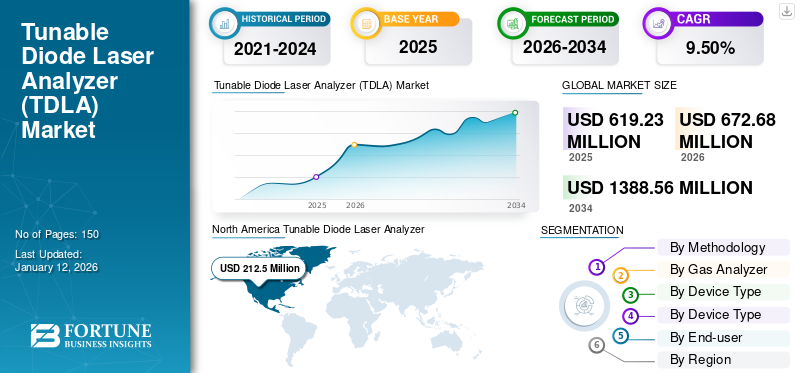
Download Free sample to learn more about this report.
Tunable Diode Laser Analyzer (TDLA) Market Key Takeaways
 Global Market Size & Forecast
- 2025 Market Size: USD 619.23 million
- 2026 Market Size: USD 672.68 million
- 2034 Forecast Market Size: USD 1,388.56 million
- CAGR: 9.50% from 2026–2034
 Market Share
- North America dominated the market with a 34.32% share in 2025.
- IN SITU methodology segment is projected to dominate with a 64.24% share in 2026.
- Fixed device segment accounted for 60.83% of the market in 2025.
 Key Regional Highlights
North America
The market reached USD 212.5 million in 2025 and is projected to reach USD 230.2 million in 2026.
Asia Pacific
The market reached USD 176.3 million in 2025 and is projected to reach USD 192.5 million in 2026.
Europe
The market reached USD 100.5 million in 2025 and is projected to reach USD 110.1 million in 2026.
U.S.
The market is projected to reach USD 141.74 million by 2026.
Japan
The market is projected to reach USD 52.30 million by 2026.
Read More

Impact of Generative AI
Leveraging the Generative AI in TDLA Devices to Drive Market Growth
Generative AI has a significant impact on the TDLA market as it enhances the system efficiency, accuracy, and automation in gas analysis. AI-powered models analyze vast amounts of spectral absorption data in real-time, reducing noise and improving gas concentration accuracy. Generative AI helps refine laser calibration, enhancing measurement precision across varying industrial conditions. Additionally, it also enhances self-learning algorithms to detect abnormal gas concentration patterns, preventing hazardous incidents. Thus, this factor drives the growth of the market.
MARKET DYNAMICS
Tunable Diode Laser Analyzer (TDLA) Market Trends
Increasing Need for Process Optimization among TDLA Systems has Emerged as an Exceptional Market Trend
Precise gas measurements are essential in improving process control and optimization in a variety of industries. By accurately tracking gas concentrations, companies can adjust their operations, minimize waste, and ensure that processes operate at their highest efficiency. This results in considerable cost savings, as reliable data helps prevent problems such as excessive use of raw materials, energy inefficiencies, or compliance issues related to emissions. As industries strive to reduce operational costs while maximizing output, the need for advanced analytical instruments such as tunable diode laser analyzers rises. This potential for boosting efficiency and cutting expenses is a significant trend driving market expansion.
Market Drivers
Growing Industrialization and Development of New Power Plants Across the Globe to Boost Market Growth
Various operational plants are found in the TDLA market across multiple sectors, including oil & gas, power generation, pulp & paper, cement, and chemicals & pharmaceuticals. In each industry, gases are assessed at different checkpoints to guarantee effective monitoring and control. Rapid industrial growth in nations including China, India, and Brazil is leading to a significant demand for electricity to sustain it.
- For instance, the levels of harmful gases, such as nitrogen oxide (NOx) and sulfur dioxide (SO2), which several environmental agencies monitor due to their dangers to both human health and the environment, can also be detected using TDLA technology.
Additionally, governments are tackling the increase in electricity consumption by making considerable investments in constructing new power plants and improving current ones. The development of new facilities, as well as the modernization and replacement of conventional analyzers with TDLA, are expected to drive Tunable Diode Laser Analyzer (TDLA) market growth.
Market Restraints
Complex Calibration and Maintenance issues hamper the Usage of TDLA Systems
Tunable diode laser analyzers need frequent calibration and upkeep to guarantee they deliver precise and dependable readings. This continuous task can be both labor-intensive and expensive, particularly in high-demand industrial settings where uninterrupted monitoring is essential. The requirement for qualified personnel to carry out these duties further increases operational expenses, and any interruptions caused by maintenance can hinder production workflows.
Additionally, industries functioning in remote or harsh conditions may encounter logistical obstacles in obtaining timely calibration and servicing. These considerations can serve as significant hurdles to broad adoption, especially for smaller enterprises with constrained resources, presenting a notable challenge to the growth of the market.
Market Opportunities
Advancements in Several TDLA Applications Create Numerous Market Opportunities
Advancements in tunable diode laser analyzers, such as improved sensitivity, portability, and miniaturization, are creating new avenues for market expansion. These improvements enhance the accessibility of the technology, facilitating its use in a broader array of applications and industries, including smaller operations and remote areas. The compact design and portability of these analyzers provide the flexibility necessary for on-site gas monitoring in difficult conditions. Furthermore, the heightened sensitivity guarantees precise detection of trace gases, thereby enhancing overall performance and dependability. As these analyzers become more affordable and versatile, they are set for increased uptake, presenting a significant market opportunity across multiple sectors. Consequently, these elements will propel the growth of the market in the coming years.
Download Free sample to learn more about this report.
SEGMENTATION ANALYSIS
By Methodology
Growing Demand for Continuous and Real-Time Gas Monitoring led to Segment Growth
On the basis of methodology, the market is categorized into IN SITU and extractive.
The IN SITU segment is expected to account for 64.24% of the market in 2026 and is expected to grow at the highest CAGR during the forecast period. The increasing need for real-time and continuous gas monitoring across various industrial applications primarily drives the demand for this method. Furthermore, IN SITU TDLA systems facilitate direct measurements of gas concentrations without requiring sample extraction, which improves accuracy and minimizes delays. Additionally, sectors such as chemicals, oil and gas, and power generation heavily depend on these systems to enhance processes, ensure compliance with environmental standards, and uphold safety regulations. Consequently, these elements contribute to the segmental growth.
Moreover, the extractive methodology is expected to have a significant share over the forecast period. This methodology takes gas samples from the process and analyzes them in a controlled environment, reducing external interferences such as moisture, dust, and pressure variations. This leads to more stable and accurate readings compared to on-situ methods. Hence, these factors boost the segment growth.
By Gas Analyzer
Increasing Demand for Oxygen Gas Analyzer among Several Industry Verticals to Drive Market Growth
On the basis of gas analyzers, the market is categorized into oxygen analyzers, ammonia analyzers, COX analyzers, moisture analyzers, HX analyzers, and others.
The COX Analyzers segment is anticipated to hold a dominant market share of 23.70% in 2026. TDLAs target specific gas absorption lines, allowing for highly selective gas detection. This leads to extremely low detection limits, making them ideal for trace gas analysis. They provide real-time or near-instantaneous readings, which is critical for dynamic processes such as combustion control or emissions monitoring. Furthermore, TDLAs are perform well in extreme industrial conditions such as high temperature, pressure, or dust-laden environments, particularly in power plants, refineries, and cement factories. Therefore, these factors boost the market growth.
Furthermore, moisture analyzers are expected to grow at the highest CAGR of 14.35% during the forecast period. These analyzers are growing due to their high accuracy, real-time monitoring capabilities, and non-contact measurement features. These analyzers play a crucial role in industries where moisture control is critical for process optimization and product quality. Hence, these factors drive the segmental growth.
By Device Type
Implementation of Fixed Devices Among Several Industries has led to the Segment Growth
On the basis of device type, the market is categorized into portable and fixed.
The Fixed segment dominated the market share by 61.56% in 2026 and is expected to grow at the highest CAGR of 10.92% during the forecast period. These devices provide highly accurate measurements of gas concentrations, ensuring consistent and reliable data collection. This is particularly important in industries such as oil & gas, chemicals, and power generation, where even minor fluctuations in gas composition can impact efficiency and safety. These devices are precisely calibrated and don’t suffer from drift, maintaining accuracy over long periods. Also, they provide high sensitivity and selectivity for gases such as O2, Co2, NH3, CH4, and HCI. Hence, these factors drive the segmental growth. The segment is likely to capture 60.83% of the market share in 2025.
Moreover, the portable device type is expected to have a significant share during the forecast period. These devices offer higher flexibility and efficiency in gas monitoring applications. These compact, mobile units provide real-time gas analysis without requiring fixed installations. Additionally, these are easy to transfer and deploy across multiple locations, making them ideal for field applications.
By Application
Advantages of Industrial Emission, Including Reduced Cross Interference from Other Gases, has Contributed to the Segmental Growth
On the basis of application, the market is categorized into environmental monitoring, process monitoring, industrial emission monitoring, and safety monitoring.
In 2026, the Industrial Emission Monitoring segment is projected to lead the market with a 38.74% share. They offer precise, real-time measurement of gas concentrations, ensuring reliable monitoring of industrial emissions. They use laser spectroscopy, reducing cross-interference from other gases. Furthermore, they offer real-time, high-precision gas analysis with minimal maintenance, making them an essential tool for modern industrial emission control.
Additionally, the process monitoring segment is expected to grow at the highest CAGR of 12.71% during the forecast period. This growth is largely attributed to its increasing application in short-range uses, affordability, enhanced sensitivity for localized applications, as well as its simplicity in both use and installation. The rising applications in areas such as leak detection, fire detection, and industrial process monitoring significantly contribute to the demand for multi-mode fibers. Therefore, these elements are driving the expansion of the segment.
By End-user
Growing Application of the Product in the Oil and Gas Industries to Drive Segmental Growth
On the basis of end-user, the market is categorized into oil & gas, metals & mining, energy & power, waste & water treatment, semiconductor & electronics, chemicals & pharmaceuticals, pulp & paper, and others.
The oil & gas application held the largest global tunable diode laser analyzer market share in 2024. The rising need for global regulations on emissions pushes oil and gas companies to adopt advanced gas monitoring solutions such as TDLAs. TDLAs provide real-time, IN-SITU analysis of gases in harsh environments, improving safety and efficiency in oil refineries, petrochemical plants, and natural gas processing facilities. Moreover, as compared to traditional gas analyzers, TDLAs offer high sensitivity, faster response time, and minimal maintenance, reducing downtime in oil and gas operations. The segment is poised to gain 20.22% of the market share in 2025.
Semiconductor & electronics application is expected to grow at the highest CAGR of 13.46% during the forecast period. Their adoption results in higher manufacturing efficiency, improved yield, reduced operational costs, and enhanced compliance with environmental and cleanroom regulations. Their high precision, real-time monitoring, and low maintenance requirements make them a critical tool for advanced semiconductor manufacturing.
To know how our report can help streamline your business, Speak to Analyst
TUNABLE DIODE LASER ANALYZER (TDLA) MARKET REGIONAL OUTLOOK
The market has been studied geographically across five main regions: North America, Europe, Asia Pacific, South America, and the Middle East & Africa.
North America Tunable Diode Laser Analyzer (TDLA) Market Size, 2025 (USD Million)
To get more information on the regional analysis of this market, Download Free sample
North America
In 2025, North America held 34.30% of the global market share, reaching a valuation of USD 212.5 million, and is projected to grow to USD 230.2 million in 2026. The region is witnessing substantial growth driven by several factors, including stringent environmental regulations and an increasing demand for precise emissions monitoring. Furthermore, the oil and gas sector is an important contributor to this trend, as businesses strive to fulfill regulations while augmenting production efficiency through real-time gas analysis. Moreover, advancements in TDLA technology improve operational safety and efficiency, further fueling market expansion. This serves to be one of the most significant factors driving the growth of the market in the region.
Furthermore, due to stringent environmental regulations and growing demand for accurate emissions monitoring across several sectors, the U.S. market held the largest share in 2024. Additionally, the oil and gas sector is crucial to this growth as businesses work to satisfy regulatory requirements while increasing production efficiency via real-time gas analysis. Furthermore, TDLA's technology developments are increasing operating safety and efficiency, which is driving important manufacturers to spend money on creative solutions to meet these changing demands. The U.S. market is likely to gain USD 141.74 million in 2026.
To know how our report can help streamline your business, Speak to Analyst
Asia Pacific
Asia Pacific contributed approximately USD 176.3 million to the global market in 2025, accounting for 28.50% share, and is expected to reach USD 192.5 million in 2026. Meanwhile, the region is anticipated to witness the highest CAGR of 11.70% in the market between 2025 and 2032. The region’s growth is driven by rapid industrialization and increasing investments by businesses in environmental monitoring technologies across various sectors. China is set to grow rapidly, expected to hold USD 47.85 million in 2026. Developing economies, such as China and India, are expected to foresee proliferation in various industries such as pulp & paper, metal & mining, power generation, and cement, which provides the base for the installation of TDLAs over the traditional analyzing devices. Thus, these factors drive the global tunable diode laser analyzer (TDLA) market growth in the region. India is set to be valued at USD 35.10 million in 2026, while Japan is poised to reach USD 52.30 million in the same year.
Europe
The market in Europe reached USD 100.5 million in 2025, representing 16.20% of total market revenue, and is projected to reach USD 110.1 million in 2026. This market expansion is driven by the region's dedication to reducing greenhouse gas emissions and enhancing air quality. The U.K. market is estimated to grow with a valuation of USD 24.78 million in 2026. Additionally, the European Union's strict regulations on emissions monitoring require industries, including chemicals, energy, and manufacturing, to implement advanced gas analysis technologies such as TDLA. Moreover, the increasing focus on sustainability and process optimization boosts the demand for real-time monitoring solutions, establishing TDLA as an essential tool for compliance and operational effectiveness in European industries. Germany is poised to reach a market value of USD 26.44 million in 2026, while France is set to be valued at USD 17.90 million in 2025.
Middle East & Africa and South America
The Middle East & Africa region captured 12.10% of the global market in 2025, generating USD 75.2 million in revenue, and is projected to reach USD 81.4 million in 2026. The markets in the Middle East & Africa, and South America are still developing but show significant potential for growth. The rising demand in sectors such as oil & gas, power generation, and water treatment industries fuels this development. Additionally, the region has a strong presence in the oil & gas sector, which heavily relies on TDLA technology for real-time gas analysis, emissions monitoring, and process control. Therefore, these factors accelerate the growth of the market.
Similarly, the South American market is expected to grow moderately. Governments in the region are enforcing air pollution control laws, leading to higher adoption of gas analyzers to monitor industrial emissions. However, the region's economic challenges and incomplete technological infrastructure may control the market's growth. The GCC market is set to expand with the valuation of USD 23.88 million in 2025.
Latin America
In 2025, Latin America generated USD 54.8 million, contributing 8.80% to global market revenue, and is projected to grow to USD 58.5 million in 2026.
COMPETITIVE LANDSCAPE
Key Industry Players
Market Players Adopt Merger & Acquisition Strategies to Expand Their Operations
Prominent firms in the industry are actively broadening their global presence by introducing specialized solutions tailored to specific sectors. They are strategically forming partnerships and acquiring local businesses to establish a robust foothold in various regions. These companies are concentrating on creating effective marketing strategies and developing new solutions to maintain and grow their market share. Thus, the growing demand for tunable diode laser analyzer is expected to create lucrative opportunities for the market players.
List of Key Tunable Diode Laser Analyzer Companies Profiled:
- Emerson Electric Co. (U.S.)
- Honeywell International Inc. (U.S.)
- ABB Ltd. (Switzerland)
- Sick AG (Germany)
- Yokogawa Electric Corporation (Japan)
- Spectris (U.K.)
- AMETEK. Inc. (U.S.)
- Siemens AG (Germany)
- METTLER TOLEDO (U.S.)
- Endress+Hauser Group Services AG (Switzerland)
- Pergram-Suisse AG (Switzerland)
- Hanwei Electronics Group Corporation (China)
- Baker Hughes Company (U.S.)
- FPI Group (China)
- Teledyne Technologies Incorporated. (U.S.)
KEY INDUSTRY DEVELOPMENTS:
- March 2025: Emerson revealed the introduction of its Rosemount 625IR Fixed Gas Detector, as the company pointed out the necessity for end users to swiftly and dependably detect hydrocarbon gases without false alarms. The detector is intended for use in all plant environments, employing sophisticated optical absorption detection technology.
- October 2024: Baker Hughes, an energy technology firm, launched XMO2pro, the latest and most advanced oxygen analyzer planned to ensure superior levels of accuracy, stability, and reliability. The launch of the product is calculated for permanence in dangerous locations and precisely measures the percentage of oxygen concentration in gases.
- April 2023: ABB has introduced Sensi+, a compact analyzer designed for detecting contaminants in natural gas, utilizing a distinct tunable diode laser (TDL) technology acknowledged as Off-Axis Integrated Cavity Output Spectroscopy (OA-ICOS). This technology consistently, precisely, and concurrently quantifies corrosive elements such as hydrogen sulfide, carbon dioxide, and water in real-time within complex and fluctuating natural gas flows.
- April 2021: Yokogawa Electric Corporation has introduced a new TDLS8200 probe-type tunable diode laser spectrometer toward its Oprex Analyzer lineup. This product launch allows for stable and simultaneous detection of oxygen, carbon monoxide, and methane in plant boilers and heating furnaces, thus promoting efficient combustion management and ensuring safe operations.
INVESTMENT ANALYSIS AND OPPORTUNITIES
The tunable diode laser analyzer market is focused on research & development activities to develop more advanced, efficient, and cost-effective solutions. Companies are gradually collaborating with small organizations, providing opportunities for merger and acquisition strategies. Expanding product offerings for new applications and industrial sectors gives enterprises a competitive advantage and helps them expand their offerings and reach across the global landscape. Emphasis on understanding customers' requirements and developing solutions that suit their needs and market trends also helps them acquire a new customer base. The company’s collected technology and production capacity to develop and deliver quality and cost-competitive products rapidly can contribute to market players' business growth.
REPORT COVERAGE
The report provides a detailed market analysis and focuses on key aspects such as leading companies, product/service types, and leading product applications. Besides, the report offers insights into the market trends and highlights key industry developments. In addition to the factors above, the report encompasses several factors that contributed to the market's growth in recent years.
Request for Customization to gain extensive market insights.
REPORT SCOPE & SEGMENTATION
|
ATTRIBUTE |
DETAILS |
|
Study Period |
2021-2034 |
|
Base Year |
2025 |
|
Estimated Year |
2026 |
|
Forecast Period |
2026-2034 |
|
Historical Period |
2021-2024 |
|
Growth Rate |
CAGR of 9.50% from 2026 to 2034 |
|
Unit |
Value (USD Million) |
|
Segmentation |
By Methodology, By Gas Analyzer, By Device Type, By Application, By End-user, and Region |
|
Segmentation |
By Methodology
By Gas Analyzer
By Device Type
By Application
By End-user
By Region
|
|
Companies Profiled in the Report |
Emerson Electric Co. (U.S.), Honeywell International Inc. (U.S.), ABB Ltd. (Switzerland), Sick AG (Germany), Yokogawa Electric Corporation (Japan), Spectris (U.K.), AMETEK. Inc. (U.S.), Siemens AG (Germany), METTLER TOLEDO (U.S.), and Endress+Hauser Group Services AG (Switzerland). |
Frequently Asked Questions
The market is projected to reach USD 1388.56 million by 2034.
In 2025, the market was valued at USD 619.23 million.
The market is projected to grow at a CAGR of 9.50% during the forecast period.
The IN SITU methodology is expected to lead the market.
Growing industrialization and development of new power plants across the globe are the key factors driving market growth.
Emerson Electric Co. (U.S.), Honeywell International Inc. (U.S.), ABB Ltd. (Switzerland), Sick AG (Germany), Yokogawa Electric Corporation (Japan), Spectris (U.K.), AMETEK. Inc. (U.S.), Siemens AG (Germany), METTLER TOLEDO (U.S.), and Endress+Hauser Group Services AG (Switzerland) are the top players in the market.
North America is expected to hold the highest market share.
By application, semiconductor is expected to grow with the highest CAGR during the forecast period.



- 2021-2034
- 2025
- 2021-2024
- 150
Get 30-60 hrs Free Customization
Expand Regional and Country Coverage, Segments Analysis, Company Profiles, Competitive Benchmarking, and End-user Insights.




















Related Reports
-
US +1 833 909 2966 ( Toll Free )
-
Get In Touch With Us