 Download Free Sample



Get a Quote
Receive a tailored pricing based on your needs.
- Choose license type
- Multiple user options
- Custom scope & coverage
- Fast turnaround
"Designing Growth Strategies is in our DNA"
 Listen to Audio Version
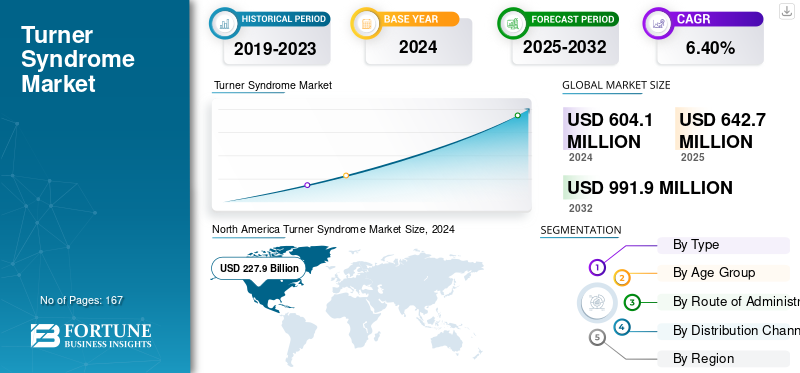
The global Turner syndrome market size was valued at USD 642.7 million in 2025. The market is projected to grow from USD 681.30 million in 2026 to USD 1106.08 million by 2034, exhibiting a CAGR of 6.24% during the forecast period. North America dominated the global turner syndrome market with a market share of 37.26% in 2025.
The Turner syndrome market is estimated to witness noteworthy growth during the forecast period. It is a rare chromosomal disorder that affects only females due to a characterized partial or complete absence of one X chromosome. Thus, to promote height and physical development and management of puberty and reproductive health, hormonal therapy is given to females. Furthermore, to address such conditions in the diagnosed population, hormonal therapies are required. Moreover, the market’s growth will also be supported by the launch of off-label generic drugs.
For instance, in June 2025, as per the data published by NIH, Turner syndrome occurs in approximately 1 in 2000 to 1 in 2500 live female births worldwide.
The market encompasses several major players with Novo Nordisk A/S, and Pfizer Inc. at the forefront with robust portfolio and strategic activities to support their dominance.
Download Free sample to learn more about this report.
 Market Size & Forecast
 Market Share
 Key Regional Highlights
North America
Valued at USD 239.47 million in 2025, supported by advanced healthcare infrastructure, reimbursement coverage, and awareness programs.
Europe
Valued at USD 192.74 million in 2025, driven by growing awareness initiatives and government support for Turner syndrome treatment.
Asia Pacific
Valued at USD 167.03 million in 2025, driven by increasing awareness, improving healthcare access, and rising diagnosis of Turner syndrome.
U.S.
Projected to reach USD 240.41 million by 2026, supported by rising Turner syndrome cases and favorable reimbursement policies.
Japan
Projected to reach USD 42.60 million by 2026, driven by increasing diagnosis and adoption of advanced treatment options.
Read More

Increasing Prevalence and Awareness Programs to Propel Market Growth
One of the most prominent driving factors of the market is the increasing number of cases of Turner syndrome in females. Also, rising awareness campaigns and newborn screening programs are being implemented to improve diagnosis and enhance treatment adoption.
High Cost of Therapy and Limited Reimbursement in Emerging Countries to Restrict Market Growth
The high cost of hormonal therapy for growth treatment is one of the major factors hampering its adoption in the lower-income countries. The high cost is associated with limited patient pool for clinical studies and investments by key players for such diseases.
Also, many patients in these regions face financial challenges due to limited healthcare infrastructure and insurance coverage,.
As per the Turner Syndrome Foundation, growth treatment costs around USD 10,000 to USD 60,000 a year in the U.S.
Development of Long-Acting Growth Hormone Formulations to Create Lucrative Growth Opportunities
Traditional growth hormone therapy requires daily subcutaneous injections. This can be painful, uncomfortable, and increase the burden on patients, which can and hamper their lifestyle. Thus, to enhance treatment adherence and patient convenience, key players are focused on developing and launching extended-release therapies. This will reduce injection frequency and improve quality of life and compliance.
Lack of Treatment Adherence May Challenge Market Growth
Poor treatment adherence among patients due to lack of awareness, forgetfulness, side effects, or psychological barriers is challenging the Turner syndrome market growth. Moreover, many patients discontinue therapies, thus reducing treatment effectiveness.
Increasing Research and Development Activities Support Market Growth
The rising focus of key players to develop and launch advanced treatment options for Turner’s syndrome is a major market trend. Rising prevalence of Turner syndrome lead to increasing demand for innovative product offerings. Moreover, heightened focus on R&D result in improved patient outcomes and address unmet medical needs.
Download Free sample to learn more about this report.
Increasing Government Schemes for Growth Hormone Therapy to Propel Segment Growth
On the basis of type, the market is classified into growth hormone therapy, estrogen replacement therapy, progestogen add-on therapy, and others.
To know how our report can help streamline your business, Speak to Analyst
The growth hormone therapy segment will account for 52.79% market share in 2026 due to its effectiveness in promoting growth and physical development in the affected individuals. Also, it is a first-line treatment for Turner's syndrome. Furthermore, increasing approvals and government programs to offer growth hormone treatment to patients is boosting the segment’s growth.
The estrogen replacement therapy segment is expected to grow at a CAGR of 6.92% over the forecast period.
New Product Launches for Adults to Bolster the Segment’s Growth
In terms of age group, the market is categorized into adult and pediatric.
The adult segment is anticipated to hold a dominant market share of 61.37% in 2026. The increasing demand for estrogen–progestogen therapy in adults, after adolescence growth hormone therapy, is contributing toward its growth.
The pediatric segment is expected to grow at a CAGR of 5.38% over the forecast period.
Wide Availability and Approvals Boost Parenteral Segment Growth
Based on route of administration, the market is segmented into oral, parenteral, and others.
The parenteral segment is expected to account for 67.75% of the market in 2026. The dominant share of the segment is due to the better bioavailability and efficacy of the parenteral route. Also, growth hormone therapy is one of the prominent treatments, and it is primarily administered through subcutaneous or intramuscular injections.
The oral segment is set to flourish with a growth rate of 7.57% over the forecast period.
Patient Preference and Ease of Availability to Propel Drug Store and Retail Pharmacies
Based on distribution channel, the market is segmented into hospital pharmacies, retail pharmacies & drug stores, and online pharmacies.
The retail pharmacies & drug stores segment is poised to account for 49.77% of the market share in 2026. These channels have widespread accessibility and allow easy refilling of prescriptions for the patients and caregivers.
In addition, hospital pharmacies as a distribution channel are projected to grow at a CAGR of 5.58% during the study period. The increasing government recommendation for growth hormone treatment in children is to boost the distribution of these drugs via hospital pharmacy channels.
By geography, the market is categorized into Europe, North America, Asia Pacific, Latin America, and the Middle East & Africa.
North America Turner Syndrome Market Size, 2025 (USD Million)
To get more information on the regional analysis of this market, Download Free sample
The North America region captured 37.26% of the global market in 2025, generating USD 239.47 Million in revenue, and is projected to reach USD 253.3 Million in 2026. Its dominance is driven by advanced healthcare infrastructure, reimbursement coverage, and awareness programs. In 2025, the U.S. market is estimated to reach USD 226.7 million.
The U.S. market is projected to reach USD 240.41 million by 2026. The U.S. is expected to dominate North America’s market, owing to the rising cases of Turner syndrome and the presence of adequate reimbursement policies for better patient care. Additionally, the presence of key players in the market with strong research and development initiatives boosts the country’s growth.
Europe maintained a strong presence in the global market, reaching USD 192.74 Million in 2025, accounting for 29.99% share, and is expected to reach USD 202.22 Million in 2026. The increasing Turner syndrome awareness programs and government initiatives for adequate treatment primarily drive this. Backed by these factors, the UK market is projected to reach USD 32.2 million by 2026, and the Germany market is projected to reach USD 42.13 million by 2026 and France at USD 34.0 million in 2025.
In 2025, Asia Pacific generated USD 167.03 Million, contributing 25.99% to global market revenue, and is projected to grow to USD 180.12 Million in 2026 and secure the position of the third-largest region in the market. In 2025, India and China are estimated to reach USD 26.7 and USD 40.9 million respectively. The Japan market is projected to reach USD 42.6 million by 2026, the China market is projected to reach USD 44.79 million by 2026, and the India market is projected to reach USD 29.4 million by 2026.
The Latin America market generated USD 30.43 Million in 2025, representing 4.73% of the global market landscape, and is expected to reach USD 31.82 Million in 2026.
Middle East & Africa recorded a market size of USD 13.03 Million in 2025, capturing 2.03% of the global market share, and is projected to reach USD 13.84 Million in 2026.
Market Participants Focus on Expansion of Product Offering and Strong R&D Activities to Maintain Their Position
The global Turner syndrome market shows a fragmented structure with large-sized companies actively operating. These players have a robust product portfolio with strong research and development abilities.
Pfizer Inc., Novo Nordisk A/S, and Ferring Pharmaceuticals are some of the dominating players in the market due to their strong range of products with strategic activities to launch new products.
Apart from this, Bayer AG, Takeda Pharmaceutical Company Limited, and Sandoz, among others are major key players. These players are focusing on offering various products for the treatment of Turner syndrome to enhance their market presence.
The global Turner syndrome market analysis provides an in-depth study of the market size & forecast by all segments included in the report. It includes details on market dynamics, market trends, and market opportunities. The report also offers information on new product launches, key industry developments, and details on partnerships, mergers & acquisitions, as well as regulatory and reimbursement guidelines at the global level. It encompasses a detailed pipeline analysis and competitive landscape with information on the market share and profiles of key operating players.
Request for Customization to gain extensive market insights.
| ATTRIBUTES | DETAILS |
| Study Period | 2021-2034 |
| Base Year | 2025 |
| Forecast Period | 2026-2034 |
| Historical Period | 2021-2024 |
| Growth Rate | CAGR of 6.24% from 2026-2034 |
| Unit | Value (USD Million) |
| Segmentation |
By Type
By Age Group
By Route of Administration
By Distribution Channel
By Geography
|
Fortune Business Insights says that the global market value stood at USD 642.7 million in 2025 and is projected to reach USD 1106.08 million by 2034.
In 2025, the North America’s market value stood at USD 239.47 million.
The market is expected to exhibit a CAGR of 6.24% during the forecast period of 2026-2034.
The growth hormone therapy segment led the market by type.
The key factors driving the market are the rising number of government initiatives and new product launches.
Pfizer Inc. and Novo Nordisk A/S are some of the prominent players in the market.
North America dominated the global turner syndrome market with a market share of 37.26% in 2025.
Increasing the launch of extended-release formulations to favor product adoption.

Get 30-60 hrs Free Customization
Expand Regional and Country Coverage, Segments Analysis, Company Profiles, Competitive Benchmarking, and End-user Insights.













.webp)






Related Reports
Get In Touch With Us
US +1 833 909 2966 ( Toll Free )
Receive a tailored pricing based on your needs.
Discuss your questions with our industry experts.
Have questions? Get quick answers before you purchase.

