Two-Wheeler GPS Tracker Market Size, Share & Industry Analysis, By Product Type (Hardwired GPS Trackers, Portable/Battery-Powered GPS Trackers, and Plug-and-Play GPS Trackers), By Vehicle Type (Scooters, Motorcycles, Mopeds, and Electric Two-Wheelers), By Sales Channel (OEM and Delivery & Logistics Fleets, Shared Mobility & Rental Operators, Corporate & Institutional Fleets, and Government & Public-Service Fleets), and Regional Forecast, 2026–2034
 Download Free Sample
(Offer valid till 30th Sep 2026)

Two-Wheeler GPS Tracker Market Size and Future Outlook
 Listen to Audio Version
The global two-wheeler GPS tracker market size was valued at USD 438.7 million in 2025. The market is projected to grow from USD 489.8 million in 2026 to USD 1,131.6 million by 2034, with a CAGR of 11.0% over the forecast period. Asia Pacific dominated the two wheeler gps tracker market with a market share of 45.42% in 2025.
A two-wheeler GPS tracker is a compact device installed on two-wheelers to enable real-time vehicle tracking, geofencing, theft alerts, route history, and GPS-based vehicle monitoring through satellite positioning and cellular communication. The market growth is driven by increasing motorcycle theft, expanding delivery fleets, rising adoption of connected two-wheelers, and growing demand for smart bike security. Wider use of IoT-enabled GPS trackers, fleet tracking solutions, mobile applications, and geofencing solutions is improving safety, asset visibility, operational control, and vehicle recovery.
Major players include Teltonika, Queclink Wireless Solutions, Invoxia, Trackimo, and Shenzhen Jimi IoT Co., Ltd. Their strategies increasingly emphasize compact wireless devices, motorcycle anti-theft systems, cloud-based vehicle telematics systems, predictive analytics, OEM partnerships, subscription platforms, and intelligent vehicle security for personal mobility, commercial fleets, and shared two-wheelers.
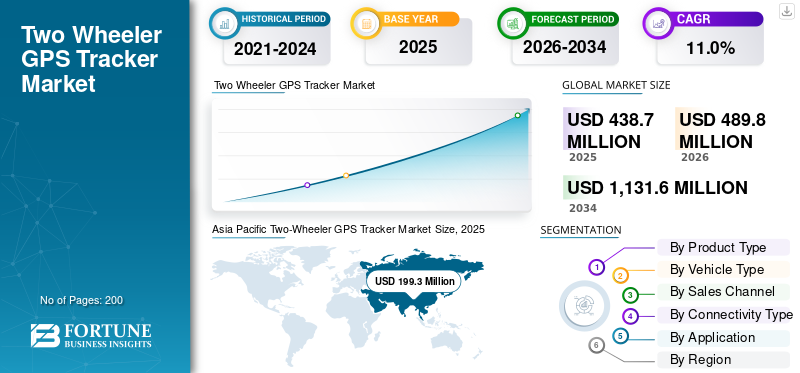
Download Free sample to learn more about this report.
Two Wheeler GPS Tracker Market Key Takeaways
 Global Market Size & Forecast
- 2025 Market Size: USD 438.7 million
- 2026 Market Size: USD 489.8 million
- 2034 Forecast Market Size: USD 1,131.6 million
- CAGR: 11.0% from 2026–2034
 Market Share
- Asia Pacific dominated the two-wheeler GPS tracker market with a 45.42% share in 2025.
- Plug-and-play GPS trackers are projected to grow at a 16.9% CAGR during the forecast period.
- OEM trackers are projected to grow at a 16.9% CAGR during the forecast period.
 Key Regional Highlights
Asia Pacific
Asia Pacific led the market, supported by high two-wheeler volumes and expanding connected mobility.
Europe
Europe is expected to grow steadily, driven by premium motorcycles, theft-recovery services, and connected mobility.
North America
North America is projected to expand steadily, supported by theft prevention, delivery fleets, and LTE-M adoption.
U.S.
The market is estimated to reach USD 69.5 million in 2026, driven by theft-recovery demand and app-based monitoring.
Japan
The market is estimated to reach USD 20.0 million in 2026, supported by advanced connectivity and premium motorcycle adoption.
Read More

TWO-WHEELER GPS TRACKER MARKET TRENDS
Layered Backup Tracking Systems Reshape Stolen-Vehicle Recovery Strategies
Security design is moving toward layered recovery systems that combine a primary tracker with a smaller, concealed backup unit. This approach helps maintain location visibility when thieves disconnect the vehicle battery, find the main device, or deliberately remove it. It also encourages suppliers to develop compact hardware, low-power communications, independent batteries, and discreet installation options suitable for motorcycles and scooter tracking devices across diverse operating environments. In February 2026, Queclink introduced a backup tracker intended to counter modern theft techniques and improve stolen-vehicle recovery performance in high-risk environments.
MARKET DYNAMICS
MARKET DRIVERS
Download Free sample to learn more about this report.
Proven Theft-Recovery Outcomes Accelerate Market Adoption
Demonstrated recovery outcomes are strengthening consumer, dealer, insurer, and fleet confidence in two-wheeler location tracking technology. Rapid location updates allow owners to share vehicle movements with police before a stolen motorcycle is dismantled, hidden, or moved beyond the local area. This practical recovery value supports adoption beyond basic theft alarms, particularly in cities where scooters and mopeds are frequently parked outdoors.
MARKET RESTRAINTS
Recurring Connectivity Costs Restrain Price-Sensitive Purchases
Recurring cellular and platform charges increase the total ownership cost beyond the initial tracker purchase, limiting adoption among price-sensitive riders and small fleet operators. Real-time tracking requires mobile data, server infrastructure, application maintenance, device management, and customer support, making ongoing fees difficult to eliminate. Buyers may instead select Bluetooth tags, basic alarms, or inactive devices after free service periods expire, reducing sustained market demand and renewal rates. In May 2026, Monimoto stated that its LTE-M vehicle tracker requires a subscription to provide network coverage and global roaming.
MARKET OPPORTUNITIES
Factory-Connected Electric Scooters Expand OEM Tracking Opportunities
Factory integration in electric scooters creates an opportunity for two-wheeler GPS tracker market growth as tracker suppliers can move beyond aftermarket theft devices and become long-term OEM technology partners. Electric platforms already contain batteries, controllers, software, mobile applications, and connected displays, simplifying the addition of location, geofencing, towing alerts, crash notifications, and remote diagnostics. Suppliers can generate demand through hardware contracts, embedded connectivity, platform integration, and replacement services across expanding electric fleets. In August 2025, TVS Motor launched the Orbiter with live location tracking, geofencing, anti-theft, towing, and crash and fall alerts.
MARKET CHALLENGES
Battery Drain and Concealed Installation Complicate Reliable Performance
Two-wheeler trackers must remain hidden and continuously available without discharging the vehicle’s relatively small battery during long parking periods. Frequent location transmissions, weak-network searching, improper wiring, and repeated alarm events can increase power consumption, while visible installation makes the device easier to remove. Manufacturers must balance update frequency, standby life, enclosure size, waterproofing, and signal reception without weakening theft protection or rider convenience. In July 2025, Queclink specified zero-power-consumption technology for its GV75CG motorcycle tracker so parked bikes could remain protected without draining their batteries.
Segmentation Analysis
By Product Type
Continuous Power and Concealed Installation Sustained Hardwired GPS Trackers Segment Growth
Based on product type, the market is segmented into hardwired GPS trackers, portable/battery-powered GPS trackers, and plug-and-play GPS trackers.
Hardwired GPS trackers segment dominated in 2025 as continuous vehicle power, concealed installation, tamper resistance, and compatibility with motorcycles, scooters, and commercial fleets support dependable monitoring. Their low maintenance, ignition detection, theft recovery, and remote immobilization capabilities sustain broad OEM and aftermarket demand. In May 2023, Teltonika launched the hardwired FMB930 tracker for electric two-wheelers globally.
The plug-and-play GPS trackers segment is projected to grow at a fastest CAGR of 16.9% during the forecast period as simplified installation, reduced labor, replacement flexibility, and OBD compatibility increase adoption. In May 2023, Teltonika launched the FMM80A plug-and-play tracker for North America.
By Sales Channel
Large Installed Vehicle Base and Retrofit Security Needs Propelled Aftermarket Segment Growth
Based on sales channel, the market is segmented into OEM and aftermarket.
The aftermarket segment held the largest two-wheeler GPS tracker market share in 2025 as the installed two-wheeler parc creates sustained retrofit demand for theft protection, location monitoring, geofencing, and fleet control. Broad availability through online retailers, accessory dealers, installers, and telematics providers supports replacement and upgrade purchases.
The OEM segment is projected to grow at a CAGR of 16.9% during the forecast period, the fastest-growth rate, as connected electric two-wheelers, embedded telematics, factory integration, and manufacturer applications expand. In January 2024, Hero MotoCorp unveiled the Mavrick 440 with eSIM-based remote tracking.
By Vehicle Type
Large Global Motorcycle Parc and Security Needs Bolstered Motorcycle Segment Growth
Based on vehicle type, the market is segmented into scooters, motorcycles, mopeds, and electric two-wheelers.
Motorcycles segment dominated the market in 2025. The growth is driven by large global vehicle parc, extensive commuter use, high theft exposure, and broad aftermarket availability sustain tracker installations. Fleet operators and individual owners adopt hardwired devices for location visibility, route history, and recovery support.
The electric two-wheelers segment is projected to grow at a fastest CAGR of 14.6% during the forecast period as OEM connectivity, battery monitoring, delivery electrification, and mobile applications expand.
To know how our report can help streamline your business, Speak to Analyst
By Connectivity Type
Broad Network Coverage and Reliable Data Transmission Fueled 4G LTE Connectivity Segment Growth
Based on connectivity type, the market is segmented into 2G/3G, 4G LTE, and low-power IoT & other connectivity.
The 4G LTE segment led the market in 2025. The growth is supported by network availability, faster data transmission, lower latency, and cloud communication support real-time tracking, alerts, diagnostics, and fleet control. Cat-1 and Cat-1 bis devices also provide cost-effective migration from legacy networks. In February 2024, Teltonika expanded its portfolio with the 4G LTE Cat-1 FMC234 tracker.
The Low-power IoT & other connectivity segment is projected to grow at a CAGR of 17.4% over the projected period, the fastest-growing rate, as LTE-M and NB-IoT improve battery life, coverage, and scalability. In August 2023, Queclink launched the LTE Cat-M1/NB2 SC350MG e-bike tracker.
By Application
Rising Theft Protection and Mobile Monitoring Needs Boosted Individual Consumer Segment Growth
Based on application, the market is segmented into individual consumers, delivery & logistics fleets, shared mobility & rental operators, corporate & institutional fleets, and government & public-service fleets.
Individual consumers accounted for the largest share in 2025. The growth is attributed to theft concerns, affordable trackers, geofencing, route history, and remote movement alerts encourage private owners to protect motorcycles and scooters. In December 2024, Yamaha offered a Datatool Stealth S5 tracker with motorcycles and scooters in the U.K.
The delivery & logistics fleets segment is projected to grow at the fastest CAGR of 15.3% in the estimated timeframe, as dispatch, theft control, and utilization monitoring become essential. In November 2021, DHL began trialing an eCargo bike for deliveries in Edinburgh.
TWO-WHEELER GPS TRACKER MARKET REGIONAL OUTLOOK
By geography, the market is categorized into Europe, North America, Asia Pacific, South America, and the Middle East & Africa.
NORTH AMERICA
Asia Pacific Two-Wheeler GPS Tracker Market Size, 2025 (USD Million)
To get more information on the regional analysis of this market, Download Free sample
North America is projected to maintain steady growth in the global market, supported by premium motorcycle ownership, rising theft-prevention spending, expanding delivery activity, and replacement of legacy tracking devices. The region benefits from mature cellular infrastructure, strong smartphone penetration, and wider adoption of LTE-M and cloud-linked security platforms. The U.S. and Canada contribute higher-value demand through premium trackers and monitored recovery services. At the same time, Mexico supports broader volume growth through commuter motorcycles, delivery fleets, and increasing use of affordable hardwired asset tracking devices overall.
U.S. TWO-WHEELER GPS TRACKER MARKET
The U.S. market is estimated to reach USD 69.5 million in 2026, supported by premium motorcycle ownership, theft-recovery demand, and strong adoption of app-based monitoring. Demand is reinforced by insurer-linked security, recreational touring, fleet tracking solutions, LTE-M connectivity, and replacement of older 2G and 3G tracking devices.
EUROPE
Europe is expected to show consistent growth in the global market, supported by a large premium motorcycle and scooter parc, established dealer networks, strong theft-recovery services, and early adoption of connected mobility technologies. Demand is strengthened by professional installation, insurer-approved trackers, urban delivery fleets, electric scooter adoption, and expanding use of mobile security applications. Germany, France, Italy, the U.K., and Russia contribute through differing mixes of premium motorcycles, commuter scooters, monitored services, and fleet use. Ongoing 2G and 3G shutdowns continue to stimulate replacement demand.
U.K. TWO-WHEELER GPS TRACKER MARKET
As per the U.K. market analysis, it is projected to reach USD 10.9 million in 2026, supported by motorcycle theft concerns, monitored recovery services, and dealer-installed security systems. Demand is strengthened by insurer-approved tracking, premium motorcycle ownership, urban scooter use, LTE-M devices, and mobile applications offering movement alerts, geofencing, and remote location visibility.
GERMANY TWO-WHEELER GPS TRACKER MARKET
Germany is estimated to account for approximately 17.2% of the European market in 2026, supported by a sizeable motorcycle fleet, high purchasing power, and advanced vehicle telematics systems. Demand is driven by OEM integration, electric scooter adoption, fleet digitization, and strong interest in real-time tracking, route history, geofencing, and secure data management among private and commercial users.
ASIA PACIFIC
Asia Pacific held a dominant position in the global market, supported by the world’s largest motorcycle, scooter, and electric two-wheeler base. China, India, Japan, Indonesia, and Southeast Asia contribute through high vehicle volumes, dense urban mobility, delivery fleets, and strong local electronics manufacturing. Demand is further supported by affordable hardwired trackers, OEM-connected electric vehicles, rapid 4G adoption, battery monitoring, and cloud-based fleet tools. Price competition remains intense, but rising connected-vehicle penetration and digital fleet management continue to expand regional revenue opportunities significantly.
CHINA TWO-WHEELER GPS TRACKER MARKET
China will account for approximately 40.9% of the Asia Pacific market in 2026, supported by its large electric two-wheeler fleet, domestic electronics manufacturing, and advanced cellular IoT ecosystem. Demand is driven by OEM-installed tracking, battery monitoring, shared mobility, delivery fleets, and locally produced low-cost devices that support broad adoption across major urban areas.
INDIA TWO-WHEELER GPS TRACKER MARKET
India is expected to register a CAGR of 12.8% during the forecast period, supported by high motorcycle and scooter sales, expanding last-mile delivery, and rising theft-prevention awareness. Affordable hardwired trackers, connected electric scooters, wider 4G coverage, and growing e-commerce fleets support adoption across metropolitan, tier-two, and rural markets steadily.
JAPAN TWO-WHEELER GPS TRACKER MARKET
Japan’s market is estimated to reach USD 20.0 million in 2026, supported by advanced cellular infrastructure, reliable vehicle electronics, and demand for high-quality GPS-based monitoring. Premium motorcycles, rental fleets, electric mobility, compact security devices, and app-linked services support revenue.
SOUTH AMERICA
South America is projected to expand steadily in the global market, supported by rising motorcycle ownership, strong delivery activity, and persistent urban theft concerns. Brazil, Argentina, and other regional countries generate demand from private riders, couriers, retailers, and fleet operators. The region is gradually moving from basic 2G trackers toward 4G LTE and cloud-connected devices, supporting replacement sales and improved service quality. Lower-cost imports, wider installer networks, and expanding geofencing and fleet-monitoring use strengthen adoption, although currency volatility and affordability remain important constraints across markets.
BRAZIL TWO-WHEELER GPS TRACKER MARKET
Brazil will account for approximately 77.8% of the South American market in 2026, supported by its large motorcycle fleet, domestic production, and widespread use of two-wheelers for commuting and delivery. Theft-recovery needs, 4G migration, fleet tracking, and a broad aftermarket installation network continue to support strong tracker demand across major cities.
MIDDLE EAST & AFRICA
The Middle East & Africa is expected to record steady growth in the global market, supported by rising urban mobility needs, expanding motorcycle-taxi and delivery activity, and greater interest in vehicle theft protection. South Africa contributes higher-value demand through mature telematics, insurance participation, and formal fleet operations, while other countries remain driven by affordable hardwired devices and improving 4G coverage. Adoption is also supported by public-service fleets, local assembly, electric two-wheeler programs, and digital logistics platforms.
SOUTH AFRICA TWO-WHEELER GPS TRACKER MARKET
South Africa is projected to grow at a CAGR of 9.7% during the forecast period, supported by mature telematics services, insurance-linked tracking, and demand for intelligent vehicle security. Adoption is concentrated among private motorcycles, delivery operators, corporate fleets, and public-service vehicles, while broader 4G availability and the replacement of older trackers sustain market growth.
COMPETITIVE LANDSCAPE
Key Industry Players
Hardware Innovation, Cloud Platforms, and OEM Partnerships to Strengthen Market Competition
The global two-wheeler GPS tracker market is fragmented, with competition spanning global telematics vendors, regional security brands, OEM-focused suppliers, and low-cost aftermarket manufacturers. Key players such as Teltonika Telematics, Queclink Wireless Solutions, Jimi IoT, Ruptela, Monimoto, PAJ GPS, Trackimo, Invoxia, and LocoNav compete through compact hardware, reliable cellular connectivity, battery efficiency, and cloud-based monitoring platforms. To strengthen their edge, companies are developing 4G LTE, LTE-M, and NB-IoT trackers, integrating geofencing, crash alerts, remote immobilization, route analytics, and mobile applications. OEM partnerships are becoming increasingly important as connected motorcycles and electric two-wheelers require factory-integrated tracking and vehicle-data access. Meanwhile, aftermarket players compete through affordable pricing, easy installation, subscription flexibility, and broad distribution. Product differentiation increasingly depends on cybersecurity, waterproof design, long standby life, platform interoperability, and localized support. At the same time, partnerships with telecom operators, insurers, dealers, and fleet managers help expand installed bases and recurring service revenue.
LIST OF KEY TWO-WHEELER GPS TRACKER COMPANIES PROFILED IN REPORT
- Teltonika Telematics, UAB (Lithuania)
- Queclink Wireless Solutions Co., Ltd. (China)
- Shenzhen Jimi IoT Co., Ltd. (China)
- Ruptela, UAB (Lithuania)
- Monimoto, UAB (Lithuania)
- PAJ UG-PAJ GPS (Germany)
- Trackimo Inc. (U.S.)
- Invoxia (France)
- Scorpion Automotive Ltd.-Datatool (U.K.)
- Tramigo Ltd. (Finland)
- BikeTrac Ltd. (U.K.)
- Digital Matter (Australia)
- SIZZAPP SIA (Latvia)
- RideLink GmbH (Germany)
- LocoNav Inc. (U.S.)
KEY INDUSTRY DEVELOPMENTS
- June 2026: Bosch eBike Systems introduced the BCM3101 ConnectModule, combining GPS with Bluetooth Low Energy to improve final-position accuracy where satellite signals weaken. The component helps locate connected electric two-wheelers in basements, gardens, and other difficult environments, strengthening OEM-integrated theft protection across Bosch’s smart-system ecosystem and service network globally.
- May 2026: Datatool activated two new Quantum3 features for its Thatcham S7-approved, battery-powered tracker developed for motorcycles, ATVs, and low-use vehicles. Owners gained customizable stationary position updates and arming schedules alongside journey tracking, movement alerts, professional installation, and 24/7 recovery support coordinated directly with law-enforcement agencies during theft incidents.
- May 2026: e-Sprinto partnered with OpsPod to integrate enterprise-grade IoT devices and telematics across its electric two-wheeler lineup. The collaboration adds live motorcycle GPS tracking, geofencing, predictive battery intelligence, rider-behavior analysis, and proactive maintenance alerts, while supporting e-Sprinto’s roadmap to deploy 20,000 connected vehicles by the end of 2026 in India.
- March 2026: Teltonika released its 2026 telematics catalog, expanding the FT hardware platform with broader configurations and improved device capabilities. New FTC887 and FTM887 units introduced dead-reckoning positioning for tunnels and underground parking, a relevant component advance for motorcycles, scooters, and fleet assets operating where GNSS reception becomes unreliable.
- January 2026: Bosch unveiled a free Mark eBike as a stolen feature for the eBike Flow application. Owners can flag an entire connected two-wheeler or individual battery, making the stolen status visible to buyers, dealers, and authorities, while blocking application connections and strengthening the broader Connect Module-enabled digital theft-protection ecosystem globally.
REPORT COVERAGE
The global two-wheeler GPS tracker market report provides an in-depth study of the market size & forecast across all market segments included in the report. It contains details on market research dynamics and trends expected to drive the market during the forecast period. It offers information on rapid technological advancements, new product launches, key industry developments, strategic partnerships, and mergers & acquisitions. The market forecast provides a comprehensive competitive landscape, including the most significant global market shares, emerging opportunities, and profiles of key players.
Request for Customization to gain extensive market insights.
Report Scope & Segmentation
| ATTRIBUTE | DETAILS |
| Study Period | 2021-2034 |
| Base Year | 2025 |
| Estimated Year | 2026 |
| Forecast Period | 2026-2034 |
| Historical Period | 2021-2024 |
| Growth Rate | CAGR of 11.0% from 2026 to 2034 |
| Unit | Value (USD Million) |
| Segmentation | By Product Type, By Vehicle Type, By Sales Channel, By Connectivity Type, By Application, and By Region |
| By Product Type |
|
| By Sales Channel |
|
| By Vehicle Type |
|
| By Connectivity Type |
|
| By Application |
|
| By Region |
|
Frequently Asked Questions
Fortune Business Insights says that the global market value stood at USD 438.7 million in 2025 and is projected to reach USD 1,131.6 million by 2034.
In 2025, the Asia Pacific’s market value stood at USD 199.3 million.
The market is expected to grow at a CAGR of 11.0% from 2026 to 2034.
By sales channel, the aftermarket segment led the market.
Increasing motorcycle theft, expanding delivery fleets, and rising adoption of connected two-wheelers are driving market momentum.
Key market players include Teltonika, Queclink Wireless Solutions, Trackimo, Shenzhen Jimi IoT Co., Ltd., and Invoxia.
The Asia Pacific region accounted for the largest share of the market in 2025.



- 2021-2034
- 2025
- 2021-2024
- 200
-
(Offer valid till 30th Sep 2026)
Get 30-60 hrs Free Customization
Expand Regional and Country Coverage, Segments Analysis, Company Profiles, Competitive Benchmarking, and End-user Insights.




















-
US +1 833 909 2966 ( Toll Free )
-
Get In Touch With Us