Tyre Puncture Repair Kit Market Size, Share & Industry Analysis, By Tyre Type (Tubeless Tyres and Tube-Type Tyres), By Product Type (Sealant-Based, Plug & Patch, Combination, and Others), By Vehicle Type (Passenger Vehicles, Two-Wheelers, Light Commercial Vehicles, and Heavy Commercial Vehicles), By Distribution Channel (OEM, Automotive Aftermarket, E-Commerce, and Others), and Regional Forecast, 2026-2034
 Download Free Sample
(Offer valid till 30th Sep 2026)

Tyre Puncture Repair Kit Market Size and Future Outlook
 Listen to Audio Version
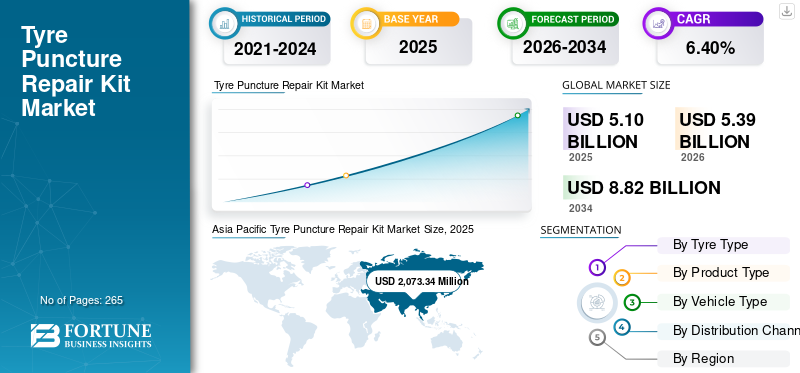
The global tyre puncture repair kit market size was valued at USD 5,100 million in 2025. The market is projected to grow from USD 5,369.79 million in 2026 to USD 8,821.56 million by 2034, exhibiting a CAGR of 6.40% during the forecast period. Asia Pacific dominated the tyre puncture repair kit market with a market share of 40.65% in 2025.
The tyre puncture repair kit market is witnessing steady growth, driven by rising vehicle ownership, increased road travel, and strong demand for quick, economical roadside solutions. These kits provide a handy & portable alternative to spare tyres and towing, facilitating quicker mobility recovery for passenger cars, two-wheelers, and commercial vehicles. Increased awareness of emergency preparedness, particularly among metropolitan commuters and fleet operators, is encouraging adoption. Technological innovations such as compact designs, sealing solutions, and tubeless tyre compatibility are also boosting the market demand. Moreover, the growth of online retail and automotive aftermarket channels is making the products readily available, thereby helping the global market to grow at a steady pace. Thus, america and the global tire repair kit market are experiencing stable growth.
- For instance, according to the National Register of Motor Vehicles, maintained by the Ministry of Road Transport & Highways (MoRTH), Government of India, the number of registered vehicles in the country has grown rapidly, with 385.1 million vehicles on the road as of 30 November 2024.
Key market players include Slime (ITW Global Brands), ContiTech (Continental AG), Michelin, Holts Automotive, and 3 M. One big move these companies have made to keep up with the competition is to innovate their products, especially designing small, easy-to-handle sealant and inflator kits that can be used with tubeless tyres. Along with that, they have been forming strong aftermarket and OEM partnerships, thereby ensuring the availability of their products to a larger market through automotive dealers, online retail channels, and electric vehicle manufacturers.
Download Free sample to learn more about this report.
Tyre Puncture Repair Kit Market KEY TAKEAWAYS
 Global Market Size & Forecast
- 2025 Market Size: USD 5,100 million
- 2026 Market Size: USD 5,369.79 million
- 2034 Forecast Market Size: USD 8,821.56 million
- CAGR: 6.40% from 2026–2034
 Market Share
- Asia Pacific dominated the tyre puncture repair kit market with a 40.65% share in 2025.
- The tube-type tyres segment is projected to grow at a 6.10% CAGR during the forecast period.
- The sealant-based segment is projected to grow at a 6.21% CAGR during the forecast period.
 Key Regional Highlights
Asia Pacific
Asia Pacific reached USD 2,073.34 million in 2025, driven by rising vehicle ownership and expanding automotive production.
North America
North America reached USD 1,077.63 million in 2025, supported by strong vehicle ownership and growing demand for roadside repair solutions.
Europe
Europe accounted for USD 1,185.11 million in 2025, driven by increasing adoption of tubeless tyres and compact repair kits.
U.S.
The U.S. market reached USD 868.38 million in 2025, fueled by high passenger vehicle ownership and increasing preference for quick tyre repair solutions.
Japan
Japan reached USD 345.26 million in 2025, supported by widespread use of tubeless tyres and demand for compact sealant-based repair kits.
Read More

TYRE PUNCTURE REPAIR KIT MARKET TRENDS
Shift Toward Compact Sealant-Based Repair Solutions Driven by Convenience Needs
Due to rising urban mobility and limited vehicle storage space, the tyre puncture repair kit market is currently shifting toward compact, sealant-based, and inflator-integrated solutions. Also, as spare tyres are being removed from modern vehicles to reduce weight and improve fuel efficiency, there is a growing demand for lightweight, easy-to-use repair kits. This trend enhances consumer convenience, reduces reliance on roadside assistance, and enables faster temporary tyre recovery.
MARKET DYNAMICS
MARKET DRIVERS
Download Free sample to learn more about this report.
Rising Vehicle Ownership and Increased Road Travel Fuel Demand for Emergency Repair Solutions
One of the key factors driving the global tyre puncture repair kit market growth is the constant increase in global vehicle ownership rates, especially in emerging economies. More and more passenger cars, two-wheelers, and commercial vehicles are being used on ever more crowded, rough road networks, which increases the likelihood of tyre punctures. This, in turn, drives a higher demand for quick, portable, and cost-effective roadside solutions. Therefore, consumers and fleet operators are getting ahead of the game by using puncture repair kits so they can quickly get back to work, save on towing costs, and avoid interruptions to their mobility in the event of a breakdown.
MARKET RESTRAINTS
Limited Effectiveness for Severe Tyre Damage Restrains Wider Adoption
Tyre puncture repair tools are generally meant for small tread punctures only and cannot handle the sidewall damage or large cuts. This restriction makes the consumers less trusting of these kits as a full substitute for professional repair or spare tyres. Consequently, several car owners still depend on conventional repair services, which limits market adoption at scale.
MARKET OPPORTUNITIES
Growing OEM Integration Creates New Demand Avenues Generating Market Growth Opportunities
One of the biggest growth opportunities in the market is the increasing demand for tyre puncture repair tool kits as standard or optional equipment from automobile manufacturers. As car makers get rid of spare tyres to make vehicles lighter and more fuel-efficient, fitting small repair kits is a nice solution. At the OEM level, this kind of inclusion increases product penetration, builds consumer trust, and provides a consistent, high-volume demand source for manufacturers.
MARKET CHALLENGES
Low Consumer Awareness in Price-Sensitive and Rural Markets Impacts Adoption
One of the main challenges is a lack of understanding of how to use puncture repair kits properly and of their benefits, especially in rural and low-income areas. The majority of vehicle owners are unfamiliar with sealants and base solutions and stick to conventional repair methods. The lack of this knowledge leads to lower acceptance rates, increased risk of misuse, and slower market penetration, even as the number of vehicle owners and road travel is on the rise.
Segmentation Analysis
By Tyre Type
Dominance of Tubeless Tyres Segment is Driven by Higher Adoption and Repair Compatibility
Based on the tyre type, the market is divided into tubeless tyres and tube-type tyres.
The tubeless tyres segment dominated market growth, driven by rising penetration, especially in modern passenger vehicles and premium two-wheelers. Furthermore, manufacturers of puncture repair kits, particularly those offering sealant-based and inflator-integrated solutions, focus mainly on tubeless tyres, which allow quicker, easier repairs. The trend among automakers toward tubeless tyres aims to improve safety, fuel efficiency, and ease of maintenance, thereby driving demand for wear-and-tear change kits. The increase in the demand for repair kits, in turn, causes the segment to generate higher revenue.
The tube-type tyres segment is anticipated to rise at the second-fastest CAGR of 6.10% over the forecast period.
To know how our report can help streamline your business, Speak to Analyst
By Product Type
Combination Kits Lead the Market Due to Rising Convenience and OEM Preference
Based on product type, the market is classified into sealant-based, plug & patch, combination, and others.
In 2025, the combination segment, which includes inflator- and sealant-based repair kits, dominated the global market. This dominance of the segment was due to their ability to perform quick repairs, ease of use, and suitability for modern tubeless tyres. Automotive manufacturers increasingly opt for combination kits as alternatives to spare tyres to reduce the weight of heavy vehicles and save space. Consequently, rising consumer preference and growing OEM adoption for all-in-one emergency solutions directly contribute to the segment’s dominance.
The sealant-based segment is projected to grow at the second-fastest CAGR of 6.21% over the forecast period.
By Vehicle Type
Passenger Vehicles Dominate, Driven by High Ownership and Daily Usage Frequency
Based on the vehicle type, the market is categorized into passenger vehicles, two-wheelers, light commercial vehicles, and heavy commercial vehicles.
The passenger vehicles segment is anticipated to hold a dominant tyre puncture repair kit market share over the forecast period, owing to the large global vehicle base and the high frequency of daily use. Rising car ownership for convenience and personal mobility, combined with increased urban commuting and long-term travel, raises the risk of punctures and the need for quick roadside solutions. Moreover, several modern passenger vehicles are fitted with tubeless tyres and increasingly lack spare wheels, directly increasing reliance on puncture kits.
The two-wheeler segment is projected to grow at a CAGR of 7.45% over the forecast period.
By Distribution Channel
Automotive Aftermarket Leads the Market Due to Broad Availability and Growing Replacement Demand
Based on distribution channel, the market is segmented into OEM, automotive aftermarket, e-commerce, and others.
The automotive aftermarket segment dominated the global market in 2025. This high market share was driven by broad product availability and growing replacement demand. Vehicle owners frequently purchase repair kits as add-on safety accessories through repair shops, service centers, and auto parts retailers. Unlike OEM supply, which is limited to new-vehicle sales, the aftermarket caters to the vast installed vehicle base, directly leading to higher sales volumes and greater revenue dominance.
In addition, the e-commerce segment is projected to grow at the fastest CAGR of 8.20% during the forecast period.
Tyre Puncture Repair Kit Market Regional Outlook
By region, the market is categorized into Europe, North America, Asia Pacific, South America, the Middle East, and Africa.
North America
Asia Pacific Tyre Puncture Repair Kit Market Size, 2025 (USD Million)
To get more information on the regional analysis of this market, Download Free sample
North America is projected to record the highest growth rate of 5.73% in the coming years, surpassing all other regions, and reach a valuation of USD 1,077.63 million in 2025. Given the large number of passenger vehicles on the road and the prevalence of long-distance highway travel, consumers value fast, dependable solutions when their tyres suddenly fail. Also, the growing trend of buying vehicles without spare tyres, alongside mature automotive aftermarket and e-commerce penetration, is directly driving up demand for puncture repair kits in the region.
U.S Tyre Puncture Repair Kit Market
Given North America’s strong contribution and the U.S.'s dominance in the region, the U.S. market reached USD 868.38 million in 2025, accounting for roughly 17.03% of global market sales.
Europe
Europe held the third-largest share in 2025, valued at USD 1,185.11 million and accounting for 23.39% of the global market. A large pool of passenger vehicles, the growing adoption of tubeless tyres, and the shift by automotive manufacturers toward replacing spare wheels with compact repair kits to reduce vehicle weight and improve fuel efficiency are driving market growth.
U.K Tyre Puncture Repair Kit Market
The U.K market in 2025 reached USD 203.23 million, representing roughly 3.98% of global market revenues.
Germany Tyre Puncture Repair Kit Market
Germany’s market reached USD 258.83 million in 2025, equivalent to around 5.08% of global market sales.
Asia Pacific
Asia Pacific reached USD 2,073.34 million in 2025 and secured the leading position in the market. In the region, India and China both reached USD 670.78 million and USD 540.39 million, respectively, in 2025.
Japan Tyre Puncture Repair Kit Market
The Japanese market in 2025 was valued at USD 345.26 million, accounting for roughly 6.43% of global market revenues. Widespread use of tubeless tyres, high passenger-car ownership, and automakers’ preference for compact sealant-based repair kits in space-constrained vehicles drive the country’s market growth.
China Tyre Puncture Repair Kit Market
China’s market in 2025 was valued at USD 670.78 million in revenues, representing roughly 13.15% of global market sales.
India Tyre Puncture Repair Kit Market
The Indian market in 2025 was valued at USD 540.39 million, accounting for roughly 10.60% of global market revenues.
South America and the Middle East & Africa
The South America and Middle East & Africa regions are expected to witness moderate growth in the market during the forecast period. The South America market reached USD 367.57 million in 2025. Rising vehicle ownership due to increasing consumer purchasing power, uneven road conditions that increase the risk of puncture, and growing demand for affordable roadside solutions across passenger and commercial vehicles drive regional market growth. In the Middle East and Africa, the UAE reached USD 76.96 million in 2025.
South Africa Tyre Puncture Repair Kit Market
The South African market reached USD 66.21 million in 2025, representing roughly 1.30% of global market revenues.
COMPETITIVE LANDSCAPE
Key Industry Players
Intensifying Competition Through Product Innovation and Channel Expansion
Players in the tyre puncture restoration kit market are competing by launching compact, easy-to-use, multi-functional kits compatible with modern tubeless tyres. Companies in the industry are focusing on product innovation to develop user-friendly, easy-to-use repair solutions that enable quick and safe roadside puncture repair without professional assistance. This innovation enhances consumer convenience and differentiates products in a price-sensitive market. Simultaneously, companies are strengthening their aftermarket and commerce channels to expand their geographic reach and improve product availability. Consequently, brand visibility, customer loyalty, and sales volumes are growing globally, in both developed and developing countries.
LIST OF KEY TYRE PUNCTURE REPAIR KITS COMPANIES PROFILED
- ITW Global Brands (U.S.)
- Continental AG (ContiMobilityKit / ContiTech) (Germany)
- Michelin Group (France)
- Holts Automotive (U.K.)
- 3M Company (U.S.)
- AirMan Products Company (Denmark)
- Sumitomo Rubber Industries (Japan)
- Stop & Go International (U.S.)
- Camel Tire Repair Systems (U.S.)
- Tech Tire Repairs (TECH International) (U.S.)
KEY INDUSTRY DEVELOPMENTS
- March 2025: Slime introduced its flat tyre repair kit portfolio, including a range of Smart Spair Ultra models and Smart Spair, designed for ease and emergency preparedness. These are push-button sealant-and-air repair combos for passenger cars, trucks, SUVs, and trailers.
- March 2025: Michelin kept emergency puncture repair sealant products available and promoted them as easy, one-step solutions that allow temporary sealing, deflatable tyre inflation to safe driving pressure, thus fulfilling consumer demand for a fast fix at the roadside without hassle.
- January 2025: Continental continued endorsing its ContiMobilityKit, a combination of a compressor and a sealant, which is made for car owners to seal a punctured tyre (up to 6 mm) and pump it up again without taking the wheel off, thus helping the car to move on the road and making the reliance on the spare tyre less.
- August 2024: Holts Automotive continued to market and distribute its Tyreweld emergency puncture repair kits, highlighting that the operation requires no tools or jack and that the quick, self-inflating foam can get vehicles back on the road safely, thus catering to the growing DIY and aftermarket demand.
REPORT COVERAGE
The global tyre puncture repair kit market analysis includes a comprehensive study of the market size & forecast across all market segments covered in the report. It contains details on the market dynamics and market trends expected to drive the market over the forecast period. It provides information on key aspects, including technological advancements, pipeline candidates, the regulatory environment, and product launches. Additionally, it details partnerships, mergers & acquisitions, and key industry developments, as well as their prevalence by key regions. The global market research report also provides a detailed competitive landscape, including market share and profiles of key operating players.
Request for Customization to gain extensive market insights.
Report Scope & Segmentation
| ATTRIBUTE | DETAILS |
| Study Period | 2021-2034 |
| Base Year | 2025 |
| Estimated Year | 2026 |
| Forecast Period | 2026-2034 |
| Historical Period | 2021-2024 |
| Growth Rate | CAGR of 6.40% from 2026-2034 |
| Unit | Value (USD Million) |
| Segmentation | By Tyre Type, Product Type, Vehicle Type, Distribution Channel, and Region |
| By Tyre Type |
|
| By Product Type |
|
| By Vehicle Type |
|
| By Distribution Channel |
|
| By Region |
|
Frequently Asked Questions
According to Fortune Business Insights, the global market value stood at USD 5,100 million in 2025 and is projected to reach USD 8,821.56 million by 2034.
In 2025, the market value stood at USD 1,077.63 million.
The market is expected to grow at a CAGR of 6.40% over the forecast period.
By tyre type, the tubeless tyres segment leads the market.
Increasing vehicle ownership, rising road travel, and strong demand for quick, economical roadside solutions are driving market expansion.
Slime (ITW Global Brands), ContiTech (Continental AG), Michelin, Holts Automotive, and 3M are the major players in the global market.
Asia Pacific dominated the market in 2025.



- 2021-2034
- 2025
- 2021-2024
- 265
-
(Offer valid till 30th Sep 2026)
Get 30-60 hrs Free Customization
Expand Regional and Country Coverage, Segments Analysis, Company Profiles, Competitive Benchmarking, and End-user Insights.



















-
US +1 833 909 2966 ( Toll Free )
-
Get In Touch With Us