Database Security Market Size, Share, and Industry Analysis, By Deployment (Cloud and On-premises), By Enterprise Type (Small & Medium-sized Enterprises (SMEs) and Large Enterprises), By Application (Data Auditing and Monitoring, Data Discovery and Classification, Data Encryption, Tokenization, and Masking, Data Authorization and Access, Data Security Analytics, Data Backup and Recovery, and Others), By Industry (BFSI, IT & Telecom, Retail, Government, Healthcare & Life Science, Energy & Utilities, and Others) and Regional Forecast, 2026-2034
 Download Free Sample
(Offer valid till 15th Aug 2026)
DATABASE SECURITY MARKET SIZE AND FUTURE OUTLOOK
 Listen to Audio Version
The global database security market size was valued at USD 9.00 billion in 2025. The market is projected to grow from USD 9.99 billion in 2026 to USD 25.94 billion by 2034, exhibiting a CAGR of 12.70% during the forecast period. North America dominated the database security market with a market share of 40.11% in 2025.
Database security solutions comprise a set of technologies and practices designed to protect structured and unstructured data stored within databases from unauthorized access, breaches, and misuse. These solutions include capabilities such as database activity monitoring, encryption, access control, data masking, and vulnerability management, ensuring data integrity, confidentiality, and compliance across enterprise environments. Unlike traditional security approaches that focus only on network or endpoint protection, database security platforms provide granular control and real-time visibility into data interactions across on-premise, cloud, and hybrid infrastructures.
The increasing volume of sensitive enterprise data, coupled with rising cyber threats and stringent data protection regulations, is driving organizations to adopt advanced database security solutions. As businesses expand digital operations, integrate cloud databases, and enable remote access, the attack surface for critical data assets continues to grow. This has led to a stronger emphasis on proactive threat detection, continuous monitoring, and automated security controls to safeguard business-critical information and maintain regulatory compliance.
Key players such as Oracle Corporation, SAP SE, Cisco Systems, Fortinet, and IBM are actively enhancing their database security offerings through product innovation, AI-driven threat intelligence integration, and strategic collaborations. Their focus is on delivering scalable, intelligent, and unified security platforms that protect complex, distributed database environments while addressing evolving enterprise security requirements.
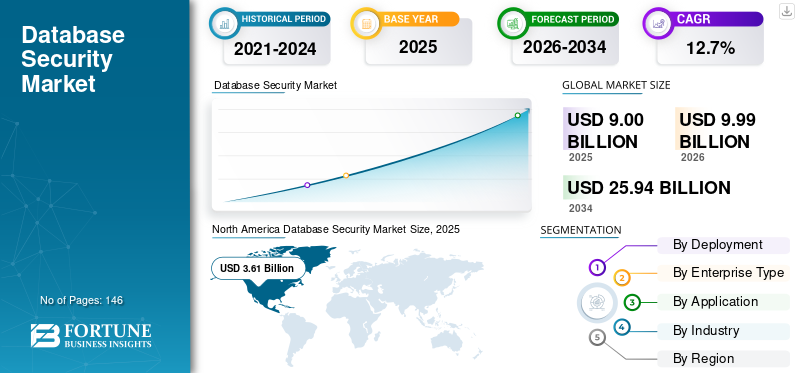
Download Free sample to learn more about this report.
Database Security Market Key Takeaways
 Market Size & Forecast
- 2025 Market Size: USD 9.00 billion
- 2026 Market Size: USD 9.99 billion
- 2034 Forecast Market Size: USD 25.94 billion
- CAGR: 12.70% from 2026–2034
 Market Share
- North America dominated the database security market with a 40.11% share in 2025.
- BFSI led the market with a 26.8% share in 2025.
- On-premise deployment dominated the market with a 58.7% share in 2025.
 Key Regional Highlights
North America
North America held the largest market, valued at USD 3.61 billion in 2025.
Europe
Europe reached USD 2.00 billion in 2025 and is projected to grow at a CAGR of 11.3%.
Asia Pacific
Asia Pacific was valued at USD 1.97 billion in 2025 and is expected to record the highest growth rate during the forecast period.
U.S.
The market stood at USD 2.61 billion in 2025, accounting for approximately 29.0% of global revenue.
Japan
The market reached USD 0.54 billion in 2025, representing around 6.0% of global revenue.
Read More

Impact of Generative AI
Generative AI’s Ability to Mitigate Potential Threats In Real Time Boosts Product Demand
Generative AI has significantly transformed the landscape of database security by enhancing traditional security measures with advanced, intelligent solutions. AI-driven algorithms can proactively detect, analyze, and mitigate potential threats in real time, beating the limitations of rule-based security systems. Machine learning models powered by large datasets enable predictive threat detection, anomaly identification, and automated incident response, thereby reducing human intervention and response times. Additionally, it can simulate complex cyber-attack scenarios, helping security teams identify vulnerabilities and strengthen security protocols more effectively.
- For instance, in November 2024, Accenture announced new generative AI-powered cybersecurity services to help organizations combat rising AI-driven threats, including deepfakes and advanced cyberattacks. The company introduced Secure AI Solutions, Deepfake Protection, Business Cyber Crisis Recovery, and a Quantum Security Suite to strengthen resilience and data protection.
DATABASE SECURITY MARKET TRENDS
Integration of AI and ML in Database Security to Fuel Market Growth
The integration of AI and ML is pushing database security growth by enabling real-time threat detection, automated response, and adaptive protection against evolving cyber risks. Unlike traditional rule-based systems, AI-driven solutions can analyze large volumes of data, identify anomalies, and respond to threats such as zero-day attacks, insider risks, and advanced persistent threats more effectively. This shift is driving demand for intelligent, automated security systems, particularly as organizations manage increasingly complex, data-intensive environments. Additionally, AI and ML help reduce manual intervention, improve security efficiency, and support more proactive protection of critical data assets.
- For instance, according to the Ponemon Institute, over 60% of organizations recognize the role of machine learning in enhancing security, with many professionals already using AI for rule-based detection, and nearly 70% find it effective at identifying unknown threats. However, adoption is still evolving, as more than half of organizations remain in early stages of implementation.
MARKET DYNAMICS
MARKET DRIVERS
Download Free sample to learn more about this report.
Increasing Frequency and Complexity of Cybersecurity Threats to Drive Market Expansion
The market is experiencing significant growth, driven by the increasing frequency and complexity of cybersecurity threats. Organizations across various industries are becoming more reliant on data to drive business operations, which makes their databases prime targets for malicious actors. The growing volume of sensitive information, including financial records, personal data, and intellectual property, has heightened the risk landscape.
- For instance, the FBI’s IC3 reported USD 16.6 billion in cybercrime losses in 2024, with many incidents involving unauthorized access, credential abuse, and data exfiltration, underscoring that enterprise databases remain a primary target for financially motivated attacks.
Hackers leverage advanced tools to exploit vulnerabilities in database systems, often targeting weak access controls, outdated software, and misconfigured security settings. Threats such as zero-day vulnerabilities allow attackers to exploit security flaws before organizations have the chance to apply patches. Additionally, the widespread adoption of remote work, cloud computing, and IoT devices has expanded the digital attack surface, providing more entry points for cyber intrusions.
- For instance, according to Netgate’s 2024 data, cloud security remains a major concern for 83% of organizations, highlighting the critical need for robust security measures. Findings from StationX 2023 indicate that 82% of cloud data breaches involved data stored in the cloud. Additionally, 27% of businesses reported experiencing a public cloud security incident in 2024, a 10% increase from 2023.
MARKET CHALLENGES
High Cost of Implementation to Hamper Market Development
The high cost of implementation and maintenance for advanced security solutions is a significant factor hindering the database security market growth. Comprehensive database security requires significant investments in specialized software, hardware, and skilled personnel. For small and medium-sized enterprises (SMEs), these costs can be prohibitive, making it difficult for them to adopt robust security measures. Additionally, ongoing expenses for software updates, security audits, and system maintenance add to the financial burden, limiting market penetration, especially in cost-sensitive regions.
The complexity of integrating security with existing IT infrastructure is another restraining factor for the market. Many organizations operate in environments with legacy systems that lack compatibility with modern security solutions. Integrating advanced database security tools into these older systems can be technically challenging, time-consuming, and risky, as it may disrupt critical business operations.
- For instance, according to Ponemon’s 2024-2025 research on AI in cybersecurity, 65% of security teams reported challenges integrating AI cybersecurity solutions with legacy systems.
MARKET OPPORTUNITIES
Growing Adoption of Cloud-Based Technologies to Create Significant Opportunities for the Market
The rapid adoption of cloud computing technologies has emerged as a significant opportunity for the market. Organizations increasingly migrate their data to cloud platforms such as Amazon Web Services (AWS), Microsoft Azure, and Google Cloud Platform (GCP), increasing the need for robust, scalable, and flexible security solutions. However, the cloud environment also introduces new security challenges, including data breaches, unauthorized access, and compliance risks. For instance,
- IBM’s Cost of a Data Breach Report 2025 showed that 30% of breaches involved data stored across multiple environments, with 20% tied to public cloud and 19% to private cloud.
These challenges are creating substantial opportunities for database security vendors to develop and deliver specialized, cloud-native security solutions that can address the evolving threat landscape.
Segmentation Analysis
By Industry
BFSI Segment Dominated the Market, Driven by Its Ability to Handle High Data Sensitivity
Based on industry, the market is classified into BFSI, IT & Telecom, retail, government, healthcare & life sciences, energy & utilities, and others.
BFSI held the majority share of the market in 2024. In 2025, the segment dominated with a 26.8% share, as it handles highly sensitive and high-value data such as financial transactions, customer identities, and credit information, making it a prime target for cyberattacks. The sector operates under strict regulatory frameworks that mandate strong data protection, auditing, and compliance practices, driving continuous investment in database security solutions. Frequent incidents of fraud, data breaches, and ransomware further push banks and financial institutions to strengthen their defenses.
Healthcare & Life Science is expected to witness the highest compound annual growth rate (CAGR) of 15.4% during the forecast period.
To know how our report can help streamline your business, Speak to Analyst
By Deployment
On-Premise Segment Led the Market, Supported by its Greater Control Over Sensitive Data
Based on deployment, the market is divided into cloud & on-premises.
On-Premise held the majority share in 2024. In 2025, the segment dominated with a 58.7% due to greater control over sensitive data and infrastructure, which is critical for organizations handling confidential information. Many enterprises, especially in regulated industries, prefer on-premise setups to meet strict compliance, data residency, and governance requirements. It also allows tighter control over access management, customization, and security policies compared to shared cloud environments.
Cloud is expected to witness the highest CAGR of 15.3% during the forecast period.
By Enterprise Type
Large Enterprise Dominated the Market Due to Complex IT Infrastructure
Based on enterprise type, the market is categorized into large enterprise and small & medium-sized enterprise.
Large enterprise held the major database security market share in 2024. In 2025, the segment is dominated with a 63.5% share due to the vast volumes of sensitive and business-critical data they hold, making them prime targets for sophisticated cyberattacks. Their complex IT environments, spanning multiple databases, applications, and geographies, require advanced, layered security solutions. Higher financial capacity allows these organizations to invest in comprehensive security tools, continuous monitoring, and dedicated cybersecurity teams.
Small & Medium-sized Enterprises (SMEs) are expected to witness the highest Compound Annual Growth Rate (CAGR) of 15.1% during the forecast period.
By Application
Data Auditing and Monitoring Lead Market Driven by Need for Real-Time Threat Detection and Compliance
Based on application, the market is segmented into data auditing and monitoring, data discovery and classification, data encryption, tokenization, and masking, data authorization and access, data security analytics, data backup and recovery, and others.
Data auditing and monitoring held the majority share in 2024. In 2025, the segment dominated the market with a 24.8% share as organizations need continuous visibility into how data is accessed, modified, and used in real-time. These solutions help detect suspicious activities, insider threats, and unauthorized access before they escalate into major breaches. They are also critical for meeting compliance requirements, as many regulations mandate detailed logs and audit trails of database activities. Unlike preventive tools alone, monitoring provides ongoing oversight across dynamic and complex IT environments.
Data encryption, tokenization, and masking are expected to witness the highest Compound Annual Growth Rate (CAGR) of 14.6% during the forecast period.
Database Security Market Regional Outlook
By geography, the market is categorized into North America, South America, Europe, the Middle East & Africa, and Asia Pacific.
North America
North America Database Security Market Size, 2025 (USD Billion)
To get more information on the regional analysis of this market, Download Free sample
North America held the largest market at USD 3.61 billion in 2025 due to the strong presence of data-intensive enterprises and a well-established cybersecurity framework across the region. Organizations in sectors such as BFSI, healthcare, and government operate under strict regulatory and compliance requirements, which necessitate continuous investment in advanced database protection solutions.
The region also demonstrates early adoption of emerging technologies, including cloud computing and hybrid IT environments, increasing the need for robust database security measures. In addition, the presence of leading cybersecurity vendors and continuous innovation in security technologies supports widespread deployment. Higher enterprise spending capacity and a proactive risk management approach further strengthen the region’s dominant position in the market.
U.S. Database Security Market
Given North America’s strong contribution and the U.S. dominance in the region, the U.S. market stood at around USD 2.61 billion in 2025, accounting for roughly 29.0% of sales.
Europe
Europe reached a valuation of USD 2.00 billion in 2025 and is projected to grow at 11.3% over the coming years, driven by the region’s consistent focus on data privacy, regulatory compliance, and enterprise risk management. Organizations across industries continue to strengthen database protection measures to align with strict data governance standards and evolving cybersecurity obligations. Growth is also supported by the gradual modernization of enterprise IT systems and the steady adoption of cloud and hybrid infrastructures across developed economies. At the same time, the presence of mature industries and relatively established security practices results in more measured expansion compared to high-growth emerging regions.
U.K. Database Security Market
The U.K. market in 2025 stood at around USD 0.37 billion, representing roughly 4.1% of global revenues.
Germany Database Security Market
Germany’s market reached approximately USD 0.41 billion in 2025, equivalent to around 4.5% of global sales.
Asia Pacific
Asia Pacific reached a valuation of USD 1.97 billion in 2025 and is expected to grow at the highest CAGR during the study period, driven by the region’s uneven but rapidly intensifying digitalization across large economies such as China, India, Southeast Asia, Japan, and South Korea. A significant share of enterprises in the region are moving directly from legacy or lightly secured environments to cloud, hybrid, and digitally connected data architectures, creating a substantial rise in demand for database security compared with more mature markets. The region is also witnessing strong expansion in digital banking, e-commerce, telecom platforms, public digital infrastructure, and manufacturing digitization, all of which generate large volumes of sensitive transactional and customer data that require stronger security controls.
Japan Database Security Market
The Japanese market in 2025 stood at around USD 0.54 billion, accounting for roughly 6.0% of global revenues.
China Database Security Market
China’s market is projected to be one of the largest worldwide, with 2025 revenues standing at around USD 0.58 billion, representing roughly 6.4% of global sales.
India Database Security Market
The Indian market in 2025 stood at around USD 0.35 billion, accounting for roughly 3.8% of global sales.
South America and the Middle East & Africa
The Middle East & Africa region is expected to grow at the second-highest CAGR in the market. It is due to the region’s accelerating digital transformation, particularly across the GCC, where enterprises are rapidly scaling cloud, AI, and digital infrastructure programs. At the same time, a large share of workloads in key Middle Eastern markets remains on-premises, creating a substantial modernization opportunity as organizations strengthen security around newly connected and hybrid database environments. Growth is also being supported by rising regulatory emphasis on data governance and personal data protection, including frameworks such as Saudi Arabia’s Personal Data Protection Law, which is pushing enterprises to formalize database controls, access governance, and audit capabilities.
South America is expected to grow at a stable CAGR. Demand is supported by a gradual strengthening of data protection and privacy frameworks across the region, while adoption remains more measured than in faster-scaling markets. Countries such as Brazil and other South American economies have continued to formalize privacy and cybersecurity rules, pushing enterprises to improve database governance, access controls, and monitoring practices.
GCC Database Security Market
The GCC market reached around USD 0.37 billion in 2025, representing roughly 1.26% of global revenues.
COMPETITIVE LANDSCAPE
Key Industry Players
Leading Companies Focus on Strategic Partnerships and Innovation to Improve Anomaly Detection
Key players in the market are continuously strengthening their solution portfolios to meet the growing demand for advanced data protection, real-time threat detection, and regulatory compliance. Companies are undertaking strategic initiatives such as partnerships, acquisitions, product enhancements, and platform integrations to expand their capabilities in areas including database activity monitoring, encryption, access control, and cloud database protection. Many vendors are also incorporating AI and automation features to improve anomaly detection, incident response, and security policy management. These efforts aim to deliver more scalable, intelligent, and flexible database security solutions that address the evolving needs of enterprises operating across on-premises, cloud, and hybrid environments.
LIST OF KEY DATABASE SECURITY COMPANIES PROFILED
- Oracle Corporation (U.S.)
- SAP SE (Germany)
- Cisco Systems, Inc. (U.S.)
- Huawei Technologies Co., Ltd. (China)
- Fortinet, Inc. (U.S.)
- IBM Corporation (U.S.)
- Check Point Software Technologies Ltd. (Israel)
- Thales SA (France)
- Open Text Corporation (Canada)
- McAfee, LLC (U.S.)
KEY INDUSTRY DEVELOPMENTS
- February 2026: Check Point Software’s Infinity Platform achieved top scores in Miercom’s security tests, blocking 99.9% of Zero+1-day malware, 99.7% of phishing attempts, and 98% of critical network intrusions. Leveraging deep learning from AI and Quantum Firewall, it provided strong threat prevention across on-premises, cloud, and SSE/SASE environments, ensuring robust protection for networks, endpoints, and databases while minimizing vulnerabilities.
- February 2026: Cisco enhanced its security portfolio to protect AI-driven workflows and data interactions, including AI supply chain governance and real-time monitoring through Cisco AI Defense. Updates to AI-aware SASE and secure routing ensure encrypted, resilient access to data stores and enterprise systems.
- February 2026: IBM unveiled its next-generation FlashSystem portfolio, including the 5600, 7600, and 9600 models, powered by agentic AI to enable autonomous storage management. These systems provide AI-driven ransomware detection, automated recovery, and intelligent workload optimization, enhancing database security, protecting data integrity, and reducing manual administration in enterprise storage environments.
- September 2025: During HUAWEI CONNECT 2025, Huawei launched its Xinghe AI Campus Full-Scope Security Solution, using AI to secure both digital and physical campus environments. It provides asset visibility, encrypted transmission, spatial intrusion detection, and privacy protection, including hidden camera detection, ensuring comprehensive campus network security.
- June 2025: iOT365 partnered with Check Point Software to provide enhanced threat intelligence for OT and IoT networks. The collaboration uses AI analytics, zero-trust enforcement, and Check Point’s global threat database to detect, prevent, and respond to cyber threats in real time, improving security for industrial sites and critical infrastructure without disrupting operations.
- May 2025: During the 4th Huawei Innovative Data Storage Summit, Huawei unveiled its AI Data Lake Solution to accelerate AI model training and inference. The platform integrates high-performance storage, data management, and AI toolchains, enabling efficient handling of large-scale enterprise data. It also introduces advanced backup and disaster recovery features for enterprise workloads.
- April 2025: OpenText released Titanium X with Cloud Editions 25.2, bringing AI-driven automation, enhanced security, and improved analytics across content, IT operations, supply chain, and DevOps, helping enterprises manage information smarter, faster, and more securely.
REPORT COVERAGE
The report provides a detailed analysis of the market and focuses on key aspects, including leading companies, product types, and the product's leading applications. Besides, it offers insights into the market trends and highlights key industry developments. In addition to the factors above, the market's growth in recent years was driven by several other factors.
Request for Customization to gain extensive market insights.
Report Scope & Segmentation
| ATTRIBUTE | DETAILS |
| Study Period | 2021-2034 |
| Base Year | 2025 |
| Estimated Year | 2026 |
| Forecast Period | 2026-2034 |
| Historical Period | 2021-2024 |
| Growth Rate | CAGR of 12.7% from 2026 to 2034 |
| Unit | Value (USD Billion) |
| Segmentation | By Deployment, Enterprise Type, Application, Industry, and Region |
| By Deployment |
|
| By Enterprise Type |
|
| By Application |
|
| By Industry |
|
| By Region |
|
Frequently Asked Questions
According to Fortune Business Insights, the global market value stood at USD 9.00 billion in 2025 and is projected to reach USD 25.94 billion by 2034.
In 2025, the market value stood at USD 3.61 billion.
The market is expected to grow at a CAGR of 12.7% over the forecast period.
By industry, the BFSI segment led the market.
Increasing frequency and complexity of cybersecurity threats are the key factors driving the market.
Oracle Corporation, SAP SE, Cisco Systems, Fortinent, and IBM are the major players in the global market.
North America dominates the market.



- 2021-2034
- 2025
- 2021-2024
- 146
-
(Offer valid till 15th Aug 2026)
Get 30-60 hrs Free Customization
Expand Regional and Country Coverage, Segments Analysis, Company Profiles, Competitive Benchmarking, and End-user Insights.




















Related Reports
-
US +1 833 909 2966 ( Toll Free )
-
Get In Touch With Us