UHT Milk Market Size, Share & Industry Analysis, By Product Type (White UHT Milk, Flavored UHT Milk, Fortified UHT Milk, and Others), By Fat Content (Whole, Semi-skimmed, and Skimmed), By Source (Cow, Buffalo, Goat, and Others), By Packaging Type (PET Bottles, Cartons, Tetra Pack, and Bulk Packaging), By End-Use (B2B and B2C), and Regional Forecast, 2026-2034
 Download Free Sample
(Offer valid till 15th Oct 2026)

UHT Milk Market Size and Future Outlook
 Listen to Audio Version
The global UHT milk market size was valued at USD 82.86 billion in 2025 and is projected to grow from USD 84.73 billion in 2026 to USD 127.86 billion by 2034, exhibiting a CAGR of 5.28% during the forecast period. Asia Pacific dominated the global market with a market share of 35.02% in 2025.
Ultra-high temperature (UHT) milk is processed by heating milk at very high temperatures for a short duration and then packing it under aseptic conditions. This treatment improves microbial stability and allows the product to be stored for extended periods without refrigeration until opened. The category has become strategically important in both mature and developing dairy markets as it combines convenience, safety, extended shelf life, and broad distribution reach across modern retail, general trade, institutional supply, and export channels. The market is expanding on the back of rising global milk output, growing urban populations, broader acceptance of shelf-stable dairy, and the need for more efficient dairy distribution in regions where refrigerated logistics remain uneven.
The global market demand is shaped by major dairy processors and cooperatives, including Lactalis, Nestlé, Danone, FrieslandCampina, Arla Foods, Fonterra, China Mengniu, Yili, and GCMMF (Amul). All of these companies maintain substantial dairy processing and branded milk positions across international markets.
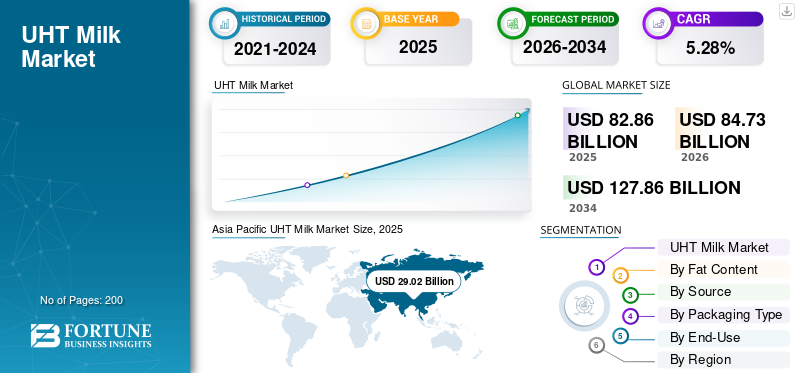
Download Free sample to learn more about this report.
UHT MILK MARKET KEY TAKEAWAYS
 Market Size & Forecast
- 2025 Market Size: USD 82.86 Billion
- 2026 Market Size: USD 84.73 Billion
- 2034 Forecast Market Size: USD 127.86 Billion
- CAGR: 5.28% from 2026–2034
 Market Share
- Asia Pacific dominated the global UHT milk market with a 35.02% share in 2025.
- The white UHT milk segment dominated the market and was valued at USD 66.09 billion in 2025.
- The tetra pack segment held the largest share, reaching USD 43.40 billion in 2025.
 Key Regional Highlights
Asia Pacific
Asia Pacific led the market with USD 29.02 billion in 2025 and is projected to reach USD 48.18 billion by 2034, growing at the fastest CAGR of 6.13%.
Europe
Europe was valued at USD 22.91 billion in 2025 and is projected to reach USD 33.45 billion by 2034.
North America
North America accounted for USD 16.71 billion in 2025 and is expected to reach USD 26.67 billion by 2034.
U.S.
The market was valued at USD 13.38 billion in 2025 and is projected to grow at a CAGR of 5.62% through 2034.
China
The market was valued at USD 13.85 billion in 2025 and is expected to expand at a CAGR of 5.81% through 2034.
Read More

UHT Milk Market Trends
Rising Preference for Shelf-Stable, Aseptic, and Functional Dairy Products to Shape Industry Trends
A major trend in the global market is the steady shift toward shelf-stable dairy formats that reduce dependence on refrigerated storage and support wider retail penetration. This is particularly relevant in densely populated urban markets, export-oriented dairy trade, foodservice distribution, and regions with variable cold-chain infrastructure. The longer shelf life of UHT milk products makes it suitable for modern retail, convenience stores, institutional procurement, and household pantry stocking. In parallel, the market is witnessing stronger innovation in flavored, fortified, lactose-free, and value-added white milk variants, which are helping brands move beyond basic commoditized offerings.
- According to Tetra Pak, one of the world's leading food processing and packaging solutions companies, approximately 80% of organic milk sold in the U.S. is Ultra-High Temperature (UHT) processed to allow for extended transportation, shelf-stability, and wider distribution.
MARKET DYNAMICS
Market Drivers
Download Free sample to learn more about this report.
Rising Global Milk Availability and Demand for Convenient Dairy Nutrition Expected to Drive Market Growth
The rising availability of raw milk worldwide, combined with consumer demand for convenient and safe dairy products, is a key factor supporting global UHT milk market growth. Ultra-high temperature milk is particularly well-positioned in countries where retail modernization is advancing faster than refrigerated distribution networks, and where consumers increasingly prefer dairy products with longer storage life and lower spoilage risk. Its ease of transport and merchandising also makes it commercially attractive for supermarkets, neighborhood stores, e-commerce fulfillment, and institutional channels.
- The Food and Agriculture Organization (FAO) reported that world liquid milk production reached 982 million tons in 2024, up 1.4%, with Asia alone accounting for close to 460 million tons, up 2.4% year over year.
Market Restraints
Strict Aseptic Processing Requirements and Consumer Preference for Fresh Milk to Limit Market Expansion
Despite its clear logistical advantages, UHT milk continues to face resistance in markets where consumers prefer the taste profile of fresh refrigerated milk. In addition, the category is subject to strict processing, packaging, and food safety requirements as commercial sterility is fundamental to product performance and shelf stability. Compliance with aseptic processing standards increases capital intensity for processors, especially those entering the category or upgrading legacy dairy infrastructure.
- In the U.S., commercial sterility for aseptic processing and packaging is defined under 21 CFR Part 113, reflecting the importance of validated sterilization and packaging integrity in shelf-stable foods.
Similar food safety discipline across regulated markets raises operating complexity, validation needs, and quality assurance costs for ultra-high temperature milk manufacturers.
Market Opportunities
Rising Scope for Fortified, Flavored, and Nutrient-Focused UHT Milk to Create New Growth Avenues
A major opportunity area lies in fortified and flavored UHT milk, especially in school nutrition, convenience retail, and health-positioned dairy portfolios. Shelf-stable fortified milk offers processors an efficient format for delivering calcium, protein, vitamin-enriched, and specialty dairy propositions in both consumer and institutional channels. The format is also attractive in export markets and hot-climate geographies where storage flexibility matters. Manufacturers are thus coming up with innovative launches in order to meet the increased demand for ultra-high temperature milk.
- For instance, in January 2026, Benefitt, a new brand from Thailand-based Lactasoy, launched the country's first high-protein ultra-high temperature milk. This product addresses the growing demand for convenient, ambient-stable protein beverages in Thailand's market. The Benefitt High Protein UHT Milk packs 31 grams of protein per 350 ml serving, making it a standout for fitness-focused consumers. It's lactose-free, has no added sugar, features a smooth low-viscosity texture, and is fortified with BCAAs, vitamins B2/B12, calcium, and phosphorus.
SEGMENTATION ANALYSIS
By Product Type
White UHT Milk Segment Dominated the Market Due to Wide Household Consumption and Everyday Utility
Based on product type, the market is segmented into white UHT milk, flavored UHT milk, fortified UHT milk, and others.
The white UHT milk segment dominated the market, valued at USD 66.09 billion in 2025, as it remains the standard everyday milk format across household consumption, retail, and foodservice applications. Its dominance is supported by routine use in tea, coffee, breakfast, cooking, and direct consumption, particularly in markets where consumers prioritize affordability and product familiarity. The segment also benefits from strong distribution efficiency and a broad consumer base spanning both developed and emerging economies.
The fortified UHT milk segment is projected to grow at the fastest CAGR of 7.87% during 2026-2034. The growth is driven by rising health awareness, micronutrient enrichment strategies, and increasing demand for value-added dairy nutrition.
To know how our report can help streamline your business, Speak to Analyst
By Fat Content
Whole UHT Milk Segment Dominated the Market Due to Traditional Preference and Strong Taste Profile
Based on fat content, the market is segmented into whole, semi-skimmed, and skimmed.
The whole UHT milk segment held the dominant global market share, reaching USD 42.52 billion in 2025. The growth is supported by its richer mouthfeel, fuller taste, and widespread consumer preference in family consumption and conventional retail markets. Whole milk continues to perform strongly in Asia, Europe, Latin America, and parts of the Middle East, where consumers often associate full-fat dairy with better taste and satiety.
The semi-skimmed segment is expected to grow at the fastest CAGR of 6.16% during 2026-2034, reflecting a balanced consumer shift toward reduced-fat dairy without fully sacrificing taste and texture.
By Source
Cow Milk Segment Dominated the Market Due to Large Global Production Base and Processing Efficiency
Based on the source, the market is categorized into cow, buffalo, goat, and others.
The cow milk segment dominated the market, valued at USD 78.13 billion in 2025, owing to its overwhelming share in commercial milk production, organized dairy collection systems, and compatibility with large-scale UHT processing. Cow milk remains the default raw material for most branded ultra-high temperature milk globally due to supply consistency, standardized composition, and established procurement infrastructure.
The buffalo milk segment is projected to grow at the fastest CAGR of 7.58% during 2026-2034. Such a growth is supported by strong demand in South Asia and selected Middle Eastern markets, where buffalo milk is valued for its higher solids content and richer sensory profile.
By Packaging Type
Tetra Pack Segment Dominated the Market Due to Superior Shelf Stability and Distribution Efficiency
Based on packaging type, the market is divided into PET bottles, cartons, tetra pack, and bulk packaging.
The tetra pack segment held the dominant global UHT milk market share, reaching USD 43.40 billion in 2025. The growth was supported by its strong barrier properties, consumers’ preference for long shelf life, ease of storage, and suitability for aseptic filling. This format remains the industry benchmark for ultra-high temperature milk as it supports large-scale retail distribution, lower breakage risk, and efficient merchandising across ambient supply chains. The tetra pack segment is also expected to grow at the fastest CAGR of 5.78% during 2026-2034, reflecting continued investment in aseptic packaging systems and the global expansion of shelf-stable dairy distribution.
The PET bottles segment in the global market is expected to grow at a moderate CAGR of 5.03% during 2026-2034. This growth is due to the reason that PET packaging is increasingly preferred for its convenience, durability, and cost efficiency, but its adoption is balanced by competition from cartons and sustainability concerns.
By End-Use
B2C Segment Dominated the Market Due to Strong Retail Offtake and Daily Household Consumption
Based on end-use, the market is bifurcated into B2B and B2C.
The B2C segment dominated the market, valued at USD 74.13 billion in 2025, due to strong household demand through supermarkets, hypermarkets, convenience stores, online platforms, and traditional retail. Ultra-high temperature milk is a staple packaged dairy product in consumer retail due to its convenience, extended storage life, and suitability for stock-up purchasing.
The B2B segment is projected to grow at the fastest CAGR of 6.10% during 2026-2034, supported by rising usage across cafés, hotels, restaurants, institutional kitchens, vending, and food manufacturing applications.
UHT Milk Market Regional Outlook
Regionally, the market is studied across North America, Europe, Asia Pacific, South America, and the Middle East & Africa.
Asia Pacific
Asia Pacific UHT Milk Market Size, 2025 (USD Billion)
To get more information on the regional analysis of this market, Download Free sample
Asia Pacific dominated the global market and was valued at USD 29.02 billion in 2025 and is projected to reach USD 48.18 billion by 2034, growing at the fastest CAGR of 6.13% during 2026-2034. Growth is driven by rapid urbanization, rising disposable incomes, expanding middle-class dairy consumption, and the commercial advantage of shelf-stable dairy in dense and geographically diverse markets. FAO reported that Asia produced close to 460 million tons of milk in 2024, underlining the region’s central role in global dairy expansion.
China UHT Milk Market
China dominates the regional market, valued at approximately USD 13.85 billion in 2025, and is expected to grow at a CAGR of around 5.81% during 2026-2034. Growth is supported by strong demand for packaged dairy, nationwide retail reach, and the continued scaling of branded milk portfolios by leading domestic processors.
India UHT Milk Market
India is another major growth market, valued at approximately USD 5.16 billion in 2025, and is projected to expand at a CAGR of around 7.46% during 2026-2034. Demand is being supported by urban consumption, convenience-led packaged dairy adoption, and rising availability of branded UHT white and flavored milk.
North America
North America was valued at USD 16.71 billion in 2025 and is projected to reach USD 26.67 billion by 2034, growing at a CAGR of 5.67% during 2026-2034. The region’s growth is supported by rising demand for long-life dairy products, premium flavored milk formats, school and institutional dairy programs, and broader penetration of shelf-stable dairy through club stores, e-commerce, and foodservice. Demand is also aided by the need for waste reduction and logistics efficiency in ambient distribution.
U.S. UHT Milk Market
The U.S. dominates the North American market, valued at approximately USD 13.38 billion in 2025, and is expected to grow at a CAGR of around 5.62% during 2026-2034. Growth is supported by increasing acceptance of shelf-stable milk, expanding institutional use, and stronger demand for flavored, lactose-free, and fortified milk formats.
Europe
Europe was valued at USD 22.91 billion in 2025, and is projected to reach USD 33.45 billion by 2034, registering a CAGR of 4.63% during 2026-2034. The region benefits from established dairy consumption patterns, large organized retail networks, and mature aseptic packaging infrastructure. UHT-based milk remains deeply integrated into grocery retail across Southern and Western Europe, where consumers are highly familiar with ambient milk formats.
Germany UHT Milk Market
Germany was valued at approximately USD 4.14 billion in 2025, and is expected to grow at a CAGR of around 4.05% during 2026-2034. The country’s scale in dairy processing, strong retail base, and preference for packaged milk support stable market demand.
U.K. UHT Milk Market
The U.K. market was valued at approximately USD 2.38 billion in 2025, with a CAGR of around 6.02% over 2026-2034. The growth is driven by convenience-led consumption, pantry stocking behavior, and the expansion of flavored and health-positioned dairy drinks.
South America and the Middle East & Africa
South America was valued at USD 8.60 billion in 2025 and is projected to reach USD 12.10 billion by 2034, registering a CAGR of 4.20% during 2026-2034. Growth is supported by steady dairy consumption, increasing modern trade penetration, and the practicality of long-life milk in large distribution geographies.
The Middle East & Africa market was valued at USD 5.62 billion in 2025 and is projected to reach USD 7.46 billion by 2034, expanding at a CAGR of 3.51% during 2026-2034. Growth is supported by rising urban populations, the utility of ambient dairy in hot-climate markets, and the commercial relevance of long-shelf-life packaged milk, where refrigerated distribution can be less efficient.
Brazil UHT Milk Market
Brazil dominates the South American market, valued at approximately USD 5.85 billion in 2025, and is expected to grow at a CAGR of around 3.91% during 2026-2034. The country’s large consumer base, strong dairy processing sector, and familiarity with shelf-stable milk formats continue to support category demand.
COMPETITIVE LANDSCAPE
Key Industry Players
Key Players Focus on Brand Strength, Shelf-Stable Dairy Innovation, Packaging Efficiency, and Regional Distribution Expansion
The global UHT milk market is moderately consolidated, with leading dairy processors competing through brand strength, large-scale milk sourcing, aseptic processing capabilities, and broad retail distribution. Companies in the ultra-high temperature milk market are investing in value-added white milk, flavored milk, fortified variants, and packaging innovation to protect margins in an otherwise high-volume category. Cross-border expansion, premiumization, and operational efficiency remain central to competitive strategy. Major dairy groups, such as Lactalis, Nestlé, Danone, FrieslandCampina, Arla, Fonterra, Mengniu, Yili, and Amul, maintain meaningful exposure to milk and liquid dairy portfolios across multiple geographies.
Key Players in the UHT Milk Market
|
Rank |
Company Name |
|
1 |
Lactalis |
|
2 |
Nestlé S.A. |
|
3 |
Danone S.A. |
|
4 |
FrieslandCampina |
|
5 |
Arla Foods |
List of Key UHT Milk Companies Profiled
- Lactalis (France)
- Nestlé S.A. (Switzerland)
- Danone S.A. (France)
- FrieslandCampina (Netherlands)
- Arla Foods (Denmark)
- Fonterra Co-operative Group (New Zealand)
- China Mengniu Dairy Company Limited (China)
- Inner Mongolia Yili Industrial Group Co., Ltd. (China)
- GCMMF / Amul (India)
- Saputo Inc. (Canada)
KEY INDUSTRY DEVELOPMENTS
- January 2026: Thailand's Lactasoy Co., under its new brand Benefitt, launched the country's first high-protein UHT milk using SIG's flexible aseptic filling technology. This innovation shifts high-protein milk from refrigerated pasteurized formats to ambient shelf-stable cartons, enabling wider distribution such as at 7-Eleven stores nationwide.
- November 2025: Egyptian Deputy Prime Minister Kamel Al-Wazir inaugurated a USD 20.4 million expansion at Beyti Food Industries, a subsidiary of Saudi-based Almarai Group. A standout feature is the launch of Egypt's inaugural ultra-high-temperature milk production line packaged in PET bottles, marking an innovation in the local dairy sector. This supports Beyti's annual output of 650,000 tons across 130 products, exported to 45 countries, while creating over 6,000 jobs.
- October 2025: India’s Prime Minister Narendra Modi virtually inaugurated Rajasthan’s first ultra‑high temperature milk processing and aseptic packaging plant at the Bhilwara Milk Producers’ Cooperative. Further, marking a major step in modernizing the state’s dairy infrastructure.
- April 2025: French dairy company Malo Dairy (a subsidiary of SILL Enterprises) launched an ultra‑high‑temperature milk in cartons under Elopak’s Pure‑Pak Sense packaging platform. The product is positioned as a sustainable, shelf‑stable milk option using grass-fed cow milk from farms near Malo’s facilities in Brittany.
- October 2020: Gokul, the Kolhapur‑based dairy cooperative (Kolhapur Zilla Sahakari Dudh Utpadak Sangh Ltd.), has launched a UHT‑treated milk brand called Gokul Select, positioned as a long‑shelf‑life, room‑temperature‑stable packaged milk for urban consumers.
REPORT COVERAGE
The global market forecast report analyzes the market in depth and highlights crucial aspects such as global market trends, market dynamics, supply chains, prominent companies, investment in research and development, and end-use. Besides this, the report also provides insights into the global UHT milk market analysis and highlights significant industry developments.
Request for Customization to gain extensive market insights.
Report Scope & Segmentation
| ATTRIBUTE | DETAILS |
| Study Period | 2021-2034 |
| Base Year | 2025 |
| Estimated Year | 2026 |
| Forecast Period | 2026-2034 |
| Historical Period | 2021-2024 |
| Growth Rate | CAGR of 5.28% from 2026 to 2034 |
| Unit | Value (USD Billion) |
| Segmentations | By Product Type, Fat Content, Source, Packaging Type, End-Use, and Region |
|
Segmentation |
By Product Type
|
|
By Fat Content
|
|
|
By Source
|
|
|
By Packaging Type
|
|
|
By End-Use
|
|
|
By Region
|
Frequently Asked Questions
Fortune Business Insights says that the global market was valued at USD 82.86 billion in 2025 and is anticipated to reach USD 127.86 billion by 2034.
At a CAGR of 5.28%, the global market will exhibit steady growth over the forecast period.
By source, the cow segment led the market.
Asia Pacific held the largest market share in 2025.
The rising global milk availability and demand for convenient dairy nutrition support market growth.
Lactalis, Nestlé S.A., Danone, FrieslandCampina, and Arla Foods are the leading players in the market.
The rising preference for shelf-stable, aseptic, and functional dairy products to shape industry trends.



- 2021-2034
- 2025
- 2021-2024
- 200
-
(Offer valid till 15th Oct 2026)
Get 30-60 hrs Free Customization
Expand Regional and Country Coverage, Segments Analysis, Company Profiles, Competitive Benchmarking, and End-user Insights.




















Related Reports
-
US +1 833 909 2966 ( Toll Free )
-
Get In Touch With Us