Ultrasonic Cleaning Market Size, Share & Industry Analysis, By Product (Benchtop, Standalone, Multistage), By Industry (Automotive, Healthcare, Food & Beverage, Metal), and Regional Forecast, 2026-2034
 Download Free Sample
Ultrasonic Cleaning Market Overview
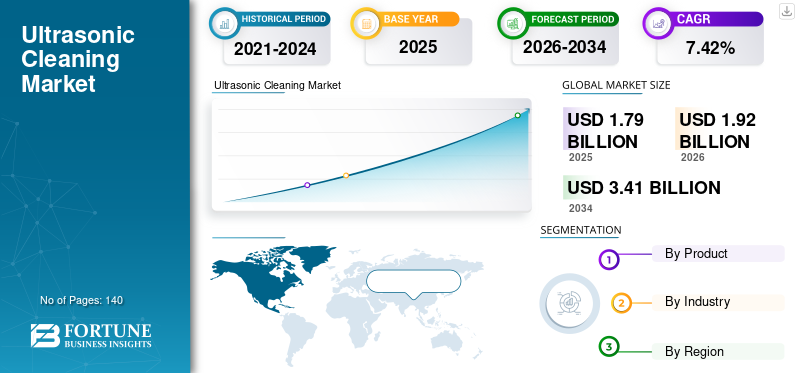
The global ultrasonic cleaning market size was valued at USD 1.78 billion in 2025. The market is projected to grow from USD 1.92 billion in 2026 to USD 3.41 billion by 2034, exhibiting a CAGR of 7.42% during the forecast period.

The ultrasonic cleaning market is expanding steadily due to increasing demand for precision cleaning across healthcare, automotive, electronics, aerospace, and industrial manufacturing sectors. Ultrasonic cleaning systems use high-frequency sound waves to remove contaminants, oil residues, dust particles, and microscopic impurities from sensitive equipment and components. The market is witnessing strong adoption of automated cleaning technologies because manufacturers require higher cleaning consistency and lower operational downtime. growth in semiconductor manufacturing, medical device production, and electric vehicle component assembly is accelerating equipment deployment worldwide. The ultrasonic cleaning market report indicates that industries are prioritizing eco-friendly aqueous cleaning systems to replace solvent-based methods, creating long-term opportunities for advanced ultrasonic cleaning technologies.
The United States ultrasonic cleaning market is driven by strong manufacturing activity, advanced healthcare infrastructure, and increasing use of precision cleaning systems in aerospace and semiconductor facilities. The country accounts for nearly 31% share of global demand due to high adoption in surgical instrument sterilization and automotive component maintenance. Industrial automation initiatives across Texas, California, Ohio, and Michigan continue to increase procurement of multistage ultrasonic cleaning equipment. The ultrasonic cleaning industry analysis highlights rising demand for automated benchtop units in laboratories and dental clinics. Medical device manufacturers in the USA are increasingly investing in compact ultrasonic systems capable of removing microscopic contaminatio
Download Free sample to learn more about this report.
Ultrasonic Cleaning Market Key Takeaways
 Global Market Size & Forecast
- 2025 Market Size: USD 1.78 Billion
- 2026 Market Size: USD 1.92 Billion
- 2034 Forecast Market Size: USD 3.41 Billion
- CAGR: 7.42% from 2026-2034
 Market Share
- North America dominated with a revenue share of 36% in 2025.
- Benchtop ultrasonic cleaning systems accounted for approximately 39% of the market share.
- Automotive applications held approximately 29% of the market share.
 Key Regional Highlights
North America
North America led the market with a 36% share, supported by strong adoption across automotive, healthcare, and industrial sectors.
Asia-Pacific
Asia-Pacific accounted for 29% of the market, driven by expanding manufacturing and electronics industries.
Europe
Europe held a 28% share, supported by growing demand for precision cleaning and industrial automation.
U.S.
The U.S. market is supported by increasing adoption of ultrasonic cleaning systems in automotive, healthcare, and manufacturing applications.
Japan
Japan accounted for 22% of the Asia-Pacific market, supported by advanced manufacturing and precision cleaning technologies.
Read More

Ultrasonic Cleaning Market Latest Trends
The ultrasonic cleaning market trends indicate rapid transition toward smart cleaning systems integrated with digital monitoring capabilities and automated frequency control. Manufacturers are introducing programmable ultrasonic cleaning machines with touchscreen interfaces, temperature management systems, and energy-efficient transducers to improve operational efficiency. The ultrasonic cleaning market Analysis shows growing demand for multistage systems capable of rinsing, drying, and degassing within a single automated process. Industrial users increasingly prefer low-noise ultrasonic cleaning equipment to improve workplace safety and employee comfort.
Download Free sample to learn more about this report.
Healthcare applications are emerging as a major trend area because hospitals and laboratories require contamination-free surgical tools and diagnostic instruments. Demand for compact tabletop systems has increased by 18% in dental and clinical facilities. Semiconductor and electronics manufacturers are investing heavily in precision cleaning technologies due to rising production of microelectronic components. Electric vehicle battery manufacturers are also adopting ultrasonic cleaning systems for battery cell and connector cleaning operations.
Ultrasonic Cleaning Market Dynamics
Driver
Rising Demand for Precision Cleaning in Healthcare and Electronics Industries
The ultrasonic cleaning market growth is strongly supported by expanding requirements for contamination-free manufacturing and sterilization processes. Healthcare facilities increasingly use ultrasonic cleaners for surgical instruments, dental tools, endoscopes, and laboratory equipment because ultrasonic cavitation removes microscopic debris more effectively than manual cleaning methods. Semiconductor and electronics manufacturers are also accelerating equipment purchases due to rising complexity of miniaturized components. Precision cleaning has become essential for printed circuit boards, optical devices, and lithium battery connectors. Industrial manufacturers reported a 24% increase in automated cleaning adoption across electronics facilities during recent production expansion projects. The ultrasonic cleaning market Insights reveal that manufacturers prefer ultrasonic systems because they reduce cleaning time, improve repeatability, minimize labor requirements, and support high-volume production processes.
Restraint
High Initial Equipment and Maintenance Costs
The ultrasonic cleaning market faces restraints associated with elevated equipment acquisition and maintenance expenses. Advanced multistage ultrasonic systems require high-capacity generators, durable stainless-steel tanks, filtration units, and automated drying systems, increasing procurement costs for small and medium-sized enterprises. Industrial-grade systems used in aerospace and semiconductor sectors can require significant infrastructure modifications and operator training. Maintenance of transducers and replacement of cleaning fluids also contribute to operational expenditure. In developing economies, manufacturers continue using conventional cleaning techniques due to lower installation costs. The ultrasonic cleaning market Research Report highlights that many small workshops hesitate to adopt automated cleaning systems because return-on-investment periods remain relatively long. Supply chain fluctuations affecting electronic components and stainless-steel materials are also increasing equipment production costs globally.
Opportunity
Expansion of Electric Vehicle and Semiconductor Manufacturing
Rapid expansion of electric vehicle production and semiconductor fabrication is creating substantial opportunities in the ultrasonic cleaning market outlook. EV battery manufacturing requires precision cleaning of connectors, casings, electrodes, and metal components to ensure operational reliability. Semiconductor production facilities rely heavily on ultrasonic systems for wafer cleaning and contamination control. Global semiconductor plant investments increased significantly during recent industrial modernization programs, creating strong equipment demand. The ultrasonic cleaning industry analysis indicates that automated cleaning systems capable of handling delicate components are gaining preference among advanced manufacturers. growth in aerospace component production and renewable energy equipment manufacturing is also opening new application areas. Companies are developing AI-enabled monitoring systems that optimize cleaning cycles, reduce water consumption, and improve equipment lifespan, further expanding market opportunities.
Challenge
Technical Limitations in Cleaning Delicate Materials
One major challenge in the ultrasonic cleaning market is the potential risk of damage to highly delicate surfaces and sensitive materials. Excessive ultrasonic frequency or improper cleaning solution selection can affect fragile coatings, precision optics, thin electronic substrates, and soft metals. Certain industrial users remain cautious regarding cavitation-related erosion in long-duration cleaning processes. Manufacturers must carefully calibrate frequency levels, temperature settings, and exposure duration to prevent material degradation. The ultrasonic cleaning market Size continues to grow, but technical complexity remains a concern for operators without specialized training. Inconsistent cleaning performance due to incorrect fluid chemistry also affects operational efficiency. Industries requiring strict quality standards, such as aerospace and semiconductor manufacturing, demand advanced validation systems and highly controlled cleaning environments, increasing operational complexity for equipment suppliers.
Ultrasonic Cleaning Market Segmentation
By Product
Market share for benchtop ultrasonic cleaning systems accounts for nearly 39% of the global ultrasonic cleaning market Share due to widespread use in laboratories, dental clinics, jewelry cleaning, and small-scale industrial applications. These compact systems are preferred because they require minimal installation space and support low-volume precision cleaning operations. Healthcare facilities increasingly deploy benchtop units for surgical instrument sterilization and contamination removal. Electronics repair workshops also use benchtop systems for cleaning circuit boards and miniature components. Demand increased by 16% among educational laboratories and testing facilities because of growing research activities. Manufacturers are introducing portable benchtop systems with digital timers, programmable frequency control.
Standalone ultrasonic cleaning systems represent approximately 34% share of the Ultrasonic Cleaning Industry Report because they support large-scale industrial cleaning applications. Automotive component manufacturers, aerospace facilities, and heavy machinery workshops are major users of standalone systems. These units provide higher tank capacity and improved cleaning power suitable for engine parts, metal assemblies, and industrial tools. Manufacturing plants increasingly integrate standalone ultrasonic systems into automated production lines to improve operational efficiency and reduce manual labor. Industrial users reported nearly 21% improvement in cleaning consistency after replacing conventional cleaning methods with standalone ultrasonic systems.
Multistage ultrasonic cleaning systems hold nearly 27% share of the ultrasonic cleaning market outlook and are experiencing strong adoption in semiconductor, aerospace, and medical device manufacturing industries. These systems combine washing, rinsing, drying, and degassing processes within a single integrated setup, improving production efficiency and contamination control. Semiconductor manufacturers increasingly prefer multistage systems because microelectronic components require highly controlled cleaning environments. Medical device producers also rely on multistage systems to maintain strict sterilization standards. Industrial automation investments increased deployment of robotic handling systems integrated with multistage ultrasonic platforms. Manufacturers are introducing closed-loop water recycling systems to improve sustainability.
By Industry
The automotive segment accounts for nearly 29% share of the ultrasonic cleaning market Size due to increasing use in engine component cleaning, fuel injector maintenance, brake system cleaning, and EV battery production. Automotive manufacturers require precision cleaning technologies to remove oil residues, metal particles, and contaminants from critical components. Electric vehicle production is further accelerating demand because battery connectors and electronic assemblies require contamination-free surfaces. Automotive repair workshops increasingly use ultrasonic systems for carburetors, filters, and transmission parts. Industrial automation in vehicle assembly plants has expanded deployment of standalone and multistage cleaning systems.
Healthcare applications contribute approximately 26% share of the ultrasonic cleaning market Analysis because hospitals, diagnostic laboratories, and dental clinics require advanced sterilization and contamination removal technologies. Surgical instruments, orthopedic implants, dental tools, and laboratory equipment must meet strict hygiene standards. Ultrasonic cleaning systems effectively remove biological residues and microscopic contaminants from hard-to-reach instrument surfaces. Healthcare facilities reported nearly 19% improvement in sterilization efficiency after integrating ultrasonic cleaning processes. Compact benchtop systems are widely adopted in dental and clinical environments, while larger multistage systems are used in medical manufacturing facilities. Rising surgical procedure.
The food and beverage segment holds nearly 18% share of the ultrasonic cleaning market growth due to increasing hygiene regulations and food safety standards. Processing facilities use ultrasonic cleaning systems to remove contaminants from molds, conveyor parts, filters, cutting equipment, and packaging machinery. Manufacturers prefer ultrasonic cleaning because it reduces chemical usage and supports environmentally sustainable operations. Beverage manufacturers increasingly deploy automated systems to clean bottling equipment and stainless-steel processing components. Food processors reported approximately 14% reduction in maintenance downtime after adopting ultrasonic cleaning technologies.
Metal processing applications account for approximately 27% share of the ultrasonic cleaning market trends due to extensive use in industrial manufacturing and fabrication facilities. Ultrasonic systems remove grease, polishing compounds, rust particles, and machining residues from metal surfaces before coating or assembly operations. Aerospace and heavy machinery manufacturers increasingly rely on ultrasonic cleaning technologies for precision metal components. Industrial facilities reported around 22% improvement in cleaning consistency compared with manual methods. Multistage ultrasonic systems are widely used for high-volume metal processing applications because they improve operational efficiency and reduce labor requirements.
Ultrasonic Cleaning Market Regional Outlook
North America
North America accounts for nearly 36% share of the ultrasonic cleaning market Share because of strong industrial automation, advanced healthcare systems, and high adoption of precision cleaning technologies. The United States dominates regional demand due to extensive semiconductor production, aerospace manufacturing, and medical device development. Automotive manufacturers in Michigan and Ohio increasingly use ultrasonic systems for EV battery components and fuel injection systems. Healthcare facilities continue expanding procurement of benchtop ultrasonic systems for surgical instrument sterilization. Canada is also experiencing growth in industrial manufacturing and laboratory research applications. Regional manufacturers are introducing smart ultrasonic systems integrated with digital monitoring platforms and energy-efficient generators. The ultrasonic cleaning market forecast indicates increasing demand for multistage systems capable of supporting automated production environments. Aerospace manufacturers across North America are investing heavily in contamination-free cleaning technologies for turbine components and precision assemblies. Industrial users are also shifting toward water-based cleaning solutions to comply with environmental regulations and workplace safety requirements.
Europe
Europe represents approximately 28% share of the ultrasonic cleaning market Size due to strong engineering industries and strict industrial hygiene standards. Germany, France, Italy, and the United Kingdom are major contributors to regional demand. Automotive manufacturing remains a primary growth driver because European automakers require precision cleaning for transmission systems, EV batteries, and engine components. Medical device production across the region is also expanding demand for advanced ultrasonic cleaning equipment. Industrial facilities increasingly adopt automated multistage systems to improve production efficiency and reduce labor costs. Sustainability initiatives across Europe are encouraging replacement of solvent-based cleaning processes with aqueous ultrasonic technologies. The Ultrasonic Cleaning Industry Report highlights increasing investments in energy-efficient transducers and recyclable cleaning fluids. Aerospace manufacturing and precision machining sectors continue driving equipment upgrades across industrial facilities. European manufacturers are focusing on development of compact low-noise ultrasonic systems suitable for research laboratories and healthcare institutions.
Germany Ultrasonic Cleaning Market
Germany accounts for nearly 34% share of the European ultrasonic cleaning market Analysis due to its strong automotive engineering and industrial manufacturing sectors. German manufacturers widely use ultrasonic systems in automotive component production, aerospace engineering, and precision machining applications. Industrial automation programs across Bavaria and Baden-Württemberg continue increasing deployment of multistage cleaning equipment. Semiconductor and medical device production facilities are also expanding procurement of contamination-control technologies. German companies prioritize energy-efficient systems with automated monitoring capabilities. The ultrasonic cleaning market trends in Germany indicate rising adoption of environmentally sustainable aqueous cleaning technologies across industrial operations.
United Kingdom Ultrasonic Cleaning Market
The United Kingdom contributes approximately 18% share of the European ultrasonic cleaning market outlook due to increasing demand from healthcare, aerospace, and laboratory sectors. Hospitals and dental clinics continue adopting compact benchtop ultrasonic systems for sterilization and precision cleaning. Aerospace manufacturing facilities are investing in advanced multistage systems to improve component reliability and contamination control. Industrial research laboratories also require ultrasonic technologies for sample preparation and equipment maintenance. The ultrasonic cleaning market Research Report highlights rising demand for automated cleaning systems integrated with digital process monitoring across manufacturing facilities in the United Kingdom.
Asia-Pacific
Asia-Pacific holds nearly 29% share of the ultrasonic cleaning market growth and remains the fastest expanding regional market due to rapid industrialization and electronics manufacturing growth. China, Japan, South Korea, and India are major production hubs for semiconductors, automotive components, and consumer electronics. Manufacturers across the region increasingly deploy ultrasonic cleaning systems to improve production quality and operational efficiency. Electric vehicle battery production is creating substantial demand for precision cleaning technologies. Semiconductor fabrication facilities continue investing heavily in multistage ultrasonic systems capable of contamination-free wafer cleaning. Healthcare infrastructure modernization across Asia-Pacific is also supporting demand for compact medical cleaning systems. Industrial users are prioritizing automated cleaning technologies to reduce labor dependency and improve consistency. The ultrasonic cleaning market Insights indicate strong export activity from regional manufacturers producing cost-effective benchtop and standalone systems. Government initiatives supporting advanced manufacturing and electronics production continue accelerating equipment deployment across the region.
Japan Ultrasonic Cleaning Market
Japan accounts for approximately 22% share of the Asia-Pacific ultrasonic cleaning market Share due to strong semiconductor manufacturing and advanced electronics production capabilities. Japanese manufacturers extensively use ultrasonic cleaning technologies for precision optical components, medical devices, and automotive electronics. The country maintains high demand for multistage cleaning systems integrated with automated robotics. Healthcare institutions also rely heavily on ultrasonic cleaning for surgical instruments and laboratory equipment sterilization. The ultrasonic cleaning market Analysis indicates increasing investments in compact high-frequency systems capable of handling miniature electronic components with minimal surface damage.
China Ultrasonic Cleaning Market
China contributes nearly 26% share of the Asia-Pacific ultrasonic cleaning market Size because of its dominant electronics manufacturing and industrial production sectors. Semiconductor fabrication plants, automotive factories, and metal processing facilities are major users of ultrasonic cleaning technologies. Chinese EV battery manufacturers increasingly invest in automated cleaning systems for battery connectors and electronic assemblies. The country also exports large volumes of affordable benchtop ultrasonic equipment to international markets. Industrial automation initiatives continue accelerating deployment of multistage cleaning systems across manufacturing facilities. The ultrasonic cleaning industry analysis highlights strong growth in healthcare and laboratory applications throughout China.
Rest of World
The Rest of World segment accounts for approximately 7% share of the ultrasonic cleaning market Opportunities due to expanding industrialization and healthcare modernization in Latin America, the Middle East, and Africa. Industrial manufacturing facilities in Brazil and Mexico increasingly use ultrasonic systems for automotive and metal processing applications. Healthcare institutions across the Middle East are investing in advanced sterilization technologies for surgical and diagnostic equipment. Oil and gas industries also utilize ultrasonic cleaning systems for maintenance of precision tools and industrial components. Regional manufacturers are gradually adopting automated cleaning solutions to improve operational efficiency and product quality. Government infrastructure development programs are supporting industrial modernization projects across several emerging economies. The ultrasonic cleaning market forecast indicates growing imports of standalone and multistage systems into developing markets. Rising awareness regarding contamination control and workplace safety standards continues encouraging adoption of environmentally sustainable ultrasonic cleaning technologies.
List of Top Ultrasonic Cleaning Companies
- SharperTek
- Mettler Electronics Corp.
- L&R Manufacturing
- Elma Schmidbauer GmbH
- Steelco S.p.A.
- Emerson Electric Co.
- GT Sonic
- Kemet International Limited
- Crest Ultrasonics Corporation
- Ultrasonic LLC
Top Two Companies with Highest Market Share
- Emerson Electric Co. – 14% market share
- Elma Schmidbauer GmbH – 11% market share
Investment Analysis and Opportunities
The ultrasonic cleaning market opportunities are expanding due to increasing investments in healthcare infrastructure, semiconductor manufacturing, aerospace engineering, and electric vehicle production. Industrial automation initiatives worldwide are encouraging manufacturers to replace manual cleaning processes with advanced ultrasonic systems capable of delivering higher precision and operational efficiency. Investors are focusing on companies developing energy-efficient transducers, AI-enabled process monitoring systems, and multistage automated cleaning platforms. Demand for environmentally sustainable aqueous cleaning technologies is creating additional opportunities for equipment suppliers and chemical solution manufacturers.
Semiconductor fabrication facilities are allocating substantial capital toward contamination-control technologies, increasing procurement of high-frequency ultrasonic systems. Healthcare institutions continue investing in compact benchtop systems for sterilization and infection prevention applications. Automotive manufacturers are also increasing investment in EV battery production facilities, accelerating demand for precision cleaning technologies. Asia-Pacific remains a major investment destination because electronics and automotive production capacity continues expanding rapidly. The ultrasonic cleaning market Research Report identifies strong opportunities in robotic integration, automated material handling, and closed-loop water recycling systems. Manufacturers capable of offering customizable ultrasonic cleaning solutions for specialized industrial applications are expected to gain competitive advantages in the global market.
New Product Development
New product development in the ultrasonic cleaning market trends is focused on automation, sustainability, and precision cleaning performance. Manufacturers are introducing intelligent ultrasonic systems equipped with digital frequency adjustment, remote monitoring interfaces, and programmable cleaning cycles. Advanced multistage systems now integrate washing, rinsing, drying, and filtration functions into compact automated units designed for high-volume industrial operations. Development of energy-efficient piezoelectric transducers is improving cleaning consistency while reducing electricity consumption.
Healthcare equipment suppliers are launching compact benchtop ultrasonic cleaners with enhanced sterilization compatibility and low-noise operation suitable for clinics and laboratories. Semiconductor manufacturers require ultra-high-frequency systems capable of cleaning delicate wafers and microelectronic assemblies without surface damage. Automotive industry demand is encouraging development of large-capacity standalone systems optimized for EV battery and engine component cleaning applications. The ultrasonic cleaning market Insights indicate increasing adoption of touchscreen control systems and IoT-enabled predictive maintenance technologies. Manufacturers are also investing in environmentally sustainable product development by introducing recyclable cleaning solutions and water-saving filtration systems. Robotic integration and AI-driven process optimization remain important innovation areas across industrial ultrasonic cleaning equipment production.
Five Recent Developments (2023-2025)
- Emerson Electric Co. introduced automated multistage ultrasonic cleaning systems for semiconductor manufacturing applications in 2024.
- Elma Schmidbauer GmbH launched energy-efficient benchtop ultrasonic cleaners with smart digital interfaces in 2023.
- Crest Ultrasonics Corporation expanded production capacity for industrial standalone cleaning systems in North America during 2025.
- GT Sonic introduced compact ultrasonic cleaning equipment designed specifically for EV battery component cleaning in 2024.
- Steelco S.p.A. developed integrated medical instrument cleaning and disinfection systems for hospitals and laboratories in 2025.
Report Coverage of Ultrasonic Cleaning Market
The ultrasonic cleaning market report provides detailed analysis of industrial trends, equipment adoption patterns, technological innovations, and application-based demand across global markets. The report evaluates market performance across benchtop, standalone, and multistage ultrasonic cleaning systems while assessing deployment in automotive, healthcare, food & beverage, and metal processing industries. It includes detailed regional analysis covering North America, Europe, Asia-Pacific, and Rest of World markets along with country-level insights for the United States, Germany, the United Kingdom, Japan, and China.
Request for Customization to gain extensive market insights.
The ultrasonic cleaning market analysis also examines industrial automation trends, semiconductor manufacturing expansion, EV battery production growth, and healthcare sterilization requirements influencing equipment demand. The study evaluates market share distribution, operational advancements, sustainability initiatives, and competitive positioning among major manufacturers. Technological developments such as smart monitoring systems, automated process control, recyclable cleaning solutions, and robotic integration are comprehensively assessed. The Ultrasonic Cleaning Industry Report further covers investment trends, supply chain developments, production expansion strategies, and innovation activities shaping future market opportunities across industrial and healthcare applications.
Frequently Asked Questions
Fortune Business Insights says that the global market value stood at USD 1.78 billion in 2025 and is projected to reach USD 3.41 billion by 2034.
The market is expected to exhibit a CAGR of 7.42% during the forecast period of 2026-2034.
Benchtop ultrasonic cleaning systems were the leading product segment, accounting for nearly 39% of the market share. Their compact design and suitability for precision cleaning support their dominance.
Key players include Branson Ultrasonics Corporation, Crest Ultrasonics, Blue Wave Ultrasonics, Elma Schmidbauer GmbH, Omegasonics, and Kemet International Limited.
Major trends include increasing adoption of automated and multistage ultrasonic cleaning systems and growing demand for sustainable cleaning technologies. North America led the market with a 36% regional share.



- 2021-2034
- 2025
- 2021-2024
- 140
-

(Offer valid till 30th Sep 2026)
Get 30-60 hrs Free Customization
Expand Regional and Country Coverage, Segments Analysis, Company Profiles, Competitive Benchmarking, and End-user Insights.




















-
US +1 833 909 2966 ( Toll Free )
-
Get In Touch With Us