Unilateral Biportal Endoscopy Market Size, Share & Industry Analysis, By Product (Reusable, Single-Use), By Application (Decompression, Deherniation), By End Use and Regional Forecast, 2026-2034
 Download Free Sample
Unilateral Biportal Endoscopy Market Overview
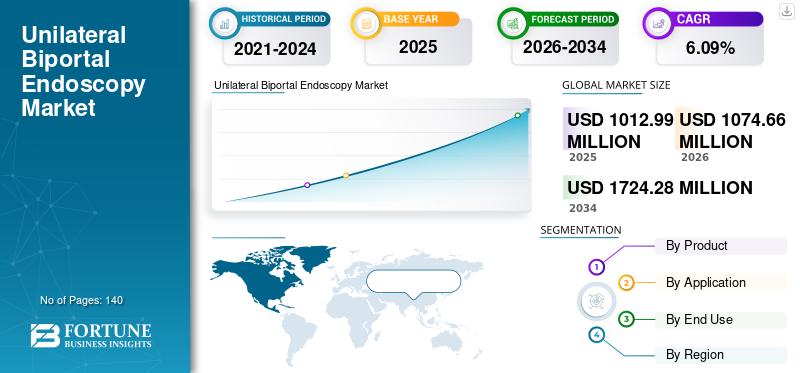
The unilateral biportal endoscopy market size was valued at USD 1012.99 million in 2025. The Market is projected to grow from USD 1074.66 million in 2026 to USD 1724.28 million by 2034, exhibiting a CAGR of 6.09% during the forecast period.

The unilateral biportal endoscopy market is witnessing substantial expansion due to the growing adoption of minimally invasive spine surgery procedures across hospitals, orthopedic centers, and specialty clinics. Increasing prevalence of lumbar spinal stenosis, degenerative disc disease, and herniated discs has accelerated demand for advanced spinal visualization technologies. Surgeons are increasingly adopting unilateral biportal endoscopy systems because they provide enhanced flexibility, wider visualization angles, reduced muscle damage, and shorter hospitalization periods. The unilateral biportal endoscopy market report indicates strong demand for reusable and single-use endoscopic instruments as healthcare institutions focus on precision surgery and improved patient recovery outcomes. Rising investments in spinal surgery infrastructure and training programs are also strengthening the unilateral biportal endoscopy market industry analysis globally.
The United States represents a major share of the unilateral biportal endoscopy market due to the widespread adoption of advanced surgical technologies and strong presence of specialized spine centers. Around 41% of North American procedural adoption is concentrated in the U.S. healthcare sector owing to high patient awareness regarding minimally invasive spinal treatments. The country has experienced increasing outpatient spinal decompression procedures supported by advanced imaging integration and robotic-assisted navigation systems. Academic medical institutions and orthopedic research centers continue to expand training programs for unilateral biportal endoscopy techniques. The U.S. unilateral biportal endoscopy market research report highlights growing procedural volumes among aging populations suffering from chronic lower back disorders and degenerative spinal conditions.
Download Free sample to learn more about this report.
Unilateral Biportal Endoscopy Market Key Takeaways
 Global Market Size & Forecast
- 2025 Market Size: USD 1,012.99 Million
- 2026 Market Size: USD 1,074.66 Million
- 2034 Forecast Market Size: USD 1,724.28 Million
- CAGR: 6.09% from 2026-2034
 Market Share
- North America dominated with a revenue share of 39% in 2025.
- Reusable systems accounted for approximately 63% of the market share.
- Decompression procedures held approximately 58% of the market share.
 Key Regional Highlights
North America
North America led the market with a 39% share, supported by advanced healthcare infrastructure and rising adoption of minimally invasive spine procedures.
North America
Europe accounted for 28% of the market, driven by growing demand for advanced spinal surgical technologies.
Asia-Pacific
Asia-Pacific held a 25% share, supported by increasing healthcare investments and adoption of endoscopic spine surgery.
U.S.
The U.S. market is supported by increasing adoption of minimally invasive spinal procedures and advanced endoscopic technologies.
Japan
Japan accounted for 29% of the Asia-Pacific market, supported by advanced healthcare infrastructure and growing adoption of minimally invasive spine surgery.
Read More

Unilateral Biportal Endoscopy Market Latest Trends
The unilateral biportal endoscopy market trends indicate a rapid shift toward minimally invasive spinal procedures integrated with high-definition imaging systems and precision surgical tools. Hospitals are increasingly deploying 4K visualization platforms and advanced irrigation systems to improve surgical accuracy during decompression and deherniation procedures. The integration of navigation-assisted endoscopy has become a key trend supporting procedural consistency and reduced tissue trauma. Surgeons are also adopting ergonomic biportal instruments to improve maneuverability during spinal canal access.
Download Free sample to learn more about this report.
Another major trend shaping the unilateral biportal endoscopy market outlook is the growing preference for outpatient spinal surgery. Healthcare providers are focusing on reducing hospitalization duration and postoperative complications, which has increased demand for efficient unilateral biportal endoscopic techniques. Single-use endoscopic devices are gaining momentum because of infection control advantages and simplified sterilization processes. Emerging economies are investing heavily in spine surgery training workshops and cadaver-based educational programs, enabling broader adoption of unilateral biportal endoscopy procedures. Furthermore, partnerships between medical device manufacturers and specialty hospitals are supporting innovation in compact endoscopic towers, AI-assisted imaging software, and flexible surgical instruments, contributing significantly to unilateral biportal endoscopy market growth.
Unilateral Biportal Endoscopy Market Dynamics
DRIVER
Rising Prevalence of Spinal Degenerative Disorders and Preference for Minimally Invasive Surgery
The increasing incidence of lumbar spinal stenosis, degenerative disc disease, cervical disc compression, and herniated discs is acting as a major growth driver for the unilateral biportal endoscopy market. Aging populations globally are contributing to higher patient volumes requiring spinal decompression and nerve root treatment procedures. Healthcare providers are increasingly recommending minimally invasive spine surgery because it minimizes blood loss, shortens recovery periods, and reduces muscle tissue damage. These advantages are encouraging hospitals and ambulatory surgical centers to invest in advanced unilateral biportal endoscopy systems.
The unilateral biportal endoscopy market analysis also highlights increasing patient awareness regarding postoperative rehabilitation benefits associated with biportal endoscopic techniques. Surgeons prefer unilateral biportal endoscopy because it enables wider surgical visualization compared to traditional endoscopic approaches. Continuous technological advancements in visualization equipment, surgical drills, and irrigation systems are improving procedural outcomes. Medical institutions are further supporting market expansion through specialized spine surgery training programs and advanced simulation platforms designed to enhance surgeon proficiency in unilateral biportal endoscopic procedures.
RESTRAINT
Limited Availability of Skilled Surgeons and High Procedural Learning Curve
One of the major restraints affecting the unilateral biportal endoscopy market growth is the shortage of highly trained spinal endoscopy specialists. The unilateral biportal endoscopy technique requires advanced hand-eye coordination, precise portal placement, and extensive understanding of spinal anatomy. Many healthcare facilities in developing regions still lack experienced surgeons capable of performing complex endoscopic decompression procedures efficiently. This limitation reduces procedural adoption in several regional healthcare systems.
The unilateral biportal endoscopy market industry report also identifies equipment acquisition costs and training expenditures as important barriers for smaller hospitals. High-definition imaging systems, specialized surgical instruments, and advanced irrigation units require significant capital investments. Additionally, the procedural learning curve may increase operation time during the early adoption phase, creating hesitation among healthcare providers. Regulatory approvals for new endoscopic devices and reimbursement uncertainties in certain healthcare systems further slow Market penetration. Limited awareness regarding unilateral biportal endoscopy benefits in underdeveloped medical Markets also restricts the pace of global adoption.
OPPORTUNITY
Expansion of Outpatient Spine Surgery Centers and Technological Innovation
The increasing establishment of ambulatory surgical centers and outpatient spine clinics is creating significant opportunities for the unilateral biportal endoscopy market Opportunities landscape. Outpatient facilities are focusing on minimally invasive procedures that enable same-day discharge and lower hospitalization costs. Unilateral biportal endoscopy aligns strongly with these healthcare objectives because it supports reduced postoperative discomfort and faster patient mobility. As healthcare systems prioritize cost-efficient surgical pathways, adoption of biportal endoscopy systems is expected to accelerate.
Technological innovation is another major opportunity area within the unilateral biportal endoscopy market forecast. Medical device companies are developing compact visualization systems, disposable endoscopic instruments, and AI-supported navigation technologies to improve surgical precision. Integration of augmented imaging and robotics into endoscopic spinal surgery platforms is expected to strengthen procedural efficiency. Emerging Markets across Asia-Pacific and Latin America are also increasing investments in advanced orthopedic care infrastructure, creating new business expansion opportunities for manufacturers. Training collaborations between hospitals and device manufacturers are further improving surgeon accessibility to modern unilateral biportal endoscopy technologies.
CHALLENGE
Rising Equipment Maintenance Costs and Procedural Standardization Issues
The unilateral biportal endoscopy market Challenges are strongly associated with rising maintenance expenditures and inconsistent procedural standardization across healthcare institutions. Endoscopic visualization systems require regular calibration, sterilization, and servicing to maintain surgical accuracy. High maintenance requirements can increase operational expenses for hospitals and specialty clinics. Smaller medical centers often face difficulties maintaining advanced imaging towers and precision surgical instruments over extended operational periods.
Another significant challenge in the unilateral biportal endoscopy market insights involves the lack of universally standardized procedural protocols. Surgical approaches may vary significantly among practitioners depending on experience and institutional practices. This inconsistency can influence patient outcomes and training effectiveness. Healthcare systems are also facing reimbursement variability related to advanced minimally invasive spinal procedures, which affects adoption rates. In addition, concerns regarding accidental nerve injury, fluid management complications, and prolonged surgery duration during initial learning phases continue to challenge broader acceptance among conventional spine surgeons.
Unilateral Biportal Endoscopy Market Segmentation
By Product
Reusable systems dominate the unilateral biportal endoscopy market share with approximately 63% contribution because large hospitals and specialized spine centers prioritize long-term cost optimization. Reusable endoscopic instruments are extensively utilized in high-volume spinal surgery facilities where procedural frequency justifies repeated sterilization and maintenance investments. These systems include reusable cannulas, endoscopic cameras, irrigation devices, and surgical forceps designed for multiple procedural cycles. Hospitals prefer reusable products due to their durability and compatibility with integrated visualization platforms. The unilateral biportal endoscopy market research report indicates that reusable systems are highly adopted in developed healthcare environments where advanced sterilization infrastructure is available. Spine surgeons favor reusable endoscopes because of superior optical clarity and precision handling during decompression and deherniation procedures. Manufacturers are focusing on improving material durability, corrosion resistance, and ergonomic design to extend equipment lifecycle. Academic hospitals and teaching institutions also prefer reusable systems for surgeon training and procedural demonstrations. The growing number of complex spinal surgeries performed annually is further supporting sustained demand for reusable unilateral biportal endoscopy products.
Single-use products are gaining significant momentum within the unilateral biportal endoscopy market analysis due to increasing infection control requirements and simplified workflow management. Single-use endoscopic tools eliminate the need for extensive sterilization procedures, reducing turnaround time between surgeries. Healthcare providers are increasingly adopting disposable instruments in outpatient surgery centers and ambulatory facilities where operational efficiency and contamination prevention are critical priorities. Approximately 37% of procedural adoption currently involves single-use endoscopic accessories and visualization tools. The unilateral biportal endoscopy market Industry analysis shows strong growth in disposable cannulas, tubing systems, and surgical blades due to rising concerns regarding cross-contamination and hospital-acquired infections. Manufacturers are developing cost-efficient disposable instruments with improved imaging compatibility and lightweight ergonomic designs. Single-use devices are also becoming popular in emerging healthcare facilities lacking sophisticated sterilization systems. Increasing government regulations emphasizing infection prevention protocols are expected to further accelerate adoption of disposable unilateral biportal endoscopy products globally.
By Application
Decompression procedures account for nearly 58% of the unilateral biportal endoscopy market Size due to the high prevalence of lumbar spinal stenosis and nerve compression disorders. Unilateral biportal decompression procedures are increasingly preferred because they allow surgeons to remove compressed tissue while preserving surrounding muscles and ligaments. Patients undergoing minimally invasive decompression surgery often experience shorter recovery periods and reduced postoperative pain compared to conventional open spinal procedures. The unilateral biportal endoscopy market report highlights strong procedural demand among elderly populations experiencing chronic spinal degeneration. Hospitals and spine clinics are adopting advanced visualization systems specifically designed for decompression applications. Continuous innovation in surgical burrs, radiofrequency systems, and irrigation technologies has enhanced decompression precision and intraoperative visibility. Spine specialists are increasingly recommending unilateral biportal decompression techniques for patients requiring minimally invasive treatment pathways. Rising awareness regarding motion preservation and rapid rehabilitation outcomes continues to strengthen this segment globally.
Deherniation procedures represent approximately 42% of the unilateral biportal endoscopy market share and are expanding steadily due to rising incidence of lumbar disc herniation among working-age populations. Unilateral biportal endoscopic deherniation enables targeted removal of herniated disc material while minimizing damage to spinal structures. This minimally invasive technique supports faster patient mobilization and lower postoperative complications. The unilateral biportal endoscopy market Insights indicate increasing procedural adoption in outpatient surgery settings where rapid discharge and minimal surgical trauma are key priorities. Surgeons are utilizing high-definition endoscopic systems to improve precision during disc fragment extraction and nerve decompression. Technological advancements in flexible instruments and angled visualization devices are enhancing procedural success rates. Growing participation in sports activities, sedentary work lifestyles, and rising obesity prevalence are contributing to increased disc herniation cases globally, supporting long-term growth of the deherniation application segment.
Unilateral Biportal Endoscopy Market Regional Outlook
North America
North America remains the leading regional contributor to the unilateral biportal endoscopy market with approximately 39% Market share supported by advanced healthcare infrastructure and strong adoption of minimally invasive spine surgery. The region benefits from a large base of orthopedic specialists, technologically advanced hospitals, and increasing spinal disorder prevalence among aging populations. Healthcare providers are heavily investing in endoscopic visualization systems, navigation-assisted surgery platforms, and robotic integration technologies to improve spinal treatment outcomes.
The United States and Canada continue expanding outpatient spinal surgery programs focused on reducing hospitalization duration and improving postoperative rehabilitation. Academic medical institutions in North America are conducting extensive surgeon training initiatives for unilateral biportal endoscopic procedures. Strong reimbursement structures for minimally invasive spinal interventions are also supporting procedural adoption. Medical device manufacturers are actively collaborating with specialty spine centers to introduce advanced surgical instruments, disposable accessories, and precision imaging platforms, strengthening the regional unilateral biportal endoscopy market growth.
Europe
Europe accounts for nearly 28% of the unilateral biportal endoscopy market share due to rising demand for minimally invasive orthopedic procedures and expanding healthcare modernization programs. Countries across Western Europe are increasingly adopting advanced spinal surgery technologies to reduce patient recovery time and optimize hospital resource utilization. Hospitals are investing in high-definition endoscopy systems and precision surgical instruments for decompression and deherniation procedures.
The unilateral biportal endoscopy market forecast in Europe is supported by rising elderly populations affected by degenerative spinal diseases and chronic back pain disorders. Medical universities and spine research institutions are enhancing surgeon training programs focused on biportal endoscopic techniques. Increased healthcare expenditure on orthopedic innovation and strong regulatory standards for surgical safety are also driving regional adoption. Several European healthcare systems are emphasizing outpatient spinal procedures, further accelerating demand for unilateral biportal endoscopy equipment and disposable accessories.
Germany Unilateral Biportal Endoscopy Market
Germany represents approximately 31% of the European unilateral biportal endoscopy market due to advanced orthopedic infrastructure and strong technological integration across hospitals. The country has experienced increasing adoption of minimally invasive spinal surgery techniques in university hospitals and specialty orthopedic clinics. German healthcare providers prioritize precision surgical technologies and advanced imaging systems, supporting widespread deployment of unilateral biportal endoscopy platforms.
The German unilateral biportal endoscopy market Industry report highlights strong demand for reusable endoscopic instruments because of well-established sterilization infrastructure and high procedural volumes. Spine surgeons in Germany are actively participating in cadaveric training workshops and advanced endoscopic education programs. The growing elderly population affected by lumbar stenosis and degenerative disc disease is further increasing procedural demand. Medical technology innovation and collaborations between device manufacturers and research hospitals continue strengthening Germany’s leadership position within the European unilateral biportal endoscopy sector.
United Kingdom Unilateral Biportal Endoscopy Market
The United Kingdom contributes nearly 24% of the European unilateral biportal endoscopy market Share due to increasing preference for minimally invasive spinal surgery across public and private healthcare institutions. Hospitals are expanding spinal treatment capabilities through investments in endoscopic imaging systems and advanced surgical instrumentation. Growing patient awareness regarding reduced recovery time and lower postoperative pain is accelerating adoption of unilateral biportal endoscopy procedures.
The UK healthcare system is emphasizing outpatient spinal surgery models to improve operational efficiency and reduce inpatient burden. The unilateral biportal endoscopy market outlook for the United Kingdom is supported by increasing training programs for spinal endoscopy specialists and rising orthopedic procedure volumes. Specialty clinics are integrating advanced navigation-assisted technologies to enhance procedural precision. Continuous modernization of spinal treatment facilities and rising incidence of chronic lower back disorders are contributing significantly to Market expansion within the United Kingdom.
Asia-Pacific
Asia-Pacific holds around 25% of the unilateral biportal endoscopy market size and is emerging as one of the fastest developing regions due to increasing healthcare infrastructure investments and growing spinal surgery awareness. Countries including Japan, China, South Korea, and India are expanding orthopedic care capabilities through advanced surgical technology adoption. Rising urbanization, sedentary lifestyles, and aging populations are increasing the prevalence of spinal disorders requiring minimally invasive treatment approaches.
The unilateral biportal endoscopy market trends in Asia-Pacific are strongly influenced by growing medical tourism and rising availability of cost-effective spinal surgery procedures. Healthcare providers are investing in surgeon training initiatives and international collaboration programs to strengthen procedural expertise. Medical device manufacturers are also expanding regional production facilities and distribution networks to meet increasing demand for endoscopic systems and surgical instruments. Government healthcare modernization programs are further supporting regional growth across emerging economies.
Japan Unilateral Biportal Endoscopy Market
Japan accounts for nearly 29% of the Asia-Pacific unilateral biportal endoscopy market because of its advanced healthcare technology ecosystem and aging population profile. The country has experienced rising demand for minimally invasive spinal surgeries aimed at improving recovery outcomes among elderly patients suffering from degenerative spinal disorders. Japanese hospitals are widely recognized for adopting high-precision endoscopic imaging systems and robotic-assisted surgical technologies.
The unilateral biportal endoscopy market analysis for Japan highlights increasing procedural adoption in specialty orthopedic institutions and academic medical centers. Healthcare providers emphasize early rehabilitation and motion-preserving surgical approaches, encouraging broader acceptance of unilateral biportal endoscopy techniques. Medical technology companies in Japan are focusing on compact imaging devices, ergonomic surgical tools, and AI-assisted visualization systems to improve procedural accuracy. Continuous investment in orthopedic innovation and surgeon training programs continues to strengthen Japan’s position in the regional Market landscape.
China Unilateral Biportal Endoscopy Market
China contributes approximately 36% of the Asia-Pacific unilateral biportal endoscopy market share driven by expanding healthcare infrastructure and rapidly increasing spinal surgery volumes. Urban hospitals and large orthopedic centers are aggressively adopting minimally invasive surgical technologies to address rising cases of lumbar disc herniation and spinal stenosis. Government investments in healthcare modernization are accelerating deployment of advanced endoscopic equipment across public hospitals.
The Chinese unilateral biportal endoscopy market Industry analysis indicates strong growth in outpatient spinal procedures and increasing domestic production of endoscopic instruments. Local manufacturers are expanding production capabilities for affordable visualization systems and disposable accessories. Growing patient awareness regarding minimally invasive surgery benefits is also supporting procedural adoption. International collaborations between Chinese hospitals and global medical device companies are strengthening surgeon training initiatives and accelerating technology transfer within the country’s spinal endoscopy sector.
Rest of World
The Rest of World region represents approximately 8% of the unilateral biportal endoscopy market and includes Latin America, the Middle East, and Africa. Healthcare systems across these regions are gradually adopting minimally invasive spinal surgery technologies due to increasing patient awareness and improving orthopedic infrastructure. Private hospitals and specialty clinics are leading adoption of unilateral biportal endoscopy systems, particularly in urban medical centers.
The unilateral biportal endoscopy market opportunities within these regions are supported by rising investments in advanced surgical equipment and international medical partnerships. Countries are expanding orthopedic training programs to improve surgeon expertise in endoscopic spinal procedures. Medical tourism growth in selected regions is also encouraging hospitals to deploy advanced minimally invasive surgical platforms. Although procedural adoption remains lower compared to developed regions, improving healthcare accessibility and growing incidence of spinal disorders are expected to support long-term Market expansion across the Rest of World segment.
List of Top Unilateral Biportal Endoscopy Market Companies
- Endovision Co. Ltd.
- Karl Storz
- Smith & Nephew
- Stryker Corporation
- CONMED Corporation
- Maxer Endoscopy GmbH
- Joimax GmbH
- Richard Wolf
- Jiangsu Bonss Medical Technology Co. Ltd.
- Kinetix Lifesciences
Top Two Companies by Market Share
- Karl Storz – 19%
- Stryker Corporation – 16%
Investment Analysis and Opportunities
The unilateral biportal endoscopy market opportunities are attracting substantial investment from medical device manufacturers, orthopedic research institutions, and specialty healthcare providers. Investments are increasingly directed toward minimally invasive spinal surgery technologies designed to improve patient recovery and surgical precision. Hospitals are allocating larger budgets for advanced visualization systems, navigation-assisted platforms, and AI-supported imaging tools to strengthen spinal treatment capabilities.
Private equity groups and healthcare technology investors are actively funding companies involved in endoscopic surgical innovation and disposable instrument manufacturing. Emerging economies are also witnessing increasing investments in orthopedic infrastructure development and surgeon training centers. The unilateral biportal endoscopy market forecast indicates growing opportunities in ambulatory surgical centers where minimally invasive spinal procedures are rapidly expanding. Partnerships between medical technology firms and academic institutions are encouraging development of next-generation endoscopic systems with improved ergonomics and imaging quality. Manufacturers are also investing in regional production facilities to improve supply chain efficiency and meet rising global demand for unilateral biportal endoscopy devices.
New Product Development
The unilateral biportal endoscopy market trends show rapid innovation in advanced spinal visualization technologies and precision surgical instrumentation. Manufacturers are introducing lightweight endoscopic cameras with enhanced optical clarity and integrated irrigation systems to improve procedural efficiency. Several companies are developing AI-assisted imaging software capable of improving anatomical visualization during decompression and deherniation procedures.
Single-use surgical instruments and compact portable endoscopic towers are emerging as important product development areas within the unilateral biportal endoscopy market research report. Medical technology firms are focusing on ergonomic instrument design to reduce surgeon fatigue and improve procedural control. Advanced navigation-compatible systems are also being introduced to enhance portal placement accuracy during minimally invasive spinal surgery. Integration of robotics and augmented visualization technologies is strengthening procedural consistency and patient safety outcomes. Product innovation efforts are further targeting infection control improvements through disposable accessories and antimicrobial instrument coatings, supporting broader adoption across outpatient and hospital-based surgical environments.
Recent Developments (2023-2025)
- Karl Storz expanded its spinal endoscopy portfolio with upgraded high-definition visualization platforms for minimally invasive spine procedures in 2024.
- Stryker Corporation introduced enhanced navigation-assisted spinal endoscopy integration technologies for precision decompression surgeries in 2025.
- Smith & Nephew expanded surgeon training collaborations across Asia-Pacific for unilateral biportal endoscopy techniques in 2023.
- Richard Wolf launched advanced ergonomic endoscopic instruments designed for outpatient spinal surgery applications in 2024.
- Joimax GmbH strengthened international distribution partnerships to expand minimally invasive spinal surgery system availability in emerging healthcare Markets during 2025.
Report Coverage of Unilateral Biportal Endoscopy Market
The unilateral biportal endoscopy market report provides comprehensive analysis of industry trends, product innovation, competitive landscape, segmentation patterns, regional performance, and technological developments influencing global market expansion. The report evaluates procedural adoption trends across hospitals, ambulatory surgical centers, and specialty orthopedic clinics. It includes detailed assessment of reusable and single-use product categories along with decompression and deherniation application analysis.
Request for Customization to gain extensive market insights.
The unilateral biportal endoscopy market industry analysis further examines regional healthcare infrastructure development, surgeon training initiatives, and investments in minimally invasive spinal surgery technologies. The report highlights competitive positioning of leading manufacturers, product development strategies, and expansion activities across emerging Markets. In-depth evaluation of market drivers, restraints, opportunities, and challenges is included to support business planning and strategic investment decisions. Coverage also includes analysis of outpatient surgical trends, technological integration in spinal endoscopy systems, and evolving demand for advanced visualization and navigation-assisted surgical platforms.
Frequently Asked Questions
Fortune Business Insights says that the global market value stood at USD 1,012.99 million in 2025 and is projected to reach USD 1,724.28 million by 2034.
The market is expected to exhibit a CAGR of 6.09% during the forecast period of 2026-2034.
Reusable systems were the leading product segment, accounting for approximately 63% of the market share, driven by their durability and long-term cost advantages.
Key players include Endovision Co. Ltd., Karl Storz, Smith & Nephew, Stryker Corporation, CONMED Corporation, and Maxer Endoscopy GmbH.
Major trends include the adoption of high-definition imaging and navigation-assisted endoscopy, along with growing preference for outpatient spinal surgery. North America led the market with a 39% regional share.



- 2021-2034
- 2025
- 2021-2024
- 140
-

(Offer valid till 30th Sep 2026)
Get 30-60 hrs Free Customization
Expand Regional and Country Coverage, Segments Analysis, Company Profiles, Competitive Benchmarking, and End-user Insights.













.webp)






-
US +1 833 909 2966 ( Toll Free )
-
Get In Touch With Us