Endoscopy Devices Market Size, Share & Industry Analysis, By Product (Bronchoscope, Duodenoscope, Colonoscope, and Others), By Type (Flexible and Rigid), By Usage (Reusable and Disposable), By Application (Gastroenterology, Pulmonology, Urology, and Others), By End User (Hospitals & ASCs, Specialty Clinics, Diagnostic Centers, and Others), and Regional Forecast, 2026-2034
 Download Free Sample
Endoscopy Devices Market Size and Future Outlook
 Listen to Audio Version
The global endoscopy devices market size was valued at USD 63.56 billion in 2025. The market is projected to grow from USD 66.20 billion in 2026 to USD 88.99 billion by 2034, exhibiting a CAGR of 3.8% during the forecast period. North America dominated the endoscopy devices market with a market share of 39.41% in 2025.
The global market is expanding as hospitals, ambulatory surgery centers, and specialty clinics increasingly use minimally invasive procedures for diagnosis, screening, and treatment. Endoscopy devices include flexible and rigid scopes, visualization systems, and related instruments used to examine internal organs through small openings or natural body passages. Their role has become especially important in gastroenterology, pulmonology, urology, gynecology, and general surgery, where physicians need accurate visualization with reduced trauma, shorter hospital stays, and quicker patient recovery. The market is growing due to the rising burden of gastrointestinal diseases, colorectal cancer screening, chronic respiratory disorders, and urological conditions. The wider availability of high-definition imaging, disposable endoscopes, and AI-assisted lesion detection is also improving clinical confidence.
Furthermore, Olympus Corporation, Boston Scientific Corporation, Stryker Corporation, and KARL STORZ SE & Co. KG held the largest market share in 2025. The dominance is driven by increased investments and strategic initiatives, including new product launches and partnerships.
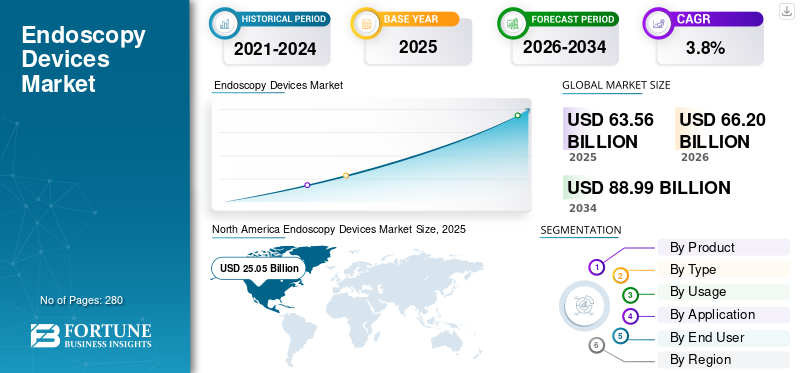
Download Free sample to learn more about this report.
Endoscopy Devices Market Key Takeaways
 Global Market Size & Forecast
- 2025 Market Size: USD 63.56 billion
- 2026 Market Size: USD 66.20 billion
- 2034 Forecast Market Size: USD 88.99 billion
- CAGR: 3.8% from 2026–2034
 Market Share
- North America dominated the endoscopy devices market with a 39.41% share in 2025.
- The bronchoscope segment is projected to grow at a CAGR of 4.4% over the forecast period.
- The rigid segment is projected to grow at a CAGR of 3.2% over the forecast period.
 Key Regional Highlights
North America
North America led the market with a valuation of USD 25.05 billion in 2025.
Europe
Europe is projected to reach USD 16.54 billion in 2026, ranking as the second-largest regional market.
Asia Pacific
Asia Pacific is projected to reach USD 16.12 billion in 2026, ranking as the third-largest regional market.
U.S.
The market is estimated to reach USD 23.85 billion in 2026, accounting for 36.0% of global revenue.
Japan
The market is projected to reach approximately USD 4.39 billion in 2026, contributing nearly 6.6% of global revenue.
Read More

ENDOSCOPY DEVICES MARKET TRENDS
Advanced Visualization and Single-use Scopes are Reshaping Product Demand
One of the significant trends in the global market is the movement toward better image quality, improved workflow, and safer procedure delivery. Hospitals are upgrading from older visualization systems to HD, 4K, 3D, narrow-band imaging, fluorescence imaging, and AI-supported platforms. These technologies help clinicians see tissue structure more clearly, detect subtle lesions, and make faster decisions during diagnostic and therapeutic procedures. The trend is particularly strong in gastroenterology and minimally invasive surgery, where visualization quality directly affects diagnostic accuracy and procedural outcomes.
At the same time, single-use endoscopy is changing procurement behavior. Disposable bronchoscopes have already gained traction in emergency, ICU, and infectious-disease settings, while disposable duodenoscopes and urology scopes are being evaluated as alternatives to reusable devices in selected procedures. The trend is not a complete replacement of reusable systems. Rather, the market is moving toward a hybrid model. High-volume centers continue to rely on reusable devices for cost efficiency, while disposable scopes are used where infection control, availability, or reprocessing limitations matter most. This shift is encouraging manufacturers to offer broader portfolios that combine reusable platforms, disposable scopes, digital connectivity, and service-based support.
MARKET DYNAMICS
MARKET DRIVERS
Download Free sample to learn more about this report.
Rising Preference for Minimally Invasive Diagnosis and Treatment to Drive Market Growth
The strongest driver for the global endoscopy devices market growth is the steady shift from conventional open procedures to minimally invasive diagnosis and treatment. Patients and physicians increasingly prefer endoscopic procedures as they usually involve smaller incisions or natural-orifice access, less pain, fewer complications, shorter hospital stays, and faster recovery. This shift is particularly visible in gastroenterology, where colonoscopy and upper GI endoscopy are widely used for screening, biopsy, polyp removal, and disease monitoring. Colorectal cancer remains one of the leading cancer burdens globally and screening programs have increased the demand for colonoscopes and related visualization systems. The U.S. Preventive Services Task Force recommends colorectal cancer screening for adults aged 45 to 75 years, which supports recurring procedure volumes in mature markets.
Beyond gastroenterology, the product demand is also increasing in pulmonology, urology, ENT, and gynecology as hospitals invest in better visualization platforms and procedure-specific scopes. The market growth is further supported by rising healthcare spending, expanding ambulatory surgery infrastructure, and continuous product upgrades by major manufacturers. The market also benefits from recurring replacement demand, as endoscopes and imaging systems require periodic upgrades due to wear, reprocessing damage, image-quality requirements, and technology obsolescence.
MARKET RESTRAINTS
High Device Cost and Reprocessing Burden May Limit Adoption in Cost-sensitive Settings
Despite strong clinical demand, the high cost of endoscopy devices remains a major restraint, particularly in emerging markets and budget-constrained public healthcare systems. Advanced flexible endoscopes, video processors, imaging towers, light sources, monitors, and procedure-specific instruments require significant upfront investment. For hospitals that perform high volumes of procedures, the cost can be justified by utilization. However, smaller clinics, rural hospitals, and diagnostic centers may struggle to purchase and maintain complete endoscopy systems. The cost burden does not end with procurement. Reusable endoscopes require cleaning, disinfection, leak testing, storage, repairs, staff training, and compliance with infection-control protocols.
Reprocessing is especially challenging given that flexible endoscopes have narrow channels and complex designs. Inadequate cleaning can create infection risks and increase regulatory scrutiny. The FDA has issued safety communications regarding duodenoscope reprocessing and contamination risk, underscoring why hospitals face growing pressure to strengthen cleaning practices or shift selectively toward disposable alternatives. The move toward disposable endoscopes can reduce some reprocessing concerns but it also increases per-procedure cost and creates sustainability questions. As a result, many facilities continue to balance clinical safety, cost efficiency, and operational feasibility, which can slow the adoption of newer premium technologies.
MARKET OPPORTUNITIES
Disposable and AI-enabled Endoscopy Creates a Strong Growth Opportunity
A major opportunity in this market lies in the growing adoption of disposable endoscopes and AI-enabled imaging solutions. Disposable bronchoscopes, cystoscopes, ureteroscopes, and selected GI endoscopes are gaining attention as they reduce the risk of cross-contamination, eliminate complex reprocessing steps, and offer predictable availability in emergency or low-volume settings. These products are especially attractive in intensive care units, emergency departments, and facilities with limited reprocessing capacity. While reusable devices will continue to dominate high-volume procedures, disposable scopes are expected to gain share in infection-sensitive and procedure-specific applications.
AI-assisted endoscopy is another important opportunity. Computer-aided detection tools are being developed to help physicians identify lesions, polyps, and abnormal tissue in real time during procedures. In colonoscopy, AI can support better detection consistency and reduce the risk of missed lesions. Research has shown that AI-based computer-aided detection and diagnosis can improve endoscopist performance and colonoscopy effectiveness. The opportunity is not limited to developed markets. As Asia Pacific, Latin America, and the Middle East invest in hospital modernization, the demand for integrated imaging platforms, cloud-enabled systems, training tools, and AI-supported workflow solutions is likely to increase steadily.
MARKET CHALLENGES
Infection Control, Training Gaps, and Procurement Pressure to Remain Key Challenges
The market faces several practical challenges that can affect adoption even when clinical demand is strong. Infection control remains one of the most important concerns. Reusable endoscopes must undergo detailed cleaning and disinfection after every procedure and any lapse can pose patient-safety risks. Complex devices such as duodenoscopes are particularly challenging given that their design can make complete cleaning difficult. This has pushed regulators, hospitals, and manufacturers to focus on better device design, validated reprocessing protocols, and selective use of disposable alternatives.
Another challenge is the shortage of trained endoscopists and reprocessing staff in several countries. Endoscopy is operator-dependent and the benefits of advanced systems can be limited if physicians and technicians are not adequately trained. This is particularly relevant in emerging markets, where procedure demand is increasing faster than specialist availability. The procurement pressure is also a concern. Hospitals often need to balance endoscopy investments against competing priorities such as imaging systems, surgical robotics, ICU equipment, and digital infrastructure. In public healthcare systems, tender-based purchasing and reimbursement constraints can delay replacement cycles. Environmental concerns around disposable devices may also become more prominent, especially in Europe and other sustainability-focused markets.
Segmentation Analysis
By Product
Bronchoscope Segment to Depict the Fastest Growth owing to Soaring Burden of Respiratory Disorders
Based on product, the market is segmented into bronchoscope, duodenoscope, colonoscope, and others.
To know how our report can help streamline your business, Speak to Analyst
The bronchoscope segment is the fastest-growing segment, projected to grow at a CAGR of 4.4% during the forecast period. The segment is expected to grow steadily due to the rising burden of respiratory diseases, lung cancer, COPD, and ICU-related airway management needs. The product demand is further supported by the increasing use of bronchoscopy for diagnosis, biopsy, foreign body removal, and therapeutic interventions and the growing adoption of single-use bronchoscopes in infection-sensitive settings.
The colonoscope segment holds the significant share as it is one of the most widely performed endoscopic procedures globally. The device is used for diagnosis, biopsy, polyp removal, bleeding management, and colorectal cancer screening. Screening recommendations beginning at age 45 in several markets have expanded the eligible patient pool, while aging populations and rising gastrointestinal disease prevalence continue to support procedure volumes.
By Type
Flexible Segment Leads the Market due to Broader Use across Natural-orifice Procedures
By type, the market is classified into flexible and rigid.
The flexible segment holds the largest share by type given that they are used across high-volume procedures in gastroenterology, pulmonology, urology, and ENT. Their ability to navigate curved anatomical pathways makes them essential for colonoscopy, bronchoscopy, upper GI endoscopy, duodenoscopy, cystoscopy, and several diagnostic procedures performed through natural body openings. Moreover, the segment is projected to hold a 65.7% share in 2026.
Additionally, the rigid segment is estimated to grow at a CAGR of 3.2% during the forecast period.
By Usage
Reusable Devices Segment Dominates the Market as High-volume Centers Prioritize Cost Efficiency
By usage, the market is classified into reusable and disposable.
The reusable segment holds the highest endoscopy devices market share given that they remain more economical for high-volume hospitals, ASCs, and specialty centers. A reusable colonoscope, bronchoscope, or duodenoscope can be used across many procedures when supported by proper reprocessing infrastructure, lowering the cost per procedure compared to disposable alternatives in busy healthcare facilities. Moreover, the segment is projected to hold a 90.1% share in 2026.
Additionally, the disposable segment is estimated to grow at a CAGR of 8.9% during the forecast period.
By Application
Gastroenterology Segment Bags Major Share as GI Screening and Disease Management Drive Volumes
By application, the market is classified into gastroenterology, pulmonology, urology, and others.
The gastroenterology segment accounts for the highest market share given that GI procedures represent a major portion of global endoscopy volumes. Colonoscopy, upper GI endoscopy, ERCP, enteroscopy, and capsule endoscopy are widely used for screening, diagnosis, biopsy, polyp removal, and treatment of digestive disorders. The rising colorectal cancer awareness, aging populations, inflammatory bowel disease, gastrointestinal bleeding, and acid-related disorders continue to increase demand. Moreover, the segment is projected to hold a 40.6% share in 2026.
Additionally, the pulmonology segment is estimated to grow at a CAGR of 4.7% during the forecast period.
By End User
Hospitals & ASCs Segment Leads the Market as Procedure Infrastructure is Concentrated in these Settings
On the basis of end user, the market is classified into hospitals & ASCs, specialty clinics, diagnostic centers, and others.
The hospitals & ASCs segment holds the highest market share given that most endoscopic procedures require specialized infrastructure, trained clinicians, sedation support, reprocessing facilities, imaging systems, and emergency backup. Hospitals remain the main setting for complex procedures such as ERCP, bronchoscopy, urological endoscopy, and surgical endoscopy. Furthermore, the segment is set to hold 74.6% share in 2026.
In addition, the diagnostic centers segment is projected to grow at a CAGR of 6.2% during the forecast period.
Endoscopy Devices Market Regional Outlook
Based on geography, the market is classified into North America, Europe, Asia Pacific, Latin America, and the Middle East & Africa.
North America
North America Endoscopy Devices Market Size, 2025 (USD Billion)
To get more information on the regional analysis of this market, Download Free sample
North America held the largest market share in 2024, with a value of USD 24.13 billion, and also led in 2025, reaching a value of USD 25.05 billion. The regional market growth is primarily supported by high procedure volumes, rising preference for minimally invasive surgeries, and a mature installed base that requires regular replacement and technology upgrades. The region has broad use of endoscopy across gastroenterology, pulmonology, urology, gynecology, and ENT, supported by hospitals, ASCs, and outpatient facilities. The U.S. remains the largest contributor due to high healthcare spending, colorectal cancer screening activity, availability of advanced visualization systems, and early adoption of disposable and AI-assisted endoscopy technologies.
U.S. Endoscopy Devices Market
In 2026, the U.S. market is estimated to touch a value of USD 23.85 billion, capturing 36.0% of the global revenue.
Europe
The Europe market is expected to depict a growth rate of 2.9% over the forecast period, the second-highest globally, reaching USD 16.54 billion by 2026. The regional market is growing steadily due to the rising demand for minimally invasive procedures, continued replacement of older endoscopy systems, and the adoption of advanced imaging platforms across major healthcare systems. Countries such as Germany, the U.K., France, Italy, and Spain have large hospital networks and established screening and diagnostic programs, which support the recurring demand for colonoscopes, gastroscopes, bronchoscopes, and visualization systems.
U.K. Endoscopy Devices Market
The U.K. market is projected to reach USD 2.63 billion by 2026, accounting for 4.0% of the global market revenue.
Germany Endoscopy Devices Market
The Germany market is anticipated to reach about USD 3.79 billion by 2026, representing roughly 5.7% of global revenue.
Asia Pacific
In 2026, the Asia Pacific market is predicted to be valued at USD 16.12 billion, ranking as the third-largest globally. Asia Pacific is expected to record the fastest growth due to improving healthcare infrastructure, rising hospital investments, expanding private healthcare networks, and increasing access to diagnostic and surgical procedures. China, India, Japan, Australia, and Southeast Asian countries are seeing higher product demand as awareness of early diagnosis improves and minimally invasive procedures become more widely available.
Japan Endoscopy Devices Market
The Japan market is projected to generate approximately USD 4.39 billion in revenue by 2026, contributing nearly 6.6% to the global market.
China Endoscopy Devices Market
The China market is anticipated to reach approximately USD 5.35 billion by 2026, contributing about 8.1% to global revenues.
India Endoscopy Devices Market
The India market is poised to contribute approximately USD 1.50 billion to the market by 2026, corresponding to about 2.3% of global revenues.
Latin America and Middle East & Africa
Latin America and the Middle East & Africa markets are anticipated to witness moderate growth, with Latin America expected to reach around USD 3.87 billion by 2026. The Latin America market growth is supported by the rising preference for minimally invasive procedures, improving awareness of endoscopy for diagnosis and treatment, and the gradual expansion of private healthcare infrastructure. Brazil and Mexico are the major contributors, driven by larger patient pools, improving hospital capabilities, and increasing demand for GI, urology, gynecology, and respiratory procedures. The Middle East & Africa market is growing due to rising healthcare infrastructure investment, increasing demand for early disease diagnosis, and the rising adoption of advanced medical technologies in selected countries. The GCC countries are the main growth engine, supported by hospital modernization, medical tourism, high per-capita healthcare spending, and government initiatives to improve reimbursement and access to specialized care.
GCC Endoscopy Devices Market
By 2026, the GCC market is expected to generate approximately USD 1.77 billion in the market, accounting for nearly 2.7% of global revenues.
COMPETITIVE LANDSCAPE
Key Industry Players
Robust Product Innovation to Reinforce the Market Position of Prominent Players
The global endoscopy devices market is moderately consolidated, with a few large multinational companies holding strong positions across flexible endoscopes, visualization systems, surgical endoscopy platforms, and therapeutic accessories. Olympus Corporation remains the leading player, particularly in flexible GI endoscopy, supported by its broad product portfolio, global distribution network, and strong hospital relationships. Boston Scientific Corporation, Stryker Corporation, and KARL STORZ SE & Co. KG are other key competitors with significant positions across GI, pulmonology, urology, laparoscopy, arthroscopy, and single-use endoscopy.
The competition is mainly driven by image quality, clinical reliability, infection-control performance, product breadth, pricing, service support, and hospital procurement relationships. Companies are increasingly focusing on high-definition/4K visualization, AI-assisted detection, single-use endoscopes, improved reprocessing safety, and integrated operating room solutions to differentiate their offerings.
Other key players in the market comprise FUJIFILM Holdings Corporation, HOYA Corporation, Medtronic plc, and Johnson & Johnson. These companies compete through ongoing technological developments, the growing demand for improved healthcare infrastructure, and efforts to improve procedural outcomes.
LIST OF KEY ENDOSCOPY DEVICES COMPANIES PROFILED
- Olympus Corporation (Japan)
- Boston Scientific Corporation (U.S.)
- Stryker Corporation (U.S.)
- KARL STORZ SE & Co. KG (Germany)
- FUJIFILM Holdings Corporation (Japan)
- HOYA Corporation (Japan)
- Medtronic plc (Ireland)
- Johnson & Johnson (U.S.)
- Smith+Nephew plc (U.K.)
- Arthrex, Inc. (U.S.)
KEY INDUSTRY DEVELOPMENTS
- January 2026: Boston Scientific announced a roughly USD 14.5-15.0 billion agreement to acquire Penumbra, strengthening its vascular/interventional portfolio. The transaction is expected to close later in 2026.
- August 2024: KARL STORZ acquired Asensus Surgical, strengthening its robotic surgery and digital surgery capabilities.
- March 2024: KARL STORZ introduced an augmented-reality version of CollaboratOR for Apple Vision Pro, enabling 3D surgical content visualization outside the OR.
- January 2024: KARL STORZ announced the acquisition of Innersight Labs Ltd., a London-based software company focused on surgical planning and visualization.
- January 2024: Canon Medical Systems and Olympus agreed to collaborate on a jointly developed endoscopic ultrasound system, combining Olympus’ endoscopy expertise with Canon’s ultrasound capabilities.
- September 2023: Olympus acquired EndoClot Plus, Inc., strengthening its gastrointestinal hemostasis and endotherapy portfolio.
REPORT COVERAGE
The report provides an in-depth analysis of all market segments, highlighting key drivers, trends, opportunities, restraints, and challenges. It also provides insights into technological advancements, key industry developments, company market share analysis, and profiles of leading companies. In addition to the aforementioned factors, the report encompasses several factors that have contributed to the growth and advancement of the market over recent years.
Request for Customization to gain extensive market insights.
Report Scope & Segmentation
| ATTRIBUTE | DETAILS |
| Study Period | 2021-2034 |
| Base Year | 2025 |
| Estimated Year | 2026 |
| Forecast Period | 2026-2034 |
| Historical Period | 2021-2024 |
| Growth Rate | CAGR of 3.8% from 2026-2034 |
| Unit | Value (USD Billion) |
| Segmentation | By Product, Type, Usage, Application, End User, and Region |
| By Product |
|
| By Type |
|
| By Usage |
|
| By Application |
|
| By End User |
|
| By Region |
|
Frequently Asked Questions
Fortune Business Insights says that the global market value stood at USD 63.56 billion in 2025 and is projected to reach USD 88.99 billion by 2034.
In 2025, the North America market value stood at USD 25.05 billion.
The market is expected to exhibit a CAGR of 3.8% during the forecast period of 2026-2034.
The colonoscope segment led the market by product in 2025.
The rising preference for minimally invasive diagnosis and treatment is a key factor driving the market.
Olympus Corporation, Boston Scientific Corporation, Stryker Corporation, and KARL STORZ SE & Co. KG are some of the major players in the market.
North America dominated the market in 2025.



- 2021-2034
- 2025
- 2021-2024
- 280
Get 30-60 hrs Free Customization
Expand Regional and Country Coverage, Segments Analysis, Company Profiles, Competitive Benchmarking, and End-user Insights.













.webp)






Related Reports
-
US +1 833 909 2966 ( Toll Free )
-
Get In Touch With Us