Unmanned Traffic Management Market Size, Share & Industry Analysis, By Type (Persistent and Non-Persistent), By Component (Hardware, Software, and Services), By Solution (Communication Infrastructure, Navigation Infrastructure, Surveillance Infrastructure, and Others), By End-Use (Agriculture & Forestry, Logistics & Transportation, Surveillance & Monitoring, and Others) and Regional Forecast, 2026-2034
 Download Free Sample
KEY MARKET INSIGHTS
 Listen to Audio Version
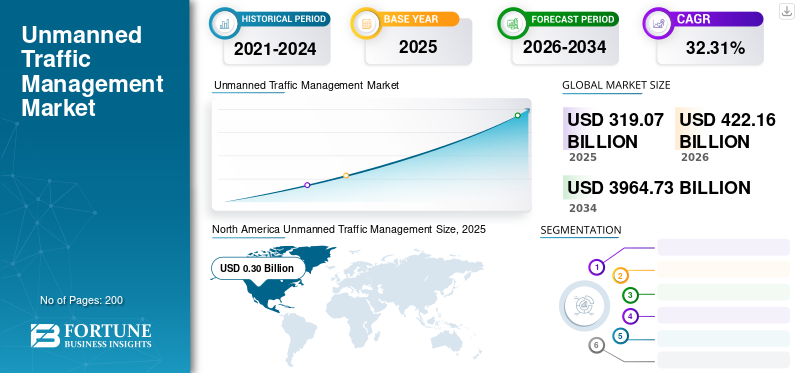
The global unmanned traffic management market size was valued at USD 319.07 billion in 2025. The market is projected to grow from USD 422.16 billion in 2026 to USD 3964.73 billion by 2034, exhibiting a CAGR of 32.31% during the forecast period.
North America dominated the unmanned traffic management market with a market share of 37.97% in 2025.
The high market growth is due to increased drone activities in developed countries for commercial and military applications. The global impact of COVID-19 has been unprecedented and staggering, with unmanned traffic management systems witnessing a positive impact on demand across all regions amid the pandemic. Based on our analysis, the global market exhibited a lower growth of 12.32% in 2020 as compared to the average year-on-year growth during 2017-2019. The rise in CAGR is attributable to this market’s demand and growth, returning to pre-pandemic levels once the pandemic is over.
Unmanned traffic management (UTM) system is used to manage the traffic operations for unmanned aerial vehicles that are complementary to, but different from the standard air traffic management (ATM) system. UTM development will ultimately identify roles, responsibilities, services, data exchange protocols, infrastructure, software functions, information architecture, and performance needs for enabling the management of low-altitude uncontrolled drone operations. The National Aeronautics and Space Administration and Federal Aviation Administration have developed a joint UTM system study plan to document research objectives and map out UTM development. NASA is conducting its research study at UAS Test locations to further discover UTM capabilities that will accommodate rulemaking as it expands opportunities for drone integration.
Unmanned traffic management possesses superior functionalities and wide operations in disaster management, oil & gas industries, defense-related surveillance & monitoring and logistic transportation, and other security organizations. These services have added an advantage that can boost the operations of security forces during countering homeland security and defense. Moreover, the adoption of autonomous aerial vehicles can identify terrorism and other security challenges. These advanced vehicles have the ability to detect other loopholes.
Download Free sample to learn more about this report.
UNMANNED TRAFFIC MANAGEMENT MARKET KEY TAKEAWAYS
 Market Size & Forecast
- 2025 Market Size: USD 319.07 billion
- 2026 Market Size: USD 422.16 billion
- 2034 Forecast Market Size: USD 3964.73 billion
- CAGR: 32.31% from 2026–2034
 Market Share
- North America dominated the market with a 37.97% share in 2025.
- The persistent type segment is expected to witness significant growth.
- The software segment is growing at a higher rate in the market.
 Key Regional Highlights
North America
North America leads the market due to strong UAV adoption and supportive policies from stakeholders.
Europe
Europe is expected to grow significantly with strong investments in aviation technologies.
Asia Pacific
Asia Pacific is witnessing robust growth driven by drone manufacturing and precision farming demand.
U.S.
Rising use of UAVs for military, surveillance, and logistics applications supports market growth.
Japan
Growing demand for advanced drone applications is supporting unmanned traffic management adoption.
Read More

Unmanned Traffic Management Market Trends
Embracing 5G Test Network for Unmanned Aircraft Management System to Bolster Growth Potential
The adoption of 5G mobile cellular network technology is widely increasing in several end-use industries as it offers great benefits over conventional technology. This technology also supports to enhance drone industry operations. The industry is looking for a Federal Aviation Administration (FAA) and Federal Communications Commission (FCC)-approved communications network with an improved functionality required for safe commercial drone operations. The fifth generation technology holds the promise of unlocking scalable, economically viable drone operations. The key players involved in the market are confident that their strategies will help determine if 5G is a suitable solution for the unmanned aircraft traffic management industry.
- In September 2021, Governor Hochul announced New York’s 50-mile drone corridor to host a first-in-the-nation 5G test network for unmanned aircraft. This helps New York to hold its position as a global leader in unmanned aircraft systems with investment of USD 70 million.
- North America witnessed unmanned traffic management market growth from USD 0.27 Billion in 2019 to USD 0.30 Billion in 2020.
Unmanned Traffic Management Market Growth Factors
Rising Footfall of Air Logistics Services to Boost Demand for Drones
The potential of drones or UAVs has gained traction across various industries over the past few years. The self-sufficiency in drone technologies is improving commercial usages and operation methods. The drones are sought-after in the media, surveying, entertainment, advertisement, remote sensing, and precision agriculture, disinfect contaminated areas, real estate, construction, environment monitoring, forest monitoring, and emergency management & disaster response applications. Moreover, the existing ATM systems that are used to control the number of conventional aircraft are dependent on human monitoring, which is expensive. These systems are not feasible to control the unmanned air vehicle. Therefore, the rising adoption of drones is surging the demand for UTM. In addition, the surging demand for lightweight, quick delivery and use of drones in logistics is projected to fuel the global market size during the forecast period.
- In June 2021, airline firm Spice jet’s cargo division, Spicexpress announced that by December it would introduce a drone delivery pilot project on a commercial scale. Spicexpress signed a Memorandum of Understanding along with e-commerce logistics platform Delhivery to form drone delivery facilities in India. Spicexpress is shortlisted by the Directorate General of Civil Aviation to perform Beyond Visual Line of Sight (BVLOS) drone trials in India.
Increasing Defense Budget to Propel Market Growth
As per the latest report by Stockholm International Peace Research Institute, the global military & defense budget reached USD 1981.00 billion in 2020. Large military spending is done by key countries such as China, India, South Korea, Saudi Arabia, and Russia. Among these, the U.S., China, and India were the highest defense expenditure economies. Moreover, advancements in air traffic management due to border disputes will drive the demand for unmanned traffic management worldwide. Besides, the growing procurement of next-generation military drones from military forces and the need for law enforcement communication systems will drive the market growth of UTM systems during the forecast period
- In September 2021, the Indian Army signed a contract worth USD 13.7 million with Alpha Design along with Israel’s Elbit Security Systems (ELSEC) for the procurement of over 100 strike drones.
- In November 2021, a drone logistics company PABLO AIR, a member of Born2Global Center, successfully demonstrated 75km maritime flight by integrating Ground Control System (GCS) as well as the unmanned traffic management (UTM) and the Air Traffic Management (ATM).
RESTRAINING FACTORS
Strict Rules and Regulations on Drone Usage by Government to Hinder Market Growth
The drone industry could receive flak in the commercial sector. Civil aviation authorities are implementing rigorous rules to keep a check on drone-related activities due to national security and safety measures. With different rules and regulations for drone pilots and drone flying authorization, industry players could face immense challenges over the next few years. For instance,
- In October 2021, the Civil Aviation Ministry of India introduced a traffic control framework for public and private third-party drone service providers to manage their movement in airspace under 1,000 feet. The integration of UTM and ATM will be necessary to continuously separate manned and unmanned aircraft from each other in the airspace.
Download Free sample to learn more about this report.
Segmentation Analysis
By Type Analysis
Persistent Type to Dominate Market
Based on type, this market is segmented into persistent and non-persistent. The persistent type is expected to witness significant growth due to the need for safe traffic management systems and the growing demand for commercial drones for logistics and medical supplies transportation services. For Instance, in 2020, the commercial drone industry, which includes drones used for everything, including logistic supply and COVID-19 vaccine distribution, led to a growth rate of up to 23%, up from 2018’s figure of 18%.
By Component Analysis
To know how our report can help streamline your business, Speak to Analyst
Software Segment to Grow at a Faster Pace
Based on components, the market is divided into software, hardware, and services. The UTM software is designed to support drone operations by providing a platform to perform several operations. It sets out to track all the UAVs that are in the air in real-time as well as show restricted and non-restricted airspaces to help pilots avoid flying into areas that are forbidden. The software segment is growing at higher growth rates due to the developments and updates in software for efficient air traffic planning. The service segment is estimated to witness significant growth owing to increased drone traffic for commercial applications. Moreover, service providers worldwide are getting contracts from government agencies for smooth unmanned traffic planning services.
- The Hardware segment is expected to hold a 45.67% share in 2020.
By Solution Analysis
Communication Infrastructure Segment to Grow at High CAGR
On the basis of the solution, this market is segregated into communication infrastructure, navigation infrastructure, surveillance infrastructure, and others. The communication infrastructure segment is anticipated to lead the unmanned traffic management market growth with a high CAGR during the forecast period. Improved drone communication is important in all operations to ensure that drone controllers have direct control of the drone, this is important if the drone is having BVLOS flight operations. It is important for the UTM software to track registered drones in real time. The surveillance segment will be the emerging segment during the forecast period due to UAVs’ demand for surveillance applications by military and defense organizations.
By End-Use Analysis
Logistics & Transportation Segment to Own Highest Market Share
Based on end-use, the market is fragmented into agriculture & forestry, logistics & transportation, surveillance & monitoring, and others. The logistics & transportation segment is expected to dominate the market due to rising drone transportation activities in developed countries. Moreover, there is rising adoption of small-sized drones to transport emergency medical supplies, food items, and other necessary items. For instance, in August 2020, Amazon received approval to operate its drone fleet for prime air delivery from the Federal Aviation Administration (FAA). The approval will allow Amazon to deliver packages efficiently and safely. The company targets to deliver emergency packages within 30 minutes or on the same day. The surveillance & monitoring segment is expected to witness significant growth due to the growing demand for UAVs to carry out homeland surveillance, border patrolling & security, and border management.
REGIONAL ANALYSIS
North America Unmanned Traffic Management Size, 2025 (USD Billion)
To get more information on the regional analysis of this market, Download Free sample
The market has been classified into North America, Europe, Asia Pacific, and the Rest of the World.
The North America unmanned traffic management market was valued at USD 0.30 billion in 2020. The country is likely to dominate the market owing to robust policies of leading stakeholders in the U.S. and Canada, such as Lockheed Martin and L3 Harris Group. Moreover, the North American market growth is linked to the rising usage of UAVs for military, surveillance, and logistic applications. It is anticipated to lead the small drone market in terms of revenue.
Europe is anticipated to grow at a significant CAGR due to robust strategies from key players such as Thales Group and Leonardo Finmeccanica. These companies are among the top companies in the region and hold potential customers across the world. There is an urgent and clear need to develop new technologies to regain global leadership for Europe’s aviation industry.
The Asia Pacific market is expected to exhibit significant growth owing to the surging demand for crop monitoring, aerial photography, and precision farming. In addition, the Asia Pacific market is expected to grow significantly due to the region's rising drone manufacturers. Moreover, emerging countries with improving economies such as India are expected to support market growth.
Latin America could observe a lower market share due to increasing awareness of drones for logistics and medical supplies. The Middle East market is likely to observe significant growth in the market. This growth is attributable to the growing usage of UAVs in oil & gas industries for operations where human life is at risk.
KEY INDUSTRY PLAYERS
Urgent Requirement of Unmanned Traffic Management Solutions to Boost Market Growth
The competitive landscape of the unmanned traffic management market depicts the domination of selected players such as Thales Group, Frequentis, L3 Harris Technologies, and Lockheed Martin Corporation. These companies are focusing on designing and developing advanced autonomous maintenance solutions. Moreover, these companies are expanding their geographic reach worldwide in the forthcoming years.
List of Top Unmanned Traffic Management Companies:
- Frequentis (Austria)
- Leonardo S.p.A. (Italy)
- Thales Group (France)
- L3Harris Technologies Inc (U.S.)
- Lockheed Martin Corporation (U.S.)
- Airbus SE (France)
- Raytheon Technologies Corporation (U.S.)
- Nova Systems (Australia)
- Unifly (Belgium)
- PrecisionHawk (U.S.)
- Altitude Angel Limited (U.K.)
KEY INDUSTRY DEVELOPMENTS
- In November 2021- Thales’s TopSky announced that its UAS solution, which was already in service in Lille, in northern France, had been adopted by air traffic controllers at Rennes airport in Brittany to manage unmanned air traffic. The solution makes flight request process more efficient, helping drone operators to gain easier access to airspace.
- In December 2021- DroneUp announced that it acquired the digital airspace and automation company, AirMap, Inc. The acquired company offers an Unmanned Aircraft System Traffic Management service, which will benefit DroneUp’s network of pilots and growing ground infrastructure.
REPORT COVERAGE
The global unmanned traffic management research report provides a detailed analysis of the market and focuses on key aspects such as leading companies, product types, and leading product applications. Besides, the report offers insights into the market trends and highlights key industry developments. In addition to the aforementioned factors, the report encompasses several factors that have contributed to the market growth in recent years.
Report Scope & Segmentation
|
ATTRIBUTE |
DETAILS |
|
Study Period |
2021-2034 |
|
Base Year |
2025 |
|
Forecast Period |
2026-2034 |
|
Historical Period |
2021-2034 |
|
Unit |
Value (USD Billion) |
|
|
By Type
|
|
Segmentation |
By Component
|
|
By Solution
|
|
|
By End-Use
|
|
|
By Geography
|
Frequently Asked Questions
According to Fortune Business Insights, the global unmanned traffic management market size was USD 0.79 billion in 2020 and is projected to grow from USD 0.92 billion in 2021 to USD 3.59 billion by 2028, at a CAGR of 21.40% during the forecast period.
Growing at a CAGR of 21.40%, the market will exhibit steady growth over the forecast period (2021-2028).
Unmanned traffic management (UTM) refers to a system designed to manage low-altitude drone traffic, complementing traditional air traffic management. It ensures safe routing, collision avoidance, and communication protocols for commercial, defense, and industrial drone operations.
North America leads the market with a 37.97% share in 2020, driven by high drone adoption for logistics, defense surveillance, and commercial applications, supported by FAA regulations and NASA’s UTM research programs.
UTM systems include software, hardware, and services. Software solutions dominate due to real-time drone tracking, airspace mapping, and flight planning capabilities, while hardware includes communication and navigation infrastructure.
Growth is fueled by increased drone use in logistics, agriculture, and defense, rising precision farming, e-commerce deliveries, and government initiatives to integrate drones safely into national airspace systems.
Key trends include integration of 5G networks for drone communication, AI-based collision avoidance, Beyond Visual Line of Sight (BVLOS) approvals, and expansion of urban air mobility and drone corridors for commercial operations.
The logistics and transportation segment dominates, driven by last-mile deliveries, emergency medical supply transport, and rising e-commerce demand. Companies like Amazon and UPS are actively deploying drones for faster deliveries.
Leading companies include Thales Group, L3Harris Technologies, Lockheed Martin, Frequentis, Leonardo S.p.A., Airbus, Raytheon Technologies, and Unifly, focusing on advanced UTM software and airspace integration solutions.
The UTM market is expected to see rapid growth driven by drone delivery services, smart city integration, and defense surveillance applications, reaching USD 3.59 billion by 2028 with strong expansion in Asia Pacific and North America.



- 2021-2034
- 2025
- 2021-2024
- 200
Get 30-60 hrs Free Customization
Expand Regional and Country Coverage, Segments Analysis, Company Profiles, Competitive Benchmarking, and End-user Insights.




















-
US +1 833 909 2966 ( Toll Free )
-
Get In Touch With Us